In July 2015 there are 4,242 applications submitted by people in Great Britain compared to 7,321 in July 2016. Meanwhile 6,638 passport requests are submitted from Northern Ireland.
Within in a day of the Brexit vote there is a surge in online interest in Irish passports and moving to Ireland. While the UK as a whole vote to leave the EU in the referendum, Northern Ireland votes to remain by a majority of 56 percent to 44 percent. The Department of Foreign Affairs says there is “an increase in queries in respect of entitlements to Irish passports” the very next day. The year-on-year figures for January show a 20 percent increase in applications prior to the vote.
Google Trends says UK searches for “getting an Irish passport” jump more than 100% after the Brexit result comes through. And while the data analysts do not reveal the exact number of searches for information on the Republic of Ireland‘s citizenship rules, they say most interest is shown in Northern Ireland with the normally unionist heartland of Holywood, County Down, taking top spot.
Sinn Féin repeatedly says that Northern Ireland must not be “dragged out of Europe.” Up to this point the British government dismisses calls from its representatives and others for a border poll in Irish unity.
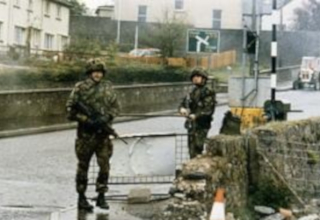
In August 2005, it is announced that in response to the Provisional IRA declaration that its campaign is over, and in accordance with the Good Friday Agreement provisions, Operation Banner would end by August 1, 2007. This involves troops based in Northern Ireland being reduced to 5,000, and only for training purposes. Security is entirely transferred to the police. The Northern Ireland Resident battalions of the Royal Irish Regiment, which had grown out of the Ulster Defence Regiment, stand down on September 1, 2006. The operation officially ends at midnight on July 31, 2007, making it the longest continuous deployment in the British Army’s history, lasting over 38 years.
While the withdrawal of troops is welcomed by the nationalist parties Social Democratic and Labour Party and Sinn Féin, the unionist Democratic Unionist Party and Ulster Unionist Party oppose the decision, which they regard as premature. The main reasons behind their resistance are the continuing activity of republican dissident groups, the loss of security-related jobs for the protestant community and the perception of the British Army presence as an affirmation of the political union with Great Britain.
According to the Ministry of Defence, 1,441 serving British military personnel die in Operation Banner, 722 of whom are killed in paramilitary attacks and 719 of whom die as a result of other causes. The British military kills 307 people during the operation, about 51% of whom are civilians and 42% of whom are members of republican paramilitaries.
(Pictured: Two British soldiers on duty at a vehicle checkpoint near the A5 Omagh/Armagh road junction)
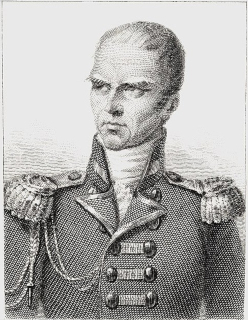
Lowe is the son of John Lowe, an army surgeon. His childhood is spent in various garrison towns, particularly in the West Indies, but he is educated chiefly at Salisbury Grammar. He obtains a post as ensign in the East Devon Militia when he is eleven. In 1787 he enters his father’s regiment, the 50th Regiment of Foot, which is then serving in Gibraltar under Governor-GeneralCharles O’Hara. In 1791, he is promoted to lieutenant. The same year he is granted eighteen months’ leave and chooses to spend the time traveling through Italy rather than return to Britain. He chooses to avoid traveling to France as the French Revolution had recently broken out.
Lowe holds several important commands in the war with France from 1793. He is knighted in 1814. He arrives on the island of Saint Helena, Napoleon’s last place of exile, in April 1816. Many persons, notably Arthur Wellesley, 1st Duke of Wellington, consider the choice ill advised, for Lowe is a conscientious but unimaginative man who takes his responsibility with excessive seriousness. Overwhelmed by the magnitude of the charge given him, he adheres rigorously to orders and treats Napoleon with extreme punctiliousness. After October 1816, the news that rescue operations are being planned by Bonapartists in the United States causes Lowe to impose even stricter regulations. The next month he deports Emmanuel, comte de Las Cases, Napoleon’s confidant and former imperial chamberlain, for writing letters about Lowe’s severity.
When, in late 1817, Napoleon first shows symptoms of his fatal illness, Lowe does nothing to mitigate the emperor’s living conditions. Yet he recommends that the British government increase its allowance to Napoleon’s household by one-half. After the emperor’s death on May 5, 1821, Lowe returns to England, where he receives the thanks of King George IV but is met with generally unfavourable opinion and is widely criticized for his unbending treatment of the former emperor. He later commands the British forces on Ceylon (1825–30) but is not appointed governor of that island when the office falls vacant in 1830.
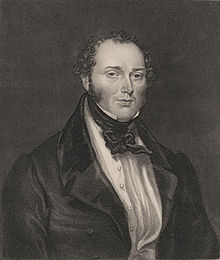
O’Connor is born into a prominent Irish Protestant family who claims to be the descendants of the 12th-century king Ruaidrí Ua Conchobair. He is educated mainly at Portarlington Grammar School and has some elementary schooling in England.
O’Connor practices law but exchanges law for politics when he enters the British Parliament in 1832 as a member for County Cork. Unseated in 1835, he turns to radical agitation in England, although he continues to press Irish grievances and to seek Irish support. As a result of his humour, invective, and energy, he becomes the best-known Chartist leader and the movement’s most popular speaker. His journal, the Northern Star (founded in 1837), gains a wide circulation.
O’Connor’s methods and views alienate other Chartist leaders, particularly William Lovett, but in 1841, after spending a year in prison for seditious libel, he acquires undisputed leadership of the Chartists. Failing to lead the movement to victory and vacillating in his attitude toward the middle class and toward the People’s Charter, a six-point bill drafted and published in May 1838, he begins to lose power, although he is elected to Parliament for Nottingham in 1847. The failure of the People’s Charter in 1848 marks the beginning of the end for O’Connor, whose egocentricity is already bordering on madness.
The circulation of the Northern Star falls steadily, and it loses money. O’Connor’s health is failing, and reports of his mental breakdown regularly appear in the newspapers. In the spring of 1852, he visits the United States, where his behaviour leaves no doubt that he is not a well man.
In 1852 in the House of Commons O’Connor strikes three fellow MPs, one of them Sir Benjamin Hall, a vocal critic of the Land Plan. Arrested by the Deputy Sergeant-at-Arms, he is sent by his sister to Dr. Thomas Harrington Tuke‘s private Manor House Asylum in Chiswick, where he remains until 1854, when he is moved to his sister’s house. He dies on August 30, 1855, at 18 Albert Terrace, Notting Hill Gate and is buried on September 10 in Kensal Green Cemetery. No fewer than 40,000 people witness the funeral procession. Most Chartists preferred to remember O’Connor’s strengths rather than his shortcomings.
The attack is led by a Dutch captain, Jan Janszoon van Haarlem, also known as Murad Reis the Younger. Murad’s force is led to the village by a man called Hackett, the captain of a fishing boat he had captured earlier, in exchange for his freedom. Hackett is subsequently hanged from the clifftop outside the village for conspiracy.
Murad’s crew, made up of Dutchmen, Moroccans, Algerians and Ottoman Turks, launches their covert attack on the remote village on June 20, 1631. They capture 107 villagers, mostly English settlers along with some local Irish people (some reports put the number as high as 237). The attack is focused on the area of the village known to this day as the Cove. The villagers are put in irons and taken to a life of slavery in North Africa.
There are conspiracy theories relating to the raid. It has been suggested that Sir Walter Coppinger, a prominent Catholic lawyer and member of the leading Cork family, who had become the dominant power in the area after the death of Sir Thomas Crooke, 1st Baronet, the founder of the English colony, orchestrates the raid to gain control of the village from the local Gaelic chieftain, Sir Fineen O’Driscoll. It is O’Driscoll who had licensed the lucrative pilchard fishery in Baltimore to the English settlers. Suspicion also points to O’Driscoll’s exiled relatives, who had fled to Spain after the Battle of Kinsale and had no hope of inheriting Baltimore by legal means. On the other hand, Murad may have planned the raid without any help. It is known that the authorities had advance intelligence of a planned raid on the Cork coast, although Kinsale is thought to be a more likely target than Baltimore.
Some prisoners are destined to live out their days as galley slaves, rowing for decades without ever setting foot on shore while others spend long years in harem or as labourers. At most, only three of them ever return to Ireland. One is ransomed almost at once and two others in 1646.
In the aftermath of the raid, the remaining villagers move to Skibbereen, and Baltimore is virtually deserted for generations.
(Pictured: “The sack of Baltimore (West Cork), ca. 1890-1891” pen and ink by Jack Butler Yeats)
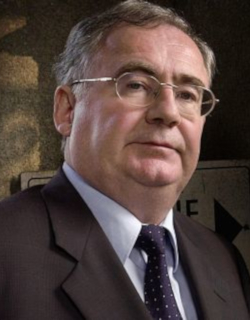
Rabbitte becomes involved in electoral politics for the first time in late 1982, when he unsuccessfully contests Dublin South-West for the Workers’ Party (WP) at the November general election. He is elected to Dublin County Council in 1985. He enters Dáil Éireann as a Workers’ Party Teachta Dála (TD) for Dublin South-West at the 1989 election. He retains his seat at every election until 2016.
After Tomás Mac Giolla‘s retirement as President of the Workers’ Party in 1988, Rabbitte is seen as one of those who wants to move the party away from its hard left position. In 1992, he plays a prominent role with Proinsias De Rossa in an attempt to jettison some of the party’s harder left positions. This eventually splits the Workers’ Party.
In 1994, a new ‘Rainbow Coalition’ government of Fine Gael, the Labour Party and Democratic Left comes to power. Rabbitte is a member of the junior ministerial team, serving as Minister of State to the Government, as well as Minister for State at the Department of Enterprise and Employment with responsibility for Commerce, Science and Technology.
Following the 1997 general election the Rainbow Coalition loses power. The following year sees a merger between the Labour Party and Democratic Left, with Rabbitte participating in the negotiations. In October 2002 he succeeds Ruairi Quinn as the new leader of the Labour Party. Under his leadership the party makes some gains in the local elections of 2004.
The Labour Party agrees to enter a pre-election pact, commonly known as ‘The Mullingar Accord,’ with Fine Gael in an attempt to offer the electorate an alternative coalition government at the 2007 general election. This move causes some tension in the parliamentary party, as some members prefer not to be aligned with any party in advance of an election.
Following the disappointing result in the election for Labour, Rabbitte announces he is stepping down as leader on August 23, 2007. He is succeeded as party leader by Eamon Gilmore. Rabbitte is re-elected on the first count in the 2011 general election. His running mate Eamonn Maloney is also elected. On March 9, 2011, he is appointed as Minister for Communications, Energy and Natural Resources.
In July 2014, Rabbitte is replaced by Alex White as part of a reshuffle of the cabinet. He does not contest the 2016 general election.
In 1778, English Catholics are relieved of the restrictions on land inheritance and purchase. A savage reaction to these concessions produces the Gordon Riots of 1780, and the whole history of Catholic Emancipation is one of struggle against great resistance. In 1791 the Roman Catholic Relief Act repeals most of the disabilities in Great Britain, provided Catholics take an oath of loyalty. In 1793 the army, the navy, the universities, and the judiciary are opened to Catholics, although seats in Parliament and some offices are still denied. These reforms are sponsored by William Pitt the Younger, who hopes thereby to split the alliance of Irish Catholics and Protestants. But Pitt’s attempt to secure a general repeal of the Penal Laws is thwarted by George III. Pope Pius VII consents to a royal veto on episcopal nominations if the Penal Laws are repealed, but the move fails. In Ireland the repeal of Poynings’ Law in 1782 is followed by an act (1792) of the Irish Parliament relaxing the marriage and education laws and an act (1793) allowing Catholics to vote and hold most offices.
The Roman Catholic Relief Act 1829 permits members of the Catholic Church to sit in the parliament at Westminster and to hold all but a handful of public offices. O’Connell had won a seat in a by-election for Clare in 1828 against an Anglican. Under the then extant penal law, O’Connell as a Catholic, is forbidden to take his seat in Parliament. Peel, the Home Secretary, until then is called “Orange Peel” because he always supports the Orange (anti-Catholic) position. Peel now concludes, “Though emancipation was a great danger, civil strife was a greater danger.” Fearing a revolution in Ireland, Peel draws up the Catholic Relief Bill and guides it through the House of Commons. To overcome the vehement opposition of both the House of Lords and King George IV, the Duke of Wellington works tirelessly to ensure passage in the House of Lords and threatens to resign as Prime Minister if the King does not give Royal Assent.
With the Universities Tests Act 1871, which opens the universities to Roman Catholics, Catholic Emancipation in the United Kingdom is virtually complete.
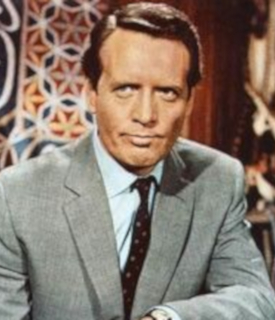
McGoohan is the son of Rose (Fitzpatrick) and Thomas McGoohan, who are living in the United States after emigrating from Ireland to seek work. He is brought up as a Catholic. Shortly after he is born, his parents move back to Mullaghmore, County Leitrim. Seven years later they emigrate to Sheffield, England.
McGoohan attends St. Vincent’s School and De La Salle College in Sheffield. During World War II, he is evacuated to Loughborough, Leicestershire. There he attends Ratcliffe College, where he excels in mathematics and boxing. He leaves school at the age of 16 and returns to Sheffield, where he works as a chicken farmer, a bank clerk, and a lorry driver before getting a job as a stage manager at Sheffield Repertory Theatre. When one of the actors becomes ill, McGoohan is substituted for him, launching his acting career.
McGoohan is most closely identified with two 1960s British television series, Danger Man and The Prisoner. The espionage drama Danger Man, which runs in the United States as Secret Agent, runs for 86 episodes during 1960–1961 and 1964–1967. The cult hit The Prisoner runs for 17 episodes in 1967–1968.
In Danger Man McGoohan puts a new spin on the secret agent formula by refusing to allow his character, John Drake, to carry a gun or indulge in sexual dalliances. The show’s success makes him Britain’s highest-paid TV actor.
McGoohan is one of several actors considered for the role of James Bond in Dr. No. While McGoohan turns down the role on moral grounds, the success of the Bond films is generally cited as the reason for Danger Man being revived in 1964. He is later considered for the Bond role in Live and Let Die but again turns it down.
The success of Danger Man provides McGoohan the leverage he needs to produce The Prisoner, an allegorical Kafkaesque series in which he portrays Number Six, an unnamed agent, thought by many to represent Drake, who angrily resigns and is then held captive in a superficially banal place called The Village, where the mysterious unseen Number One, the ever-changing Number Two, and others try to overcome the fiercely individualistic Number Six’s escape attempts and pry information from him.
McGoohan’s later works include the short-lived medical mystery series Rafferty (1977), such films as Ice Station Zebra (1968), Escape from Alcatraz (1979), and Braveheart (1995), the Broadway spy drama Pack of Lies (1985), and a record four guest-villain appearances on the American detective series Columbo, two of which earned him Emmy Awards. He also directs and writes several episodes of The Prisoner and Columbo. One of his last roles is as Number Six in a 2000 episode of the animated TV comedy The Simpsons.
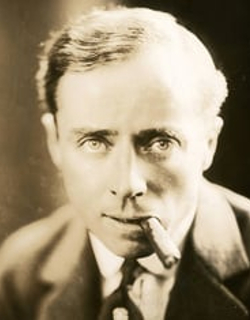
In 1911 Brenon is hired as a writer by Carl Laemmle, directing his first short the following year. Signed by William Fox in 1915, he graduates to feature films. With Paramount Pictures from 1923, he directs several spectacular productions with British themes, including the silent version of Beau Geste (1926). He regards sound pictures with a measure of apprehension.
A Church of Ireland landowner, his family had originally migrated to Ireland from Congleton in Cheshire. Although not from an Irish Roman Catholic background, Parnell, the only son of Sir John Parnell, 1st Baronet, is renowned in Irish history for his efforts to bring about a more emancipated country. He is the great-grandfather of Charles Stewart Parnell, known as the uncrowned king of Ireland and best known for opposing the Acts of Union 1800 between the two kingdoms of Great Britain and Ireland.
From a line of politically astute ancestors who had moved to Ireland in the 17th century, Parnell rises to the highest positions in Irish politics as Commissioner of the Revenue (1780), Chancellor of the Exchequer of Ireland (1787), and Lord of the Treasury (1793).
Henry Grattan describes Parnell as “an honest, straightforward, independent man, possessed of considerable ability and much public spirit; as Chancellor of the Exchequer, he was not deficient, and he served his country by his plan to reduce the interest of money. He was amiable in private, mild in disposition, but firm in mind and purpose. His conduct at the Union did him honour, and proved how warmly he was attached to the interests of his country, and on this account, he was dismissed.”
(Pictured: Oil painting on canvas, The Right Hon. Sir John Parnell, 2nd Bt (1744–1801) by Pompeo Girolamo Batoni (Lucca 1708 – Rome 1787))




 seamus dubhghaill