On February 13, 1782, the Irish Brigade of France plays a significant role in the capture of Saint Kitts during the American Revolutionary War. The brigade, commanded by Arthur Dillon, is part of the French forces that besiege the British stronghold of Brimstone Hill. The siege lasts for 31 days, and after a fierce battle, the British forces surrender.
When Hood returns to the West Indies in late 1781 after the Battle of the Chesapeake, he is for a time in independent command owing to Admiral George Rodney‘s absence in England. The French admiral, François Joseph Paul de Grasse, attacks the British islands of Saint Kitts and Nevis with 7,000 troops and 50 warships, including the 110-gun Ville de Paris. He starts by besieging the British fortress on Brimstone Hill on January 11, 1782. Hoping to salvage the situation, Hood makes for Saint Kitts by departing Antigua on January 22 with twenty-two ships of the line, compared to de Grasse’s thirty-six.
The British fleet on January 24 consists of twenty-two sail of the line, and is close off the southeast end of Nevis. They run into and capture the French 16-gun cutter Espion, which carries a large amount of ammunition for the besieging French forces at Brimstone Hill.
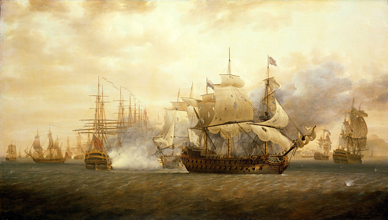
At daybreak on January 25, the French fleet is discovered having stood to the southward of Basseterre, consisting of a 110-gun ship, 28 two-decked ships, and two frigates. Hood stands toward the French fleet with the apparent intention of bringing on action, and effectively draws the French fleet off the land. As soon as Hood effects this maneuver, he is aided by a favorable change in wind and is able to guide his fleet within the anchorage of Basseterre, which the French admiral has just quit. Hood orders his fleet in an L-formation and then orders his fleet to lay anchor. De Grasse makes three distinct attacks upon the British fleet on January 26 but is repulsed.
The Pluton, commanded by François Hector d’Albert de Rions, leads the French line, “receiving the crashing broadside of ship after ship until the splintered planking flew from her off side and her rigging hung in a tangled mass.” Chauvent goes on to describe the battle as “…a sulphurous hell, with cannon vomiting forth flame and death.” The entire battle lasts from 7:00 a.m. to 6:30 p.m., with the major action in the afternoon.
Damage on both sides is heavy, though the French suffer higher casualties. However, Hood is unable to stop the French and can only observe the land action. After the successful French siege of Brimstone Hill fortress, Saint Kitts and Nevis surrender on February 12. Hood leaves on February 14 and joins forces with the recently arrived Admiral George Rodney.
The capture of Saint Kitts marks a pivotal moment in the war, as it is the last major military action of the Irish Brigade of France. The regiment’s efforts are crucial in the French victory, and their legacy is remembered for their contributions to the fight for liberty.
In 1791, after the French Revolution, the Brigade’s close ties to the monarchy of France causes the leaders of the new Republic to disband the famous unit. Dillon, whose family and regiment sacrifice so much for France during its 100-years service, later dies on the Revolutionary government’s guillotine.
(Pictured: “The Battle of Frigate Bay, 26 January 1782,” oil on canvas painting by Nicholas Pocock, 1784, current location Royal Museums Greenwich)
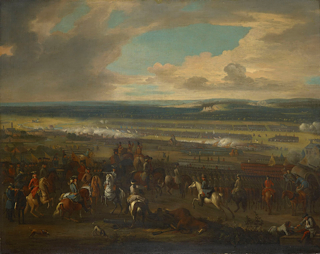
Eugene welcomes the prospect of a decisive battle, and waits on the eastern side of the Oglio to be attacked. The Imperial commander has chosen his ground carefully, entrenching his troops and guns in front of the small fortress of Chiari. Streams protect his position on three sides so, as there is not enough room for a cavalry engagement, Eugene can count on a frontal attack by the French infantry. Two battalions and a few pieces of artillery are placed in Chiari itself.
Villeroy ignores Catinat’s warning that Eugene is in a strong position, remarking that the King, “had not sent so many brave men just to look at the enemy through their spy glasses.” On September 1, the Franco-Spanish infantry advances. Deceived by the report of spies that the Imperialists are retiring, Villeroy crosse the Oglio and pushes on to Chiari expecting to attack their rearguard. The attack begins around 2:00 p.m. when three French brigades approach Chiari and overpower the Imperial troops there without much difficulty. However, instead of facing the rearguard, the French commander encounters the whole Imperial army securely entrenched in their positions. As the Bourbons’ army approaches the Imperial positions, Eugene forbids his men to fire. Loading their artillery with canister shot, they only unleash a withering fire when the Bourbon army enters point-blank range. This disorders the attackers and chaos ensues which the French and Spanish commanders cannot suppress. While this is going on, Chiari is recaptured by the Imperials after a fierce struggle. The Bourbons are driven back with heavy casualties in a contest as destructive as any battle during the war in Italy. With only minor losses, the Imperial army inflicts over 3,000 casualties in the ranks, and over 250 officers. This number grows rapidly as fever attacks the wounded.
Villeroy loses personal control during the battle, and Catinat, despite being wounded, has to organise a retreat. The French dig themselves in only a mile or so away from the Austrians on the same side of the Oglio. Here, the two opposing sides remain for the next two months: the French are too much discouraged by their repulse to resume the assault, and Eugene is unwilling to risk the advantages he had gained by attacking the French in their strong defensive position. However, as autumn advances, conditions deteriorate in both camps: fodder is so short that Eugene’s horses are forced to eat fallen leaves. But the French, whose camp is built on marshy ground, suffers most, and they move out first in mid-November, crossing the Oglio before entering winter quarters in the Duchy of Milan.
In Milan, the French presence proves increasingly unpopular: five million French livres for soldiers’ pay and lodgings, and two million for fodder, has soon been imposed on the local population, most of which has to be taken by force. For his winter quarters, Eugene proceeds to reduce the whole Duchy of Mantua, except the capital and Goito, which he closely blockades. Shortly after he occupies Mirandola and Guastalla. Eugene’s relationship with the local population has been good and he has kept a tight control: he has executed 48 of his men for looting, telling the Emperor that he had “imposed more severe discipline than has possibly ever been seen in an army.” Eugene receives little cash from the Emperor, far less than he expects, but he secures a sound footing in northern Italy and, as hoped, his success helps to encourage the Maritime Powers to come to the aid of Leopold I. Since the beginning of the year Count Johann Wenzel Wratislaw von Mitrowitz has been in London as Imperial minister, pressing for assistance. With Eugene’s two victories (Carpi and Chiari), Leopold I has proven he would fight to protect his interests, giving Wratislaw the arguments he needs to push through the alliance with the Maritime Powers. On September 7, 1701, within a week of the battle, England and the Dutch Republic sign the second treaty of the Grand Alliance, backing the Emperor’s claims to the Spanish possessions in Italy.
The French are still in Milan, but their position is weak: morale is poor and desertion is high. Louis XIV writes to Villeroy urging him to work closely with Catinat and “not again to attack the enemy without advantage.” “If you do … the King, my grandson, will lose Italy.” By October, French optimism for the campaign is gone, but Louis XIV hopes to send reinforcements for the next year’s campaign, believing the Emperor will not be able to make a comparable increase in Eugene’s strength. However, the campaign season is not yet over. As Villeroy settles down for the winter, Eugene is preparing to attack him at his headquarters in Cremona.
In Enniskillen, armed Williamite civilians drawn from the local Protestant population organise a formidable irregular military force. The armed civilians of Enniskillen ignore an order from Robert Lundy that they should fall back to Derry and instead launch guerrilla attacks against the Jacobites. Operating with Enniskillen as a base, they carry out raids against the Jacobite forces in Connacht and Ulster, plundering Trillick, burning Augher Castle, and raiding Clones.
A Jacobite army of about 3,000 men, led by Justin McCarthy, Viscount Mountcashel (in the Jacobite peerage), advance on them from Dublin. Lord Mountcashel’s men consist of three regiments of infantry and two of dragoons. The regiments include his own regiment, Mountcashel (approx. 650 men in 13 companies), The O’Brien regiment (also 13 companies of 650 men), and the Lord Bophin (Burke) regiment. He also has the dragoon regiments of Cotter and Clare, each with seven companies of about 350 dragoons. On July 28, 1689, Mountcashel’s force encamps near Enniskillen and bombards the Williamite outpost of Crom Castle to the southeast of Enniskillen. Crom Castle is almost 20 miles (32 km) from Enniskillen by road and about 5 miles (8.0 km) from Newtownbutler.
Two days later, they are confronted by about 2,000 Williamite ‘Inniskilliniers’ under Colonel Berry, Colonel William Wolseley and Gustave Hamilton. The Jacobite dragoons under Antoine Hamilton stumble into an ambush laid by Berry’s men near Lisnaskea and are routed, taking 230 casualties. Mountcashel manages to drive off Berry’s cavalry with his main force but is then faced with the bulk of the Williamite strength under Wolseley. There is some debate in the sources over troop numbers, though it is believed that Mountcashel has a large number of poorly armed conscripts. Unwisely, Mountcashel halts and draws up his men for battle about a mile south of Newtownbutler.
Williamite histories claim that many of the Jacobite troops flee as the first shots are fired. Up to 1,500 of them are hacked down or drowned in Upper Lough Erne when pursued by the Williamite cavalry. Of the 500 men who try to swim across the Lough, only one survives. Approximately 400 Jacobite officers, along with Lord Mountcashel, the Jacobite commander, are captured and later exchanged for Williamite prisoners, with the other Jacobites being killed. These claims seem unlikely, for several reasons. Each Irish regiment includes approximately 40 officers. The entire force, therefore, would include only about 200 officers. Many of these officers are accounted for in an October 1689 roll call, which shows approximately a 15–20% change in the officer roll call since July for the infantry regiments and 5% for the dragoons. This totals some 20–30 officers in all. Also, the Mountcashel regiment’s roll call for October shows that companies which would normally have 50–60 men, have around 25, which results in a loss of approximately 300–400 men for this regiment. The Cotter and Clare dragoons who ride away from the battle do not have significant losses, based on the October 1689 roll call. Assuming the other two infantry regiments suffer similar losses, gives a total loss of 1,200–1,300. Given their officers are recorded in the October roll and show fewer losses than the Mountcashel regiment among officers, there may be fewer losses in the ranks as well. The Williamite histories acknowledge that they captured approximately 400, including men who are later sent to Derry, which would indicate a total loss of killed, wounded, and missing of 800–900, and likely less. This number is necessarily an estimate based on the available data but should be contrasted with Williamite claims that they killed and drowned 2,000. It appears likely that a couple of hundred men from Mountcashel’s regiment may have fled into the bogs toward Lough Erne, and some of them who made it to the river tried to swim and were drowned, leading to the story of the hundreds drowned.
The battle is still commemorated by the Orange Order in Ulster and is mentioned in the traditional unionist song, “The Sash.”
The battle is significant in another way: the regiments on both sides go on to have long and famous histories. On the Williamite side, the Innsikilling Regiment (27th Foot), and on the Jacobite side, the Clare and Mountcashel/Lee/Bulkeley regiments of the Irish Brigade. The two Irish regiments face off again at the Battle of Fontenoy in 1745, where the Irish Brigade famously drives the British army from the battlefield with a charge in the final stage of the battle.
Butler succeeds to the title at the age of fifteen and was educated at the University of Oxford, taking the degree of LL.D. in 1677. In 1678, he is commissioned as a captain in Colonel Thomas Dongan‘s regiment, which is disbanded before he takes up his post.
In 1692, Butler is created Earl of Newcastle in County Limerick in the Jacobite peerage of Ireland. In France he is named Colonel of the 2nd Queen’s Regiment of Irish Horse in the service of that country and serves with distinction in various battles of the War of the Spanish Succession, also becoming a Lieutenant-General in the Spanish army. He is at the Siege of Roses in 1693, and in 1694 is a Brigadier attached to the army of Germany. He serves in Italy and other parts of Continental Europe from 1701 to 1703, sharing all the fortunes of the Irish Brigade. He later serves in the French army as a Lieutenant-General. He is created Brigadier of Cavalry in 1694.
Butler dies at the age of eighty-eight in Paris on June 18, 1740, and is buried at St. Paul’s there. John C. O’Callaghan writes in Irish Brigades in the Service of France (Glasgow, 1870): “The successive claimants of the title of Galmoy were officers in France down to the Revolution; in whose armies, as well as in others, various gentlemen have honourably represented a name, of which the illustrious General Lafayette is related to have said, in the war for the independence of the United States of America, that ‘whenever he wanted anything well done, he got a Butler to do it.'”
Notwithstanding the attainder, the viscountcy is assumed by his nephew, James Butler of the Irish Brigade in France, the son of the Viscount’s brother, Richard Butler of Galmoye.
O’Mahony comes from a distinguished Munster family. One brother, Dermod, had been a colonel and another, Daniel, a captain in the Irish Jacobite army that left Limerick for the continent in 1691 in what is known as the Flight of the Wild Geese. Daniel is also a brother-in-law of another famous officer of the Irish Brigade of France, the Marshal James FitzJames, 1st Duke of Berwick. Holding the rank of major, O’Mahony achieves great fame for his part in the Battle of Cremona, where the Irish Brigade foils Prince Eugene of Savoy‘s surprise attack on the city in 1702, and has steadily risen through the ranks.
During the War of Spanish Succession, many officers and units of the Irish Brigade serve in Spain fighting the Allies’ attempt to place Archduke Charles, son of Habsburg (Austrian) Emperor Leopold I, on the Spanish throne. In the early part of 1707, O’Mahony commands an unsuccessful attempt to capture the town of Alcoy with a force of about 1,800 men. On January 2, 1708, he arrives at the gates of the city again, but this time he commands a force of over 6,000, including the Irish battalions of Dillon, Berwick and Bourke.
By January 4, O’Mahony’s six guns have breached the walls of Alcoy, but the Allied garrison fights well and repulses attempts to take it on the 5th and 7th with much loss of life on the Franco-Spanish side. With no relief in sight, the garrison’s situation is hopeless. O’Mahony accepts the garrison’s surrender on January 9.
Daniel O’Mahony is one of the finest commanders of all The Wild Geese. After Alcoy he serves in Sicily and then back in Spain again. He is created a Count of Castile and promoted to lieutenant general. One of the Count’s sons, James, also reaches the rank of lieutenant general in the Spanish army and the other, Dermod, becomes the Ambassador of Spain to Austria.
(Pictured: The flag of the Duke of Berwick’s regiment of the Irish Brigade of France)
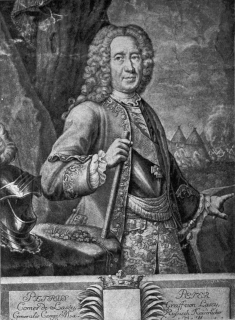
Peter Lacy, Irish-born soldier who later serves in the Imperial Russian Army, is born Pierce Edmond de Lacy into a noble Irish family on September 26, 1678, in Killeedy near Limerick, County Limerick. Considered one of the most successful Russian Imperial commanders before Pyotr Rumyantsev and Alexander Suvorov, in a military career that spans half a century, he claims to have participated in 31 campaigns, 18 battles, and 18 sieges.
Lacy’s first taste of land battle in Russia is the disastrous defeat at Narva, in which he commands a unit of musketeers, holding the rank of poruchik. During the Great Northern War he is seriously wounded on two occasions, also gaining the rank of colonel in 1706. In the same year, Peter the Great gives him command of the Polotskii regiment and three new regiments raising him to colonel status. The following year he leads his brigade at Poltava and in the ensuing battle he greatly distinguishes himself. In the 1708 battle of Rumna, he attacks and captures the headquarters of Charles XII of Sweden. He gains fame at this stage by advising the Czar that musketeers should wait until they were within a few yards of the enemy before opening fire. Prior to this, the Russians were known for uncoordinated fire. From this point begins his fame as a soldier. His next active service, still under Prince Anikita Repnin, is the siege of Riga. He is reputedly the first Russian officer to enter the capital of Livland and he is appointed the first Russian chatelain of Riga Castle in the aftermath.
In 1719, Major General Fyodor Apraksin‘s fleet lands Lacy with 5,000 infantry and 370 cavalry near Umeå in Sweden, where they proceed to devastate a dozen iron foundries and a number of mills. Two years later he leads a similar action against Sundsvall. Soon promoted to General, he enters the Military Collegium, as the Russian Ministry of Defense was then known, in 1723. Three years later, he succeeds Repnin in command of the Russian forces quartered in Livland, and in 1729 he is appointed Governor of Riga. These positions bring him in contact with the Duchess of Courland, who before long ascends the Russian throne as Empress Anna. During her reign, Lacy’s capacity for supreme command is never doubted.
Lacy is one of the first recipients of the Order of Saint Alexander Nevsky when it is established, furthermore, he is given command of all infantries in Saint Petersburg, Ingria and Novgorod. By 1728 he is ranked third of only six full generals in the Russian Army and the only foreigner. As a foreigner, his salary is 3,600 Roubles a year, 15% higher than Russian generals. Higher salaries for foreign-born generals are seen in other ranks too. His signature, even on documents in Cyrillic script, always appear in English and Latin script which suggests he never gains proficiency in the Russian language.
Having saved her from marriage to Saxe, Anna is very familiar with Lacy, and he becomes one of her most trusted generals. The War of the Polish Succession again calls him into the field. In 1733, he and Burkhard Christoph von Münnich expel the Polish king, Stanisław I, from Warsaw to Danzig, which is besieged by them in 1734. Thereupon the Irishman is commanded to march toward the Rhine and join his 13,500-strong contingent with the forces of Eugene of Savoy. To that end, his corps advances into Germany and, meeting the Austrians on August 16, returns to winter quarters in Moravia with exemplary discipline. In 1734, he commands Russian forces at the Siege of Danzig in which French and Polish forces are defeated. Lacy leads the Russians in two other decisive battles of the conflict, Wisiczin and Busawitza. In the latter battle, he is outnumbered ten to one but nevertheless prevails. For this victory, he is awarded Order of the White Eagle. After Busawitza Lacy is ordered to reinforce the Austrians at Mannheim. however, when he reaches Mannheim peace has been declared. He is received by Emperor Charles and Viennese society. On his return from Vienna, he is met by a courier from Saint Petersburg who delivers to him his patent honouring him as Field Marshal.
With the patent of Field Marshal is the news that Russia is at war with Turkey and Lacy is ordered at once to capture Azov Fortress. This he does despite being wounded in the fray. His rival, Burkhard Christoph von Münnich, had been campaigning in the Crimea with little success. Thus, after taking Azov, Lacy is ordered to capture Crimea. He bridges the Sea of Azov at a narrow point near Perekop. Within four days, aided by favourable winds and tides, his entire army crosses it and begins marching on Arabat. The Russians meet the Khan’s much larger Crimean army and rout them in two battles, on June 12 and 14. In 1738, his corps again land in Crimea and take the fortress of Chufut-Kale near the Khan’s capital, Bakhchisaray. For his success in Poland and Crimea he is awarded the Order of St. Andrew.
As soon as peace has been restored, Lacy is reinstated as the Governor of Livland, while Emperor Charles VI confers on him the title of an imperial count. His indifference to politics prevents his downfall following Anna’s death, when other foreign commanders, most notably von Münnich, fall into disgrace and are expelled from active service.
In December 1741, Elizabeth seizes power. Lacy is roused from bed in the early hours of the morning in a test of his loyalty. He is not aware if the men sent to him are from Elizabeth or Grand Duchess Anna. He is asked what party he is of, Anne or Elizabeth, and he answers, “Of the party of the reigning Empress.” A period of unrest follows, and he is called upon to restore order. Most of what is known as the German Faction falls out of favour at this stage. The restoration of order in Saint Petersburg is largely down to the prompt actions of Lacy.
When the Russo-Swedish War breaks out in 1741, the government of Anna Leopoldovna appoints Lacy Commander-in-Chief as the most experienced among Russian generals. He quickly strikes against Finland and wins his last brilliant victory at Lappeenranta in August 1741. His force, however, is poorly supplied and he is forced to withdraw to Saint Petersburg. The following year he rallies his forces and proceeds to capture Hamina, Porvoo and Hämeenlinna, by August encircling more than 17,000 Swedes near Helsinki and effectively bringing the hostilities to an end.
The war over, Lacy withdraws to Riga and resumes the command of the Russian forces stationed in Livland. He administers what is now northern Latvia and southern Estonia until his death on his private estate in Riga on April 30, 1751. His son, Franz Moritz von Lacy, enters the Austrian service in 1743 and becomes one of the most successful imperial commanders of the 18th century and also a Count of the Holy Roman Empire. His nephew, George Browne, is also a general in the Russian army.
The first officers include members of the Society of United Irishmen who had fled to France in 1797. It also includes Irishmen who had been taken during the Irish Rebellion of 1798 who were freed during the short peace effected by the Treaty of Amiens on condition of exile, and who had sailed for France in June 1802. The treaty breaks down in May 1803 with the start of the War of the Third Coalition. As a part of Napoleon’s planned invasion of the United Kingdom in 1803–05, the Irish Legion is to provide the indigenous core for a much larger invasion force of 20,000 earmarked to take Ireland, known as the Corps d’Irlande.
The purpose of the Legion is to align the Irish hearts to the French cause in the imminent invasion of Ireland. General Charles-Pierre Augereau is ordained to lead the invasion and wants Irishmen to serve in his army. However, the Battle of Cape Finisterre and the Battle of Trafalgar in 1805 make a safe sea crossing uncertain at best, and Napoleon is forced to abandon his plans for Ireland. He shifts his focus towards Austria and Eastern Europe and launches the Austerlitz campaign in late 1805. The legion remains on the French coast on garrison duty and coastal defence.
The Legion is eventually expanded from a battalion to a regiment and there is greater demand for more soldiers. These make a varied group; some are former United Irishmen who were taken prisoner in 1798-99 and then freed during the peace that followed the Treaty of Amiens (1802–03), some had been impressed into the Royal Navy and deserted, and some were German or Polish. While the Legion is stationed at the Fortress of Mainz in 1806, they are joined by 1,500 Poles and many Irishmen who were sent in 1799 to serve the King of Prussia. Its headquarters is at ‘s-Hertogenbosch, known to the French as Bois-le-Duc, in what is then the Kingdom of Holland.
The Irish Legion has its own flag, and in December 1805 receives an eagle. The Legion is the only group of foreign soldiers in the French military to whom Napoleon ever gives an eagle. Wearing a green uniform, its maximum size is about 2,000 men.
The regiment is greatly assisted from 1807 by Napoleon’s war minister Marshal of FranceHenri Clarke, who was born in France to Irish parents and whose family had close links to the ancien regime Irish brigade that had served the kings of France. He and his father had served in Dillon’s Regiment, and his mother’s father and several uncles served in Clare’s Regiment. In August 1811, the Legion is renamed the 3e Regiment Etranger (Irlandais) (3rd Foreign Regiment (Irish)), but throughout the unit’s history it is always referred to as the Irish Regiment.
The regiment divides in loyalty during the “Hundred Days,” and is officially disbanded by King Louis XVIII on September 28, 1815. Its flags are burned and its eagle, like many, disappears.
(Pictured: Regimental Colours of the Irish Legion (Obverse))




 seamus dubhghaill