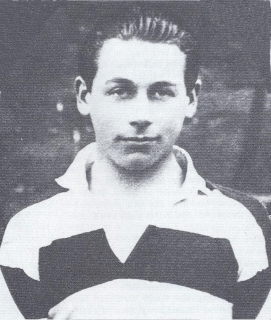
Barry is the fourth of seven children born to Thomas Barry, dairyman, and Mary Barry (née Dowling), both originally from northeast County Carlow. His father dies of heart disease on February 8, 1908, at the age of 56. His mother then moves the family to the family’s farm at Tombeagh, Hacketstown, County Carlow, while retaining the family’s townhouse on Fleet Street. As a child he goes to the National School in Rathvilly. In 1915, he is sent to live in Dublin and attends the O’Connell Schools for three months, before enrolling in the Preparatory Grade at St. Mary’s College, Rathmines, in September 1915. He remains at that school until May 31, 1916, when it is closed by its clerical sponsors. With the closure of St. Mary’s College, he transfers to Belvedere College, a Jesuit school in Dublin. He joins the Irish Volunteers, the forerunner of the IRA, while still at Belvedere College, and enters University College Dublin (UCD) in 1919 to study medicine.
As a member of 1st Battalion, Dublin Brigade of the Irish Volunteers, he takes part in a successful raid for arms on the military post in King’s Inns, Dublin, on June 1, 1920. Within only six minutes the raiders secure rifles, light machine guns, and large quantities of ammunition, and depart the site with no casualties. He also takes part in an abortive attempt to burn Aughavanagh House, Aughrim, County Wicklow in July 1920, and an attack on a British ration party in Church Street, Dublin, on September 20, with the aim of seizing arms. The final operation fails. Gunfire breaks out, three soldiers of around Barry’s own age are killed or fatally wounded, and he becomes the first Volunteer to be captured in an armed attack since 1916.
During interrogation, Barry is threatened with a bayonet and is mistreated. A general court-martial on October 20, which he refuses to recognise, condemns him to death for murdering the three soldiers, although one of the bullets taken from Private Marshall Whitehead’s body is a .45 calibre, while all witnesses state that Barry was armed with a .38 Mauser Parabellum. Despite widespread appeals on grounds of both clemency and expediency, the cabinet in London and officials in Dublin decide separately against a reprieve, probably because of its likely effect on the morale of soldiers and police.
On October 28, the Irish Bulletin, the official propaganda newspaper produced by Dáil Éireann‘s Department of Publicity, publishes Barry’s statement alleging torture. The headline reads English Military Government Torture a Prisoner of War and are about to Hang him. The Irish Bulletin declares Barry to be a prisoner of war, suggesting a conflict of principles is at the heart of the conflict. The British do not recognise a war and treat all killings by the Irish Republican Army (IRA) as murder. The public learns on this day that the date of execution has been fixed for November 1.
He was hanged in Mountjoy Prison, Dublin, on November 1, after hearing two Masses in his cell. The timing of the execution, only seven days after the death by hunger strike of Terence MacSwiney, the republican Lord Mayor of Cork, brings public opinion to a fever-pitch. He is buried in unconsecrated ground on the jail property. His comrade and fellow student Frank Flood is buried alongside him four months later. A plain cross marks their graves and those of Patrick Moran, Thomas Whelan, Thomas Traynor, Patrick Doyle, Thomas Bryan, Bernard Ryan, Edmond Foley and Patrick Maher who are hanged in the same prison before the Anglo-Irish Treaty of July 1921 which ends hostilities between Irish republicans and the British. The graves go unidentified until 1934. They become known as the Forgotten Ten by republicans campaigning for the bodies to be reburied with honour and proper rites. On October 14, 2001, the remains of the ten men are given a state funeral and moved from Mountjoy Prison to be re-interred at Glasnevin Cemetery in Dublin.
Barry is the first person to be tried and executed for a capital offence under the Restoration of Order in Ireland Act 1920, passed twelve weeks earlier. Together with his youth, this makes him a republican martyr celebrated in many ballads and verses. The best-known, set to a tune popular with British servicemen, is recorded by the American singer Paul Robeson, among others. A memorial stained-glass window by Richard King of the Harry Clarke Studio is later installed in the former UCD council chamber (afterward called the Kevin Barry Room), Earlsfort Terrace, Dublin.
The Custom House in Dublin is occupied and then burned in an operation by the Irish Republican Army (IRA) on May 25, 1921, during the Irish War of Independence. At the time, the Custom House is the headquarters of the Local Government Board for Ireland, an agency of the British administration in Ireland, against which the IRA is fighting in the name of the self-proclaimed Irish Republic. The operation, involving over 100 IRA volunteers, is a propaganda coup for the republicans but a military disaster for the IRA in the Irish capital. A force of British Auxiliaries quickly arrives, and a gun battle erupts. Five IRA volunteers, John Doyle, Edward Dorins, Daniel Head, Captain Patrick and Lieutenant Stephen O’Reilly, are killed, along with three civilians. Approximately 80 volunteers are captured.
The operation is the largest action in Dublin by rebels since the Easter Rising of April 1916.
The Irish War of Independence is a guerrilla campaign by the IRA in support of the Irish Republic. The conflict enters its bloodiest phase in the first six months of 1921. In Dublin, a total of 309 people are killed in the conflict and several hundred more wounded.
Dublin is garrisoned by over 10,000 British troops and 1,600 police including 400 men of the Royal Irish Constabulary (RIC) Auxiliary Division. Most IRA actions in the city consist either of assassinations of selected police, military or administration figures by the Squad, or ambushes on British forces by one of the four Active Service Units (ASU) of the IRA’s Dublin Brigade, together comprising about 100 men. These are usually rapid and fleeting attacks using grenades and handguns, followed by a quick getaway. There are strict orders given to IRA units to avoid prolonged engagements with the better-armed British forces.
However, this policy is reversed after a meeting of the Ministry of Dáil Éireann in May 1921 where the President of the Republic, Éamon de Valera, calls for a spectacular public show of force by the IRA, to reinforce the idea that it is an army representing an Irish government. For this reason, it is decided to attack and burn the Custom House, which, although an important government building, is not defended by the British military. Michael Collins is against the attack but is overruled.
Michael O’Kelly, Lieutenant E Company, 2nd Battalion, Dublin Brigade, recalls plans to “deliver a smashing blow to England.” Two large scale operations – to capture Beggars Bush Barracks, or to destroy the Customs House are initially considered. The Custom House is eventually chosen. IRA member Vincent Byrne says that the operation is “one of many under review.”
In the early afternoon of May 25, 1921, roughly 120 non-uniformed IRA Volunteers begin to gather around the Custom House in groups of two or three. Three quarter of those involved belonged to the 2nd Battalion of the Dublin Brigade under Tom Ennis. Only a minority of them are experienced guerrilla fighters and they are armed only with pistols and a limited amount of ammunition. At 1:00 p.m., they rush the Custom House and overpower the police guard. A lorry pulls up outside the building with tins of petrol and bales of cotton, which are then sprinkled throughout the building. The IRA Volunteers herd all the staff into the main hall. The caretaker of the building, Francis Davis, is shot dead when he tries to call the police.
However, at about 1:10 p.m., a watching policeman notifies British forces and 60 Auxiliaries in three lorries and an armored car quickly arrive on the scene. IRA Volunteers from the 1st, 3rd and 4th battalions are positioned outside the building to stop the enemy from approaching.
Four Auxiliaries are wounded in a gun battle with one of these IRA protection teams outside the building. Other Auxiliaries fire into the building with rifles and Lewis machine guns, exchanging fire with the IRA fighters inside. A number of IRA Volunteers and civilians are killed or wounded by the Auxiliaries. As fighting rages outside, IRA Volunteers inside the building are ordered to set it alight.
The ammunition of the IRA Volunteers quickly runs out and the firefight ends within 30 minutes. Some Volunteers are shot as they try to run away. Tom Ennis, in command of the operation, escapes but is hit twice in the leg. Many others are arrested along with civilians as they come out of the now burning Custom House with their hands up. The Fire Brigade, which had been delayed from responding by other IRA companies in the city, arrives too late to put out the fire.
British military forces composed of units from the Wiltshire Regiment arrive and take over the operation from the Auxiliaries at this point. A total of 111 people are arrested, of whom 70–80 are IRA volunteers.
The Custom House burns for five days and is all but completely destroyed by the fire. With it are destroyed many centuries of local government records. The Irish Bulletin, official gazette of the Irish Republic, reports:
“A detachment of the Dublin Brigade of the Irish Army was ordered to carry out the destruction of the Custom House in accordance with a decision arrived at after due deliberation of the ministry of Dáil Éireann. We in common with the rest of the nation regret the destruction of historical buildings. But the lives of four million people are a more cherished charge than any architectural masterpiece. The Custom House was the seat of an alien tyranny.”
From the republican point of view, the operation is successful for its propaganda value, but it is a heavy blow in terms of the numbers lost, both killed and arrested. Following the operation, the Dublin Brigade and The Squad are amalgamated into the Dublin Guard. However, the operation does not totally impede the IRA’s campaign in Dublin. The Dublin Brigade carries out 107 attacks in the city in May and 93 in June, showing a decline but not a dramatic one.
The memoir of Harry Colley, Adjutant of the Dublin IRA, estimates the numbers in the five Dublin battalions at 1,400 in early 1921.
The armed conflict is brought to an end on July 11, 1921, and negotiations are opened which produces the Anglo-Irish Treaty in December of that year. The Custom House is re-built after the end of the war.
Irish local government records from the 1600s had been brought from rural parts of Ireland to the Custom House for safekeeping, and these are lost in the blaze. At the time, The New York Times subtitles their report on the fire as “Priceless Records Lost.” Some genealogists still lament the loss of these historical records.
(Pictured: The Custom House in flames, taken on May 25, 1921)
McKenna is born Kathleen Maria Kenna on September 9, 1897, in Oldcastle, County Meath. Her parents are William, a draper and hardware merchant, and Mary Kenna (née Hanley). She is the eldest child of seven, with three sisters and three brothers. She and her siblings add “Mc” to their surname as teenagers. Her maternal grandfather, a Fenian, miller and land agitator, is a strong influence on her. Agnes O’Farrelly is her paternal great aunt. She attends the Oldcastle Endowed School and goes on to pass the National University of Ireland (NUI) matriculation examination. She attends University College Dublin (UCD) briefly, but the family’s circumstances prevent her from completing her course.
McKenna’s father had been an active member of the Irish National Land League and the Meath Labour Union. He is one of the organisers of a short-lived local newspaper, Sinn Féin – Oldcastle Monthly Review, in 1902. Both her parents are members of Conradh na Gaielge. Arthur Griffith and Brian O’Higgins frequently visit the family home. Denounced by the local parish priest, Fr. Robert Barry, her father’s business goes into decline. The family leaves Oldcastle and moves to Dundalk in August 1915, and to Rugby, Warwickshire, England, in March 1916. In Rugby, her father teaches typing and shorthand, and her mother works in an ammunition factory. She works as a secretary for an engineering firm. Members of the family return to Ireland from 1919 to 1922, and by the time of her father’s death in 1939, he is living back in Oldcastle.
McKenna spends some holidays in Ireland and, during a visit to Dublin in the summer of 1919, she presents herself to the Sinn Féin offices in Harcourt Street. She has a letter of introduction from her father to Griffith, which emphasises her willingness to work for Irish independence. For her holidays, she works in the Sinn Féin press bureau and is employed as one of the first “Dáil girls” of the clandestine government. She is informed that if a planned news bulletin comes through, she will be summoned back to Dublin. In October 1919, she receives that summons and, after a typing test on November 11, she joins the Irish Bulletin under Minister for Publicity, Desmond FitzGerald, and director of publicity, Robert Brennan. She also becomes a member of the Conradh na Gaielge Parnell branch.
The Irish Bulletin is published five times a week, circulating the misdeeds of the British government in Ireland. McKenna edits and mimeographs a summary of “acts of aggression” from British forces in Ireland weekly, compiled by Anna Kelly. Frank Gallagher does most of the writing, edited by FitzGerald, and later Erskine Childers. Though she is sometimes described as the Bulletin‘s editor, she is more akin to an editorial assistant. R. M. Smyllie later recalls that she was in regular contact with the media. She types out each issue on a wax stencil in a typewriter which is used to create mimeograph copies, and then circulated to England. In the beginning, about 30 recipients, mostly London journalists, receive the Bulletin but by October 1920 it has grown to 600, and by July 1921 over 1,200. She also keeps the accounts, takes dictation of statements, and at times works up articles from notes given to her by Griffith or others. She also acts as a confidential messenger, couriering between Dáil departments and Irish Republican Army (IRA) leaders such as Michael Collins. Through this, she meets Moya Llewelyn Davies.
The Bulletin becomes a symbol of the underground government and a target for British forces. This necessitates the frequent moving of the operation from one Dublin hideout to another. She fears that if she were captured, she would break under interrogation. When FitzGerald is arrested, he is asked about “the girl wearing a green tam” in reference to McKenna’s tam-o’-shanter hat which prompts her to change her choice of hat. Despite the capture of a number of the Bulletin staff, as well as the capture of the office files and equipment on March 26, 1921, it never misses an issue.
McKenna’s sister Winifred also works as a secretary to the clandestine government. Her brother, Tadhg (Timothy), is a member of Sinn Féin and in Greenore, County Louth, is involved in trade union affairs. He is detained, beaten, and interned in March 1921. He is later an activist with the Irish Labour Party. Her brother William is a messenger for the Irish government during this period and during the Irish Civil War serves in the Free State Army.
After the truce in 1921, McKenna is assigned to the Dáil cabinet secretarial staff at the Mansion House, where she continues to work in the publicity department. She travels as Griffith’s private secretary to London as part of the Irish delegation to the treaty negotiations in October 1921. She is an admirer of both Griffith and Collins and is a firm supporter of the Anglo-Irish Treaty. She works as Griffith’s secretary until just before his death and also does some secretarial work for Collins during the negotiations. One of her sisters is anti-Treaty, and she later recalls that she lost friends due to her support of the treaty.
McKenna marries Vittorio Napoli in 1931. He is a captain, and later a general, in the Italian royal grenadier guards. They meet when she is on holiday in Italy in 1927. For the first five years of their marriage, they live in the port of Derna in Cyrenaica, Libya, while her husband is stationed there. A son and daughter are born there. From September 1939 to June 1940, the family lives in Albania, but after Italy enters World War II, she and the children move to Viterbo. Her husband is taken prisoner in Greece in September 1943, and is detained in Germany and Poland. He returns to Italy in September 1945. Viterbo had been heavily bombed, and after Allied troops arrive, McKenna works as a translator and gives English language lessons to support her family. Her husband remains in the army, and they remain in Viterbo until 1956, later moving to Rome.
After the war, McKenna writes articles for the Irish Independent and other publications from Ireland, the United States and New Zealand, including The Irish Press, Irish Travel, Standard, Word, and Writer’s Digest. Sometimes she writes under her own name, as well as her pen name Kayn or Kayen MacKay. As the wives of Italian officers do not traditionally work, the money she earns from this is kept for travel and other leisure activities. This money allows her to visit her family in Ireland in 1947 for the first time since 1932. After their retirement, she and her husband visit Ireland regularly, and travel around Italy.
McKenna applies for an Irish military pension in 1950/51 and 1970, receiving references in support of her claim from Gallagher. As she had not served in a military organisation, her claims are rejected. As an Irish War of Independence veteran, she is awarded free travel in 1972, which is later extended to her husband. In her later years, she becomes concerned about the inaccuracies in the history around the Irish War of Independence and the Irish Civil War. She gives two talks to Radio Éireann in 1951, speaking about her time with the Irish Bulletin. Copies of these recordings are now held by the Bureau of Military History. During her lifetime, extracts of her memoir are published in the Capuchin Annual and The Irish Times. She drafted and redrafted these memoirs from the late 1940s to the early 1980s. A version edited by her daughter and niece is published in 2014 as A Dáil girl’s revolutionary recollections.
McKenna dies on March 22, 1988, in Rome. She is buried with an Irish flag which she had kept with her. A large collection of her papers is held in the National Library of Ireland (NLI). In 2010, 2011 and 2016, some of her memorabilia is sold in Dublin.
In April 1919, Terence MacSwiney proposes the establishment of a daily paper by the Dáil for the purpose of publicity. His suggestion is not implemented until November, when Desmond FitzGerald decides that some form of printed counterpropaganda is vital to republican aims and to take advantage of the success of Sinn Féin and the increasing international interest in Ireland. Fitzgerald succeeds Laurence Ginnell in the Ministry following the latter’s arrest in April 1919, though he does not take up the position until July. At a Cabinet meeting held on November 7, there is agreement that there should be “A scheme for daily news bulletin to foreign correspondents, weekly lists of atrocities; entertainment of friendly journalists approved, and £500 voted for expenses under Mr. Griffith’s personal supervision.” Four days later the Irish Bulletin makes its debut, in a run consisting of just thirty copies. Five issues of the bulletin are issued each week for the next two years, despite efforts by the British authorities to suppress it.
The Irish Bulletin‘s offices are originally located at No. 6 Harcourt Street, Dublin. FitzGerald is the paper’s first editor, until his arrest and replacement by Erskine Childers. In the early days, the paper is produced mainly by Frank Gallagher and Robert Brennan. Brennan, as Sinn Féin’s Director of Publicity since April 1918, had played a leading role in that party’s success in the 1918 Irish General Election.
Following FitzGerald’s arrest in 1921, Childers is appointed Director of Propaganda taking charge of publicity and thus becoming the paper’s new editor. On May 9, 1921, both Childers and Gallagher are arrested and taken to Dublin Castle. Following the intervention of Sir Alfred Cope, both are released that night and go on the run. The hasty release of the two leads to speculation between Art O’Brien and Michael Collins that there is a rift developing between the British military authorities and the civil administration. Despite the arrests, the Irish Bulletin continues to appear on schedule. Alan J. Ellis, a journalist with The Cork Examiner makes occasional contributions to the paper. Kathleen Napoli McKenna is “a key force behind the daily newssheet.”
In the early days, the Irish Bulletin consists mainly of lists of raids by the security forces and the arrests of suspects. In order to stimulate interest, this is expanded in 1921 at the behest of the Irish President, Éamon de Valera, in his direction to Childers to give more detailed accounts of events. Extracts from foreign publications, particularly sympathetic English papers, are frequently included. A regular feature is accounts from the Dáil Courts, which are reported in detail.
The Irish Bulletin is more graphic in its coverage of violence than is usual for its time. An example is its reporting on the deaths of two prominent Sinn Féin leaders, Henry and Patrick Loughnane, from Shanaglish, Gort, County Galway. The men had been handed over by the Royal Irish Constabulary (RIC) to local members of the Auxiliary Division. On December 6, the bodies are found in a pond. The skulls had been battered in and the flesh was hanging loose on both bodies.The two men were evidently tied by the neck to a motor lorry and dragged behind it until they were dead. Before the bodies were hidden in a pond an effort was made to burn them.
On the night of March 26-27, 1921, the offices of the Irish Bulletin are discovered by the British authorities. Captured typewriters and duplicators are used to fabricate bogus issues of the paper. These are distributed to the usual subscribers using lists found at the office. Lord Henry Cavendish-BentinckMP on receiving some of the counterfeit papers through the post, asks in the House that those responsible “not (to) waste their money in sending me any more of their forgeries.” The initial efforts of the forgers, Captains Hugh Pollard and William Darling, are of poor quality and easily identified as counterfeit.
(Pictured: The “Irish Bulletin” issue of October 12, 1920, National Museum of Ireland)



 seamus dubhghaill