
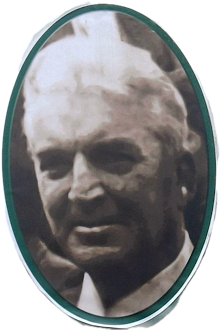
Proinsias Mac Airt (English: Frank Card), Irish republican activist and long-serving member of the Irish Republican Army (IRA), is born in Belfast, Northern Ireland, on April 18, 1922.
Mac Airt first becomes involved in Irish republicanism as a boy when he joins the Fianna Éireann. His first imprisonment is in 1942 when he is sent to jail for illegal military foot drilling. He Is later interned during the IRA’s Border Campaign of 1956-1962.
Having retired at some earlier point, Mac Airt returns to the republican movement in 1969, throwing his lot in with the newly established Provisional Irish Republican Army (PIRA) and their political arm Provisional Sinn Féin. Indeed, in early 1970 his Patrick Pearse cumann, which he sets up in the Clonard area of the Falls Road, is the first branch of Provisional Sinn Féin established in Belfast and proves central to the growth of the dissident party in the city. In August 1970, he Is appointed editor of the Belfast-based Republican News, succeeding Jimmy Steele who had died soon after being appointed editor. Despite his advancing age Mac Airt also becomes involved in the gun battles that rage between the republicans from Falls and loyalists from the neighbouring Shankill Road. As a consequence, he becomes one of the leaders of the nascent PIRA in Belfast. He is publicly named as a leading republican by General Anthony Farrar-Hockley who commands the British Army present during the clashes and with whom Mac Airt has held failed negotiations at the scene of conflict. He serves as Adjutant to Billy McKee, who is first commander of the Provisional IRA Belfast Brigade. According to Brendan Hughes, Mac Airt’s Kane Street home doubles as Belfast Brigade headquarters at the early stage in the movement’s history.
On April 15, 1971, Mac Airt, along with Billy McKee, is arrested by the British Army when found in possession of a handgun. Both men are sentenced under the Explosive Substances Act 1883 and sent to Crumlin Road Gaol. In the prison the two men are recognised as the leaders of the republican prisoners, a role held by Gusty Spence on the loyalist side. They co-operate informally with Spence to maintain order until they agree to establish an official Camp Council. The make-up of this group sees Mac Airt and McKee representing the PIRA, Spence and an associate identified only as “Robert” representing the Ulster Volunteer Force (UVF) and Ned McCreery and James Craig as Ulster Defence Association (UDA) delegates, with members of the Official IRA (OIRA) and Irish National Liberation Army (INLA) eventually added.
Mac Airt is involved in the talks held between republicans and clergymen from various Protestant churches held at Feakle, County Clare, on December 12, 1974. While the talks produced little, he Is one of those who maintains contact with the clergymen. Indeed, on January 19, 1975, one of the ministers, Rev William Arlow of the Irish Council of Churches (ICC), even introduces Mac Airt and his ally Jimmy Drumm to British government officials Michael Oatley and James Allan in an attempt to have the republican grievances heard.
Although a new generation of leaders emerges in the Provisional IRA and Sinn Féin, Mac Airt remains an influential veteran. He is close to Danny Morrison and Tom Hartley and helps to ensure the removal of Seán Caughey from the editorship of Republican News in 1975 and his replacement by Morrison.
In 1968, Mac Airt records two vocal songs, “Croppy Boy” and “Flag of the Fianna” on the LP record Irish Songs of Freedom produced for the Outlet Recording Co. Ltd, Belfast.
Mac Airt dies on January 8, 1992, at the age of 69. The President of Sinn Féin, Gerry Adams, delivers the graveside oration at his funeral, describing him as “a radical in the Connolly tradition.”


