seamus dubhghaill

Promoting Irish Culture and History from Little Rock, Arkansas, USA


Leave a comment

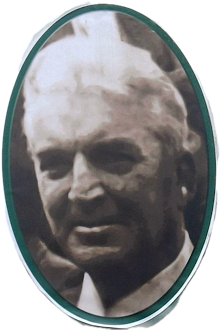
Birth of Proinsias Mac Airt, Activist & IRA Volunteer

Proinsias Mac Airt (English: Frank Card), Irish republican activist and long-serving member of the Irish Republican Army (IRA), is born in Belfast, Northern Ireland, on April 18, 1922.

Mac Airt first becomes involved in Irish republicanism as a boy when he joins the Fianna Éireann. His first imprisonment is in 1942 when he is sent to jail for illegal military foot drilling. He Is later interned during the IRA’s Border Campaign of 1956-1962.

Having retired at some earlier point, Mac Airt returns to the republican movement in 1969, throwing his lot in with the newly established Provisional Irish Republican Army (PIRA) and their political arm Provisional Sinn Féin. Indeed, in early 1970 his Patrick Pearse cumann, which he sets up in the Clonard area of the Falls Road, is the first branch of Provisional Sinn Féin established in Belfast and proves central to the growth of the dissident party in the city. In August 1970, he Is appointed editor of the Belfast-based Republican News, succeeding Jimmy Steele who had died soon after being appointed editor. Despite his advancing age Mac Airt also becomes involved in the gun battles that rage between the republicans from Falls and loyalists from the neighbouring Shankill Road. As a consequence, he becomes one of the leaders of the nascent PIRA in Belfast. He is publicly named as a leading republican by General Anthony Farrar-Hockley who commands the British Army present during the clashes and with whom Mac Airt has held failed negotiations at the scene of conflict. He serves as Adjutant to Billy McKee, who is first commander of the Provisional IRA Belfast Brigade. According to Brendan Hughes, Mac Airt’s Kane Street home doubles as Belfast Brigade headquarters at the early stage in the movement’s history.

On April 15, 1971, Mac Airt, along with Billy McKee, is arrested by the British Army when found in possession of a handgun. Both men are sentenced under the Explosive Substances Act 1883 and sent to Crumlin Road Gaol. In the prison the two men are recognised as the leaders of the republican prisoners, a role held by Gusty Spence on the loyalist side. They co-operate informally with Spence to maintain order until they agree to establish an official Camp Council. The make-up of this group sees Mac Airt and McKee representing the PIRA, Spence and an associate identified only as “Robert” representing the Ulster Volunteer Force (UVF) and Ned McCreery and James Craig as Ulster Defence Association (UDA) delegates, with members of the Official IRA (OIRA) and Irish National Liberation Army (INLA) eventually added.

Mac Airt is involved in the talks held between republicans and clergymen from various Protestant churches held at Feakle, County Clare, on December 12, 1974. While the talks produced little, he Is one of those who maintains contact with the clergymen. Indeed, on January 19, 1975, one of the ministers, Rev William Arlow of the Irish Council of Churches (ICC), even introduces Mac Airt and his ally Jimmy Drumm to British government officials Michael Oatley and James Allan in an attempt to have the republican grievances heard.

Although a new generation of leaders emerges in the Provisional IRA and Sinn Féin, Mac Airt remains an influential veteran. He is close to Danny Morrison and Tom Hartley and helps to ensure the removal of Seán Caughey from the editorship of Republican News in 1975 and his replacement by Morrison.

In 1968, Mac Airt records two vocal songs, “Croppy Boy” and “Flag of the Fianna” on the LP record Irish Songs of Freedom produced for the Outlet Recording Co. Ltd, Belfast.

Mac Airt dies on January 8, 1992, at the age of 69. The President of Sinn FéinGerry Adams, delivers the graveside oration at his funeral, describing him as “a radical in the Connolly tradition.”

Leave a comment

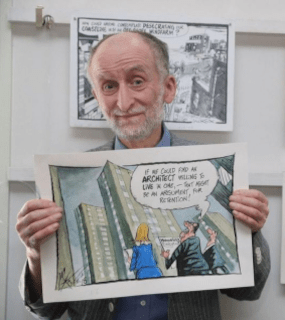
Birth of Political Cartoonist Ian Knox

Ian Knox, political cartoonist for The Irish News, is born on May 4, 1943, in Belfast, Northern Ireland. He also draws cartoons for the BBC Northern Ireland political show Hearts and Minds.

Knox trains as an architect at Edinburgh College of Art in Scotland from 1963 to 1967 and Heriot-Watt University in Edinburgh from 1967 to 1968 and works as an architect before establishing himself as a cartoonist. He works in animation from 1970 to 1975 for Halas & Batchelor in London, Potterton Productions in Montreal, and Kotopoulis Productions in Toronto. He then joins Red Weekly and Socialist Challenge as a political cartoonist, as well as contributing to various children’s comics for IPC Media from 1975 to 1988.

Knox signs much of his political work “Blotski,” and he and Republican News cartoonist Brian Moore, better known as “Cormac,” work together as “Kormski,” drawing the anti-clerical strip “Dog Collars” for Fortnight magazine. Since 1989 he has been the editorial cartoonist for The Irish News, a nationalist newspaper based in Belfast. Since 1996 he has contributed the “As I See It” feature to Hearts and Minds on BBC2 Northern Ireland. From 1997 to 1998 he is political cartoonist for Ireland on Sunday.

Knox cites Ronald Searle, David Low, John Glashan, Victor Weisz, Steve Bell, Pat Oliphant and Charles Addams among those who have influenced him.


Leave a comment

Birth of Danny Morrison, IRA Volunteer, Author & Activist

Daniel Gerard Morrison, former Provisional Irish Republican Army (IRA) volunteer, Irish author and activist, is born in staunchly Irish nationalist Andersonstown, Belfast, on January 9, 1953. He plays a crucial role in public events during the Troubles in Northern Ireland.

Morrison is the son of Daniel and Susan Morrison. His father works as a painter at the Harland & Wolff shipyard in East Belfast. His uncles, including Harry White, had been jailed for their part in the IRA‘s Northern Campaign in the 1940s. He joins Sinn Féin in 1966 and helps to organise 50th anniversary commemorations of the Easter Rising in Belfast. At this time, he later recalls, “as far as we were concerned, there was absolutely no chance of the IRA appearing again. They were something in history books.”

After the 1969 Northern Ireland riots, in which nationalist areas of Belfast are attacked and burned, Morrison joins the newly formed Provisional IRA. After this, he is engaged in clandestine republican activities, but as late as 1971, is still attending Belfast College of Business Studies and editing a student magazine there. He is interned in Long Kesh Detention Centre in 1972.

Morrison’s talents for writing and publicity are quickly recognised within the republican movement and after his release in 1975 he is appointed editor of Republican News. In this journal, he criticises many long-standing policies of the movement. At this time, he becomes associated with a grouping of young, left-wing Belfast based republicans, led by Gerry Adams, who want to change the strategy, tactics and leadership of the IRA and Sinn Féin.

With the rise of Adams’ faction in the republican movement in the late 1970s, Morrison succeeds Seán Ó Brádaigh as Director of Publicity for Sinn Féin. During the 1981 Irish hunger strike, he acts as spokesman for the IRA hunger strikers’ leader Bobby Sands, who is elected to the British Parliament on an Anti H-Block platform.

Morrison is elected as a Sinn Féin Member for Mid Ulster of a short-lived Northern Ireland Assembly from 1982 to 1986. He also stands unsuccessfully for the European Parliament in 1984 and again in 1989. He also stands for the Mid Ulster Westminster seat in 1983 and 1986. Along with Owen Carron, he is arrested on January 21, 1982, while attempting to enter the United States illegally from Canada by car. He is deported and later both men are convicted on a charge of making false statements to US immigration officials.

Morrison is director of publicity for Sinn Féin from 1979 until 1990, when he is charged with false imprisonment and conspiracy to murder a British informer in the IRA, Sandy Lynch. He is sentenced to eight years in prison and is released in 1995.

Since 1989, Morrison has published several novels and plays on themes relating to republicanism and events in the modern history of Belfast. His latest play, The Wrong Man, opens in London in 2005. It is based on his 1997 book of the same name and deals with the career of an IRA man who is suspected by his colleagues of working for the police.

The Bobby Sands Trust (BST) is formed after the 1981 Hunger Strike where ten republican prisoners die due to their hunger strike protest against the UK Government. The legal firm Madden & Finucane continues to act for the Trust whose original members are Gerry Adams, Danny Morrison, Tom Hartley, Tom Cahill, Marie Moore and Danny Devenny. For a time, Bobby’s two sisters, Marcella and Bernadette, are members of the Trust. Current members still include Adams, Morrison and Hartley. The BST claims to hold copyright to all the written works of Bobby Sands. The family of Sands has been critical of the BST, and they have called for it to disband.

Morrison lives in West Belfast with his Canadian-born wife, Leslie. He has two sons from his first marriage.