seamus dubhghaill

Promoting Irish Culture and History from Little Rock, Arkansas, USA


Leave a comment

Blair & Ahern Meet in Aftermath of the Omagh Bombing

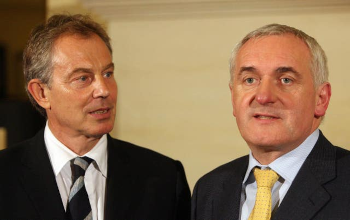
British Prime Minister Tony Blair meets with Taoiseach Bertie Ahern in Ashford Castle, County Mayo on August 26, 1998. They join forces to fight terrorism and discuss laws which will be introduced in the aftermath of the Omagh bombing, which took place eleven day earlier on August 15 in Omagh, County Tyrone, 110 kilometres west of Belfast, and resulted in 28 deaths.

Leading the way in a return to the past is Ahern’s Dublin government, which has introduced the toughest anti-terrorist legislation in the history of the Irish Republic. He concedes that the measures are draconian but says that his government is determined to do everything in its power, “working closely with the British government to defeat and suppress this murderous conspiracy against the people of Ireland.”

Prime Minister Blair promises that he too plans to introduce extreme measures. “We will bring in similar measures to those proposed by the Irish government, so we will then have the toughest anti-terrorist measures for the whole of Ireland, the Republic and Northern Ireland, that we have ever seen.”

With no plans to recall the British parliament, it is thought that existing legislation will be applied, since it already includes measures similar to those announced by the Irish government.

Oppressive British legislation has sustained British rule in Ireland for decades. This includes internment without trial, non-jury courts, entry and search of homes without a warrant, seven-day detention with unrecorded and unsupervised interrogation, denial of access to lawyers, exclusion orders and more. Most of these are still in use in 1998.

The Ahern package includes withdrawal of a suspect’s right to silence — refusal to answer questions can be used as evidence that a suspect is a member of an illegal organisation, the seizure of property that has been used for storing weapons or making bombs, and the creation of a new offence of directing an unlawful organisation. This is expected to carry the penalty of life imprisonment.

Omagh is 75% nationalist, with good cross-community relations, and has largely escaped the worst of the conflict. Although Republican dissidents have carried out a spate of similar bombings in the previous year, the towns targeted are mainly Unionist and further east.

In the wake of the Good Friday Agreement, Republican splinter groups remain on a military footing. These groups — the Irish National Liberation Army (INLA), the Continuity IRA and the Real IRA — have announced their determination to fight on.

The group that claims responsibility for the Omagh bombing is the Real IRA, which was formed in protest at the IRA’s 1997 cease-fire. Irish police have insisted that the Real IRA is the military wing of the recently formed 32 County Sovereignty Movement (32CSM), although this is denied by that organisation.

Although both the INLA and the Real IRA have declared a unilateral cease-fire since the Omagh bombing, media focus has settled on Bernadette Sands McKevitt, sister of the 1980s IRA hunger striker Bobby Sands, who is a leading figure in the 32 County Sovereignty Movement. Sands-McKevitt has condemned the Omagh bombing, but her home in Blackrock, County Louth, has since been targeted by local townspeople who have staged protests against her and her family. She has also been denied a visa to enter the United States on a speaking tour.

The Omagh bombing could not have come at a better time for Britain. With the war formally over and Sinn Féin penned, the bombing delivers an opportunity to smash the Republican left once and for all and wrench it from any semblance of ongoing support in Ireland.

All nationalist opponents of the Good Friday Agreement must now cope with being stained by the blood of Omagh. With the massive referendum vote in favour of peace to back them up, the British and Irish governments can be satisfied that the Good Friday Agreement now looks more in place than at any other time. As one nationalist describes the situation, “If the Good Friday Agreement was a defeat for the cause of Irish nationalism, the Omagh bombing has turned it into a rout.”

(From: “Blair, Ahern make the most of Omagh bomb” by Dave Riley, Green Left (www.greenleft.org), August 26, 1998)

2 Comments

Irish Republican Patsy O’Hara Dies on Hunger Strike

Patsy O’Hara, Irish republican hunger striker and member of the Irish National Liberation Army (INLA), dies on hunger strike in the H Blocks of Long Kesh Prison at 11:29 PM on May 21, 1981. Earlier in the day, at 2:11 AM, he is preceded in death by his friend and fellow hunger-striker, Raymond McCreesh.

O’Hara is born on July 11, 1957, in Bishop Street, Derry, County Londonderry, Northern Ireland.

O’Hara joins Na Fianna Éireann in 1970 and, in 1971, his brother Sean is interned in Long Kesh Prison. In late 1971, at the age of 14, he is shot and wounded by a soldier while manning a barricade. Due to his injuries, he is unable to attend the civil rights march on Bloody Sunday but watches it go by him in the Brandywell Stadium, and the events of the day have a lasting effect on him.

In October 1974, O’Hara is interned in Long Kesh Prison, and upon his release in April 1975 he joins the Irish Republican Socialist Party (IRSP) and INLA. He is arrested in Derry in June 1975 and held on remand for six months. In September 1976, he is arrested again and once more held on remand for four months.

On May 10, 1978, O’Hara is arrested on O’Connell Street in Dublin under section 30 of the Offences Against the State Act and is released eighteen hours later. He returns to Derry in January 1979 and is active in the INLA. On May 14, 1979, he is arrested and is convicted of possessing a hand grenade. He is sentenced to eight years in prison in January 1980.

O’Hara becomes Officer Commanding of the INLA prisoners at the beginning of the first hunger strike in 1980, and he joins the 1981 strike on March 22.

On Thursday, May 21, 1981, at 11:29 PM, Patsy O’Hara dies at the age of 23 after 61 days on hunger strike. In accordance with his wishes, his parents do not get him the medical intervention needed to save his life. His corpse is found to be mysteriously disfigured prior to its departure from prison and before the funeral, including signs of his face being beaten, a broken nose, and cigarette burns on his body.

O’Hara’s mother, Peggy O’Hara, is a candidate in the 2007 Northern Ireland Assembly election in the Foyle constituency. She is not elected, but she is one of the more successful dissident republican candidates opposed to the new policy of the Sinn Féin leadership of working with the Police Service of Northern Ireland (PSNI) and wins 1,789 votes. On the eve of the election, over 330 former republican prisoners write a letter to the Derry Journal endorsing her campaign.


Leave a comment

The Droppin’ Well Bombing

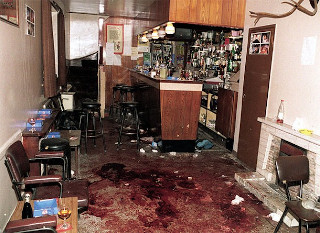
The Droppin’ Well bombing or Ballykelly bombing occurs on December 6, 1982, when the Irish National Liberation Army (INLA) explodes a time bomb at a disco in Ballykelly, County Londonderry, Northern Ireland. The disco, known as the Droppin’ Well, is targeted because it is frequented by British Army soldiers from nearby Shackleton Barracks. The bomb kills eleven soldiers and six civilians and 30 people are injured, making it the most deadly attack during the INLA’s paramilitary campaign and the most deadly attack during The Troubles carried out in County Londonderry.

The bomb is manufactured by the INLA in nearby Derry. One of those involved later reveals that the INLA unit had carried out reconnaissance missions to the Droppin’ Well to see if there were enough soldiers to justify the likelihood of civilian casualties.

On the evening of December 6, 1982, an INLA member leaves a bomb inside the pub. There are about 150 people inside. The Royal Ulster Constabulary (RUC) believe that the bomb, estimated to be 5 to 10 pounds of commercial (Frangex) explosives, is small enough to fit into a handbag. It has, however, been left beside a support pillar and, when it explodes at about 11:15 PM, the blast brings down the roof. Many of those killed and injured are crushed by fallen masonry.

Following the blast, it takes a few hours to pull survivors from the rubble. The last survivor is freed at 4:00 AM, but it is not until 10:30 AM that the last of the bodies is recovered. Ultimately, 17 people die and 30 are injured, some seriously. Five of the civilians are young women and three (Alan Callaghan, Valerie McIntyre and Angela Maria Hoole) are teenagers. Angela Hoole is celebrating her engagement to one of the soldiers who survives the incident. Of the eleven soldiers who die, eight are from the 1st Battalion Cheshire Regiment, two from the Army Catering Corps and one from The Light Infantry. One of those on the scene is Bob Stewart, then a company commander in the Cheshire Regiment. He loses six soldiers from his company and is deeply affected as he tends to the dead and injured.

Suspicion immediately falls upon the Provisional Irish Republican Army (IRA), who denies involvement. By December 8, the British Army is blaming the INLA on grounds that the IRA, in a mixed village, would have made greater efforts not to risk killing civilians. Shortly afterwards, the INLA issues a statement of responsibility.

The INLA describes the civilians killed as “consorts.” The attack is criticised by many on both sides of the conflict in Northern Ireland due to the high loss of civilian lives. Soon after the INLA had issued its statement, the government of the Republic of Ireland bans the INLA, making membership punishable by seven years imprisonment.

In an interview after the bombing, INLA leader Dominic McGlinchey says that the Droppin’ Well’s owner had been warned six times to stop offering entertainment to British soldiers. He adds that the owner, and those who socialise with the soldiers, “knew full well that the warnings had been given and that the place was going to be bombed at some stage.” It later emerges that the INLA may also have targeted Ballykelly because it believed that the military base was part of NATO‘s radar and communications network.

Six days after the bombing, RUC officers shoot dead INLA members Seamus Grew and Roddie Carroll near a vehicle checkpoint in Armagh. The officers say they believed that the two men were ferrying McGlinchey into Northern Ireland. Neither was armed, nor was McGlinchey in their car.

In June 1986, four INLA members, sisters Anna Moore and Helena Semple, Eamon Moore (no blood relation) and Patrick Shotter, receive life sentences for the attack. Anna Moore later marries loyalist Bobby Corry while both are in prison. Anna’s daughter, Jacqueline Moore, is given ten years for manslaughter as the court believes she had been coerced into involvement. She is pregnant during her arrest and later gives birth in jail. All of those convicted are from Derry.

(Pictured: The Droppin’ Well bar and disco in Ballykelly destroyed by a Irish National Liberation Army bomb in 1982. Credit: PA Wire)


Leave a comment

Assassination of Irish Republican Ronnie Bunting

Ronnie Bunting, a Protestant Irish republican and socialist activist, is assassinated on October 15, 1980, when several gunmen enter his home in the Downfine Gardens area of Andersonstown.

Bunting is born into an Ulster Protestant family in East Belfast. His father, Ronald Bunting, had been a major in the British Army and Ronnie grew up in various military barracks around the world. His father became a supporter and associate of Ian Paisley and ran for election under the Protestant Unionist Party banner.

Having completed his education and graduating from Queen’s University Belfast, Bunting briefly becomes a history teacher in Belfast, but later becomes involved in the Northern Ireland Civil Rights Association and then with Irish republican organisations.

Unlike most Protestants in Northern Ireland, Bunting becomes a militant republican. His father, by contrast, was a committed Ulster loyalist. Despite their political differences, they remain close.

Bunting joins the Official Irish Republican Army (OIRA) around 1970 as he is attracted to their left-wing and secular interpretation of Irish republicanism and believes in the necessity of armed revolution. The other wing of the IRA, the Provisional Irish Republican Army, is seen to be more Catholic and nationalist in its outlook. At this time, the communal conflict known as the Troubles is beginning and the Official IRA is involved in shootings and bombings. He is interned in November 1971 and held in Long Kesh until the following April.

In 1974, Bunting follows Seamus Costello and other militants who disagree with the Official IRA’s ceasefire of 1972, into a new grouping, the Irish National Liberation Army (INLA). Immediately, a violent feud breaks out between the Official IRA and the INLA.

In 1975, Bunting survives an assassination attempt when he is shot in a Belfast street. In 1977, Costello is killed by an Official IRA gunman in Dublin. Bunting and his family hide in Wales until 1978, when he returns to Belfast. For the remaining two years of his life, he is the military leader of the INLA. The grouping regularly attacks the British Army and Royal Ulster Constabulary (RUC) in Belfast. He calls in claims of responsibility to the media by the code name “Captain Green.”

At about 4:30 AM on October 15, 1980, several gunmen wearing balaclavas storm Bunting’s home in the Downfine Gardens area of Andersonstown. They shoot Bunting, his wife Suzanne and another Protestant INLA man and ex-member of the Red Republican Party, Noel Lyttle, who has been staying there after his recent release from detention.

Both Bunting and Lyttle are killed. Suzanne Bunting, who is shot in the face, survives her serious injuries. The attack is claimed by the Ulster Defence Association (UDA), but the INLA claims the Special Air Service are involved.

Upon his death, Bunting’s body is kept in a funeral parlour on the Newtownards Road opposite the headquarters of the UDA. On the day of the funeral, as the coffin is being removed, UDA members jeer from their building. The Irish Republican Socialist Party wants a republican paramilitary-style funeral for Bunting but his father refuses and has his son buried in the family plot of a Church of Ireland cemetery near Donaghadee.


Leave a comment

Death of Hunger Striker Michael “Mickey” Devine

michael-devine

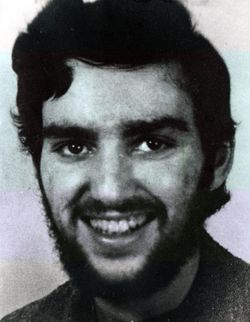
Michael James “Mickey” Devine, a founding member of the Irish National Liberation Army (INLA) and participant in the 1981 Irish hunger strike, dies in Maze Prison on August 20, 1981, the tenth and last of the hunger strikers to die.

Devine, also known as “Red Mickey” because of his red hair, is born into a family from the Springtown Camp, on the outskirts of Derry, a former United States military base from the World War II. In 1960, when he is six years of age, the Devine family, including his grandmother, sister Margaret and parents Patrick and Elizabeth, move to the then newly built Creggan estate to the north of Derry city centre. He is educated at Holy Child Primary School and St. Joseph’s Boy’s School, both in the Creggan.

After British soldiers shoot dead two unarmed civilians, Dessie Beattie and Raymond Cusack, Devine joins the James Connolly Republican Club in Derry in July 1971. Bloody Sunday has a deep impact on him. In the early 1970s, he joins the Irish Labour Party and Young Socialists.

Devine helps found the Irish National Liberation Army (INLA) in 1975. In 1976, after an arms raid in County Donegal in the Republic of Ireland, he is arrested in Northern Ireland. He is convicted and sentenced to twelve years in prison. He joins the blanket protest before joining the hunger strike.

Devine participates in a brief hunger strike in 1980, which is called off without fatalities. On June 22, 1981, he joins Joe McDonnell, Kieran Doherty, Kevin Lynch, Martin Hurson, Thomas McElwee and Paddy Quinn on hunger strike at the Maze Prison. He dies on August 20, after sixty days on hunger strike.


Leave a comment

Death of Hunger Striker Kevin Lynch

kevin-lynch

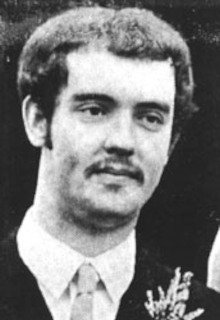
Kevin Lynch, Irish republican hunger striker and member of the Irish National Liberation Army (INLA), dies on August 1, 1981 at Maze Prison in County Down, Northern Ireland following 71 days on hunger strike.

Lynch is born on May 25, 1956 in Park near Dungiven, County Londonderry, Northern Ireland, the youngest in a family of eight children born to Paddy and Bridie Lynch. His older brother, Frank, is an amateur boxer and he also participates in the sport as well as Gaelic football and hurling. He is a member of the winning Dungiven GAC team which wins the Féile na nGael Division 3 in Thurles, County Tipperary in 1971. In 1972 he captains the Derry Hurling team to an Under-16 All-Ireland title at Croke Park in Dublin by defeating the Armagh GAA club.

Lynch stands as a Anti H-Block candidate in the Waterford constituency during the June 1981 general election in the South and polls extremely well despite missing out on election.

Lynch is tried, convicted and sentenced to ten years for conspiracy to obtain arms, taking part in a punishment shooting and conspiring to take arms from the security forces. He is sent to the Maze Prison in County Down in December 1977. He becomes involved with the blanket protest and joins the 1981 hunger strike at the Maze on May 23, 1981. He dies at Maze Prison 71 days later on August 1, 1981.

The Dungiven hurling team is renamed Kevin Lynch’s Hurling Club in his honour following his death.


Leave a comment

The Loughinisland Massacre

CREATOR: gd-jpeg v1.0 (using IJG JPEG v80), quality = 90

The Loughinisland massacre takes place on June 18, 1994, in the small village of Loughinisland, County Down, Northern Ireland. Members of the Ulster Volunteer Force (UVF), a loyalist paramilitary group, burst into a pub with assault rifles and fire on the customers, killing six civilians and wounding five. The pub is targeted because it is frequented mainly by Catholics. The UVF claims the attack is retaliation for the killing of three UVF members by the Irish National Liberation Army (INLA) two days earlier.

About 24 people are gathered in The Heights Bar, also known as O’Toole’s Pub, watching the Republic of Ireland vs. Italy in the 1994 FIFA World Cup. It is thus sometimes referred to as the “World Cup massacre.”

At 10:10 PM, two UVF members wearing boilersuits and balaclavas walk into the bar. One shouts “Fenian bastards!” and opens fire on the crowd with a vz. 58 assault rifle, spraying the small room with more than sixty bullets. Six men are killed outright, and five other people are wounded. Witnesses say the gunmen then run to a getaway car, “laughing.” One witness describes “bodies … lying piled on top of each other on the floor.” The dead were Adrian Rogan (34), Malcolm Jenkinson (52), Barney Green (87), Daniel McCreanor (59), Patrick O’Hare (35) and Eamon Byrne (39), all Catholic civilians. O’Hare is the brother-in-law of Eamon Byrne and Green is one of the oldest people to be killed during the Troubles.

The UVF claims responsibility within hours of the attack. It claims that an Irish republican meeting was being held in the pub and that the shooting was retaliation for the INLA attack. Police say there is no evidence the pub had links to republican paramilitary activity and say the attack is purely sectarian. Journalist Peter Taylor writes in his book Loyalists that the attack may not have been sanctioned by the UVF leadership. Police intelligence indicates that the order to retaliate came from the UVF leadership and that its ‘Military Commander’ had supplied the rifle used. Police believe the attack was carried out by a local UVF unit under the command of a senior member who reported to the leadership in Belfast.

The attack receives international media coverage and is widely condemned. Among those who send messages of sympathy are Pope John Paul II, Queen Elizabeth II and United States President Bill Clinton. Local Protestant families visit their wounded neighbours in the hospital, expressing their shock and disgust.

There have been allegations that police (Royal Ulster Constabulary) double agents or informants in the UVF were linked to the massacre and that police protected those informers by destroying evidence and failing to carry out a proper investigation. At the request of the victims’ families, the Police Ombudsman for Northern Ireland investigate the police. In 2011 the Ombudsman concludes that there were major failings in the police investigation, but no evidence that police colluded with the UVF. The Ombudsman does not investigate the role of informers and the report is branded a whitewash. The Ombudsman’s own investigators demand to be disassociated from it. The report is quashed, the Ombudsman replaced, and a new inquiry ordered.

In 2016, a new Ombudsman report concludes that there had been collusion between the police and the UVF, and that the investigation was undermined by the wish to protect informers but found no evidence police had foreknowledge of the attack. A documentary film about the massacre, No Stone Unturned, is released in 2017. It names the main suspects, one of whom is a member of the British Army and claims that one of the killers was an informer.


Leave a comment

Death of IRA Blanket Protester Kieran Nugent

kieran-nugent

Kieran Nugent, volunteer in the Provisional Irish Republican Army, dies from a heart attack on May 4, 2000. He is best known for being the first person to start the blanket protest against the British Government’s treatment of republican prisoners.

Born in 1958, Nugent’s adolescence comes at a time when Northern Ireland is exploding into turmoil. On March 20, 1973, at the age of 15, he is standing with a friend on the corner of Merrion Street and Grosvenor Road when a car pulls up beside them and one of the occupants asks them for directions. Another occupant of the vehicle then opens fire with a submachine gun. Nugent is seriously wounded after being shot eight times in the chest, arms and back by the Ulster loyalists in the car. His friend, Bernard McErlean, aged 16, is killed.

At some point afterwards, Nugent joins the Provisional IRA. At the age of sixteen he is arrested by the British Army and spends five months on remand in Crumlin Road Gaol. When he is eventually tried, the case against him is withdrawn and he is released. He becomes an active volunteer until his arrest and internment, without trial, on February 9, 1975.

Nugent spends nine months in Cage 4 at the Long Kesh Detention Centre until November 12, 1975. He is arrested and imprisoned again on May 12, 1976, following the hijacking of a bus. On September 14, 1976, he is sentenced to three years and becomes the first Republican prisoner convicted since the withdrawal of Special Category Status for those convicted through juryless courts, due to the new British policy of ‘criminalisation’ introduced that March. Among other things, this change in policy means convicted paramilitaries can no longer wear their own clothes. Viewing himself as a political prisoner and not a criminal, he refuses to wear the uniform saying the prison guards would have to “…nail it to my back.” This begins the blanket protest.

Nugent is soon joined by Jackie McMullan, the next prisoner to don the blanket, followed by six more Irish republican prisoners from the Beechmount area of Belfast. By Christmas 1976 the number of participants has risen to over forty prisoners. Most incoming republican prisoners emulate Nugent, and this starts five years of prison protests in pursuit of political status, which culminates in the 1981 Irish hunger strike and the death of eleven, including seven IRA and three Irish National Liberation Army prisoners.

Nugent, the father of four, is found dead of a heart attack at his home in Anderstown, Belfast on May 4, 2000.


Leave a comment

Birth of Patsy O’Hara, Republican Hunger Striker

patsy-o-hara

Patsy O’Hara, Irish republican hunger striker and member of the Irish National Liberation Army (INLA), is born on July 11, 1957, in Bishop Street, Derry, County Londonderry, Northern Ireland.

O’Hara joins Na Fianna Éireann in 1970 and, in 1971, his brother Sean is interned in Long Kesh Prison. In late 1971, at the age of 14, he is shot and wounded by a soldier while manning a barricade. Due to his injuries, he is unable to attend the civil rights march on Bloody Sunday but watches it go by him in the Brandywell Stadium, and the events of the day have a lasting effect on him.

In October 1974, O’Hara is interned in Long Kesh Prison, and upon his release in April 1975 he joins the Irish Republican Socialist Party (IRSP) and INLA. He is arrested in Derry in June 1975 and held on remand for six months. In September 1976, he is arrested again and once more held on remand for four months.

On May 10, 1978, O’Hara is arrested on O’Connell Street in Dublin under section 30 of the Offences Against the State Act and is released eighteen hours later. He returns to Derry in January 1979 and is active in the INLA. On May 14, 1979, he is arrested and is convicted of possessing a hand grenade. He is sentenced to eight years in prison in January 1980.

O’Hara becomes Officer Commanding of the INLA prisoners at the beginning of the first hunger strike in 1980, and he joins the 1981 strike on March 22.

On Thursday, May 21, 1981, at 11:29 PM, Patsy O’Hara dies after 61 days on hunger strike, at the age of 23. In accordance with his wishes, his parents do not get him the medical intervention needed to save his life. His corpse is found to be mysteriously disfigured prior to its departure from prison and before the funeral, including signs of his face being beaten, a broken nose, and cigarette burns on his body.

O’Hara’s mother, Peggy O’Hara, is a candidate in the 2007 Northern Ireland Assembly election in the Foyle constituency. She is not elected, but she is one of the more successful dissident republican candidates opposed to the new policy of the Sinn Féin leadership of working with the Police Service of Northern Ireland (PSNI) and wins 1,789 votes. On the eve of the election, over 330 former republican prisoners write a letter to the Derry Journal endorsing her campaign.


Leave a comment

Assassination of Billy “King Rat” Wright

billy-wright

Billy “King Rat” Wright, prominent Ulster loyalist death squad leader during the ethno-nationalist conflict in Northern Ireland known as the Troubles, is murdered on December 27, 1997, in HM Prison Maze by three members of the Irish National Liberation Army (INLA) who manage to smuggle guns into the prison.

William Stephen “Billy” Wright, named after his grandfather, is born in Wolverhampton, England on July 7, 1960, to David Wright and Sarah McKinley, Ulster Protestants from Portadown, Northern Ireland. The family returns to Northern Ireland in 1964. While attending Markethill High School, Wright takes a part-time job as a farm labourer where he comes into contact with a number of staunchly unionist and loyalist farmers who serve with the Royal Ulster Constabulary (RUC) Reserve or the Ulster Defence Regiment (UDR). The conflict known as the Troubles has been raging across Northern Ireland for about five years by this stage, and many young men such as Wright are swept up in the maelstrom of violence as the Provisional Irish Republican Army ramps up its bombing campaign and sectarian killings of Catholics by loyalists continue to escalate. During this time his opinions move towards loyalism and soon he gets into trouble for writing the initials “UVF” on a local Catholic primary school wall. When he refuses to clean off the vandalism, he is transferred from the area and sent to live with an aunt in Portadown.

Wright joins the Ulster Volunteer Force (UVF) in 1975. After spending several years in prison and becoming a born-again Christian, he resumes his UVF activities and becomes commander of its Mid-Ulster Brigade in the early 1990s, taking over from Robin “the Jackal” Jackson. According to the Royal Ulster Constabulary, he is involved in the sectarian killings of up to 20 Catholics, although he is never convicted for any. It is alleged that Wright, like his predecessor, is an agent of the RUC Special Branch.

Wright attracts considerable media attention during the Drumcree standoff, when he supports the Protestant Orange Order‘s desire to march its traditional route through the Catholic/Irish nationalist area of his hometown of Portadown. In 1994, the UVF and other paramilitary groups call ceasefires. However, in July 1996, Wright’s unit breaks the ceasefire and carries out a number of attacks, including a sectarian killing. For this, Wright and his Portadown unit of the Mid-Ulster Brigade are stood down by the UVF leadership. He is expelled from the UVF and threatened with execution if he does not leave Northern Ireland. He ignores the threats and, along with many of his followers, defiantly forms the breakaway Loyalist Volunteer Force (LVF), becoming its leader.

The LVF carries out a string of killings of Catholic civilians. In March 1997 Wright is sent to the HM Prison Maze for having threatened the life of a woman. While imprisoned, Wright continues to direct the LVF’s activities. On the morning of December 27, 1997, he is assassinated inside the prison by three INLA volunteers – Christopher “Crip” McWilliams, John “Sonny” Glennon and John Kennaway – armed with two smuggled pistols, a FEG PA-63 semi-automatic and a .22 Derringer. The LVF carries out a wave of sectarian attacks in retaliation. There is speculation that the authorities collude in his killing as he is a threat to the peace process. An inquiry finds no evidence of this but concludes there are serious failings by the prison authorities.

Owing to his uncompromising stance as an upholder of Ulster loyalism and opposition to the Northern Ireland peace process, Wright is regarded as a cult hero, icon, and martyr by hardline loyalists. His image adorns murals in loyalist housing estates and many of his devotees have tattoos bearing his likeness. His death is greeted with relief and no little satisfaction, however, from the Irish nationalist community.