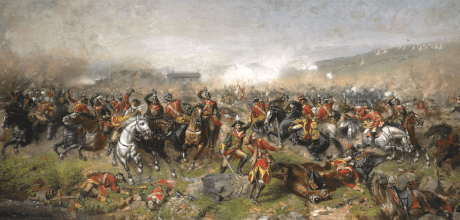
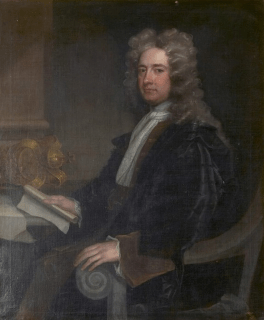
Talbot is born likely in 1630, probably in Dublin. He is one of sixteen children, the youngest of eight sons of William Talbot and his wife Alison Netterville. His father is a lawyer and the 1st Baronet Talbot of Carton, County Kildare. His mother is a daughter of John Netterville of Castletown, Kildare. The Talbots are descended from a Norman family that had settled in Leinster in the 12th century. They adhere to the Catholic faith, despite the founding of the Reformed Church of Ireland under Henry VIII. Little is recorded of Talbot’s upbringing. As an adult he grows to be unusually tall and strong by standards of the time.
Talbot marries Katherine Baynton in 1669, and they have two daughters, Katherine and Charlotte. Katherine dies in 1679. In 1681, he marries Frances Jennings, sister of Sarah Jennings, the future Sarah Churchill, Duchess of Marlborough.
Talbot’s early career is spent as a cavalryman in the Irish Confederate Wars. Following a period on the European continent, he joins the court of James, Duke of York, then in exile following the English Civil War, becoming a close and trusted associate. After the 1660 restoration of James’s older brother, Charles, to the thrones of England, Ireland and Scotland, he begins acting as agent or representative for Irish Catholics attempting to recover estates confiscated after the Cromwellian conquest, a role that defines the remainder of his career. James converts to Catholicism in the late 1660s, strengthening his association with Talbot.
When James takes the throne in 1685, Talbot’s influence increases. He oversees a major purge of Protestants from the Irish Army, which had previously barred most Catholics. James creates him Earl of Tyrconnell and later makes him Viceroy, or Lord Deputy of Ireland. He immediately begins building a Catholic establishment by admitting Catholics to many administrative, political and judicial posts.
Talbot’s efforts are interrupted by James’s 1688 deposition by his Protestant son-in-law William of Orange. He continues as a Jacobite supporter of James during the subsequent Williamite War in Ireland, but also considers a peace settlement with William that would preserve Catholic rights. Increasingly incapacitated by illness, he dies of a stroke on August 14, 1691, shortly before the Jacobite defeat. He is thought to have been buried in St. Mary’s Cathedral, Limerick. By depriving the Jacobites of their most experienced negotiator, his death possibly has a substantial impact on the terms of the Treaty of Limerick that ends the war.
Talbot’s widow, Frances, and his daughter, Charlotte, remain in France, where Charlotte marries her kinsman, Richard Talbot, son of William Talbot of Haggardstown. Their son is Richard Francis Talbot. Talbot’s other daughter, Katherine, becomes a nun. An illegitimate son, Mark Talbot, serves as an officer in France before his death in the Battle of Luzzara in 1702. Talbot’s estate in nearby Carton, renamed Talbotstown, is uncompleted at the time of his death. Tyrconnell Tower on the site is originally intended by him as a family mausoleum to replace the existing vault at Old Carton graveyard but is also left unfinished.
Talbot is controversial in his own lifetime. His own Chief Secretary, Thomas Sheridan, later describes him as a “cunning dissembling courtier […] turning with every wind to bring about his ambitious ends and purposes.” Many 19th and early 20th century historians repeat this view. Recent assessments have suggested a more complex individual whose career was defined by personal loyalty to his patron James and above all by an effort to improve the status of the Irish Catholic gentry, particularly the “Old English” community to which he belonged.
(Pictured: Watercolour portrait of Richard Talbot by John Bulfinch (d.1728) after painting by Sir Godfrey Kneller)
Ahern is urged by Paisley to ensure that criminals who flee across the Irish border are arrested. The Democratic Unionist leader makes the proposal during a cordial one-and-a-half-hour meeting at Farmleigh in Phoenix Park, where the two leaders exchange their first public handshake.
Afterwards Paisley, who receives an invitation from the taoiseach to visit the Battle of the Boyne site later in the year, says that they had also discussed the need for the new administrations in Northern Ireland and in the Republic of Ireland to work for each other’s best interests. “We can confidently state that we are making progress to ensure our two countries can develop and grow side by side in the spirit of generous cooperation,” he declares. “I trust that old barriers and threats will be removed in my day. Business opportunities are flourishing. Genuine respect for the understanding of each other’s differences and, for that matter, similarities is now developing.”
Earlier the DUP leader, who becomes the First Minister of the new power-sharing government on May 8 alongside Sinn Féin‘s Martin McGuinness as deputy First Minister, firmly shakes the hand of Ahern in public for the first time. As he arrives at Farmleigh, he quips, “I better shake the hands of this man. I’ll give him a firm handshake.”
Paisley, who is accompanied by his son, Ian Paisley, Jr., affectionately grabs the taoiseach by the shoulder. There is another handshake after the meeting at Farmleigh is finished.
Paisley says, “Mr. Ahern has come to understand me as an Ulsterman of plain speech. He didn’t ever need a dictionary to find out what I was saying. We engaged in clear and plain speech about our hopes and our aspirations for the people we both serve. The prime minister kindly congratulated me on my election victory.”
Paisley says that he had raised a number of issues crucial to unionists. “I have taken the opportunity to raise with the prime minister a number of key matters including ensuring that fugitives from justice who seek to use the border to their advantage are quickly apprehended and returned without protracted legal wrangle.” He adds, “I raised other legal issues of interests to unionists, and we discussed cooperation of an economic nature that will be to our mutual benefit.” He also says he had raised the issue of bringing Northern Ireland’s corporation tax into line with that of Ireland.
Regarding the invitation to visit the site of the Battle of the Boyne, Paisley says, “We both look forward to the visit to the battle site at the Boyne… Not to refight it, because that would be unfair, for he would have the home advantage. No Ulsterman ever gives his opponents an advantage. He adds, “Such a visit would help to demonstrate how far we have come when we can celebrate and learn from the past, so the next generation more clearly understands.”
Ahern pays tribute to the leadership shown by Paisley in helping to deliver a better future for the people of Northern Ireland. As Northern Ireland’s politicians continue at great pace to prepare for the return of power sharing, the taoiseach says that the progress has been very encouraging. “At this important time in our history, we must do our best to put behind us the terrible wounds of our past and work together to build a new relationship between our two traditions,” he says. “That new relationship can only be built on a basis of open dialogue and mutual respect. I fervently believe that we move on from here in a new spirit of friendship. The future for this island has never been brighter. I believe that this is a future of peace, reconciliation and rising prosperity for all. We stand ready to work with the new executive. We promise sincere friendship and assured cooperation. I believe that we can and will work together in the interests of everyone on this island.”
Ahern says he believes that the Battle of the Boyne site can be a symbol of the new beginning in the relationship between governments in Belfast and Dublin. “I believe that this site can become a valuable and welcome expression of our shared history and a new point of departure for an island, north and south, which is at ease with itself and respectful of its past and all its traditions,” he declared.
The Battle of the Boyne was fought in 1690 between the followers of England‘s King William of Orange, a Protestant, and the deposed King James, a Catholic, in Drogheda, eastern Ireland. Ireland was at that point under English rule. The battle is commemorated by many Northern Irish loyalists on July 12 each year.
Ministerial posts within the new devolved Stormont government have yet to be finalised. Already Sinn Féin has announced that MPs Michelle Gildernew and Conor Murphy and assembly members Gerry Kelly and Caitríona Ruane will be members of the government. However, the party has not yet indicated which of the four will take the three senior cabinet posts in education, agriculture and regional development and which one will be the junior minister in the Office of First and Deputy First Minister.
The DUP has also yet to name its ministers, but it has chosen finance, economy, environment and culture arts and leisure as the government departments it will head. The DUP’s deputy leader, Peter Robinson, and Nigel Dodds, the Belfast North MP, who both served in the last devolved government, are tipped to be the finance and economy ministers.
The Ulster Unionist Party (UUP) has yet to declare who their two ministers will be at the Departments of Health and Employment and Learning.
(From: “Upbeat Paisley shares first handshake with Irish PM” by Hélène Mulholland and agencies, The Guardian, http://www.theguardian.com, April 4, 2007)
In January and February 1689, Butler votes against the motion to put William of Orange and Mary on the throne and against the motion to declare that James II has abdicated it. Nevertheless, he subsequently joins the forces of William of Orange, by whom he is made colonel of the 2nd Troop of Horse Guards on April 20, 1689. He accompanies William in his Irish campaign, debarking with him in Carrickfergus on June 14, 1690, and commands this troop at the Battle of the Boyne in July 1690. In February 1691 he becomes Lord Lieutenant of Somerset.
Butler serves on the continent under William of Orange during the Nine Years’ War and, having been promoted to major general, he fights at the Battle of Steenkerque in August 1692 and the Battle of Landen in July 1693, where he is taken prisoner by the French and then exchanged for the Duke of Berwick, James II’s illegitimate son. He is promoted to lieutenant general in 1694.
Butler plays a dramatic role at the notorious meeting of the Privy Council on March 8, 1711, when Antoine de Guiscard, a French double agent who is being questioned about his treasonable activities, attempts to assassinate Robert Harley, 1st Earl of Oxford, against whom he has a personal grudge for drastically cutting his allowance, by stabbing him with a penknife. Harley is wounded, but not seriously, due largely to the fact that he is wearing a heavy gold brocade waistcoat in which the knife gets stuck. Several Councillors, including Butler, stab Guiscard in return. Guiscard implores Butler to finish the deed, but he replies that it is not for him to play the hangman. In any case, he has the sense to see that Guiscard must be kept alive at least long enough to be questioned, although as it turns out Guiscard’s wounds are fatal, and he dies a week later.
On April 23, 1712, Butler leaves Harwich for Rotterdam to lead the British troops taking part in the war. Once there he allows himself to be made the tool of the Tory ministry, whose policy is to carry on the war in the Netherlands while giving secret orders to him to take no active part in supporting their allies under Prince Eugene. In July 1712, he advises Prince Eugene that he can no longer support the siege of Le Quesnoy and that he is withdrawing the British troops from the action and instead intends to take possession of Dunkirk. The Dutch are so exasperated at the withdrawal of the British troops that they close the towns of Bouchain on Douai to British access, despite the fact that they have plenty of stores and medical facilities available. Butler takes possession of Ghent and Bruges as well as Dunkirk, in order to ensure his troops are adequately provided for. On April 15, 1713, he becomes Lord Lieutenant of Norfolk.
Ormonde’s position as Captain-General makes him a personage of much importance in the crisis brought about by the death of Queen Anne and, during the last years of Queen Anne, he almost certainly has Jacobite leanings and corresponds with the Jacobite Court including his cousin, Piers Butler, 3rd Viscount Galmoye, who keeps barrels of gunpowder at Kilkenny Castle. King George I, on his accession to the throne in August 1714, institutes extensive changes and excludes the Tories from royal favour. Butler is stripped of his posts as Captain-General, as colonel of the 1st Regiment of Foot Guards and as Commander in Chief of the Forces with the first two posts going to the Duke of Marlborough and the role of Commander-in-Chief going to John Dalrymple, 2nd Earl of Stair. On November 19, 1714, Butler is instead made a member of the reconstituted Privy Council of Ireland.
Accused of supporting the Jacobite rising of 1715, Butler is impeached for high treason by Lord Stanhope on June 21, 1715. He might avoid the impending storm of Parliamentary prosecution, if he remains in England and stands trial but instead, he chooses to flee to France in August 1715 and initially stays in Paris with Lord Bolingbroke. On August 20, 1715, he is attainted, his estate forfeited, and honours extinguished. The Earl Marshal is instructed to remove the names and armorial bearings of Butler and Bolingbroke from the list of peers and his banner as Knight of the Garter is taken down in St. George’s Chapel.
On June 20, 1716, the Parliament of Ireland passes an act extinguishing the regalities and liberties of the county palatine of Tipperary; for vesting Butler’s estate in the crown and for giving a reward of £10,000 for his apprehension, should he attempt to land in Ireland. But the same parliament passes an act on June 24, 1721, to enable his brother, Charles Butler, 1st Earl of Arran, to purchase his estate, which he does accordingly.
Butler subsequently moves to Spain where he holds discussions with Cardinal Giulio Alberoni. He later takes part in a Spanish and Jacobite plan to invade England and puts James Francis Edward Stuart on the British throne in 1719, but his fleet is disbanded by a storm in the Bay of Biscay. In 1732, he moves to Avignon, where he is seen in 1733 by the writer Lady Mary Wortley Montagu. He dies at Avignon in exile on November 16, 1745, but his body is returned to London and buried in Westminster Abbey on May 22, 1746.
On July 20, 1682, Butler, then called Lord Ossory, marries Lady Anne Hyde, daughter of Laurence Hyde, who is then Viscount Hyde of Kenilworth but becomes Earl of Rochester in November. The couple has a daughter, Mary, who dies young in 1688.
Following the death of his first wife in 1685, Butler plans to marry again in order to secure a male heir. He gains permission from the House of Lords for the arranging of a jointure for another marriage in May 1685, and in August of that year, he marries Lady Mary Somerset, daughter of the Duke of Beaufort and Mary Capel. The couple has a son, Thomas (1686–1689), and two daughters, Elizabeth (1689–1750) and Mary (1690–1713). His second wife is a Lady of the Bedchamber to Queen Anne. Their younger daughter, Mary, marries John Ashburnham, 1st Earl of Ashburnham.
(Pictured: Portrait of James Butler, 2nd Duke of Ormonde, by Michael Dahl, National Portrait Gallery)
He has been invited by the Protestant noblemen of the country to come and usurp the English throne. Led by Lord Monmouth, a group of Protestant nobles have unsuccessfully attempted to prevent the Catholic James from ascending to the throne on the death of Charles II in 1685. Since then, James has been disturbing the Protestant noblemen who have remained loyal to him in 1685 by giving Catholics more and more freedoms in both England and Ireland.
On May 7, 1688, James II issues a “Declaration of Indulgence” pledging religious toleration. Still the Protestant nobles are comforted by the fact that all the possible heirs to James are Protestant. Thus the country will be safely returned to a Protestant monarch in time and many of James’ reforms will be reversed. All that changes on June 10, 1688, when the Queen gives birth to a male heir, one who is to be raised as a Catholic.
Soon thereafter, an invitation is sent across to William, who is married to James’ sister Mary, to come and save England for Protestantism. This, William is more than happy to do, for Louis XIV of France is threatening to invade the Netherlands and what better way to ensure the support of England in that coming war than to become the King of that country.
The “Glorious Revolution,” as the British would come to call it, is now underway. In less than two months, James II flees for his life and goes into exile in France, never to return. For the native population of Ireland, the eventual results of this revolution are far from “glorious.” The results are death, destruction, poverty, hundreds of years of second-class citizenship in their own land, and a legacy of hatred between Protestant and Catholic in the north of Ireland that persists to this day.
(Pictured: “William III Landing at Brixham, Torbay, 5 November 1688” by Jan Wyck, National Maritime Museum)
Levinge is the second son of Richard Levinge of Parwich Hall, Derbyshire, Recorder of Chester, and Anne Parker, daughter of George Parker of Staffordshire and his wife Grace Bateman. The Levinges (sometimes spelled “Levin”) are a long-established Derbyshire family with a tradition of public service. Through his mother he is a first cousin of Thomas Parker, 1st Earl of Macclesfield, Lord High Chancellor of Great Britain.
Levinge is one of the first to declare for William III of England at the Glorious Revolution and is sent by the new Government to Ireland as Solicitor-General in 1689. In 1692 he is elected as a member of the Irish House of Commons for Belfast and for Blessington, but chooses to sit for Blessington, a seat he holds until 1695. During this time, he serves as Speaker of the Irish House of Commons. In politics he is a moderate Tory, noted throughout his career for his desire to conciliate. In an age of bitter political faction this earns him the uncharitable nickname “Tom Double.” Although he supports the Penal Laws, as no Irish officeholder then could do otherwise, he is very tolerant in religious matters and has several Roman Catholic friends, including his predecessor as Solicitor-General, Sir Theobald Butler.
Levinge later represents Longford Borough from 1698 to September 1713 and Kilkenny City from 1713 to November 1715 in the Irish Parliament. In 1713 he is also returned for Gowran but chooses to sit for Kilkenny. He is created a Baronet of High Park in the County of Westmeath, in the Baronetage of Ireland on October 26, 1704.
Levinge had expressed his interest in being appointed to the English Bench but meets with no success in his efforts to achieve office in England. Under George I of Great Britain, despite being of the “wrong” political persuasion, and his growing age, his famous moderation, and his 30 years’ experience of Irish public life make him acceptable as an Irish judge to the Government, in which he has a powerful supporter in his cousin Lord Macclesfield. In 1721 he becomes Chief Justice of the Irish Common Pleas for Ireland and a member of the Privy Council of Ireland. He complains bitterly of the poor quality of his junior judges, and asks for suitable replacements, although he complains equally about some of those whose names are put forward as possible replacements. Despite being in great pain from gout in his last years, he remains on the Bench until his death on July 13, 1724.
Levinge divides his time between his ancestral home, Parwich Hall, which he purchases from his childless elder brother, and his newly acquired property Knockdrin Castle, County Westmeath. Most of his estates passes to his eldest son, who extensively rebuilds Parwich.
(Pictured: Knockdrin Castle, County Westmeath, the main Levinge residence in Ireland)
Clare Marsh, still life and portrait artist, is born Emily Cecil Clare Marsh on January 13, 1875, at New Court, Bray, County Wicklow, the house of her maternal grandfather, Andrew McCullagh, a wine merchant.
Marsh’s parents are Arthur and Rachel Marsh (née McCullagh). She has four siblings. Her family is descended from the Anglo-Irish aristocracy, specifically from Francis Marsh of Edgeworth, Gloucestershire, with his wife the great-aunt of James II‘s first wife. The family later moves to Raheen, Clondalkin, and later to Cappaghmore, Clondalkin. There is little information about her early life although she is involved in the suffrage movement.
Marsh meets Mary Swanzy at Mary Manning‘s art classes, with Swanzy remembering Marsh as being from “a background of impecuniosity, which did not apparently worry them in spite of a more affluent upbringing.” She is influenced artistically by her aunt and John Butler Yeats, with whom she becomes close friends. In the summer of 1898, Yeats paints Marsh’s portrait at Manning’s studio. She is more drawn to the work of Yeats than of his son, Jack, and models her portraits on that of the older Yeats. He mentors her, encouraging her to see other artists’ work as much as possible and saying, “to produce a picture will force you to think.” He urges her to paint more industriously. She exhibits with the Royal Hibernian Academy (RHA) for the first time in 1900 with East wind effect and Roses. Yeats later claims that Marsh helped him with “line drawing or sketching, by putting him on the track of bulk drawing.”
Alongside Manning’s classes, Marsh takes night classes in sculpture with John Hughes and Oliver Sheppard at the Metropolitan School of Art. Aside from a trip to Paris in 1910 or 1911, she is taught exclusively in Dublin throughout her 20s. She takes a course at Norman Garstin‘s studio in Penzance, and stays in North Wales in 1914, painting two Trearddur Bay scenes. She paints still life and portraits, including one of Lily Yeats. It appears that her portraits of children and dogs are popular based on her submitted works to the RHA, exhibiting without a break from 1900 to 1921. The Hugh Lane Gallery holds her portrait of Lord Ashbourne, which demonstrates her painting style of loose brush strokes with an air of informality. Yeats suggests that she spend some time in the United States, where he is living at the time. She spends two months in New York City, staying with cousins at White Plains and then moves into a room neighbouring that of Yeats in Petitpas. Her uncle strongly disproves of this living arrangement, so she leaves and returns to Ireland in January 1912, which upsets Yeats greatly.
Upon her return from New York, Marsh starts holding classes at her studio at South Anne Street which Swanzy recalls are “well liked and always full,” with Susan Yeats becoming a pupil. She becomes the Professor of Fine Arts at Alexandra College in 1916. In the same year, she paints the fires and destruction of the 1916 Easter Rising. She paints a portrait of Jack Butler Yeats in 1918, which is now held by the Highlanes Gallery. John Butler Yeats later sympathises with her in a letter that she and other women are not elected members of the RHA. Knowing that Yeats is in financial difficulty, she sells some of his drawings and sends the money to him. It appears that over time, she works more with colour, as demonstrated in her portrait of Susan Yeats. Her final paintings are night studies, some of which show a possible influence from Swanzy with whom she shares a studio in the autumn of 1920. She is also believed to be one of the founding members of the Society of Dublin Painters.
Marsh dies on May 5, 1923. A posthumous exhibition of her work is held in October 1923. Due to her early death, she largely falls into obscurity until one of her works is included in the 1987 “Irish Women Artists from the Eighteenth Century to the Present Day” exhibition and publication from the National Gallery of Ireland. The National Gallery of Ireland holds a selection of sketches and paintings by Marsh, and a sketch of her by Swanzy. She is included in an exhibition of art by women artists at the Highlanes Gallery in 2012.
(Pictured: “Self-Portrait” by Clare Marsh, oil on canvas, circa 1900, National Gallery of Ireland)
Henry Luttrell, Irish soldier known for his service in the Jacobite cause, is murdered in Dublin on October 22, 1717, a case that has never been solved. A career soldier, he serves James II in England until his overthrow in 1688. In Ireland he continues to fight for James, reaching the rank of General in the Irish Army.
Luttrell is born in 1655, the second son of Thomas Luttrell of Luttrellstown Castle in County Dublin, an Irish landowner of Catholic heritage. He spends his early life on the Continent, where he kills the so-called 3rd Viscount Purbeck in a duel at Liège.
Following the disintegration of the English Army and William’s capture of London, Luttrell goes to Ireland. He joins the Irish Army under the command of Richard Talbot, 1st Earl of Tyrconnell, which has remained loyal to James and is undergoing a major expansion. He and other Catholic officers flock to the army, while Protestants are purged. Protestant inhabitants in Ireland rise, proclaiming their loyalty to William of Orange. While an uprising at Bandon in County Cork is quickly put down, a lengthy Siege of Derry begins. He is given command of a cavalry regiment. He also sits in the Patriot Parliament called by King James, as a representative for County Carlow.
In 1689 Luttrell is made Governor of Sligo, which had recently been recaptured from the enemy by Patrick Sarsfield. He immediately sets about improving the town’s fortifications. He is a friend and supporter of Sarsfield and backs his policy of continued resistance following the Jacobite defeat the Battle of the Boyne in 1690.
Luttrell’s precipitate withdrawal with the cavalry of the left flank at the Battle of Aughrim gives rise to suspicions of disloyalty. During the Siege of Limerick, he is found to be in correspondence with the besiegers, and scarcely escapes hanging, bringing his regiment of horse over to the Williamite side after the surrender of the city. As a reward, he receives the forfeited estates of his elder brother, Simon Luttrell, including Luttrellstown, and is made a major general in the Dutch army.
Luttrell attempts to deprive his brother’s widow, Catherine, of her jointure by discreditable means, but is ultimately obliged to yield it to her.
On October 13, 1704, Luttrell marries Elizabeth Jones and has two sons: Robert Luttrell (d. 1727), and Simon Luttrell, 1st Earl of Carhampton (1713–1787).
Luttrell is shot and mortally wounded in his sedan chair on the night of October 21, 1717, on the Blind-quay in Dublin as he is proceeding from Lucas’ Coffee House on Cork-hill to his house in Stafford Street. He dies the following day, at the age of sixty-three. Despite large rewards, the murderers are never apprehended.
His grandson, Henry Luttrell, 2nd Earl of Carhampton, sells Luttrellstown Castle which the family had owned for almost 600 years in 1800. After Luttrellstown Castle is sold Luttrell’s grave is opened and the skull smashed.
(Pictured: Depiction of the Battle of Aughrim (1691) by John Mulvany (c. 1839 – 1906). Luttrell’s conduct during the 1691 battle becomes a subject of historical debate.)
William Conolly, Irish politician, Commissioner of Revenue, lawyer and landowner also known as Speaker Conolly, resigns as Speaker of the Irish House of Commons on October 13, 1729, on grounds of ill health. Sir Ralph Gore is elected unanimously in his place. His name is spelled Conolly rather than the more familiar Connolly, derived ultimately from the Gaelic surname “Ó Conghalaigh.”
Conolly is born on April 9, 1662, in Ballyshannon, County Donegal, the son of an innkeeper, Patrick Conolly. His father is a native of County Monaghan, and a descendant of the Ó Conghalaigh clan of Airgíalla, who settles in County Donegal, embraces the Anglican Church, and has children William, Patrick, Hugh, Phelim and Thady. His father sets aside enough money that he is able to send Conolly to Dublin to study law. He qualifies as an attorney in 1685, aged twenty-three.
Conolly practises as a lawyer in Dublin and in 1694 he marries Katherine Conyngham, daughter of General Sir Albert Conyngham. The Conynghams are an Ulster Scots family who are originally from Mountcharles in County Donegal. The family later settles at Slane Castle in County Meath in the 1780s, where the Conynghams still reside. They have no children, and on Katherine’s death in 1752 the estates are inherited by William James Conolly, his nephew by his brother Patrick.
Conolly makes his fortune from land transfers, following the confiscations by the Crown of lands belonging to supporters of King James II, in the wake of the Glorious Revolution and the accession of William III and Mary II in 1688–91, known as the “Williamite War in Ireland.” About 600,000 Irish acres are confiscated to be sold to pay for the costs of the war, nearly 5% of the land area of Ireland. Conolly is the largest individual buyer, in particular buying 3,300 acres in County Meath that had been assigned to the Earl of Albemarle.
Conolly builds the first winged Palladian house in Ireland, Castletown House in Celbridge, County Kildare, starting in 1722, and specifies that every part of it has to be made from Irish materials. His Dublin townhouse is on Capel Street, then the most fashionable part of the city. He also commissions the former Customs House (now the site of the Clarence Hotel) and the Irish Houses of Parliament, the world’s first building specifically designed as a bicameral parliament.
Conolly is the most important of the “Undertakers,” the managers of Government business in the Irish House of Commons, in the early 18th century. He is associated with the moderate faction of Whigs and is opposed by the Brodrick faction from Cork. He is a Member of Parliament for Donegal Borough from 1692 to 1703 and subsequently for Londonderry County until his death in 1729. In 1703 and 1713, he is also elected for Newtown Limavady and in 1727 for Ballyshannon but chooses each time not to sit.
Conolly is Speaker of the Irish House of Commons and a Commissioner of the Revenue from 1715 to his death in 1729. He is re-elected as Speaker of the House of Commons in the first session of George II‘s parliament and continues to serve until he collapses in the Commons on September 26, 1729. He is eventually persuaded to resign the Speaker’s chair on October 13, and he dies at his house in Capel Street, Dublin, on October 30. He is buried in Celbridge following a spectacular public funeral, which sees the beginnings of the custom of mourners wearing linen scarves to promote the Irish linen industry.
On his death, the Archbishop of Armagh, Hugh Boulter, estimates Conolly’s income in 1729 at £17,000 p.a. His widow Katherine continues to live in style at Castletown until her death in 1752. She builds the Wonderful Barn and the Conolly Folly in the 1740s. Then their estates pass briefly to William’s nephew William junior, and then on to his great-nephew Thomas Conolly M.P., known as “Squire Tom,” who is married to Lady Louisa Conolly.
A pub in Celbridge, The Speaker’s Bar, is named in his memory. There is also a pub in Firhouse, Dublin, called The Speaker Conolly named after him.
The Battle of Aughrim (Irish: Cath Eachroma), the decisive battle of the Williamite War in Ireland, is fought on July 22, 1691, near the village of Aughrim, County Galway. It is fought between the largely Irish Jacobite army loyal to James II and the forces of William III. The battle is possibly the bloodiest ever fought in the British Isles with 5,000–7,000 people being killed. The Jacobite defeat at Aughrim means the effective end of James’s cause in Ireland, although the city of Limerick holds out until the autumn of 1691.
After heavy mist all morning, Dutch officer Godert de Ginkel, who is leading William’s forces, moves his forces into position by about two o’clock in the afternoon, and both sides cannonade each other for the next few hours. Ginkel planns to avoid fully joining battle until the next day. He orders a probing attack on the Jacobites’ weaker right flank led by a captain and sixteen Danish troopers, followed by 200 of Sir Albert Cunningham‘s 6th (Inniskilling) Dragoons. The Jacobite response demonstrates the strength of their defence, but also means that the attackers are no longer able to break off the engagement as Ginkel had planned. A conference is held at about 4:00 p.m. Ginkel still favours withdrawing, but the Williamite infantry general Hugh Mackay argues for an immediate full-scale attack.
The battle is joined in earnest between five and six o’clock. In the centre, the largely English and Scots regiments under Mackay attempt a frontal assault on Major-GeneralWilliam Dorrington‘s infantry on Kilcommadan Hill. The attackers have to contend with waist-deep water and a tenacious Irish defence of the reinforced hedgelines. They withdraw with heavy losses as the Jacobites pursue them downhill, capturing colonels Thomas Erle and Henry Herbert.
On their left centre, the Williamites advance across low ground exposed to Jacobite fire and take a great number of casualties. The Williamite assault in this area, led by St. John’s and Tiffin’s regiments and the Huguenot foot, is driven back into the bog by the Irish foot fighting with clubbed (reversed) muskets. Many of the attackers are killed or drowned. In the rout, the pursuing Jacobites manage to spike a battery of Williamite guns. The Jacobite regiments of the Royal Irish Regiment of Foot Guards and Gordon O’Neill are said to have fought particularly strongly. The musketry is so intense that “the ridges seemed to be ablaze” according to Andreas Claudianus, a Norwegian fighting with the Danish infantry.
The Jacobite right and centre holding firm, Ginkel tries to force a way across the causeway on the Jacobite left, where any attack would have to pass along a narrow lane covered by Walter Burke’s regiment from their positions in Aughrim castle. Four battalions led by Lieutenant GeneralPercy Kirke secure positions near the castle, following which Sir Francis Compton‘s Royal Horse Guards get across the causeway at the third attempt. Dorrington, having earlier withdrawn two battalions of infantry from this area to reinforce the Jacobite centre, are faced only with weak opposition, reaching Aughrim village. While a force of Jacobite cavalry and dragoons under Henry Luttrell have been tasked with covering this flank, their commander orders them to fall back, following a route now known locally as “Luttrell’s Pass.” He is later alleged to have been in the pay of William, though it seems most probable that Luttrell withdrew as he had little or no infantry support. The cavalry regiments of Henri de Massue, Lanier, Langston and Robert Byerley also cross the causeway, attacking Dorrington’s flank.
Most commentators, even those sympathetic to William, judge that the Irish foot fought exceptionally well. Appearing to believe that the battle could be won, General Charles Chalmot de Saint-Ruhe is heard to shout, “they are running, we will chase them back to the gates of Dublin,” before riding across the battlefield to direct the defence against the Williamite cavalry on his left wing. However, as he rides over to rally his cavalry, he pauses briefly to direct the fire of a battery and is decapitated by a cannonball. His death is said to have occurred around sunset, shortly after eight o’clock.
After Saint-Ruhe’s death the Jacobite leave, devoid of a senior commander, collapse very quickly. The regiment of Horse Guards leave the field almost immediately, followed shortly by the cavalry and dragoon regiments of Luttrell, Dominic Sheldon and Piers Butler. Chevalier de Tessé attempts to head a cavalry counterattack but is seriously wounded shortly afterwards. The Jacobite left flank is now exposed. Mackay and Thomas Tollemache also attack again in the centre, pushing the Jacobites towards the hilltop. Burke and his regiment, still holding the castle, are forced to surrender. Most of the infantry remain unaware of Saint-Ruhe’s death, however, and John Hamilton‘s infantry on the Jacobite right continues to counter-attack, fighting the Huguenot foot to a standstill in an area still known locally as the “Bloody Hollow.” At around nine o’clock towards nightfall the Jacobite infantry is finally pushed to the top of Killcommadan hill and broke, fleeing towards a bog in the left rear of their position, while their cavalry retreat towards Loughrea.
Patrick Sarsfield and Butler briefly try to organise a rearguard action but as in many battles of the period most of the Jacobite casualties occur in the pursuit, which is ended only by darkness and the onset of mist and rain. The defeated infantry is cut down by the Williamite cavalry as they try to get away, many of them having thrown away their weapons in order to run faster.
In addition to the rank and file the Jacobite casualties and prisoners include many of its most experienced infantry officers. The dead include brigadiers Barker, O’Neill and O’Connell, and colonels Moore, Talbot, O’Mahony, Nugent, Felix O’Neil and Ulick Burke, Lord Galway. The two major generals commanding the Jacobite centre, Hamilton and Dorrington, are both taken prisoner, Hamilton dying of wounds shortly afterwards. Though the killing of prisoners to prevent rescue is a common practice at the time, Jacobite soldiers are accused of having “cut to pieces” colonel Herbert after his capture. One contemporary Jacobite source, Charles Leslie, alleges that about 2,000 Jacobites are killed “in cold blood” with many, including Lord Galway and colonel Charles Moore, killed after being promised quarter.
An eyewitness with the Williamite army, George Story, writes that “from the top of the Hill where [the Jacobite] Camp had been,” the bodies “looked like a great Flock of Sheep, scattered up and down the Countrey for almost four Miles round.”
Estimates of the two armies’ losses vary, but they are extremely heavy overall. It is generally agreed that 5,000–7,000 men were killed at Aughrim. Aughrim has been described as “quite possibly the bloodiest battle ever fought in the British Isles,” but earlier medieval battles, although poorly recorded, may rival this battle in casualty numbers. At the time, the Williamites claimed to have lost only 600 and to have killed fully 7,000 Jacobites. Some recent studies put the Williamite losses as high as 3,000, but they are more generally given as between 1,000–2,000, with 4,000 Jacobites killed. Another 4,000 Jacobites deserted, while Ginkel recorded 526 prisoners taken of all ranks. While Ginkel had given word to Dorrington that the captives would be treated as prisoners of war, general officers were instead taken to the Tower of London as prisoners of state, while the majority of the rank and file were incarcerated on Lambay Island where many died of disease and starvation.
Aughrim is the decisive battle of the conflict. The Jacobites lost many experienced officers, along with much of the army’s equipment and supplies. The remnants of the Jacobite army retreat to the mountains before regrouping under Sarsfield’s command at Limerick. Many of their infantry regiments are seriously depleted. The city of Galway surrenders without a fight after the battle, on advantageous terms, while Sarsfield and the Jacobites’ main army surrender shortly afterwards at Limerick after a short siege.
Butlers’s attempts to conclude a peace are blocked by a Catholic faction that advocates complete independence for Ireland. The situation deteriorates further, and in July 1647, he departs from Ireland, leaving the Protestant cause in the hands of the parliamentarians, who had defeated King Charles I in the First English Civil War (1642–46).
Returning to Ireland in September 1648, Butler concludes a peace with the confederacy in January 1649. He then rallies Protestant royalists and Catholic confederates in support of Charles II, son and successor of Charles I. For several months most of Ireland is under his control. But the parliamentarian general Oliver Cromwell lands at Dublin in August 1649 and swiftly conquers the country for Parliament. Butler flees to France and becomes one of Charles II’s closest advisers at his court-in-exile in Paris.
When Charles II returns to England in the Restoration of 1660, Butler, who had urged constitutional rather than military rule, is made commissioner for the treasury and the navy. Appointed Lord Lieutenant of Ireland in 1662, he makes vigorous attempts to encourage Irish commerce and industry. Nevertheless, his enemies at court persuade Charles to dismiss him in 1669. He is restored to royal favour in 1677 and is again appointed Lord Lieutenant of Ireland. Although he is created a duke in the English peerage in 1682, he is recalled from Ireland in 1684 as a result of new intrigues at Charles’s court and because of the determination of James, Duke of York, to strengthen his supporters in Ireland.
Butler dies on July 21, 1688, at the Kingston Lacy estate, Dorset. He is buried in Westminster Abbey on August 4, 1688. His eldest son, Thomas, 6th Earl of Ossory, predeceases him, but Ossory’s eldest son James succeeds as 2nd Duke of Ormonde (1665–1745).
(Pictured: “James Butler, 1st Duke of Ormond,” oil on canvas by William Wissing, National Portrait Gallery)