seamus dubhghaill

Promoting Irish Culture and History from Little Rock, Arkansas, USA


Leave a comment

Birth of Mary Leadbeater, Irish Quaker Author & Diarist

Mary Leadbeater (née Shackleton), Irish Quaker author and diarist, is born in the planned Quaker settlement of BallitoreCounty Kildare, on December 1, 1758. She writes and publishes extensively on both secular and religious topics ranging from translation, poetry, letters, children’s literature and biography. Her accounts of the Irish Rebellion of 1798 provide an insight into the effects of the Rebellion on the community in Ballitore.

Shackleton is the daughter of Richard Shackleton (1726–92) by his second wife, Elizabeth Carleton (1726–66), and granddaughter of Abraham Shackleton, schoolmaster of Edmund Burke. Her parents are Quakers. She keeps a personal diary for most of her life, beginning at the age of eleven and writing in it almost daily. There 55 extant volumes of her diaries in the National Library of Ireland.

Shackleton is educated, and her literary studies are aided by Aldborough Wrightson, a man who had been educated at Ballitore school and had returned to die there. In 1784, she travels to London with her father and pays several visits to Burke’s town house, where she meets Sir Joshua Reynolds and George Crabbe. She also goes to Beaconsfield, and on her return writes a poem in praise of the place and its owner, which is acknowledged by Burke on December 13, 1784, in a long letter. On her way home she visits, at Selby, North Yorkshire, some primitive Quakers whom she describes in her journal.

On January 6, 1791, Shackleton marries William Leadbeater, a former pupil of her father and a descendent of the Huguenot Le Batre and Gilliard families. He becomes a prosperous farmer and landowner in Ballitore. She spends many years working in the village post office and also works as a bonnet-maker and a herbal healer for the village. The couple lives in Ballitore and have six children. Their daughter Jane dies at a young age from injuries sustained after an accident with a wax taper. Another daughter, Lydia, is a friend and possible patron of the poet and novelist Gerald Griffin.

On her father’s death in 1792, Leadbeater receives a letter of consolation from Burke. Besides receiving letters from Burke, she corresponds with, among others, Maria Edgeworth, George Crabbe, and Melesina Trench. On May 28, 1797, Burke writes one of his last letters to her.

Leadbeater describes in detail the effects of the Irish Rebellion of 1798 on the lives of her family and neighbours in Ballitore. She is in Carlow on Christmas Day 1796 attending a Quaker meeting when the news arrives that the French fleet has been seen off Bantry. She describes the troops marching out of the town and the ensuing confusion in Carlow and Ballitore.

Leadbeater’s first literary work, Extracts and Original Anecdotes for the Improvement of Youth, is published anonymously in 1794 in Dublin. It contains an account of the history of Quakerism and several poems on secular and religious subjects.

In 1808, Leadbeater publishes Poems with a metrical version of her husband’s prose translation of Maffeo Vegio‘s Thirteenth Book of the Æneid. She next publishes in 1811 Cottage Dialogues among the Irish Peasantry, of which four editions, with some alterations and additions, appear by 1813. In 1813, she tries to instruct the rich on a similar plan in The Landlord’s Friend. Intended as a sequel to Cottage Dialogues, in which persons of quality are made to discourse on such topics as beggars, spinning-wheels, and Sunday in the village, Tales for Cottagers, which she brings out in 1814 in conjunction with Elizabeth Shackleton, is a return to the original design. The tales illustrate perseverance, temper, economy, and are followed by a moral play, Honesty is the Best Policy.

In 1822, Leadbeater concludes this series with Cottage Biography, being a Collection of Lives of the Irish Peasantry. The lives are those of real persons, and contain some interesting passages, especially in the life of James Dunn, a pilgrim to Lough Derg. Many traits of Irish country life appear in these books, and they preserve several of the idioms of the English-speaking inhabitants of the PaleMemoirs and Letters of Richard and Elizabeth Shackleton … compiled by their Daughter is also issued in 1822. Her Biographical Notices of Members of the Society of Friends who were resident in Ireland appears in 1823, and is a summary of their spiritual lives, with a scanty narrative of events. Her last work is The Pedlars, a Tale, published in 1824.

Leadbeater’s best known work, the Annals of Ballitore, is not printed until 1862, when it is brought out with the general title of The Leadbeater Papers (2 vols.) by Richard Davis Webb, a printer who wants to preserve a description on rural Irish life. It tells of the inhabitants and events of Ballitore from 1766 to 1823, and few books give a better idea of the character and feelings of Irish cottagers, of the premonitory signs of the rebellion of 1798, and the Rebellion itself. The second volume includes unpublished letters of Burke and the correspondence with Mrs. Richard Trench and with Crabbe.

Leadbeater dies at Ballitore on June 27, 1826, and is buried in the Quaker burial-ground there.

Leave a comment

Premiere of Oliver Goldsmith’s Play “The Good-Natur’d Man”

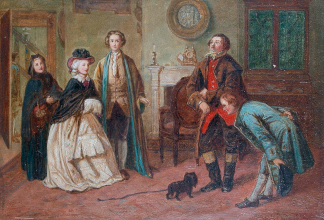
The Good-Natur’d Man, a play written by Oliver Goldsmith in 1768, is first performed at Central London’s Covent Garden on January 29, 1768. The play is written in the form of a comedy with Mary Bulkley as Miss Richland. It is released at the same time as Hugh Kelly‘s False Delicacy, staged at Drury Lane Theatre. The two plays go head-to-head, with Kelly’s proving the more popular. Goldsmith’s play is a middling success, and the printed version of the play becomes popular with the reading public.

Although his birth date and year and birthplace are not known with any certainty, it is believed that Goldsmith is born on November 10, 1728, in Kilkenny West, County Westmeath. He is an Anglo-Irish essayist, poet, novelist, dramatist, and eccentric, made famous by such works as the series of essays The Citizen of the World, or, Letters from a Chinese Philosopher (1762), the poem The Deserted Village (1770), the novel The Vicar of Wakefield (1766), and the play She Stoops to Conquer (1773).

Goldsmith is the son of an Anglo-Irish clergyman, the Rev. Charles Goldsmith, curate in charge of Kilkenny West. At about the time of his birth, the family moves into a substantial house at nearby Lissoy, where he spends his childhood. Much has been recorded concerning his youth, his unhappy years as an undergraduate at Trinity College Dublin, where he received the BA degree in February 1749, and his many misadventures before he leaves Ireland in the autumn of 1752 to study in the medical school at Edinburgh. By this time his father has died, but several of his relations support him in his pursuit of a medical degree. Later on, in London, he comes to be known as Dr. Goldsmith, Doctor being the courtesy title for one who holds the Bachelor of Medicine, but he takes no degree while at Edinburgh nor, so far as anyone knows, during the two-year period when, despite his meagre funds, which are eventually exhausted, he somehow manages to make his way through Europe. The first period of his life ends with his arrival in London, bedraggled and penniless, early in 1756.

Goldsmith’s rise from total obscurity is a matter of only a few years. He works as an apothecary‘s assistant, school usher, physician, and as a hack writer, reviewing, translating, and compiling. Much of his work is for Ralph Griffiths‘s Monthly Review. It remains amazing that this young Irish vagabond, unknown, uncouth, unlearned, and unreliable, is yet able within a few years to climb from obscurity to mix with aristocrats and the intellectual elite of London. Such a rise is possible because he has one quality, soon noticed by booksellers and the public, that his fellow literary hacks do not possess – the gift of a graceful, lively, and readable style.

Goldsmith’s rise begins with the Enquiry into the Present State of Polite Learning in Europe (1759), a minor work. Soon he emerges as an essayist, in The Bee and other periodicals, and above all in his Chinese Letters. These essays are first published in the journal The Public Ledger and are collected as The Citizen of the World in 1762. The same year brings his The Life of Richard Nash. Already he is acquiring those distinguished and often helpful friends whom he alternately annoys and amuses, shocks and charms – Samuel Johnson, Sir Joshua Reynolds, Thomas Percy, David Garrick, Edmund Burke, and James Boswell.

The obscure drudge of 1759 becomes in 1764 one of the nine founder-members of the famous The Club, a select body, including Reynolds, Johnson, and Burke, which meets weekly for supper and talk. Goldsmith can now afford to live more comfortably, but his extravagance continually runs him into debt, and he is forced to undertake more hack work. He thus produces histories of England and of ancient Rome and Greece, biographies, verse anthologies, translations, and works of popular science.

Goldsmith’s premature death on April 4, 1774, may be partly due to his own misdiagnosis of a kidney infection. He is buried in Temple Church in London. A monument is originally raised to him at the site of his burial, but this is destroyed in an air raid in 1941. A monument to him survives in the centre of Ballymahon, also in Westminster Abbey with an epitaph written by Samuel Johnson.

Among Goldsmith’s papers is found the prospectus of an encyclopedia, to be called the Universal dictionary of the arts and sciences. He wishes this to be the British equivalent of the Encyclopédie and it is to include comprehensive articles by Samuel Johnson, Edmund Burke, Adam Smith, Edward Gibbon, Sir Joshua Reynolds, Sir William Jones, Charles James Fox and Dr. Charles Burney. The project, however, is not realised due to Goldsmith’s death.

(Pictured: “Mr Honeywell introduces the bailiffs to Miss Richland as his friends,”a scene from the play “The Good-Natur’d Man” by Oliver Goldsmith, oil on panel by William Powell Frith)


Leave a comment

Birth of Edmond Malone, Shakespearean Scholar

Edmond Malone, Shakespearean scholar and editor of the works of William Shakespeare, is born on October 4, 1741 in Dublin.

Malone is born to Edmond Malone Sr. (1704–1774), MP of the Irish House of Commons and judge of the Court of Common Pleas in Ireland, and Catherine Collier, the niece of Robert Knight, 1st Earl of Catherlough. He has two sisters, Henrietta and Catherine, and an older brother, Richard (later Lord Sunderlin). His father is a successful lawyer and politician in England, but his practice fails and he returns to Ireland. Little is known of his childhood and adolescence except that in 1747 he is sent to Dr. Ford’s preparatory school in Molesworth Street, Dublin. The next record of his education is ten years later, in 1757, when he enters Trinity College, Dublin. He receives his BA degree on February 23, 1762.

After practicing in Ireland as a lawyer and journalist, Malone settles in London in 1777. There he numbers among his literary friends Samuel Johnson, Horace Walpole, and the ballad collector Thomas Percy, the Bishop of Dromore. He also is an associate of the statesmen Edmund Burke and George Canning and of the dean of English painters, Sir Joshua Reynolds, who paints his portrait and whose literary works he collects and publishes (1797). The portrait now resides in the National Portrait Gallery, London.

In the following months Malone sends a steady stream of notes and corrections to George Steevens, who, by then the inheritor, from Samuel Johnson, of the editor’s mantle for the Jacob Tonson edition of Shakespeare’s collected works, is busy preparing a second edition. His main contribution appears in the first volume as “An Attempt to Ascertain the Order in Which the Plays Attributed to Shakspeare Were Written.”

Malone’s three supplemental volumes (1780–1783) to Steevens’ edition of Johnson’s Shakespeare, containing apocryphal plays, textual emendations, and the first critical edition of the sonnets, are landmarks in Shakespearean studies. His “Historical Account of the Rise and Progress of the English Stage, and of the Economy and Usages of the Ancient Theatres in England” (1800) is the first treatise on English drama based on original sources. His own edition of Shakespeare in 11 volumes appears in 1790. A new octavo edition, unfinished at his death, is completed by James Boswell, the son of Samuel Johnson’s biographer, and published in 1821 in 21 volumes. This work, which includes a memoir of Malone, is the standard edition of Shakespeare’s writings for more than a century.

Malone dies at the age of 70 in London on May 25, 1812.

(Pictured: Portrait of Edmond Malone by Joshua Reynolds (1778), National Portrait Gallery)


Leave a comment

Death of Nathaniel Hone The Elder

nathaniel-hone-the-elder

Nathaniel Hone the Elder, Irish-born portrait and miniature painter, and one of the founder members of the Royal Academy of Arts in 1768, dies in London on August 14, 1784.

Hone is born in Dublin on April 24, 1718, the son of a Dublin-based Dutch merchant. He moves to England as a young man and, after marrying Molly Earle, daughter of the John Campbell, 4th Duke of Argyll, in 1742, eventually settles in London, by which time he has acquired a reputation as a portrait painter. While his paintings are popular, his reputation is particularly enhanced by his skill at producing miniatures and enamels. He interrupts his time in London by spending two years (1750–52) studying in Italy.

As a portrait painter, several of Hone’s works are now held at the National Portrait Gallery in London. His sitters include magistrate Sir John Fielding and Methodist preacher John Wesley, and General Richard Wilford and Sir Levett Hanson in a double portrait. He often uses his son John Camillus Hone (1745-1836) in some of his works, including his unique portrait of “The Spartan Boy,” painted in 1774.

Hone courts controversy in 1775 when his satirical picture The Conjurer (National Gallery of Ireland, Dublin) is seen to attack the fashion for Italian Renaissance art and to ridicule Sir Joshua Reynolds, leading the Royal Academy to reject the painting. It also originally includes a nude caricature of fellow Academician Angelica Kauffman in the top left corner, which is painted out by Hone after Kauffman complains to the academy. The combination of a little girl and an old man has also been seen as symbolic of Kauffman and Reynolds’s closeness, age difference, and rumoured affair. To show that his reputation is undamaged, Hone organises a one-man retrospective in London, the first such solo exhibition of an artist’s work.

The Hone family is related to the old Dutch landed family the van Vianens, who hold the hereditary title of Vrijheer. His great-grand-nephew shares the same name and is also a notable Irish painter, known as Nathaniel Hone the Younger (1831–1917). He is also a relation to painter Evie Hone.

Nathaniel Hone the Elder dies in London at the age of 66 on August 14, 1784.

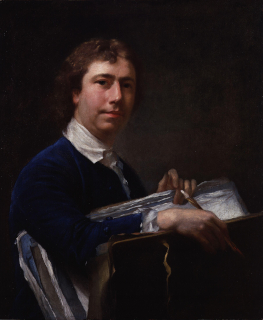
(Pictured: Oil on canvas self-portrait by Nathaniel Hone, circa 1760)


Leave a comment

Birth of Nathaniel Hone the Elder

nathaniel-hone-the-elder

Nathaniel Hone the Elder, Irish-born portrait and miniature painter, and one of the founder members of the Royal Academy of Arts in 1768, is born in Dublin on April 24, 1718.

The son of a Dublin-based Dutch merchant, Hone moves to England as a young man and, after marrying Molly Earle, daughter of the John Campbell, 4th Duke of Argyll, in 1742, eventually settles in London, by which time he has acquired a reputation as a portrait-painter. While his paintings are popular, his reputation is particularly enhanced by his skill at producing miniatures and enamels. He interrupts his time in London by spending two years (1750–52) studying in Italy.

As a portrait painter, several of Hone’s works are now held at the National Portrait Gallery in London. His sitters include magistrate Sir John Fielding and Methodist preacher John Wesley, and General Richard Wilford and Sir Levett Hanson in a double portrait. He often uses his son John Camillus Hone (1745-1836) in some of his works, including his unique portrait of “The Spartan Boy,” painted in 1774.

Hone courts controversy in 1775 when his satirical picture The Conjurer (National Gallery of Ireland, Dublin) is seen to attack the fashion for Italian Renaissance art and to ridicule Sir Joshua Reynolds, leading the Royal Academy to reject the painting. It also originally includes a nude caricature of fellow Academician Angelica Kauffman in the top left corner, which is painted out by Hone after Kauffman complains to the academy. The combination of a little girl and an old man has also been seen as symbolic of Kauffman and Reynolds’s closeness, age difference, and rumoured affair. To show that his reputation is undamaged, Hone organises a one-man retrospective in London, the first such solo exhibition of an artist’s work.

The Hone family is related to the old Dutch landed family the van Vianens, who hold the hereditary title of Vrijheer. His great-grand-nephew shares the same name and is also a notable Irish painter, known as Nathaniel Hone the Younger (1831–1917). He is also a relation to painter Evie Hone.

Nathaniel Hone the Elder dies on August 14, 1784.

(Pictured: Self-portrait by Nathaniel Hone, circa 1760)


Leave a comment

Birth of Martin Archer Shee, Portrait Painter

martin-archer-shee

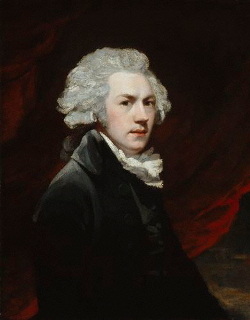
Sir Martin Archer Shee, portrait painter and president of the Royal Academy of Arts, is born in Dublin on December 23, 1769.

Shee is born into an old Irish Catholic family, the son of Martin Shee, a merchant, who regards the profession of a painter as an unsuitable occupation for a descendant of the Shees. He nevertheless studies art in the Royal Dublin Society and comes to London. There, in 1788, he is introduced by Edmund Burke to Joshua Reynolds, on whose advice he studies in the schools of the Royal Academy of Arts.

In 1789 Shee exhibits his first two pictures, the “Head of an Old Man” and “Portrait of a Gentleman.” Over the next ten years he steadily increases in practice. In 1798 he is chosen an associate of the Royal Academy and in 1800 he is elected a Royal Academician. He moves to George Romney‘s former house at 32 Cavendish Square and sets up as his successor.

Shee continues to paint with great readiness of hand and fertility of invention, although his portraits are eclipsed by more than one of his contemporaries, and especially by Thomas Lawrence. His earlier portraits are carefully finished, easy in action, with good drawing and excellent discrimination of character. They show an undue tendency to redness in the flesh painting, a defect which is still more apparent in his later works, in which the handling is less square, crisp and forcible. In addition to his portraits, he executes various subjects and historical works, such as Lavinia, Belisarius, his diploma picture “Prospero and Miranda,” and the “Daughter of Jephthah.”

In 1805 Shee publishes a poem consisting of Rhymes on Art, and a second part follows in 1809. Lord Byron speaks well of it in his English Bards and Scotch Reviewers. He publishes another small volume of verse in 1814, entitled The Commemoration of Sir Joshua Reynolds, and other Poems, but this is less successful. He also produces a tragedy, Alasco, set in Poland. The play is accepted at Covent Garden, but is refused a licence, on the grounds that it contains treasonable allusions, and Shee angrily resolves to make his appeal to the public. He carries out his threat in 1824, but Alasco is still on the list of unacted dramas in 1911. He also publishes two novels – Oldcourt (1829, in three volumes) and Cecil Hyde (1834).

On the death of Sir Thomas Lawrence in 1830, Shee is chosen president of the Royal Academy in his stead and shortly afterwards receives a knighthood. In 1831 he is elected a Fellow of the Royal Society. In an examination before the parliamentary committee of 1836 concerning the functions of the Royal Academy, he ably defends its rights. He continues to paint until 1845, when illness makes him retire to Brighton. He is deputised for at the Academy by J. M. W. Turner, who had appointed him a trustee of the projected Turner almshouse.

From 1842–1849, Shee is the first president of the Royal Birmingham Society of Artists.

Martin Archer Shee dies in Brighton, Sussex, England on August 13, 1850, and is buried in the western extension to St. Nicholas’ Churchyard in Brighton. His headstone remains but has been laid flat and moved to the perimeter of the site.


Leave a comment

Birth of Irish Statesman John Beresford

john-beresford

John Beresford, Irish statesman, is born in Cork on March 14, 1738. He is a younger son of Sir Marcus Beresford who, having married Catherine, sole heiress of James Power, 3rd Earl of Tyrone, is created Earl of Tyrone in 1746. After the death of the earl in 1763, Beresford’s mother successfully asserts her claim suo jure to the barony of La Poer. John Beresford thus inherits powerful family connections. He is educated at Kilkenny College and Trinity College, Dublin and is called to the Irish bar.

Beresford enters the Irish House of Commons as member for County Waterford in 1761. In 1768, 1783, 1789 and finally in 1798, he stands also for Coleraine, however choosing each time to sit for Waterford.

His industry, added to the influence of his family, procures his admission to the Privy Council of Ireland in 1768, and his appointment as one of the commissioners of revenue two years later. In 1780 he becomes first commissioner of revenue, a position which gives him powerful influence in the Irish administration. He introduces some useful reforms in the machinery of taxation and is the author of many improvements in the architecture of the public buildings and streets of Dublin. He is first brought into conflict with Henry Grattan and the popular party in 1784, by his support of the proposal that the Irish parliament in return for the removal of restrictions on Irish trade should be bound to adopt the English navigation laws.

In 1786, Beresford is sworn a member of the Privy Council of Great Britain, and the power which he wields in Ireland through his numerous dependants and connections grows to be so extensive that a few years later he is spoken of as the “King of Ireland.” He is a vehement opponent of the increasing demand for Catholic Emancipation and when it becomes known that the Earl Fitzwilliam is to succeed John Fane, 10th Earl of Westmorland, as Lord Lieutenant of Ireland in 1795 for the purpose of carrying out a conciliatory policy, Beresford expresses strong hostility to the appointment. One of Fitzwilliam’s first acts is to dismiss Beresford from his employment for corruption, but with permission to retain his entire official salary for life, and with the assurance that no other member of his family will be removed. Fitzwilliam has been encouraged in this course of action by William Ponsonby. Beresford immediately exerts all his influence with his friends in England, to whom he describes himself as an injured and persecuted man. He appeals to William Pitt the Younger and goes to London to lay his complaint before the English ministers.

The recall of Fitzwilliam, which is followed by such momentous consequences in the history of Ireland is, as the viceroy himself believes, mainly due to Beresford’s dismissal. There has been a misunderstanding on the point between Pitt and Fitzwilliam. The latter, whose veracity is unimpeachable, asserts that previous to his coming to Ireland he had informed the prime minister of his intention to dismiss Beresford, and that Pitt had raised no objection. Pitt denies all recollection of any such communication, and on the contrary describes the dismissal as an open breach of the most solemn promise. In a letter to Frederick Howard, 5th Earl of Carlisle, justifying his action, Fitzwilliam mentions that malversation had been imputed to Beresford. Beresford sends a challenge to Fitzwilliam, but the combatants are interrupted on the field and Fitzwilliam then makes an apology.

When John Pratt, 1st Marquess Camden, replaces Fitzwilliam in the viceroyalty in March 1795, Beresford resumes his former position. On the eve of the Irish Rebellion of 1798 his letters to William Eden, 1st Baron Auckland, give an alarming description of the condition of Ireland and he counsels strong measures of repression. When first consulted by Pitt on the question of the union, Beresford appears to dislike the idea, but he soon becomes reconciled to the policy and warmly supports it. After the union Beresford continues to represent County Waterford in the Parliament of the United Kingdom, and he remains in office until 1802, taking an active part in settling the financial relations between Ireland and Great Britain.

In 1760, Beresford marries Constantia Ligondes, who dies in 1772. In 1774, he marries Barbara Montgomery, a celebrated beauty who figures in Sir Joshua Reynolds‘ picture of The Graces. He has large families by both marriages. His sons include Marcus Beresford, George Beresford, and John Claudius Beresford. John Beresford dies near Derry on November 5, 1805.