seamus dubhghaill

Promoting Irish Culture and History from Little Rock, Arkansas, USA


Leave a comment

Death of William Wilde, Surgeon, Author & Father of Oscar Wilde

Sir William Robert Wills Wilde, Irish otoophthalmologic surgeon and the author of significant works on medicine, archaeology and folklore, particularly concerning his native Ireland dies on April 19, 1876. He is the father of poet and playwright Oscar Wilde.

Wilde is born in March 1815 at Kilkeevin, near Castlerea, County Roscommon, the youngest of the three sons and two daughters of a prominent local medical practitioner, Thomas Wills Wilde, and his wife, Amelia Flynne. His family are members of the Church of Ireland, and he is descended from a Dutchman, Colonel de Wilde, who came to Ireland with King William of Orange‘s invading army in 1690, and numerous Anglo-Irish ancestors. He receives his initial education at the Elphin Diocesan School in Elphin, County Roscommon. In 1832, he is bound as an apprentice to Abraham Colles, the pre-eminent Irish surgeon of the day, at Dr. Steevens’ Hospital in Dublin. He is also taught by the surgeons James Cusack and Sir Philip Crampton and the physician Sir Henry Marsh. He also studies at the private and highly respected school of anatomy, medicine, and surgery in Park Street (later Lincoln Place), Dublin. In 1837, he earns his medical degree from the Royal College of Surgeons in Ireland. In the same year, he embarks on an eight-month-cruise to the Holy Land with a recovering patient, visiting various cities and islands throughout the Mediterranean. Porpoises are flung on board the ship, Crusader, and Wilde dissects them. Taking notes, he eventually composes a two-volume book on the nursing habits of the creatures. Among the places he visits on this tour is Egypt. In a tomb he finds the mummified remains of a dwarf and salvages the torso to bring back to Ireland. He also collects embalmed ibises.

Once back in Ireland, Wilde publishes an article in the Dublin University Magazine suggesting that one of the “Cleopatra’s Needles” be transported to England. In 1878, one of the Needles is transported to London, and in 1880 the other one is brought to New York City‘s Central Park. In 1873 he is awarded the Cunningham Gold Medal by the Royal Irish Academy.

Wilde runs his own hospital, St. Mark’s Ophthalmic Hospital for Diseases of the Eye and Ear, in Dublin and is appointed to serve as Oculist-in-ordinary to Queen Victoria. At one point, he performs surgery on the father of another famous Irish dramatist, George Bernard Shaw.

Wilde had a very successful medical practice and is assisted in it by his natural son, Henry Wilson, who had been trained in Dublin, Vienna, Heidelberg, Berlin, and Paris. Wilson’s presence enables him to travel, and he visits Scandinavia, where he receives an honorary degree from Uppsala University, and is welcomed in Stockholm by Anders Retzius, among others. King Charles XV of Sweden confers on him the Nordstjärneorden (Order of the Polar Star). In 1853, he is appointed Surgeon Occulist in Ordinary to the Queen in Ireland, the first position of its kind, probably created for him.

Wilde is awarded a knighthood in a ceremony at Dublin Castle on January 28, 1864, more for his involvement with the Irish census than for his medical contributions, although he had been appointed medical commissioner to the Irish census in 1841. In 1845, he becomes editor of the Dublin Journal of Medical & Chemical Science, to which he contributes many articles.

Wilde marries the poet Jane Francesca Agnes Elgee on November 12, 1851, who writes and publishes under the pen name of Speranza. The couple has two sons, William (Willie) and Oscar, and a daughter, Isola Francesca, who dies in childhood.

In addition to his children with his wife, Wilde is the father of three children born out of wedlock before his marriage: Henry Wilson, born in 1838, and Emily and Mary Wilde, born in 1847 and 1849, respectively, of different parentage to Henry. He acknowledges paternity of his illegitimate children and provides for their education, but they are reared by his relatives rather than with his wife and legitimate children. Emily and Mary both die in 1871 following a Halloween party at which their dresses accidentally catch fire.

From 1855 until his death in 1876, Wilde lives at 1 Merrion Square, now the headquarters of American College Dublin. The building is named Oscar Wilde House after William Wilde’s son, who also lives at the address from 1855 until 1878. There is a plaque at 1 Merrion Square dedicated to him.

Wilde’s reputation suffers when Mary Travers, a long-term patient of his and the daughter of a colleague, claims that he had seduced her two years earlier. She writes a pamphlet crudely parodying Wilde and Lady Wilde as Dr. and Mrs. Quilp, and portraying Dr. Quilp as the rapist of a female patient anaesthetised under chloroform. She distributes the pamphlets outside the building where Wilde is about to give a public lecture. Lady Wilde complains to Mary’s father, Robert Travers, which results in Mary bringing a libel case against her. Mary Travers wins her case but is awarded a mere farthing in damages by the jury. Legal costs of £2,000 are awarded against Lady Wilde. The case is the talk of all Dublin, and Wilde’s refusal to enter the witness box during the trial is widely held against him as ungentlemanly behaviour.

From this time onwards, Wilde begins to withdraw from Dublin to the west of Ireland, where he had started in 1864 to build what becomes Moytura, his house overlooking Lough Corrib in Connemara, County Galway. His health deteriorates in 1875. He dies, likely of cancer, at the age of 61 on April 19, 1876. He is buried in Mount Jerome Cemetery in Dublin.

(Pictured: Sketch of William Wilde by J.H. Maguire, 1847)

Leave a comment

Death of Arthur Edward Guinness, 1st Baron Ardilaun

Arthur Edward Guinness, 1st Baron Ardilaun, Irish businessman, politician, and philanthropist, best known for giving St. Stephen’s Green back to the people of Dublin, dies on January 20, 1915.

Guinness is born on November 1, 1840 at St. Anne’s, Raheny, near Dublin, the eldest son of Sir Benjamin Guinness, 1st Baronet, and elder brother of Edward Guinness, 1st Earl of Iveagh. He is the great-grandson of Arthur Guinness. He is educated at Eton College and Trinity College Dublin and, in 1868, succeeds his father as second Baronet.

In the 1868 United Kingdom general election Guinness is elected Conservative Member of Parliament for Dublin City, a seat he holds for only a year. His election is voided because of his election agent’s unlawful efforts, which the court finds were unknown to him. He is re-elected the following year in the 1874 United Kingdom general election.

A supporter of Benjamin Disraeli‘s one-nation conservatism, Guinness’s politics are typical of “constructive unionism,” the belief that the union between Ireland and Britain should be more beneficial to the people of Ireland after centuries of difficulties. In 1872 he is a sponsor of the “Irish Exhibition” at Earlsfort Terrace in Dublin, which is arranged to promote Irish trade. Correcting a mistake about the exhibition in the Freeman’s Journal leads to a death threat from a religious extremist, which he does not report to the police. In the 1890s he supports the Irish Unionist Alliance.

After withdrawing from the Guinness company in 1876, when he sells his half-share to his brother Edward for £600,000, Guinness is in 1880 raised to the peerage as Baron Ardilaun, of Ashford in County Galway. His home there is at Ashford Castle on Lough Corrib, and his title derives from the Gaelic Ard Oileáin, a ‘high island’ on the lake.

Between 1852 and 1859, Guinness’s father acquires several large Connacht estates that are up for sale. With these purchases, he becomes landlord to 670 tenants. With his father’s death in 1868, Guinness continues in his father’s footsteps, purchasing vast swaths of Galway. When his acquisitions are combined with those of his father, total acreage for the Ashford estate is 33,298 acres, with Guinness owning most of County Galway between Maam (Maum) Bridge and Lough Mask.

Like many in the Guinness family, Guinness is a generous philanthropist, devoting himself to a number of public causes, including the restoration of Marsh’s Library in Dublin and the extension of the city’s Coombe Lying-in Hospital. In buying and keeping intact the estate around Muckross House in 1899, he assists the movement to preserve the lake and mountain landscape around Killarney, now a major tourist destination.

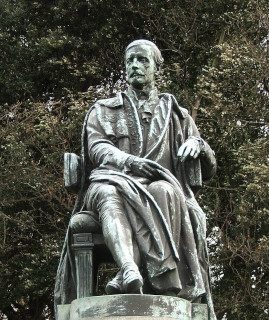
In his best-known achievement, Guinness purchases, landscapes, and donates to the capital, the central public park of St. Stephen’s Green, where his statue commissioned by the city can be seen opposite the Royal College of Surgeons in Ireland. To do so he sponsors a private bill that is passed as the Saint Stephen’s Green (Dublin) Act 1877, and after the landscaping it is formally opened to the public on July 27, 1880. It has been maintained since then by the Commissioners of Public Works in Ireland, now the Office of Public Works.

Guinness dies on January 20, 1915 at his home at St. Anne’s, Raheny, and is buried at All Saints Church, Raheny, whose construction he had sponsored. Those present at the funeral include representatives of the Royal Dublin Society, of which he is president for many years, the Royal Horticultural Society of Ireland, the Irish Unionist Alliance, and the Primrose League. His barony becomes extinct at his death, but the baronetcy devolves upon his nephew Algernon.


Leave a comment

First Aircraft Lands at Rineanna Airfield (Shannon Airport)

rineanna-airport

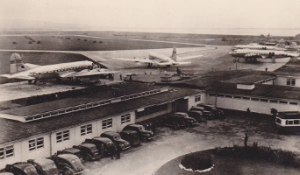
The first aircraft, an Irish Air Corps Aero Anson A43, lands at the newly opened Rineanna Airfield, which is later to become known as Shannon International Airport, on May 18, 1939.

Transatlantic aviation in the Shannon Estuary first commences with a seaplane base at Foynes. In October 1935, the Irish Government makes a decision to initiate a survey to find suitable bases for the operation of seaplanes and land planes on a transatlantic service. The Department of Defence, which provides technical advice on aviation to the Civil Aviation Section of the Department of Industry, is given the task.

On November 21, 1935, a survey party sets out and surveys sites as far north as Athlone and south to Askeaton. Among the sites for a seaplane base to be considered are the Shannon just below Limerick, Lough Derg, Lough Corrib, Tralee Bay, Kenmare Bay, Lough Ree, and Valentia. Foynes, near the mouth of the Fergus River, is finally selected due to its sheltered anchorage and its proximity to long open stretches of water.

The first priority is drainage to remove surface water from the site and to construct embankments to prevent flooding of the airfield due to its proximity to the tidal River Shannon. Several hundred men are employed to dig narrow lateral drains for the approximately 135 miles of pipes which are laid in parallel lines 50 feet apart over almost the entire area of the airfield site. They also excavate catchment drains to collect water from the surface of the site.

At this time all indications are that regular aerial travel between Europe and the United States will be initially by flying boat and accordingly, the base at Rineanna is designed to cater to both land planes and flying boats.  Construction work commences to build embankments and a breakwater to provide for a seaplane base and to protect the airfield site from flooding from the River Shannon.

Developments in aviation during World War I ensure land planes and not flying boats are to be the future of aviation, therefore the mooring basin and the east breakwater which are being constructed for flying boats at Rineanna are never quite finished.  Construction of the embankments continue to protect the site from the River Shannon and to form a drainage lagoon for surface water from the western headland of the airport site.

When World War II ends, the airport is ready to be used by the many new post-war commercial airlines of Europe and North America. On September 16, 1945, the first transatlantic proving flight, a Pan Am DC-4, lands at Shannon from New York City. On October 24, the first scheduled commercial flight, an American Overseas Airlines DC-4, passes through Shannon Airport. An accident involving President Airlines on September 10, 1961 results in the loss of 83 lives. The Douglas DC-6 aircraft crashes into the River Shannon while leaving Shannon Airport for Chicago.

The number of international carriers rises sharply in succeeding years as Shannon becomes well known as the gateway between Europe and the Americas as limited aircraft range necessitates refueling stops on many journeys. Shannon becomes the most convenient stopping point before and after a trip across the Atlantic. Additionally, during the Cold War, many transatlantic flights from the Soviet Union stop here for refueling, because Shannon is the westernmost non-NATO airport.

Shannon Airport is one of Ireland’s three primary airports, along with Dublin Airport and Cork Airport, and includes the longest runway in Ireland at 10,495 feet. It is a designated emergency landing site for the Space Shuttle during the U.S. shuttle program. In 2015, 1.715 million passengers pass through the airport, making it the third busiest airport in the country after Dublin and Cork. Shannon Airport is in Shannon, County Clare, and mainly serves Limerick, Ennis, Galway, and the south-west of Ireland.