Brennan moves to Melbourne, Australia in 1861 with his parents. He starts his career as a watchmaker and a few years later is articled to Alexander Kennedy Smith, a renowned civil and mechanical engineer of the period. He serves as a sergeant in the Victorian Engineers under the command of Captain John James Clark. He invents the idea of a steerable torpedo in 1874, from observing that if a thread is pulled on a reel at an angle with suitable leverage, the reel will move away from the thread side. He spends some years working out his invention and receives a grant of £700 from the Victorian government towards his expenses. He patents the Brennan torpedo in 1877. The idea is trialed at Camden Fort near Crosshaven, County Cork.
Brennan goes to England in 1880 and brings his invention before the War Office. Sir Andrew Clarke alerts the authorities to the possibilities of the torpedo if used in the defence of harbours and channels, and the patent is eventually bought for a sum believed to be more than £100,000 (£ 9,331,100 in 2019). In 1887 he is appointed superintendent of the Brennan torpedo factory and is consulting engineer from 1896 to 1907.
Brennan does much work on a gyro monorail locomotive which is kept upright by a gyrostat. In 1903 he patents a gyroscopically balanced monorail system that he designs for military use. He successfully demonstrates the system on November 10, 1909, at Gillingham, England, but fears that the gyroscopes might fail prevents adoption of the system for widespread use.
From 1916 to 1919 Brennan serves in the munition invention department. From 1919 to 1926 he is engaged by the air ministry in aircraft research work at the Royal Aircraft Establishment, Farnborough, and gives much time to the invention of a helicopter. The government spends a large sum of money on it, but in 1926 the air ministry gives up working on it, much to Brennan’s disappointment.
Brennan marries Anna Quinn on 10 September 10, 1892. The marriage results in a son and a daughter. He is created a Companion of the Order of the Bath in 1892 and is foundation member of the National Academy of Ireland in 1922.
In January 1932 Brennan is knocked down by a car at Montreux, Switzerland, and dies on January 17, 1932. He is buried at St. Mary’s Catholic Cemetery, Kensal Green, London, in an unmarked plot numbered 2454 that is opposite the Chapel record office. On March 11, 2014, TaoiseachEnda Kenny unveils a new gravestone for Brennan at St. Mary’s in a ceremony honouring the inventor’s life and career.
Gillingham Library retains the archive of his papers.
Edward “Ned” Kelly, Australian bushranger, outlaw, gang leader and convicted police murderer, is hanged at Old Melbourne Jail in Australia on November 11, 1880. One of the last bushrangers, and by far the most famous, he is best known for wearing a suit of bulletproof armour during his final shootout with the police.
Kelly is born in the British colony of Victoria as the third of eight children to John “Red” Kelly (born 1820 in County Tipperary), and Ellen (née Quinn). The exact date of his birth is not known, but a number of lines of evidence, including a 1963 interview with family descendants Paddy and Charles Griffiths, a record from his mother, and a note from a school inspector, all suggest his birth was in December 1854. He is baptised by an Augustinian priest, Charles O’Hea, who also administers last rites to Kelly before his execution. His father, a transported convict, dies shortly after serving a six-month prison sentence, leaving Kelly, then aged 12, as the eldest male of the household. The Kellys are a poor selector family who see themselves as downtrodden by the Squattocracy and as victims of police persecution.
While a teenager, Kelly is arrested for associating with bushranger Harry Power and serves two prison terms for a variety of offences, the longest stretch being from 1871 to 1874 on a conviction of receiving a stolen horse. He later joins the “Greta mob”, a group of bushlarrikins known for stock theft. A violent confrontation with a policeman occurs at the Kelly family’s home in 1878, and he is indicted of attempted murder. Fleeing to the bush, he vows to avenge his mother, who is imprisoned for her role in the incident. After he, his brother Dan, and two associates, Joe Byrne and Steve Hart, fatally shoot three policemen, the Government of Victoria proclaims them outlaws.
Kelly and his gang elude the police for two years, thanks in part to the support of an extensive network of sympathisers. The gang’s crime spree includes armed bank robberies at Euroa and Jerilderie, and the killing of Aaron Sherritt, a sympathiser turned police informer. In a manifesto letter, Kelly, denouncing the police, the Victorian government and the British Empire, sets down his own account of the events leading up to his outlawry. Demanding justice for his family and the rural poor, he threatens dire consequences against those who defy him.
In 1880, when Kelly’s attempt to derail and ambush a police train fails, he and his gang, dressed in armour fashioned from stolen plough mouldboards, engage in a final gun battle with the police at Glenrowan. Kelly, the only survivor, is severely wounded by police fire and is captured. Despite thousands of supporters attending rallies and signing a petition for his reprieve, he stands trial on October 19, 1880, in Melbourne before Sir Redmond Barry. The trial is adjourned to October 28, when Kelly is presented on the charge of the murder of the three policemen, the various bank robberies, the murder of Sherritt, resisting arrest at Glenrowan and a long list of minor charges. He is convicted of the willful murder of one of the officers and sentenced to death by hanging. After handing down the sentence, Barry concludes with the customary words, “May God have mercy on your soul,” to which Kelly replies, “I will go a little further than that, and say I will see you there where I go.”
On November 3, the Executive Council of Victoria decides that Kelly is to be hanged eight days later, November 11, at the Melbourne Gaol. In the week leading up to the execution, thousands turn out at street rallies across Melbourne demanding a reprieve for Kelly. On November 8, a petition for clemency with over 32,000 signatures is presented to the governor’s private secretary. The Executive Council announces soon after that the hanging would proceed as scheduled.
The day before his execution, Kelly has his photographic portrait taken as a keepsake for his family and is granted farewell interviews with relatives. The following morning, John Castieau, the Governor of the Gaol, informs him that the hour of execution has been fixed at 10:00 AM. His leg irons are removed, and, after a short time, he is marched out. He is submissive on the way, and when passing the gaol’s flower beds, remarks, “What a nice little garden,” but says nothing further until reaching the Press room, where he remains until the arrival of chaplain Dean Donaghy. His last words are famously reported to have been, “Such is life.”
Historian Geoffrey Serle calls Kelly and his gang “the last expression of the lawless frontier in what was becoming a highly organised and educated society, the last protest of the mighty bush now tethered with iron rails to Melbourne and the world.” In the century after his death, Kelly becomes a cultural icon, inspiring countless works in the arts, and is the subject of more biographies than any other Australian. He continues to cause division in his homeland as some celebrate him as Australia’s equivalent of Robin Hood while others regard him as a murderous villain undeserving of his folk hero status. Journalist Martin Flanagan writes, “What makes Ned a legend is not that everyone sees him the same—it’s that everyone sees him. Like a bushfire on the horizon casting its red glow into the night.”
Allgood joins Inghinidhe na hÉireann (“Daughters of Ireland”), where she first begins to study drama under the direction of Maud Gonne and William Fay. She begins her acting career at the Abbey Theatre and is in the opening of the Irish National Theatre Society. Her first big role is in December 1904 at the opening of Lady Gregory‘s Spreading the News. By 1905 she is a full-time actress, touring England and North America.
In 1915 Allgood is cast as the lead in Peg o’ My Heart which tours Australia and New Zealand in 1916. She marries her leading man, Gerald Henson, in September 1916 in Melbourne, however, her happiness is short lived. She gives birth to a daughter named Mary in January 1918, who dies just a day later. Her husband dies of influenza during an outbreak in November 1918. After her return to Ireland, she continues to perform at the Abbey Theatre. Her most memorable performance is in Seán O’Casey‘s Juno and the Paycock in 1923. She wins acclaim in London when she plays Bessie Burgess in O’Casey’s The Plough and the Stars in 1926.
Allgood is frequently featured in early Alfred Hitchcock films, such as Blackmail (1929), Juno and the Paycock (1930), and Sabotage (1936). She also has a significant role in Storm in a Teacup (1937).
(Note: Many accounts give October 31, 1879, as her date of birth. Her headstone also gives 1879 as her year of birth. However, her sister Margaret is born on August 1, 1879, meaning she could not have been born in that year. Sara Allgood may have been born on October 31, 1880, but her parents may have been late registering her.)
Burke is born in St. Clerens, County Galway on May 6, 1821. He migrates to Australia in 1853 arriving in Hobart, Tasmania on February 12, 1853, and promptly sailing for Melbourne.
After the South Australian explorer John McDouall Stuart reaches the centre of Australia, the Parliament of South Australia offers a reward of £2,000 for the promotion of an expedition to cross the continent from south to north, generally following Stuart’s route.
In June 1860, Burke is appointed to lead the Victorian Exploring Expedition with William John Wills, his third-in-command, as surveyor and astronomical observer.
The expedition leaves Melbourne on Monday, August 20, 1860, with a total of 19 men, 27 camels and 23 horses. They reach Menindee on September 23, 1860, where several people resign, including the second-in-command, George James Landells, and the medical officer, Dr. Hermann Beckler.
Cooper Creek, 400 miles further on, is reached on November 11, 1860, by the advance group, the remainder being intended to catch up. After a break, Burke decides to make a dash to the Gulf of Carpentaria, leaving on December 16, 1860. William Brahe is left in charge of the remaining party. The small team of Burke, William Wills, John King and Charley Gray reach the mangroves on the estuary of the Flinders River, near where the town of Normanton now stands, on February 9, 1861. Flooding rains and swamps prevent them from seeing the open ocean.
Already weakened by starvation and exposure, progress on the return journey is slow and hampered by the tropical monsoon downpours of the wet season. Gray dies four days before they reach the rendezvous at Cooper Creek. The other three rest for a day when they bury him. They eventually reach the rendezvous point on April 21, 1861, nine hours after the rest of the party had given up waiting and left, leaving a note and some food, as they had not been relieved by the party supposed to be returning from Menindee.
They attempt to reach Mount Hopeless, the furthest outpost of pastoral settlement in South Australia, which is closer than Menindee, but fail and return to Cooper Creek. While waiting for rescue Wills dies of exhaustion and starvation. Soon after, Burke also dies, at a place now called Burke’s Waterhole on Cooper Creek in South Australia. The exact date of Burke’s death is uncertain but has generally been accepted to be June 28, 1861.
King survives with the help of Aborigines until he is rescued in September by Alfred William Howitt. Howitt buries Burke and Wills before returning to Melbourne. In 1862 Howitt returns to Cooper Creek and disinters the bodies of Burke and Wills, taking them first to Adelaide and then by steamer to Melbourne where they are laid in state for two weeks. On January 23, 1863, Burke and Wills receive a state funeral and are buried in Melbourne General Cemetery.
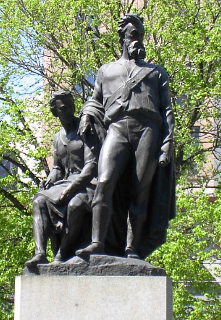
(Pictured: Burke and Wills Statue on the corner of Collins and Swanston Street, Melbourne)
McCaughey is born on July 1, 1835, at Tullynewey, near Ballymena, County Antrim, the son of Francis McCaughey, farmer and merchant, and his wife Eliza, née Wilson.
McCaughey comes to Australia with an uncle, Charles Wilson, a brother of Sir Samuel Wilson, and lands at Melbourne in April 1856. He immediately goes to the country and begins working as a jackaroo. Within three months he is appointed an overseer and two years later becomes manager of Kewell station while his uncle is on a visit to England.
In 1860, after his uncle’s return, McCaughey acquires an interest in Coonong station near Urana with two partners. His brother John who comes out later becomes a partner in other stations.
During the early days of Coonong station McCaughey suffers greatly from drought conditions but overcomes these by sinking wells for artesian water and constructing large tanks, making him a pioneer of water conservation in Australia.
In 1871 McCaughey is away from Australia for two years on holiday, and on his return does much experimenting in sheep farming. At first, he seeks the strains that can produce the best wool in the Riverina district. Afterwards, when the mutton trade develops, he considers the question from that angle.
In 1880 Sir Samuel Wilson goes to England and McCaughey purchases two of his stations, Toorale and Dunlop Stations, during his absence. He then owns about 3,000,000 acres. In 1886 he again visits the old world and imports a considerable number of Vermont sheep from the United States and also introduces fresh strains from Tasmania. He ultimately owns several million sheep, earning the nickname of “The Sheep King.”
In 1900 McCaughey purchases North Yanco and, at great cost, constructs about 200 miles of channels and irrigates 40,000 acres. The success of this scheme is believed to have encouraged the New South Wales government to proceed with the dam at Burrinjuck.
Burke is the second of three sons of James Hardiman Burke, an officer in the British army 7th Royal Fusiliers, and Anne Louisa Burke (nee O’Hara).
Burke enters the Royal Military Academy, Woolwich in May 1835. In December 1836 he fails his probationary exam and goes to Belgium to further his education. In 1841, he enters the Austrian army and spends most of his time posted to northern Italy. Towards the end of 1847 he suffers health problems and ultimately resigns from the Austrian army in June 1848.
After returning to Ireland in 1848, he joins the Irish Constabulary (later the Royal Irish Constabulary). He does his cadet training at Phoenix Park Depot in Dublin between November 1849 and January 1850. At the end of 1850 he transfers to the Mounted Police in Dublin.
Burke emigrates to Australia, arriving in Hobart, Tasmania on February 12, 1853, and promptly sails for Melbourne. On April 1, 1853, he joins the recently established Victoria Police force.
After the South Australian explorer John McDouall Stuart reaches the centre of Australia, the South Australian parliament offers a reward of £2,000 for the promotion of an expedition to cross the continent from south to north, generally following Stuart’s route. In June 1860, Burke is appointed to lead the Victorian Exploring Expedition with William John Wills, his third-in-command, as surveyor and astronomical observer.
The expedition leaves Melbourne on August 20, 1860, with a total of 19 men, 27 camels and 23 horses. They reach Menindee on September 23, 1860, where several people resign.
Cooper Creek, 400 miles further on, is reached on November 11, 1860, by the advance group, the remainder being intended to catch up. After a break, Burke decides to make a dash to the Gulf of Carpentaria, leaving on December 16, 1860. William Brahe is left in charge of the remaining party. The small team of Burke, William Wills, John King and Charley Gray reach the mangroves on the estuary of the Flinders River, near where the town of Normanton now stands, on February 9, 1861. They never see open ocean due to flooding rains and swamps.
Already weakened by starvation and exposure, progress on the return journey is slow and hampered by the tropical monsoon downpours of the wet season. Gray dies four days before they reach the rendezvous at Cooper Creek. The other three rest for a day when they bury him. They eventually reach the rendezvous point on April 21, 1861, nine hours after the rest of the party had given up waiting and left, leaving a note and some food, as they have not been relieved by the party supposed to be returning from Menindee.
Burke’s party attempts to reach Mount Hopeless, the furthest outpost of pastoral settlement in South Australia, which is closer than Menindee, but fail and return to Cooper Creek. While waiting for rescue Wills dies of exhaustion and starvation. Soon after, Burke also dies, at a place now called Burke’s Waterhole on Cooper Creek in South Australia. The exact date of Burke’s death is uncertain but has generally been accepted to be June 28, 1861.
King survives with the help of Aborigines until he is rescued in September by Alfred William Howitt. Howitt buries Burke and Wills before returning to Melbourne. In 1862 Howitt returns to Cooper Creek and disinters Burke and Wills, taking them first to Adelaide and then by steamer to Melbourne where they are laid in state for two weeks. On January 23, 1863, Burke and Wills receive a State Funeral and are buried in Melbourne General Cemetery. Ironically, on that same day John McDouall Stuart and his companions, having successfully completed the south-north crossing, are received back at a large ceremony in Adelaide.
In 1934, Dugan is appointed Governor of South Australia. He is appointed a Knight Commander of the Order of St. Michael and St. George (KCMG), retires from the Army and moves to Adelaide with his wife. They become an extremely popular and glamorous vice-regal couple. Sir Winston and Lady Dugan are both excellent public speakers and travel widely in order to bring problems to the attention of the ministers of the day. Upon the expiration of his term, there is bipartisan parliamentary support for him to serve a second term, but he has already accepted an appointment to be Governor of Victoria.
Sir Winston and Lady Dugan arrive in Melbourne on July 17, 1939. They continue their active role in community affairs, promoting unemployment reduction and making the ballroom of Government House available for the Australian Red Cross.
Dugan has an active role stabilising state politics during the tumultuous 1940s. Upon the disintegration of Albert Dunstan‘s Country Party in 1943, he installs Australian Labor Party leader John Cain as Premier. Four days later, Dunstan forms a coalition with the United Australia Party. Following the collapse of that ministry in 1945, Dugan dissolves parliament and calls a general election for November, which results in the balance of power being held by independents. Dugan commissions Cain to form the ministry of a minority government.
Dugan’s term as Governor is extended five times. He returns to England in February 1949. On July 7, 1949, he is raised to the peerage as Baron Dugan of Victoria, of Lurgan in County Armagh.
Winston Dugan dies at Marylebone, London, on August 17, 1951, at the age of 74. As there are no children from his marriage, the barony becomes extinct.
Horan emigrates to Australia with his parents and siblings as a small child. In Melbourne, he attends Bell Street School in Fitzroy and forms a friendship with Jack Blackham. Blackham encourages in Horan a love of cricket. Horan makes his first-class debut for Victoria in the 1874-1875 season.
The first of only two players born in Ireland to play Test cricket for Australia, Horan is the leading batsman in the colony of Victoria during the pioneering years of international cricket. He plays for Australia in the game against England subsequently designated as the first Test match, before touring England with the first representative Australian team, in 1878. Four years later, he tours England for the second time and plays in the famed Ashes Test match at The Oval.
An aggressive middle-order batsman renowned for his leg side play, Horan supplements his batting by bowling medium-pace in the roundarm style common to his era and once captures six wickets in a Test match innings. During a season disrupted by financial disputes and a strike by leading players, he captains Australia in two Test matches of the 1884–85 Ashes series but loses both games. Horan’s form peaks between the ages of 26 and 29 when he scores seven of his eight first-class centuries, including a score of 124 in a Test match on his home ground at the Melbourne Cricket Ground in January 1882.
In 1879, Horan begins writing a weekly newspaper column that continues until his death 37 years later. He establishes himself as the first Australian cricket writer who has played the game at the highest level, thus paving the way for many players to enter the media. Bill O’Reilly, the noted Australian player-writer of the twentieth century, describes him as, “the cricket writer par excellence.”
Horan’s documentation of the early years of Australian cricket are the basis for many works on the subject. Gideon Haigh writes that any, “serious scholar in the field…should probably acquaint himself with Tom Horan.” An anthology of his articles is published for the first time in 1989 when he is posthumously inducted into the Sport Australia Hall of Fame for his writing. In part, his citation reads, “…it was as the first nationally known cricket writer that he made his major contribution to the game.”
Thomas Patrick Horan dies on April 16, 1916, in Malvern, Victoria, Australia.






 seamus dubhghaill