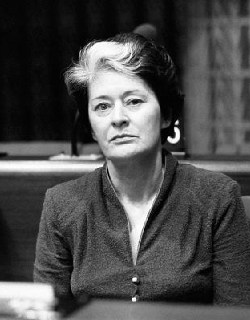
Desmond is born in Kinsale, County Cork on December 29, 1932. She is educated locally at the Convent of Mercy in Kinsale, where she is one of only two girls in her class to sit the Leaving Certificate examination. Before entering politics, she works as a civil servant with the Department of Posts and Telegraphs. She marries Dan Desmond in 1958.
Desmond is elected to the European Parliament at the 1979 European Parliament election for the Munster constituency. However, her time in Europe is short-lived, as she returns to domestic politics when she is offered a position as Minister and the chance to impact upon national legislation. At the 1981 general election she switches her constituency to Cork South-Central. A Fine Gael–Labour Party coalition comes to power, and she is appointed Minister for Health and Social Welfare.
Desmond’s cabinet appointment is historic, as she is only the second woman to be a member of cabinet since the foundation of the state in 1922, and the first in any Fine Gael or Labour Party cabinet. Countess Markievicz had held the cabinet post of Minister for Labour in the revolutionary First Dáil in 1919, but only one woman had held cabinet office after the foundation of the state, Máire Geoghegan-Quinn of Fianna Fáil who was appointed as Minister for the Gaeltacht in 1979.
Desmond retires from full-time politics at the 1987 general election for health reasons. She dies suddenly in Cork, County Cork on January 6, 2005. Her funeral Mass takes place at Our Lady and St. John’s Church, Carrigaline with burial following in Crosshaven Cemetery.
Although he is a fierce advocate of his homeland, Cruise O’Brien is a strong critic of Irish Republican Army violence and of what he considers the romanticized desire for reunification with Northern Ireland. His collection of essays Maria Cross: Imaginative Patterns in a Group of Modern Catholic Writers (1952; written under the pseudonym Donat O’Donnell) impresses UN Secretary-GeneralDag Hammarskjöld, who in 1961 appoints him UN special representative in the Congo, later the Democratic Republic of the Congo. He orders UN peacekeeping forces into the breakaway Katanga province, and the resulting scandal forces him out of office. Despite UN objections, he writes To Katanga and Back (1963) to explain his actions.
After serving as vice-chancellor of the University of Ghana (1962–65) and Albert Schweitzer Professor of Humanities at New York University (1965–69), Cruise O’Brien enters Irish politics. He holds a Labour Party seat in Dáil Éireann from 1969 to 1977 and then in the Senate from 1977 to 1979, representing Trinity College, of which he is pro-chancellor (1973–2008).
In 1979 Cruise O’Brien is named editor in chief of the British Sunday newspaper The Observer, but he leaves after three tumultuous years. He remains an active newspaper columnist, especially for the Irish Independent until 2007. His books include States of Ireland (1972) and On the Eve of the Millennium (1995), as well as perceptive studies of Charles Stewart Parnell, Edmund Burke, and Thomas Jefferson.
Conor Cruise O’Brien dies at the age of 91 on December 18, 2008, in Howth, Dublin.
De Rossa takes the Official Sinn Féin side in the 1970 split. In 1977, he contests his first general election for the party. He is successful on his third attempt and is elected at the February 1982 general election as a Sinn Féin TD for the Dublin North-West constituency. He retains his seat until the 2002 general election when he stands down in order to devote more time to his work in the European Parliament.
In 1988, De Rossa succeeds Tomás Mac Giolla as president of the Workers’ Party. The party had been growing steadily in the 1980s and has its best-ever electoral performance in the general and European elections held in 1989. The party wins 7 Dáil seats with 5% of the vote. De Rossa himself is elected to the European Parliament for the Dublin constituency, where he tops the poll, and the party almost succeeds in replacing Fine Gael as the capital’s second-largest party. However, the campaign results in a serious build-up of financial debt by the Workers’ Party, which threatens to greatly inhibit the party’s ability to ensure it will hold on to its gains.
Long-standing tensions within the Workers’ Party come to a head in 1992. Disagreements on policy issues are exacerbated by the desire of the reformers to ditch the democratic centralist nature of the party structures, and to remove any remaining questions about alleged party links with the Official IRA. De Rossa calls a special Ardfheis to debate changes to the constitution. The motion fails to get the required two-thirds majority, and subsequently he leads the majority of the parliamentary group and councillors out of a meeting of the party’s Central Executive Committee the following Saturday, splitting the party.
De Rossa and the other former Workers’ Party members then establish a new political party, provisionally called New Agenda. At its founding conference in March 1992, it is named Democratic Left and De Rossa is elected party leader. Later that year he resigns his European Parliament seat, in favour of Democratic Left general secretary Des Geraghty.
Following the collapse of the Fianna Fáil–Labour Party coalition government in 1994, Fine Gael, Labour and Democratic Left negotiate a government programme for the remaining life of the 27th Dáil, which becomes known as the “Rainbow Coalition.” De Rossa becomes Minister for Social Welfare, initiating Ireland’s first national anti-poverty strategy, a commission on the family, and a commission to examine national pension policy.
The 1997 general election results in the defeat of the outgoing coalition. At this point, Democratic Left, having accumulated significant, merges with the Labour Party. Labour leader Ruairi Quinn becomes leader of the unified party. De Rossa takes up the symbolic post of party president, which he holds until 2002.
In 1999, De Rossa is elected at the European Parliament election for the Dublin constituency. He is re-elected at the 2004 European Parliament election. He does not contest his Dáil seat at the 2002 general election.
MacSharry is educated at the local national school before later briefly attending Summerhill College. After leaving school he works as a livestock dealer throughout Sligo and Mayo before becoming involved in the Meat Exporters Factory in his native town. MacSharry also owns his own haulage firm.
Although MacSharry comes from a non-political family, he himself becomes an active member of Fianna Fáil in Sligo. In 1967 he makes his first move into politics when he secures election to both Sligo Borough Council and Sligo County Council. It was from this local base that he launches his national election campaign.
Following the 1977 general election, Fianna Fáil returns to government with a massive twenty-seat Dáil majority. With the introduction of the new Minister of State positions in 1978, MacSharry finally secures a junior ministerial post, as Minister of State at the Department of the Public Service.
Charles Haughey succeeds in becoming party leader after Jack Lynch’s resignation in 1979, albeit by a narrow margin of just six votes, and is later elected Taoiseach by the Dáil. MacSharry’s loyalty is subsequently rewarded when he is appointed Minister for Agriculture in the new government.
Fianna Fáil falls out of power in 1981 but returns to power following the February 1982 general election. MacSharry is promoted to the positions of Tánaiste and Minister for Finance, however, the government falls after just nine months in office and a new coalition government of Fine Gael, and the Labour Party take office.
In 1983 MacSharry resigns from the Fianna Fáil front bench due to a telephone tapping controversy, when it is revealed that as Tánaiste and Minister for Finance, he had borrowed police tape recorders to secretly record conversations with a cabinet colleague. He spends a number of years in the political wilderness following the phone-tapping scandal. He is elected to the European Parliament as a Member of the European Parliament (MEP) for Connacht–Ulster in 1984.
Following the 1987 general election MacSharry is returned to the Dáil once again. He resigns his European Parliament seat when he is appointed Minister for Finance in Haughey’s new government. In 1988 his loyalty to Haughey is rewarded when he is appointed European Commissioner. As a result of this he resigns his Dáil seat and ends his domestic political career.
Following the completion of his term as Commissioner, MacSharry retires from politics to pursue business interests. He is currently a director on the boards of a variety of companies including Bank of Ireland and Ryanair Holdings. In 1999 he is appointed chairman of Eircom plc. He is also a member of the Comite d’Honneur of the Institute of International and European Affairs.
On April 4, 2001, former employees and staff join three generations of the Barry family in a celebration of 100 years in business for Barry’s Tea which has become an Irish institution.
Barry’s Tea is an Irish tea company founded in 1901 by James J. Barry in Cork, County Cork. In 1934, Anthony Barry, son of the founder, is awarded the Empire Cup for Tea Blending, confirming his expertise in the tea trade. Until the 1960s, the tea is only sold from a shop in Prince’s Street, but thereafter the company expands its wholesaling and distribution operations.
In 1960, Peter Barry, Anthony’s son, pioneers the concept of wholesaling tea and begins sourcing tea from East Africa. There is an incredible reaction to these new blends, and they become something of a Barry’s Tea signature.
By the mid-1980s Barry’s Tea has become a national brand. According to their website, www.barrystea.ie, they are currently responsible for 38% of all tea sales in the Irish market, which is worth an estimated €85 million annually. Today, Barry’s Tea is also available in the United Kingdom, Spain, and in some areas of Canada, Australia, France, Luxembourg and the United States where there are significant Irish immigrant communities.
Members of the Barry family have been elected representatives for Fine Gael: the founder’s son Anthony Barry (TD 1954–1957 and 1961–1965), Anthony’s son Peter Barry (TD 1969–1997) and Peter’s daughter Deirdre Clune (TD 1997–2001 and 2007–2011, and MEP since 2014).
In May 2018, it was revealed that many of Barry’s Tea teabags are made with polypropylene and are not compostable.
Harrington is educated locally at the Convent of Mercy in Kinsale, where she is one of only two girls in her class to sit the Leaving Certificate examination. Before entering politics, she works as a civil servant with the Department of Posts and Telegraphs. She marries Dan Desmond in 1958.
Desmond is elected to the European Parliament at the 1979 European Parliament election for the Munster constituency. However, her time in Europe is short-lived, as she returns to domestic politics when she is offered a position as Minister and the chance to impact upon national legislation. At the 1981 general election she switches her constituency to Cork South-Central. A Fine Gael–Labour Party coalition comes to power, and she is appointed Minister for Health and Social Welfare.
Desmond’s cabinet appointment is historic, as she is only the second woman to be a member of cabinet since the foundation of the state in 1922, and the first in any Fine Gael or Labour Party cabinet. Countess Markievicz had held the cabinet post of Minister for Labour in the revolutionary First Dáil in 1919, but only one woman had held cabinet office after the foundation of the state, Máire Geoghegan-Quinn of Fianna Fáil who was appointed as Minister for the Gaeltacht in 1979.
Desmond retires from full-time politics at the 1987 general election for health reasons. She dies suddenly in Cork, County Cork on January 6, 2005.
In 1982 Cushnahan is elected to the Prior Assembly for North Down and two years later he becomes the new leader of Alliance, succeeding Oliver Napier. During his tenure as leader, he seeks to strengthen the party’s links with the British Liberal Party. The Anglo-Irish Agreement is signed during this period and Cushnahan faces the difficult position of giving Alliance support to it and facing the united opposition of the Unionist parties. However, when the Assembly is dissolved in 1986, Cushnahan finds it financially difficult to remain in politics and so stands down as leader in 1987 to be succeeded by John Alderdice.
Two years later Cushnahan makes a surprise political comeback when he moves to the Republic of Ireland and stands as a Fine Gael candidate in the 1989 election to the European Parliament, winning a seat in the Munster constituency. He is an MEP for fifteen years before retiring at the 2004 elections.
Cushnahan now serves as a board member of the peace and reconciliation charity Co-operation Ireland.
The Fine Gael–Labour Party coalition is defeated at the 1977 general election resulting in the resignation of Brendan Corish as Labour Party leader. Cluskey is elected the new leader of the Labour Party. In 1981, the Labour Party enters into a coalition government with Fine Gael. However, Cluskey has lost his seat in Dáil Éireann at the 1981 general election and with it the party leadership. He is appointed on July 1, 1981, as a Member of the European Parliament (MEP) for Dublin, replacing Michael O’Leary, who had resigned the seat after succeeding Cluskey as Labour leader.
On December 8, 1983, Cluskey resigns as Minister due to a fundamental disagreement over government policy about the Dublin Gas Company. He retains his Dáil seat in the 1987 general election.
Following his re-election Cluskey’s health begins to deteriorate. He dies in Dublin on May 7, 1989, following a long battle with cancer.
Paisley becomes a Protestant evangelical minister in 1946 and remains one for the rest of his life. In 1951, he co-founds the fundamentalist Free Presbyterian Church of Ulster and is its leader until 2008. Paisley becomes known for his fiery speeches and regularly preaches and protests against Catholicism, ecumenism and homosexuality. He gains a large group of followers who are referred to as “Paisleyites.”
Paisley becomes involved in Ulster unionist/loyalist politics in the late 1950s. In the mid-late 1960s he leads and instigates loyalist opposition to the Catholic civil rights movement in Northern Ireland. This leads to the outbreak of The Troubles in the late 1960s, a conflict that engulfs Northern Ireland for the next thirty years. In 1970, he becomes Member of Parliament for North Antrim and the following year he founds the Democratic Unionist Party (DUP), which he leads for almost forty years. In 1979, he becomes a Member of the European Parliament.
Throughout the Troubles, Paisley is seen as a firebrand and the face of hard-line unionism. He opposes all attempts to resolve the conflict through power-sharing between unionists and Irish nationalists/republicans, and all attempts to involve the Republic of Ireland in Northern affairs. His efforts help bring down the Sunningdale Agreement of 1974. He also opposes the Anglo-Irish Agreement of 1985, with less success. His attempts to create a paramilitary movement culminate in Ulster Resistance. Paisley and his party also oppose the Northern Ireland peace process and Good Friday Agreement of 1998.
In 2005, Paisley’s DUP becomes the largest unionist party in Northern Ireland, displacing the Ulster Unionist Party (UUP), which has dominated unionist politics since 1905. In 2007, following the St. Andrews Agreement, the DUP finally agrees to share power with republican party Sinn Féin and consent to all-Ireland governance in certain matters. Paisley and Sinn Féin’s Martin McGuinness become First Minister and deputy First Minister respectively in May 2007. Paisley steps down as First Minister and DUP leader in May 2008 and leaves politics in 2011. Paisley is made a life peer in 2010 as Baron Bannside.
In November 2011, Paisley announces to his congregation that he is retiring as a minister. He delivers his final sermon to a packed attendance at the Martyrs’ Memorial Hall on December 18, 2011, and finally retires from his religious ministry on January 27, 2012.
Paisley dies in Belfast on September 12, 2014. He is buried in Ballygowan, County Down on September 15 following a private funeral and a public memorial for 800 invited guests is held in the Ulster Hall on October 19. An obituary in The New York Times reports that late in life Paisley had moderated and softened his stances against Roman Catholics but that “the legacies of fighting and religious hatreds remained.”





 seamus dubhghaill