seamus dubhghaill

Promoting Irish Culture and History from Little Rock, Arkansas, USA


Leave a comment

Death of Gordon Lambert, Businessman, Senator & Art Collector

Charles Gordon Lambert, Irish businessman, senator and art collector, dies in a Dublin hospital on January 27, 2005.

Lambert is born on April 9, 1919, in the family home at Highfield Road, Rathmines, Dublin, the youngest of four sons of Robert James Hamilton Lambert, a veterinarian and renowned cricketer, and his wife Nora (née Mitchell). His eldest brother, Noel Hamilton “Ham” Lambert, is a versatile sportsman and noted veterinary practitioner.

Lambert is educated at Sandford Park School, Dublin, and at Rossall School, Lancashire. He is steered by his mother toward a career in accountancy for which he prepares by studying commerce at Trinity College Dublin (TCD). Graduating in 1940, he joins the accounting firm Stokes Brothers and Pim, qualifying Associate Chartered Accountant in 1943. In 1944, after auditing biscuit manufacturers W. & R. Jacob and Co. Ltd, one of Ireland’s largest and most prestigious industrial companies, he is offered and accepts a £300 a year job at Jacob’s as assistant accountant.

In 1953, Lambert becomes Jacob’s chief accountant as the management grooms him for an executive career. During 1948–56, Jacob’s suffers from profit and price controls, lack of capital investment and complacency brought about by the absence of competition. The entry of Boland’s Bakery into the Irish biscuit market in 1957 is exploited by Lambert who urges the alarmed board, which has long regarded advertising as vulgar, to market its products more vigorously. This assertiveness yields his advancement to the position of commercial manager in 1958. A year later he becomes the first non-member of the Bewley and Jacob families to be appointed to the board.

Between 1959 and 1970, biscuit consumption in Ireland doubles for which Lambert can claim much credit. Recognising that the advent of self-service stores means that manufacturers can no longer rely on retailers to sell their products, he pioneers advanced promotional techniques in Ireland, particularly the use of marketing surveys and of mass advertising in newspapers, on radio and on the emerging medium of television. To further accord with retailers’ preferences, Jacob’s drives the widespread packaging of biscuits in airtight packets rather than tins and also introduces a striking red flash logo for its packets. His interest in contemporary art enables him to contribute directly to Jacob’s packaging designs.

Lambert is appointed to the board of the Electricity Supply Board (ESB) in 1964, a position he holds until 1977, and serves as president of the National Agricultural and Industrial Development Association (NAIDA) in 1964–65, spearheading a “Buy Irish” campaign. His involvement with NAIDA dates to the mid-1950s and leads to his friendship with Jack Lynch, Minister for Industry and Commerce. This relationship and his admiration for Seán Lemass incline him toward Fianna Fáil. He also believes the party is the one most likely to deliver economic growth.

In 1977, Lambert is appointed to Seanad Éireann by Taoiseach Jack Lynch. He sits as an independent but assures Lynch he will broadly support the government. Dismayed by Ireland’s economic uncompetitiveness, he uses this platform to bemoan the state’s financial profligacy and failure to control inflation, and the indifference of Irish politicians towards the business community, contending that Irish industrialists suffer and need to learn from the expert lobbying of the indigenous agricultural sector and of large multi-national companies based in Ireland. He also articulates his social liberalism, desire for peaceful reconciliation in Northern Ireland and support for cultural and environmental causes. But his commitment to the Seanad wanes as he grasps its irrelevance. When Lynch resigns in December 1979, Lambert joins the Fianna Fáil party in a futile bid to preserve his political influence.

Following Jacob’s takeover of Boland’s Bakery in 1966, Lambert becomes joint managing director of a new entity, Irish Biscuits Ltd, the manufacturing and trading company for the Boland’s and Jacob’s biscuits operations. W. & R. Jacob and Co. Ltd becomes a holding company. In 1968, he becomes the sole managing director. From 1977 he begins withdrawing from the active administration of the company, relinquishing his managing directorship in 1979 to become chairman.

Initially, Lambert views art as a hobby but he comes to see it as a calling, drawing inspiration from Sir William Basil Goulding, his predecessor as Ireland’s leading collector and advocate of modern art. From the late 1970s he serves as head of the Contemporary Irish Art Society (CIAS) and on the Arts Council of Northern Ireland, the advisory committee of the Dublin Municipal Gallery, the board of the National Gallery of Ireland, the editorial board of the Irish Arts Review and the international council of the Museum of Modern Art (MoMA) in New York City.

The Irish Museum of Modern Art (IMMA) opens in 1991 and receives through the medium of the Gordon Lambert Trust some 212 works, which form the centerpiece of its collection. Thereafter Lambert gifts another 100 works to IMMA. He sits on IMMA’s board from 1991, and the west wing of the museum is named after him in 1999.

Despite being diagnosed with Parkinson’s disease in 1988, Lambert remains relatively active and plays golf into his 80s. In 1999 he receives an honorary LLD from TCD. From 1997, he relies increasingly on Anthony Lyons, an acquaintance of longstanding, to care for him. His last years are overshadowed by the collapse in autumn 2002 of his close but complex relationship with his family. Thereafter he shuns his relations and changes his will, granting Lyons a substantial portion of his estate while curtailing the amount to be received by his family. He dies in a Dublin hospital on January 27, 2005. Relatives challenge his final will in the High Court in 2009, but it is upheld.

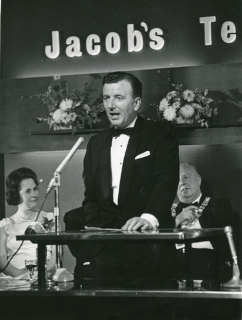
(Pictured: Photograph of director of Jacob’s Biscuits, Gordon Lambert, speaking from a podium at the first Jacob’s Television Awards. The Lord Mayor of Dublin, James O’Keefe, is sitting behind Lambert. The awards ceremony takes place at the Bishop Street factory, Dublin.)

Leave a comment

Death of Surrealist Sculptor F. E. McWilliam

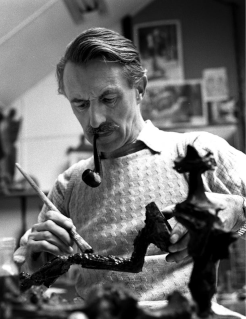
Frederick Edward McWilliam CBE RA, Northern Irish surrealist sculptor, dies in London on May 13, 1992. He works chiefly in stone, wood and bronze. His style of work consists of sculptures of the human form contorted into strange positions, often described as modern and surreal.

McWilliam is born in Banbridge, County Down, on April 30, 1909, the son of Dr. William McWilliam, a local general practitioner. Growing up in Banbridge has a great influence on his work. He makes references to furniture makers such as Carson the Cooper and Proctors in his letters to his friend, Marjorie Burnett.

McWilliam attends Campbell College in Belfast and later attends Belfast College of Art from 1926. After 1928, he continues to study at the Slade School of Fine Art in London. He originally intends to become a painter, but influenced by Alfred Horace Gerrard, head of the sculpture department at the Slade, and by Henry Moore whom he meets there, he turns to sculpture. He receives the Robert Ross Leaving Scholarship which enables him and his wife, Beth (née Crowther), to travel to Paris where he visits the studio of Constantin Brâncuși.

During the first year of World War II, he joins the Royal Air Force and is stationed in England for four years where he is engaged in interpreting aerial reconnaissance photographs. He is then posted to India. While there he teaches art in the Hindu Art School in New Delhi.

After his return from India, McWilliam teaches for a year at the Chelsea School of Art. He is then invited by A. H. Gerrard to teach sculpture at the Slade. He continues in this post until 1968.

The 1950s see McWilliam receive many commissions including the Four Seasons Group for the Festival of Britain exhibition in 1951. A major commission in 1957 is Princess Macha for Altnagelvin Area Hospital in Waterside, Derry.

During the Northern Ireland Troubles McWilliam produces a series of bronzes in 1972 and 1973 known as Women of Belfast in response to the bombing at the Abercorn Tea-Rooms.

In 1964 McWilliam is awarded an Honorary Doctor of Letters from Queen’s University Belfast. In 1966 he is appointed CBE and in 1971 he wins the Oireachtas Gold Medal. He is represented in many public collections, including the Museum of Modern Art in New York City and Tate Britain in London. In 1984 the National Self-Portrait Gallery purchases a McWilliam self-portrait amongst acquisitions from fellow Northerners Brian Ballard, Brian Ferran and T. P. Flanagan.

The Arts Council of Northern Ireland organises a retrospective of his work in 1981 and a second retrospective is shown at the Tate Gallery in 1989 for his 80th birthday.

McWilliam continues carving up to his death. He dies of cancer in London on May 13, 1992.

In September 2009 Banbridge District Council opens a gallery and studio dedicated to the work of and named after McWilliam.


Leave a comment

Birth of F. E. McWilliam, Surrealist Sculptor

Frederick Edward McWilliam CBE RA, Northern Irish surrealist sculptor, is born in Banbridge, County Down, on April 30, 1909. He works chiefly in stone, wood and bronze. His style of work consists of sculptures of the human form contorted into strange positions, often described as modern and surreal.

McWilliam is the son of Dr. William McWilliam, a local general practitioner. Growing up in Banbridge has a great influence on his work. He makes references to furniture makers such as Carson the Cooper and Proctors in his letters to his friend, Marjorie Burnett.

McWilliam attends Campbell College in Belfast and later attends Belfast College of Art from 1926. After 1928, he continues to study at the Slade School of Fine Art in London. He originally intends to become a painter, but influenced by Alfred Horace Gerrard, head of the sculpture department at the Slade, and by Henry Moore whom he meets there, he turns to sculpture. He receives the Robert Ross Leaving Scholarship which enables him and his wife, Beth (née Crowther), to travel to Paris where he visits the studio of Constantin Brâncuși.

During the first year of World War II, he joins the Royal Air Force and is stationed in England for four years where he is engaged in interpreting aerial reconnaissance photographs. He is then posted to India. While there he teaches art in the Hindu Art School in New Delhi.

After his return from India, McWilliam teaches for a year at the Chelsea School of Art. He is then invited by A. H. Gerrard to teach sculpture at the Slade. He continues in this post until 1968.

The 1950s see McWilliam receive many commissions including the Four Seasons Group for the Festival of Britain exhibition in 1951. A major commission in 1957 is Princess Macha for Altnagelvin Area Hospital in Waterside, Derry.

During the Northern Ireland Troubles McWilliam produces a series of bronzes in 1972 and 1973 known as Women of Belfast in response to the bombing at the Abercorn Tea-Rooms.

In 1964 McWilliam is awarded an Honorary Doctor of Letters from Queen’s University Belfast. In 1966 he is appointed CBE and in 1971 he wins the Oireachtas Gold Medal. He is represented in many public collections, including the Museum of Modern Art in New York City and Tate Britain in London. In 1984 the National Self-Portrait Gallery purchases a McWilliam self-portrait amongst acquisitions from fellow Northerners Brian Ballard, Brian Ferran and T. P. Flanagan.

The Arts Council of Northern Ireland organises a retrospective of his work in 1981 and a second retrospective is shown at the Tate Gallery in 1989 for his 80th birthday.

McWilliam continues carving up to his death. He dies of cancer in London on May 13, 1992.

In September 2009 Banbridge District Council opens a gallery and studio dedicated to the work of and named after McWilliam.


Leave a comment

Birth of Gordon Lambert, Businessman, Senator & Art Collector

Charles Gordon Lambert, Irish businessman, senator and art collector, is born on April 9, 1919, in the family home at Highfield Road, Rathmines, Dublin, the youngest of four sons of Robert James Hamilton Lambert, a veterinarian and renowned cricketer, and his wife Nora (née Mitchell). His eldest brother, Noel Hamilton “Ham” Lambert, is a versatile sportsman and noted veterinary practitioner.

Lambert is educated at Sandford Park School, Dublin, and at Rossall School, Lancashire. He is steered by his mother toward a career in accountancy for which he prepares by studying commerce at Trinity College Dublin (TCD). Graduating in 1940, he joins the accounting firm Stokes Brothers and Pim, qualifying Associate Chartered Accountant in 1943. In 1944, after auditing biscuit manufacturers W. & R. Jacob and Co. Ltd, one of Ireland’s largest and most prestigious industrial companies, he is offered and accepts a £300 a year job at Jacob’s as assistant accountant.

In 1953, Lambert becomes Jacob’s chief accountant as the management grooms him for an executive career. During 1948–56, Jacob’s suffers from profit and price controls, lack of capital investment and complacency brought about by the absence of competition. The entry of Boland’s Bakery into the Irish biscuit market in 1957 is exploited by Lambert who urges the alarmed board, which has long regarded advertising as vulgar, to market its products more vigorously. This assertiveness yields his advancement to the position of commercial manager in 1958. A year later he becomes the first non-member of the Bewley and Jacob families to be appointed to the board.

Between 1959 and 1970, biscuit consumption in Ireland doubles for which Lambert can claim much credit. Recognising that the advent of self-service stores means that manufacturers can no longer rely on retailers to sell their products, he pioneers advanced promotional techniques in Ireland, particularly the use of marketing surveys and of mass advertising in newspapers, on radio and on the emerging medium of television. To further accord with retailers’ preferences, Jacob’s drives the widespread packaging of biscuits in airtight packets rather than tins, and also introduces a striking red flash logo for its packets. His interest in contemporary art enables him to contribute directly to Jacob’s packaging designs.

Lambert is appointed to the board of the Electricity Supply Board (ESB) in 1964, a position he holds until 1977, and serves as president of the National Agricultural and Industrial Development Association (NAIDA) in 1964–65, spearheading a “Buy Irish” campaign. His involvement with NAIDA dates to the mid-1950s and leads to his friendship with Jack Lynch, Minister for Industry and Commerce. This relationship and his admiration for Seán Lemass incline him toward Fianna Fáil. He also believes the party is the one most likely to deliver economic growth.

In 1977, Lambert is appointed to Seanad Éireann by Taoiseach Jack Lynch. He sits as an independent but assures Lynch he will broadly support the government. Dismayed by Ireland’s economic uncompetitiveness, he uses this platform to bemoan the state’s financial profligacy and failure to control inflation, and the indifference of Irish politicians towards the business community, contending that Irish industrialists suffer and need to learn from the expert lobbying of the indigenous agricultural sector and of large multi-national companies based in Ireland. He also articulates his social liberalism, desire for peaceful reconciliation in Northern Ireland and support for cultural and environmental causes. But his commitment to the Seanad wanes as he grasps its irrelevance. When Lynch resigns in December 1979, Lambert joins the Fianna Fáil party in a futile bid to preserve his political influence.

Following Jacob’s takeover of Boland’s Bakery in 1966, Lambert becomes joint managing director of a new entity, Irish Biscuits Ltd, the manufacturing and trading company for the Boland’s and Jacob’s biscuits operations. W. & R. Jacob and Co. Ltd becomes a holding company. In 1968, he becomes the sole managing director. From 1977 he begins withdrawing from the active administration of the company, relinquishing his managing directorship in 1979 to become chairman.

Initially, Lambert views art as a hobby but he comes to see it as a calling, drawing inspiration from Sir William Basil Goulding, his predecessor as Ireland’s leading collector and advocate of modern art. From the late 1970s he serves as head of the Contemporary Irish Art Society (CIAS) and on the Arts Council of Northern Ireland, the advisory committee of the Dublin Municipal Gallery, the board of the National Gallery of Ireland, the editorial board of the Irish Arts Review and the international council of the Museum of Modern Art (MoMA) in New York City.

The Irish Museum of Modern Art (IMMA) opens in 1991 and receives through the medium of the Gordon Lambert Trust some 212 works, which form the centerpiece of its collection. Thereafter Lambert gifts another 100 works to IMMA. He sits on IMMA’s board from 1991, and the west wing of the museum is named after him in 1999.

Despite being diagnosed with Parkinson’s disease in 1988, Lambert remains relatively active and plays golf into his 80s. In 1999 he receives an honorary LLD from TCD. From 1997, he relies increasingly on Anthony Lyons, an acquaintance of longstanding, to care for him. His last years are overshadowed by the collapse in autumn 2002 of his close but complex relationship with his family. Thereafter he shuns his relations and changes his will, granting Lyons a substantial portion of his estate while curtailing the amount to be received by his family. He dies in a Dublin hospital on January 27, 2005. Relatives challenge his final will in the High Court in 2009 but it is upheld.

(Pictured: Photograph of director of Jacob’s Biscuits, Gordon Lambert, speaking from a podium at the first Jacob’s Television Awards. The Lord Mayor of Dublin, James O’Keefe, is sitting behind Lambert. The awards ceremony takes place at the Bishop Street factory, Dublin.)


Leave a comment

Birth of Cecil King, Painter & Collector

Cecil King, painter and collector, is born on February 22, 1921, at Rathdrum, County Wicklow.

King is the son of Henry King, businessman, of Rathdrum, and Susan King (née Crowe). He is educated at the Church of Ireland Ranelagh School, Athlone, and at Mountjoy School, Clontarf, Dublin (1936–39). Subsequently he joins the printing firm of W. & S. McGowan in Dundalk, where he goes on to become a director. During the 1940s his interest in amateur drama leads him to take classes at the Gaiety School of Acting in Dublin, where his fellow students include Milo O’Shea and Eamonn Andrews. Around this time, he is also involved in An Óige (the Irish Youth Hostel Association), in which he serves as honorary national secretary and honorary treasurer. This involvement leads him to travel extensively from the late 1940s around Europe, where he visits many major art museums and galleries.

King begins to acquire works of art, by both European and Irish artists, and by the mid-1950s he has amassed one of the most important collections of modern art in Ireland. Around 1954 he himself begins to paint, under the guidance of Barbara Warren and the English artist Neville Johnson. In his early work he focuses on urban scenes, often based on the area of Ringsend, Dublin, where he uses subdued tones to produce poetic images of a sombre mood. Even here his interest in the formal qualities of painting – such as the flatness of the picture surface and the juxtaposition of areas of colour on it, which becomes a defining feature of his art – is evident. In 1964 he leaves his successful business career behind in order to devote himself entirely to art, a bold move considering the limited audience for modern art that exists in Ireland at the time. In his own words he recalls how “Painting was what I wanted to do, I realised I didn’t need a car. I could do without an awful lot of things.” (Sunday Independent, November 7, 1982)

By this time, King is working in a fully abstract style. However, he still draws his inspiration from the external world, particularly the milieu of the circus. A painting such as Trapeze (1976; Allied Irish Bank collection) shows how he responds to acrobatic performance, not in any literal or figurative sense, but to the tensions and balances inherent within it. The overall effect is to convey to the viewer the essence of anticipation of the performance. Indeed, his works can create an almost physical sense of involvement on the part of the viewer. This is especially true of his Berlin Suite, a series of screen-prints produced as a result of a visit to East Berlin and published by Editions Alecto of London (1970). He is also inspired to produce a number of paintings on this theme of the claustrophobia of the divided city. Ultimately, he aspires to create works which, with their economy and restraint, achieve a meticulously balanced harmony. This concern leads him, in such works as the Baggot Street Series, to move away from even the most veiled figurative references, evidence for the fact that he constantly strives to further his artistic explorations.

King often works seven days a week. This quiet determination contributes in no small part to the international standing he soon achieves, as does his prolific record as an exhibitor. Writing a foreword to an exhibition of his work at Kilkenny in 1975, the critic William Packer finds that King’s art “confounds the expectations we might have of Irish art, for it is far from local in ambition, accomplishment, and seriousness.” He mounts over twenty-five one-man exhibitions and contributes to a large number of group shows in Ireland and abroad. A significant proportion of his output is to be found in galleries in Europe and the United States, including the Museum of Modern Art, New York, and the Tate Gallery, London. He is also represented in the major public and corporate collections in Ireland, such as the Irish Museum of Modern Art, Ulster Museum, Trinity College Dublin (TCD), Crawford Municipal Gallery, Dublin City Gallery The Hugh Lane, Arts Council, Aer Lingus, Bank of Ireland, Allied Irish Bank, and ESB. In fact, King, with his hard-edge abstract style, is one of the very few artists working in Ireland at the time whose work is comparable to that of the major (principally American) international exponents of abstraction. The term “hard-edge,” applied to King’s style, may however belie the subtlety he could achieve in terms of his handling of colour and texture. This is particularly true of his works in the media of pastel and tapestry, while his last paintings show a tendency towards more expressive brushwork and a more complex approach to colour.

King enjoys a happy relationship with Oliver Dowling from 1960 to the time of his death, at Dún Laoghaire, County Dublin, on April 7, 1986, having suffered a heart attack just three days before an exhibition of his work is due to open in Dublin at the Oliver Dowling Gallery. His legacy is not alone artistic: he also makes a significant contribution to the promotion of modern art in Ireland in his capacity as a member of the organising committee for the Rosc exhibition since its inception in the 1960s, where his wide knowledge of international art is much respected. A member of Aosdána, he twice serves as commissioner for the Department of Foreign Affairs cultural committee. He is also generous in his encouragement of young artists, whose work he regularly adds to his own collection.

(From: “King, Cecil” by Rebecca Minch, Dictionary of Irish Biography, http://www.dib.ie, May 2012 | Pictured: Abstract, Oil on Canvas by Cecil King)


Leave a comment

Birth of Irish Artist Patrick Scott

patrick-scottPatrick Scott, Irish artist, is born in Kilbrittain, County Cork, on January 24, 1921. He is perhaps best known for his gold paintings, abstracts incorporating geometrical forms in gold leaf against a pale tempura background. He also produces tapestries and carpets.

He has his first exhibition in 1944, but trains as an architect and does not become a full-time artist until 1960. He works for fifteen years for the Irish architect Michael Scott, assisting, for example, in the design of Busáras, the central bus station in Dublin. He is also responsible for the orange livery of Irish intercity trains.

His paintings are in several important collections including the Museum of Modern Art in New York City. He wins the Guggenheim Award in 1960 and represents Ireland in the 1960 Venice Biennale. The Douglas Hyde Gallery holds a major retrospective of his work in 1981 and the Hugh Lane Gallery in Dublin holds a major survey in 2002. His works are distinguished by their purity and sense of calm, reflecting his own interest in Zen Buddhism.

In October 2013, Scott weds his companion of 30 years, Eric Pearce, in a civil ceremony at the Dublin Registry Office.

On July 11, 2007, Scott, who is a founding member of Aosdána, is conferred with the title of Saoi, the highest honour that can be bestowed upon an Irish artist. The President of Ireland, Mary McAleese, makes the presentation, placing a gold torc, the symbol of the office of Saoi, around his neck. No more than seven living members may hold this honour at any one time.

Patrick Scott dies in Ballsbridge, Dublin, on February 14, 2014 at the age of 93. He is survived by his partner.