seamus dubhghaill

Promoting Irish Culture and History from Little Rock, Arkansas, USA


Leave a comment

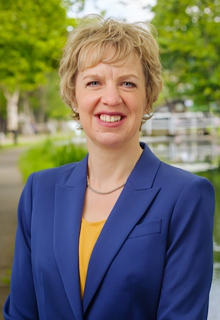
Birth of Michael Noonan, Former Fine Gael Politician

Michael Noonan, former Fine Gael politician, is born in Limerick, County Limerick, on May 21, 1943. He has been a member of every Fine Gael cabinet since 1982, serving in the cabinets of Garret FitzGeraldJohn Bruton and Enda Kenny.

The son of a local school teacher, Noonan is raised in Loughill, County Limerick. He is educated at the local National School and St. Patrick’s Secondary School in Glin, before studying to be a primary school teacher at St. Patrick’s CollegeDrumcondra, Dublin. He subsequently completes a BA and H.Dip. in English and Economics at University College Dublin (UCD). He begins to work as a secondary school teacher in Dublin. He develops an interest in politics from his mother, whose family had been heavily involved in Fine Gael at the local level in Limerick, and joins the Dublin branch of the party after graduating from university.

Having been involved in the local Fine Gael organisation in Limerick since the late 1960s, Noonan first holds political office in 1974, when he is elected as a member of Limerick County Council. Having built up a local profile he contests the 1981 Irish general election for the party and secures a seat in Limerick East. Upon taking his Dáil seat, he becomes a full-time politician, giving up his teaching post and resigning his seat on Limerick County Council. Though Fine Gael forms a coalition government with the Labour Party, as a first time Teachta Dála (TD), he remains on the backbenches. He serves as a TD from 1981 to 2020.

Noonan serves Minister for Justice from 1982 to 1986, Minister for Energy from January 1987 to March 1987, Minister for Industry and Commerce from 1986 to 1987, Minister for Health from 1994 to 1997, Leader of the Opposition and Leader of Fine Gael from 2001 to 2002, and Minister for Finance from 2011 to 2017.

In May 2017, Noonan announces he will be stepping down as Minister for Finance in the coming weeks when a new Taoiseach was appointed, and as a member of the Dáil at the next general election.

Noonan marries Florence Knightley, a native of CastlemaineCounty Kerry and a primary school teacher, in 1969. They have three sons (Tim, John and Michael) and two daughters (Orla and Deirdre). In May 2010, Noonan appears on RTÉ‘s The Frontline to talk about his wife’s battle with Alzheimer’s disease. Florence Noonan dies on February 23, 2012 of pneumonia.


Leave a comment

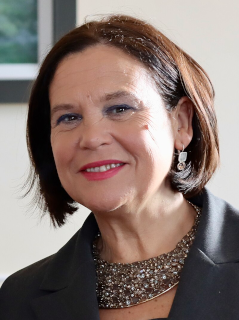
Birth of Mary Lou McDonald, Current President of Sinn Féin

Mary Louise McDonald, Irish politician and President of Sinn Féin since February 2018, is born in Dublin on May 1, 1969.

McDonald is born into a middle-class family in south Dublin. Her father Patrick McDonald, a builder and surveyor, and her mother Joan, separate when she is nine years old, and she stays with her mother in Rathgar. She has three siblings, one older and two younger. Her great-uncle, James O’Connor, was a member of the Anti-Treaty IRA and was executed at the Curragh Camp during the Irish Civil War.

McDonald is educated at Rathgar National School and at the Catholic all-girls, Notre Dame des Missions in Churchtown, South Dublin, where she is involved in debating. She then attends Trinity College Dublin (TCD), the University of Limerick and Dublin City University (DCU), studying English Literature, European Integration Studies and Human Resource Management.

She works as a researcher for the Institute of European Affairs, a consultant for the Irish Productivity Centre, a human resources consultancy that is jointly operated by Ibec and Irish Congress of Trade Unions (ICTU), and a trainer in the Partnership Unit of the Educational and Training Services Trust.

McDonald starts her political career by first joining Fianna Fáil in 1998 but leaves the party after a year due to core policy differences, particularly in relation to Northern Ireland and social justice. She quickly realises that Sinn Féin is a more appropriate party for her Republican views after meeting Sinn Féin members through the Irish National Congress.

She first runs for office at the 2002 Irish general election when she unsuccessfully contests the Dublin West constituency for Sinn Féin, polling 8.02% of first preference votes.

In 2004, McDonald becomes Sinn Féin’s first Member of the European Parliament (MEP) in Ireland, when she is elected at the 2004 European Parliament election in Ireland for the Dublin constituency, receiving over 60,000 first preference votes. She serves until 2009 and is a prominent member of the Employment and Social Affairs committee and Civil Liberties committee.

McDonald is an unsuccessful candidate in the Dublin Central constituency at the 2007 Irish general election. In 2009 she becomes the vice president of Sinn Féin.

McDonald contests the Dublin Central constituency again at the 2011 Irish general election, this time picking up 13.1% of first preference votes. She is successful in taking the last seat in the constituency. Following the election, she becomes Sinn Féin’s Spokesperson for Public Expenditure and Reform and is a member of the Public Accounts Committee from then until 2017.

After her re-election to the Dáil at the 2016 Irish general election, in which she tops the poll in Dublin Central, she becomes Sinn Féin’s All-Ireland Spokesperson for Mental Health and Suicide Prevention, which she holds until being elected president of Sinn Féin in 2018.

At a Sinn Féin party conference on November 18, 2017, Gerry Adams is re-elected party leader but announces that he will ask party leadership to call for a special Ard Fheis to be held within three months to choose a new president, and that he will not stand for re-election as TD for the Louth constituency in the next election.

At the close of nominations to succeed Adams on January 20, 2018, McDonald is announced as the president-elect of Sinn Féin, as she is the sole nominee to enter the race. She is confirmed as president at a special Ard Fheis on February 10, 2018, in Dublin.

McDonald is nominated as Taoiseach on February 20, 2020, but is defeated 45 to 84. On June 26, 2020, Fianna Fáil, Fine Gael, and the Green Party form a coalition government, leaving Sinn Féin as the largest opposition party, and McDonald as Leader of the Opposition. She dismisses the coalition agreement as a “marriage of convenience,” and accuses Fianna Fáil and Fine Gael of conspiring to exclude Sinn Féin from government.

At the 2024 Irish general election, McDonald is re-elected to the Dáil topping the poll in Dublin Central with Sinn Féin increasing their seat share by two seats, remaining the second largest party by representation in the Dáil and attaining 19% of the first preference votes, a fall of 5.5% from 2020 and fall behind Fianna Fáil by 2.9% and Fine Gael by 1.8%.

McDonald is again nominated as Taoiseach on December 18, 2024, but is defeated 44 to 110.

McDonald’s husband, Martin Lanigan, works as a gas control superintendent for the emergency dispatch division of Gas Networks Ireland, a state infrastructure provider. They have two children and live in Cabra, Dublin.


Leave a comment

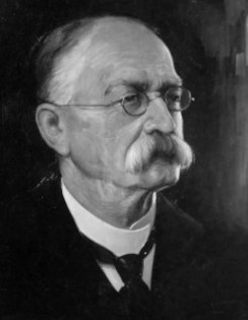
Birth of John Henry MacFarland, Irish Australian University Chancellor

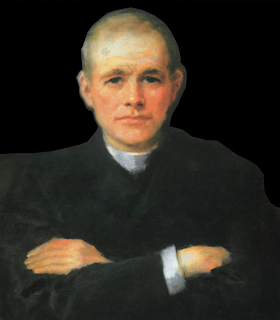
Sir John Henry MacFarland, Irish Australian educationist and churchman, is born in Omagh, County Tyrone, on April 19, 1851.

MacFarland is the elder son of John MacFarland, draper, and his second wife Margaret Jane, daughter of Rev. William Henry, a famous Covenanting Church minister. Both parents are devout Presbyterians, well educated, with strong intellectual interests.

MacFarland attends the local national school until he is 13 when he moves to the Royal Belfast Academical Institution. He is senior scholar in Mathematics and Natural Philosophy at Queen’s College, Belfast, where he is taught by John Purser. There he earns a BA in 1871 and MA in 1872. He goes on to St. John’s College, Cambridge, for three more years of undergraduate study of mathematics and physics. There he is elected a foundation scholar and earns a second BA, as 25th wrangler, in 1876. He also earns an MA there in 1879.

MacFarland teaches at Repton School in Derbyshire from 1876 to 1880. A decade later, his younger brother Robert, also a Queen’s Belfast and Cambridge mathematics graduate, also teaches at Repton.

The emissaries of the provisional council of Ormond College in the University of Melbourne are impressed with MacFarland. He negotiates a salary of £600 plus the profit from “farming” the college. On March 18, 1881, he becomes the first master of Ormond College, passing the opening-day ordeal in the presence of 440 Presbyterian grandees, clergy and their ladies.

On Sir John Madden‘s death in 1918, MacFarland becomes chancellor of the university and is knighted in 1919. He presides over a period of considerable expansion, working closely with Sir John Monash, vice-chancellor from 1923, and Sir James Barrett.

MacFarland is immensely and properly proud of his careful financial management, but the erstwhile reformers are hardly tender enough in balancing economy with humanity. The professors become increasingly restive about the limited responsibility for academic matters and allocation of resources council allows them. When the issues come to a head in 1928, MacFarland’s prestige is too much for the professoriate who have great respect for his administrative capacity, humanity and reasonableness. Even in his eighties he does not retire as chancellor, probably wisely concluding that his likely successor, Barrett, will prove to be too divisive.

In 1892, MacFarland receives and honorary LLD degree from the Royal University of Ireland.

MacFarland’s reputation as a business manager leads to his directorship from about 1905 of the National Mutual Life Association, serving as chairman from 1928, and of the Trustees Executors and Agency Company. From 1913 he represents the Trustees Executors on the Felton Bequests Committee. He is also the popular chairman from its foundation in 1908 of the Alexandra Club Co. as the members of the leading female social club prefer men to control their finances.

In his younger days MacFarland is a vigorous cyclist and walker in the Australian Alps, Tasmania and New Zealand. By the age of 40 he is spending a month each summer trout-fishing in the South Island of New Zealand. He is also a regular golfer at Royal Melbourne and belongs to the Melbourne Club.

MacFarland dies in Melbourne, Victoria, Australia, on July 22, 1935. His remains are cremated following a service at Scots’ Church. The university council minutes:

“Few men in any community, and almost no man in this community, can have won such universal esteem. No evil was ever spoken of him or could be thought of in connection with him; before him evil quailed. The greatest disciple of the greatest of the Greeks called his dead master ‘our friend whom we may truly call the wisest, and the justest, and the best of all men we have ever known’. And many of us can sincerely say that of John Henry MacFarland.”

(From: “Sir John Henry MacFarland (1851-1935)” by Geoffrey Serle, Australian Dictionary of Biography, http://www.adb.anu.edu.au, 1986)


Leave a comment

Death of Peter Farrell, Irish Footballer

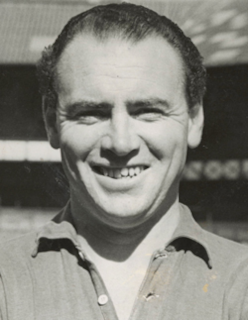
Peter Desmond Farrell, Irish footballer who plays as a right-half for, among others, Shamrock Rovers, Everton and Tranmere Rovers, dies in Dublin on March 16, 1999. As an international, he also plays for both Ireland teams – the FAI XI and the IFA XI. His playing career follows a similar path to that of Tommy Eglington. As well as teaming up at international level, they also play together at three clubs.

Farrell is born on August 16, 1922, and raised in the Convent Road area of Dalkey, County Dublin, and is educated at Harold Boy’s National School and the Christian Brothers in Dún Laoghaire, from which he wins a scholarship. He is playing football with Cabinteely Schoolboys when spotted by a Shamrock Rovers scout and subsequently joins Rovers on his 17th birthday in August 1939. Among his early teammates is the veteran Jimmy Dunne. With a team that also includes Jimmy Kelly, Tommy Eglington, Jimmy McAlinden and Paddy Coad, he later helps Rovers reach three successive FAI Cup finals. They win the competition in 1944 and 1945 and finish as runners up in 1946.

In July 1946, together with Tommy Eglington, Farrell signs for Everton. In eleven seasons with the club, he plays 421 league games and scores 14 goals. He also plays a further 31 games in the FA Cup and scores an additional four goals. In 1951 he is appointed Everton captain and during the 1953–54 season leads them to the runners up place in the Second Division, thus gaining promotion to the First Division. During his time with the club his teammates, apart from Eglington, also include Alex Stevenson, Peter Corr, Harry Catterick, Wally Fielding, Tommy E. Jones, Brian Labone and Dave Hickson. He is never sent off during his time at Goodison Park.

Farrell leaves Everton in October 1957 and follows Tommy Eglington to Tranmere Rovers where he becomes player-manager. He plays 114 league games for Tranmere, before leaving in December 1960. After a time as manager at Sligo Rovers, he becomes manager of Holyhead Town and, helped by a number of former Everton and Tranmere players, guides them to the Welsh Football League (North) title.

In September 1967, Farrell signs a one-year contract to manage St. Patrick’s Athletic F.C. He manages the Pats in their 1967–68 Inter-Cities Fairs Cup ties against FC Girondins de Bordeaux but resigns in March 1968.

When Farrell begins his international career in 1946 there are, in effect, two Ireland teams, chosen by two rival associations. Both associations, the Northern Ireland–based IFA and the Ireland–based FAI claim jurisdiction over the whole of Ireland and select players from the entire island. As a result, several notable Irish players from this era, including Farrell, play for both teams.

Farrell makes 28 appearances and scores three goals for the FAI XI. While still at Shamrock Rovers, he captains the FAI XI on his international debut on June 16, 1946, against Portugal. On September 21, 1949, together with Johnny Carey and Con Martin, he is a member of the FAI XI that defeats England 2–0 at Goodison Park, becoming the first non-UK team to beat England at home. After Martin puts the FAI XI ahead with a penalty in the 33rd minute, Farrell makes victory certain in the 85th minute. Tommy O’Connor slips the ball to Farrell and as the English goalkeeper Bert Williams advances, he lofts the ball into the unguarded net. He scores his second goal for the FAI XI on October 9, 1949, a in 1–1 draw with Finland, a qualifier for the 1950 FIFA World Cup. His third goal comes on May 30, 1951, as Farrell scores the opening goal in a 3–2 win against Norway.

Farrell also makes seven appearances for the IFA XI between 1946 and 1949. On November 27, 1946, he makes his debut for the IFA XI in a 0–0 draw with Scotland. Together with Johnny Carey, Con Martin, Bill Gorman, Tommy Eglington, Alex Stevenson and Davy Walsh, he is one of seven players born in the Irish Free State to play for the IFA XI on that day. The draw helps the team finish as runners-up in the 1946-47 British Home Championship. He also helps the IFA XI gain some other respectable results, including a 2–0 win against Scotland on October 4, 1947, and a 2–2 draw with England at Goodison Park on November 5, 1947.

After returning to Ireland following his retirement, Farrell settles in Dublin and follows his father into the insurance business. He dies on March 16, 1999, following a long illness. He is buried in Dean’s Grange Cemetery in Deansgrange, Dún Laoghaire–Rathdown, County Dublin.


Leave a comment

Birth of Noel Cantwell, Irish Footballer & Cricketer

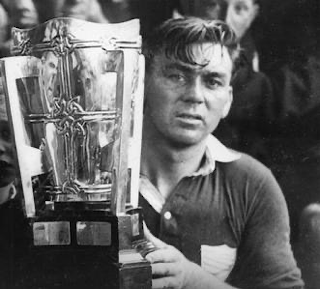
Noel Euchuria Cornelius Cantwell, Irish football player and sometime cricketer, is born at 2 Illen Villas, Mardyke Walk, Cork, County Cork, on February 28, 1932.

Cantwell is one of five sons and a daughter of Michael Cantwell, a master tailor, and his wife Hannah (née Daly). He is educated at St. Joseph’s national school and the Presentation Brothers College in Cork. He plays as a full-back for Western Rovers, Cork Athletic, West Ham United and Manchester United.

While at West Ham, Cantwell features in the London XI side that competes in the 1955–58 Inter-Cities Fairs Cup final on May 1, 1958. He captains the Hammers to winning the Division Two championship in the 1957–58 season thereby leading the club into the topflight for the first time since 1932.

In November 1960, Cantwell joins Manchester United for £29,500 which at the time is a record for a full-back. He helps the club win the 1965 and 1967 league titles and captains United when winning the 1963 FA Cup Final – just as his fellow countryman Johnny Carey had done in United’s previous FA Cup win fifteen years earlier.

Cantwell also serves as Chairman of the Professional Footballers’ Association.

During his International career (1953-67), Cantwell wins 36 full International caps for the Republic of Ireland, typically playing at left full-back and on several occasions at centre-forward. He makes his debut against Luxembourg in October 1953, with his final appearance coming away to Turkey in February 1967. He scores fourteen goals including five from penalties and also captains the Republic on several occasions including a match against England at Wembley Stadium.

In his first managerial role at Coventry City, Cantwell has the onerous task of following Jimmy Hill who had taken the club into the First Division for the first time in their history. He narrowly keeps the Sky Blues in the top in his first two seasons before taking them to a sixth-place finish in 1969–70, earning them qualification for the Inter-Cities Fairs Cup (a year before it is replaced by the UEFA Cup).

Cantwell departs Highfield Road on March 12, 1972, but within seven months is back in English football as manager of Peterborough United. He helps Peterborough win the Fourth Division title in his first full season as manager, before leaving on May 10, 1977, to manage the New England Tea Men.

Cantwell returns to Peterborough on November 19, 1986, for a second stint as manager, remaining in this role until he becomes general manager on July 12, 1988. He is general manager at London Road for a year until he quits football to become licensee of the New Inn at Peterborough, where he remains for ten years until he retires in 1999. He also is landlord of the Bull and Swan in Stamford, Lincolnshire.

Cantwell also plays cricket for Cork Bohemians Cricket Club and Ireland as a left-handed batsman and a right-arm medium bowler. He plays five times for Ireland, making his debut in what is his sole first-class match versus Scotland at Edinburgh in 1956, scoring 31 and 17. His last match for Ireland is against Lancashire in July 1959.

Cantwell dies from cancer at Addenbrooke’s Hospital, Cambridge, not far from his home in Peterborough, on September 8, 2005. He is survived by his wife Maggie, a native of Belfast, and two daughters, Liz and Kate. A 22-year-old son, John Robert, is killed in a car crash thirteen years earlier.

Cantwell’s former teams each hold a moment of silence for him before their next matches.


Leave a comment

Birth of Peadar O’Donnell, Irish Republican Politician & Writer

Peadar O’Donnell, Irish republican, socialist activist, politician, writer and one of the foremost radicals of 20th-century Ireland, is born on February 22, 1893, in Meenmore, near Dungloe, County Donegal.

O’Donnell is the youngest among six sons and three daughters of Biddy and James O’Donnell. He is greatly influenced by his upbringing in the Rosses, in northwest Donegal, one of the poorest and most remote parts of Ireland. His father, a popular local fiddler, earns a living through his smallholding, seasonal labouring in Scotland, and winter work in a local corn mill. His mother, who comes from a radical labour and nationalist political background, works in a local cooperative store. He attends Rampart national school and Roshine national school, near Burtonport, where he is a monitor for four years. In 1911 he wins a scholarship to attend St. Patrick’s College in Drumcondra, Dublin, and returns in 1913 to the Rosses, where he spends two years teaching on the islands of Inishfree. In 1915 he is appointed head of Derryhenny national school, near Dungloe, and the following year becomes principal of a national school on the island of Arranmore, where he begins to write.

O’Donnell had long been concerned by the poor conditions of the local ‘tatie-hokers’ (potato pickers) who migrate annually to Scotland. In the summer of 1918, he travels there to help organise the Scottish Farm Servants’ Union. While there he is influenced by left-wing radicals such as Willie Gallacher, later a communist Member of Parliament (MP), and Emanuel ‘Manny’ Shinwell, later Baron Shinwell. In September 1918, against a background of rising labour militancy, he leaves teaching to become a full-time organiser for the Irish Transport and General Workers’ Union (ITGWU) in the west Ulster area. The following year he organises one of Ireland’s first “soviets” when the attendants and nurses of the Monaghan District Lunatic Asylum occupy the grounds and appoint O’Donnell as governor until their demands are met.

In early 1919 O’Donnell joins the Irish Republican Army (IRA) in Monaghan, resigning from the ITGWU for full-time IRA service in late 1920. He leads the 2nd Battalion, Donegal IRA, from the summer of 1920. In December 1920 he goes “on the run” and leads a flying column in west Donegal until May 1921, when he is wounded. Regarded as insubordinate and militarily inexperienced, he is unpopular among the other senior officers of the 1st Northern Division. He, in turn, is disappointed by the lack of social radicalism among the nationalist leadership. He opposes the Anglo-Irish Treaty, is placed in command of the minority anti-treaty 1st Northern Division and is a member of the IRA executive that occupies the Four Courts in Dublin in defiance of the provisional government.

Arrested in June 1922, O’Donnell shares a prison cell with Liam Mellows and influences his radical “Notes from Mountjoy,” an important document for subsequent left-wing republicans. He spends the next two years in various prisons and internment camps. His execution is widely expected to follow those of December 8, 1922. In August 1923, he is elected as a Sinn Féin Teachta Dála (TD) for Donegal in the general election called after the end of the Irish Civil War. He goes on hunger strike for forty-one days in late 1923 and succeeds in escaping from the Curragh in March 1924. In June 1924, while on the run, he marries Lile O’Donel, a wealthy Cumann na mBan activist who had smuggled communications for republican prisoners. O’Donel, a radical and member of the Communist Party, is the daughter of Ignatius O’Donel, a prominent landowner from Mayo. They have no children but raise their nephew, Peadar Joe, as their own son after the death in New York of O’Donnell’s brother Joe.

O’Donnell begins writing seriously while in jail and remains a prolific writer, journalist, and editor until the 1960s. His first novel, Storm, set in the Irish War of Independence, is published in 1925. One of his most highly regarded books, Islanders, is published in 1928. Adrigoole, like Islanders a story of poverty and starvation in rural Ireland, is published the following year. The Knife (1930) and On the Edge of the Stream (1934) soon follow. The most significant of his later novels is probably The Big Windows (1954). Foremost among his qualities as a writer is his empathy for the people, life, and landscape of rural Ireland. But his novels have been criticised for their slow pace, excessive detail, and didactic nature. He claims his writing is incidental to his political activism. His trilogy of autobiographical non-fiction, The Gates flew Open (1932), Salud! An Irishman in Spain (1936), and There Will Be Another Day (1963), which respectively concern the Irish Civil War, his activism during the Spanish Civil War, and his role in the land annuities agitation, remain highly regarded. His other important literary achievement is with The Bell, an innovative literary and political magazine which plays a useful dissenting role in an insular and conservative period. He founds The Bell with the writer Seán Ó Faoláin in 1940 and edits it from 1946 until it ceases publication in 1954.

O’Donnell exercises an influential role in the interwar IRA, particularly through his editorship of An Phoblacht (1926–29), which he attempts to divert from militarism to socialist agitation. His ultimate aim is for a thirty-two-county socialist republic. His most successful campaign is organising small farmers against the payment of land annuities to the government in the late 1920s and early 1930s. This campaign is later adopted by Fianna Fáil and contributes to their electoral success in 1932. He is less successful in radicalising the IRA. After the failure of Saor Éire, a left-wing IRA front which provokes clerical and popular hostility against the IRA, increasing tensions between the IRA’s left-wing and the leadership lead O’Donnell, along with Frank Ryan and George Gilmore, to split from the IRA to establish the short-lived Republican Congress in 1934.

Although O’Donnell claims he was never a Communist Party member, he plays a central role in forging links between republicans and the revolutionary left both in Ireland and internationally and invariably supports the communist party line at critical junctures. After the failure of Republican Congress, he takes up the cause of the Spanish republic. His championing of unpopular causes such as communism and Spain entail a good deal of frustration. He is physically attacked at political meetings and in 1932, despite having never visited the Soviet Union, loses a high-profile libel action against the Dominican Irish Rosary, which claim he had studied in Moscow‘s Lenin College. He is banned from entering the United States for several decades, although he maintains: “My relations with all the great powers continue to be friendly.”

O’Donnell continues to support radical campaigns until his death. He is an outspoken advocate of Irish emigrants. He is prominent in the Irish Campaign for Nuclear Disarmament and serves as its president in the early 1960s. He is a leading protester against the Vietnam War and a supporter of African anti-colonial movements such as that against apartheid. In later years he is involved in the “Save the west” campaign, highlighting the problems of the west of Ireland.

After several months of ill-health following a heart attack, O’Donnell dies in Dublin, aged 93, on May 13, 1986. He leaves instructions that there are to be “no priests, no politicians and no pomp” at his funeral, and those wishes are granted. He is cremated in Glasnevin Cemetery and his ashes are buried at his wife’s home in Swinford, County Mayo. Although he once remarked that every cause he fought for was a failure, he is now regarded as one of the most influential socialist republican theorists and an important voice of dissent in twentieth-century Ireland.

(From: “O’Donnell, Peadar” by Fearghal McGarry, Dictionary of Irish Biography, http://www.dib.ie)


Leave a comment

Birth of Brendan Bracken, Politician & Businessman

Brendan Bracken, Irish-born businessman, politician and a Minister of Information and First Lord of the Admiralty in Winston Churchill‘s War Cabinet, is born on February 15, 1901, in Church Street, Templemore, County Tipperary.

Bracken is the third child and second of three sons of Joseph Kevin (J. K.) Bracken and Hannah Bracken (née Ryan). The family moves to Kilmallock, County Limerick, in 1903, the year before his father’s death. By 1908, his mother takes the family to live in Glasnevin, a new suburb in north Dublin, and subsequently off the North Circular Road. He is educated in St. Patrick’s National School, Drumcondra, and at the Christian BrothersO’Connell School in North Richmond Street. He is a mischievous, delinquent child, one time throwing a schoolfellow into the Royal Canal. In February 1915 he is sent to Mungret College, a Jesuit boarding school near Limerick. He is not amenable to the regime and runs away on several occasions, finding accommodation in local hotels under a false name.

At the end of 1915 Bracken goes to Australia with £14 in his pocket. He is first based in Echuca, Victoria, where he is put up in a convent. Later he moves to other houses run by religious orders. A voracious reader, he claims that he is doing research for a life of Cardinal Patrick Francis Moran, and signs himself “Brendan Newman Bracken.” He seeks admission as a pupil to Riverview, the fashionable Jesuit school in Sydney, claiming that he had been educated at Clongowes Wood College. Unfortunately for him, a priest who had just come out from Clongowes exposes him. Opinionated and argumentative, he does not conceal his skepticism about the Catholic religion. For a time, he teaches in a Protestant school in Orange, New South Wales.

Bracken returns to Ireland in 1919. By this time his mother has remarried and is living with her new husband, Patrick Laffan, on a farm in Beauparc, County Meath. After a short stay there, he moves to Liverpool and finds employment as a teacher at the Liverpool Collegiate School, claiming that he had been to the University of Sydney. He teaches at the school for two terms in 1920, earning extra money as tutor to a young boy. With his savings he is able to gain admission to Sedbergh School, a public school in the town of Sedbergh in Cumbria, North West England, giving his name as Brendan Rendall Bracken, born 1904, and stating that his parents had perished in a bush fire in Australia, leaving him money to complete his education. He remains only one term but distinguishes himself by winning a prize for history. After Sedbergh, Bracken teaches at Rottingdean preparatory school and then at Bishops Stortford School. He cuts a flamboyant figure and drops the name of famous acquaintances with gay abandon. He stands over 6 feet and has a powerful presence and a domineering personality; his mop of red hair and pale freckled skin combine with black teeth to give him a bizarre appearance.

In 1922 Bracken moves to London. He takes charge of the Illustrated Review when its editor, Hilaire Belloc, resigns. Renamed English Life and covering political and social events, it affords Bracken an opportunity to meet prominent people, including J. L. Garvin, editor of The Observer. In autumn 1923 Garvin introduces him to Winston Churchill, who had lost his parliamentary seat in 1922 and decided to contact Leicester West in the 1923 United Kingdom general election. Bracken offers his services as campaign manager. The friendship between Churchill and Bracken is soon so close that Bracken is rumoured to be Churchill’s natural son. Churchill’s wife Clementine dislikes Bracken and discourages the friendship.

Meanwhile Bracken enjoys the life of a ubiquitous socialite and builds up his career in publishing. He becomes a director of Eyre & Spottiswoode in 1926, starting The Banker, a monthly magazine, for them, and acquiring the Financial News in 1928 and a half-share in The Economist. To these are added in due course the Investors Chronicle and The Practitioner. His success in business enables him to acquire a home in North Street in 1928, near the Houses of Parliament. He is driven about in a chauffeured Hispano-Suiza car.

In 1929, Bracken has himself adopted as conservative candidate for Paddington North, a marginal seat. After a hard-fought campaign characterised by minor violence provoked by Bracken’s intemperate language, he wins the seat by 528 votes. At one point a rumour is put about that Bracken is in reality a Polish Jew, which he has to disprove by exhibiting a copy of his birth certificate. His background is a subject of speculation among acquaintances, and in throwaway remarks he gives different fictitious versions of it, Ireland figuring in none of them. He does however remain in constant touch with his mother, to whom he seems to have been deeply devoted, until her death in 1928. However, he has as little contact as possible with his brother and sisters, although he does give assistance to some of them and their families at various times.

In parliament Bracken voices right-wing views on economic issues and is an enthusiastic imperialist. After Churchill resigns from the conservative front bench in 1930 because they would not oppose the Labour government’s proposal for Indian self-government, he is supported by Bracken. During the 1930s, when Churchill is in the wilderness, disagreeing with the party leadership on India and on what he sees as a policy of appeasement toward Hitler‘s Germany, Bracken is his sole political ally. Stanley Baldwin calls him Churchill’s “faithful chela.”

In September 1939, Churchill joins Neville Chamberlain‘s war cabinet as First Lord of the Admiralty. Bracken is appointed his parliamentary private secretary, continuing in that role when Churchill becomes Prime Minister. Despite the king’s opposition, Churchill insists in June 1940 that Bracken should be appointed a privy councillor. Bracken shuts up his house and moves to the Prime Minister’s residence for the duration of the war. As a confidant of the Prime Minister, he often acts as a go-between with other politicians and newspapermen. He is allowed to oversee patronage and takes a special interest in ecclesiastical appointments. In July 1941, he is persuaded by Lord Beaverbrook and Churchill to become Minister for Information. He wins over most of the proprietors by giving them more news, often on a confidential basis, and censorship is kept to a minimum. The BBC is also allowed a fair measure of freedom as long as it behaves responsibly; under the leadership of Cyril Radcliffe, the civil service head of the ministry, it operates more smoothly. Bracken was generally acclaimed for that success.

After the resignation of the Labour ministers from the government at the end of the war in Europe, Bracken joins the cabinet as First Lord of the Admiralty. He is prominent in the general election campaign that follows and is the only conservative minister apart from Churchill to give more than one radio broadcast. He is accused, probably unjustly, of provoking Churchill to take extreme positions, and blamed when the conservatives are heavily defeated at the polls. Bracken himself loses Paddington North to Lt. Gen. Sir Noel Mason-MacFarlane. However, he is soon back in parliament representing Bournemouth, and as front-bench spokesman is an uncompromising opponent of the nationalisation measures of the Labour government (1945–51). He is out of sympathy with the leftward drift of the conservative party associated with Rab Butler and Harold Macmillan.

In December 1951, when Churchill is again Prime Minister, Bracken declines an invitation to serve as Colonial Secretary, pleading that his recurring sinusitis makes it impossible. He resigns his seat in the House of Commons and is created a peer, Viscount Bracken of Christchurch in Hampshire, but never takes his seat in the House of Lords. Although he retires from politics, he remains close to political events through his friendship with Churchill. He is deeply involved in concealing the severe stroke that Churchill suffers in 1953, so that he can carry on as Prime Minister.

In the postwar period, Bracken has important business interests. The Financial News group acquires the Financial Times in 1945, and he is returned as chairman of the expanded company. He writes a weekly Financial Times column until 1954. He oversees the building near St. Paul’s of a new head office, named “Bracken House” after his death. He is also chairman of the Union Corporation mining house, with interests in South Africa, which he frequently visits. From 1950 he is chairman of the board of governors of Sedbergh School, where he goes frequently and often walks for miles across the fells. He organises and finances the restoration of the eighteenth-century school building as a library, with a commemoratory inscription, “Remember Winston Churchill.”

From 1955 Bracken is a trustee of the National Gallery. He is an unrelenting opponent of the proposal to return to Ireland the impressionist paintings bequeathed to it by Hugh Lane, because a codicil willing them to Dublin has not been witnessed. Throughout the postwar period he carries on a prolific correspondence with friends such as Lord Beaverbrook, the American ambassador Lewis Douglas, and the Australian entrepreneur W. S. Robinson. These are a valuable and entertaining source on the political history of the time.

In January 1958, Bracken, who has always been a heavy smoker, is diagnosed with throat cancer. He lingers on until August 8, 1958, when he dies at the flat of his friend Sir Patrick Hennessy in Park Lane. He resists efforts made to reconcile him to the church of Rome. By his own wish he is cremated, and his ashes are scattered on Romney Marsh, Kent. On his instructions his papers are burned by his chauffeur. His estate comes to £145,032.

(From: “Bracken, Brendan” by Charles Lysaght, Dictionary of Irish Biography, www. dib.ie, October 2009 | Pictured: Brendan Bracken, bromide print by Elliott & Fry, January 13, 1950, National Portrait Gallery, London)


Leave a comment

Birth of Rory O’Hanlon, Fianna Fáil Politician

Rory O’Hanlon, former Fianna Fáil politician, is born in Dublin on February 7, 1934. He serves as Ceann Comhairle of Dáil Éireann (2002-07), Leas-Cheann Comhairle of Dáil Éireann (1997-2002), Minister for the Environment (1991-92), Minister for Health (1987-91) and Minister of State for Social Welfare Claims (1982). He serves as a Teachta Dála (TD) for the Cavan–Monaghan constituency (1977-2011).

O’Hanlon is brought up in a family that has a strong association with the republican tradition. His father is a member of the Fourth Northern Division of the Irish Republican Army (IRA) during the Irish War of Independence (1919-21). He is educated at Mullaghbawn National School, before later attending St. Mary’s College, Dundalk and Blackrock College in Dublin. He subsequently studies medicine at University College Dublin (UCD) and qualifies as a doctor. In 1965, he is appointed to Carrickmacross as the local general practitioner and is the medical representative on the North Eastern Health Board from its inception in 1970 until 1987.

O’Hanlon enters his first electoral contest when he is the Fianna Fáil candidate in the 1973 Monaghan by-election caused by the election of Erskine Childers to the Presidency. He is unsuccessful on this occasion but is eventually elected at the 1977 Irish general election for the Cavan–Monaghan constituency. He is one of a handful of new Fianna Fáil deputies who are elected in that landslide victory for the party and, as a new TD, he remains on the backbenches. Two years later he becomes a member of Monaghan County Council, serving on that authority until 1987.

In 1979, Jack Lynch suddenly resigns as Taoiseach and Leader of Fianna Fáil. The subsequent leadership election results in a straight contest between Charles Haughey and George Colley. The latter has the backing of the majority of the existing cabinet; however, a backbench revolt sees Haughey become Taoiseach. O’Hanlon supports Colley and is thus overlooked for appointment to the new ministerial and junior ministerial positions. Despite this, he does become a member of the powerful Public Accounts Committee in the Oireachtas.

When Fianna Fáil returns to power after a short-lived Fine GaelLabour Party government in 1982, O’Hanlon is once again overlooked for ministerial promotion. An extensive cabinet reshuffle toward the end of the year sees him become Minister of State for Social Welfare Claims. His tenure is short-lived as the government falls a few weeks later and Fianna Fáil are out of power.

In early 1983, Charles Haughey announces a new front bench, and O’Hanlon is promoted to the position of spokesperson on Health and Social Welfare.

Following the 1987 Irish general election, Fianna Fáil are back in power, albeit with a minority government, and O’Hanlon becomes Minister for Health. Immediately after taking office, he is confronted with several controversial issues, including the resolution of a radiographers’ dispute and the formation of an HIV/AIDS awareness campaign. While Fianna Fáil campaigns on a platform of not introducing any public spending cuts, the party commits a complete U-turn once in government. The savage cuts about healthcare earn O’Hanlon the nickname “Dr. Death.” Despite earning this reputation, he also introduces a law to curb smoking in public places.

O’Hanlon’s handling of the Department of Health means that he is one of the names tipped for promotion as a result of Ray MacSharry‘s departure as Minister for Finance. In the end, he is retained as Minister for Health and is disappointed not to be given a new portfolio following the 1989 Irish general election.

In 1991, O’Hanlon becomes Minister for the Environment following Albert Reynolds‘ failed leadership challenge against Charles Haughey.

When Reynolds eventually comes to power in 1992, O’Hanlon is one of several high-profile members of the cabinet who lose their ministerial positions.

In 1995, O’Hanlon becomes chair of the Fianna Fáil parliamentary party before being elected Leas-Cheann Comhairle (deputy chair) of Dáil Éireann in 1997. Following the 2002 Irish general election, he becomes Ceann Comhairle of Dáil Éireann. In this position, he is required to remain neutral and, as such, he is no longer classed as a representative of any political party. He is an active chair of the Dáil. However, on occasion, he is criticised, most notably by Labour’s Pat Rabbitte, for allegedly stifling debate and being overly protective of the government. Following the 2007 Irish general election, he is succeeded as Ceann Comhairle by John O’Donoghue. He is the vice-chair of the Joint Oireachtas Committee on Foreign Affairs.

O’Hanlon retires from politics at the 2011 Irish general election.

Two of O’Hanlon’s children have served as local politicians in Cavan-Monaghan. A son Shane is a former member of Monaghan County Council and a daughter Fiona O’Hea serves one term on Cootehill Town Council. The Sinn Féin TD Caoimhghín Ó Caoláin is also a relation of O’Hanlon. He is also the father of actor and comedian Ardal O’Hanlon.


Leave a comment

Birth of Kevin Barry, IRA Volunteer & Medical Student

Kevin Gerard Barry, Irish Republican Army (IRA) volunteer and medical student, is born on January 20, 1902, at 8 Fleet Street, Dublin. He becomes the first Irish republican to be executed by the British Government since the leaders of the Easter Rising.

Barry is the fourth of seven children born to Thomas Barry, dairyman, and Mary Barry (née Dowling), both originally from northeast County Carlow. His father dies of heart disease on February 8, 1908, at the age of 56. His mother then moves the family to the family’s farm at Tombeagh, Hacketstown, County Carlow, while retaining the family’s townhouse on Fleet Street. As a child he goes to the National School in Rathvilly. In 1915, he is sent to live in Dublin and attends the O’Connell Schools for three months, before enrolling in the Preparatory Grade at St. Mary’s College, Rathmines, in September 1915. He remains at that school until May 31, 1916, when it is closed by its clerical sponsors. With the closure of St. Mary’s College, he transfers to Belvedere College, a Jesuit school in Dublin. He joins the Irish Volunteers, the forerunner of the IRA, while still at Belvedere College, and enters University College Dublin (UCD) in 1919 to study medicine.

As a member of 1st Battalion, Dublin Brigade of the Irish Volunteers, he takes part in a successful raid for arms on the military post in King’s Inns, Dublin, on June 1, 1920. Within only six minutes the raiders secure rifles, light machine guns, and large quantities of ammunition, and depart the site with no casualties. He also takes part in an abortive attempt to burn Aughavanagh House, Aughrim, County Wicklow in July 1920, and an attack on a British ration party in Church Street, Dublin, on September 20, with the aim of seizing arms. The final operation fails. Gunfire breaks out, three soldiers of around Barry’s own age are killed or fatally wounded, and he becomes the first Volunteer to be captured in an armed attack since 1916.

During interrogation, Barry is threatened with a bayonet and is mistreated. A general court-martial on October 20, which he refuses to recognise, condemns him to death for murdering the three soldiers, although one of the bullets taken from Private Marshall Whitehead’s body is a .45 calibre, while all witnesses state that Barry was armed with a .38 Mauser Parabellum. Despite widespread appeals on grounds of both clemency and expediency, the cabinet in London and officials in Dublin decide separately against a reprieve, probably because of its likely effect on the morale of soldiers and police.

On October 28, the Irish Bulletin, the official propaganda newspaper produced by Dáil Éireann‘s Department of Publicity, publishes Barry’s statement alleging torture. The headline reads English Military Government Torture a Prisoner of War and are about to Hang him. The Irish Bulletin declares Barry to be a prisoner of war, suggesting a conflict of principles is at the heart of the conflict. The British do not recognise a war and treat all killings by the Irish Republican Army (IRA) as murder. The public learns on this day that the date of execution has been fixed for November 1.

He was hanged in Mountjoy Prison, Dublin, on November 1, after hearing two Masses in his cell. The timing of the execution, only seven days after the death by hunger strike of Terence MacSwiney, the republican Lord Mayor of Cork, brings public opinion to a fever-pitch. He is buried in unconsecrated ground on the jail property. His comrade and fellow student Frank Flood is buried alongside him four months later. A plain cross marks their graves and those of Patrick Moran, Thomas Whelan, Thomas Traynor, Patrick Doyle, Thomas Bryan, Bernard Ryan, Edmond Foley and Patrick Maher who are hanged in the same prison before the Anglo-Irish Treaty of July 1921 which ends hostilities between Irish republicans and the British. The graves go unidentified until 1934. They become known as the Forgotten Ten by republicans campaigning for the bodies to be reburied with honour and proper rites. On October 14, 2001, the remains of the ten men are given a state funeral and moved from Mountjoy Prison to be re-interred at Glasnevin Cemetery in Dublin.

Barry is the first person to be tried and executed for a capital offence under the Restoration of Order in Ireland Act 1920, passed twelve weeks earlier. Together with his youth, this makes him a republican martyr celebrated in many ballads and verses. The best-known, set to a tune popular with British servicemen, is recorded by the American singer Paul Robeson, among others. A memorial stained-glass window by Richard King of the Harry Clarke Studio is later installed in the former UCD council chamber (afterward called the Kevin Barry Room), Earlsfort Terrace, Dublin.


Leave a comment

Death of Joseph MacDonagh, Politician & Businessman

Joseph MacDonagh, politician and businessman, dies in Dublin while on hunger strike, from the effects of a burst appendix, on December 25, 1922.

MacDonagh is born on May 18, 1883, in Cloughjordan, County Tipperary, the youngest of six surviving children (four sons and two daughters) of Joseph MacDonagh, native of Roosky, County Roscommon, and Mary MacDonagh (née Parker), a Dublin native, both of whom are national school teachers. He is educated in his father’s school in Cloughjordan, and at Rockwell College, Cashel, County Tipperary. Prior to the execution of his eldest brother, Thomas MacDonagh, one of the signatories of the Easter 1916 Proclamation of the Irish Republic, he seems to have had no involvement in politics but works as a customs-and-excise officer with Inland Revenue in Thurles, County Tipperary. Interned after the rising entirely due to his kinship with one of the insurgent leaders, he is compelled to retire from the civil service.

Moving to Dublin by September 1916, MacDonagh is headmaster for a time of Patrick Pearse‘s St. Enda’s School, the bilingual school where his brother Thomas had formerly served on the staff under Pearse, which had reopened after the rising in Cullenswood House, Oakley Road, Rathmines. By 1918 he is in private practice as an income tax recovery expert. He later quips that by recovering thousands of pounds annually for clients, he has done greater harm to the British government than any other Irishman. He is also partner by 1919 in an insurance brokerage with fellow Sinn Féin TD William Cosgrave. Following Cosgrave’s departure, the firm trades from 1920 as MacDonagh & Boland, with offices first on Dame Street, and latterly on College Green.

MacDonagh’s prominence in the post-1916 reorganisation of Sinn Féin commences at the April 19, 1917, convention of advanced nationalists summoned by George Noble Plunkett after his parliamentary by-election victory. MacDonagh makes a resounding speech ratifying Plunkett’s determination not only to abstain from attendance at Westminster, but also to affirm the principles of the republican Easter Week proclamation rather than the dual-monarchy programme of Sinn Féin under Arthur Griffith. After campaigning vigorously on behalf of the successful by-election candidacy of Éamon de Valera in East Clare, he is arrested on August 30 and sentenced to six-months’ imprisonment for making a seditious speech. He joins in the hunger strike of republican prisoners seeking prisoner-of-war status in Mountjoy Gaol, on which Thomas Ashe dies on September 25 after enduring forcible feeding. Released with the other surviving strikers, he is a principal witness at the emotional inquest into the circumstances of Ashe’s death.

Elected to the Sinn Féin executive at the October 1917 ardfheis, at which the party adopts a republican constitution, MacDonagh is alternately rearrested and released on several occasions under the “cat-and-mouse act,” enduring further hunger strikes in both Belfast and Dundalk jails, before serving out in its entirety the original six-month sentence (1917–18). After deportation to England and while incarcerated in Reading Gaol, he is returned unopposed in the 1918 United Kingdom general election in Ireland as Sinn Féin candidate in North Tipperary and is released in time to attend the second session of the first Dáil Éireann on April 10, 1919. With the Dáil driven underground in September 1919 after its proscription, he protests against the infrequency of sessions, querying whether “private members [were] to abstain from Dublin as well as Westminster.”

Elected in January 1920 to both Dublin Corporation and Rathmines town council, MacDonagh concentrates his political energies on local government until appointment in January 1921 as acting Dáil Minister for Labour, and director of the Belfast boycott. Exercising effective authority over the labour department because of the imprisonment of the minister, Constance Markievicz, he seeks to define a comprehensive industrial and economic strategy and establishes a labour commission to formulate proposals. The resultant radical plan for supplanting capitalist ownership by developing cooperative and distributive industrial structures is ignored by his cabinet colleagues. His organisation and enforcement of the Belfast boycott – a response to the anti-Catholic rioting of July 1920, and expulsion of workers from jobs and families from homes – is relentless and efficient. He appoints a team of boycott organisers and local boycott committees empowered to impose fines and to seize goods, and blacklists firms that are facilitating circumvention of the boycott by trans-shipment of Belfast goods through non-boycotted northern towns or through British ports.

Throughout the Irish War of Independence MacDonagh is constantly on the run, usually under disguise as a priest, and is imprisoned for a time in Mountjoy Gaol in 1920. One of four Sinn Féin candidates returned unopposed to the Second Dáil for Tipperary Mid, North, and South, after a cabinet reorganisation in August 1921 following the truce, he remains as boycott director but is removed from the Labour Department. Bitterly opposed to the Anglo–Irish Treaty, in the Dáil debates he responds to Griffith’s assertion that the agreement is indeed a treaty concluded between two sovereign nations by asking why the pro-Treatyites are conducting the sovereign Irish nation into the British empire, and whether they are doing so “with their heads up or their hands up.”

Manager of the anti-Treaty bulletin Poblacht na hÉireann, in the 1922 Irish general election MacDonagh is returned on the first count to the third seat in his constituency. Arrested soon after the outbreak of the Irish Civil War, he escapes from Portobello military barracks. Rearrested on September 30 and imprisoned in Mountjoy Gaol, he falls seriously ill with acute appendicitis but refuses to sign the required form to secure release for medical treatment because it implicitly recognises the legitimacy of the Free State government. Transferred at length to the Mater Misericordiae private nursing home, he undergoes an operation, but two days later, having developed peritonitis, he dies on December 25, 1922. He is buried in Glasnevin Cemetery.

A small, supple man with alert blue eyes, MacDonagh wielded a swift and stinging tongue in debate. It is said that he indulged his caustic wit more for the delight in the bon mot than for the bitterness of the invective. Genial in company, with a store of amusing anecdote, he was celebrated for hearty humour even in the face of hardship and danger. On a prison sickbed days before his death, he referred to another inmate, bald-headed like himself, “who wears his hair like mine.” In 1913, he married Margaret O’Toole of Dublin. They had one daughter and two sons. They resided in Rathmines, first at 86 Moyne Road, before moving during 1922 to 9 Palmerston Road.

(From: “MacDonagh, Joseph” by Lawrence William White, Dictionary of Irish Biography, http://www.dib.ie, October 2009)