Maurice O’Neill, an Irish Republican Army (IRA) Captain captured in 1942 after a shootout with Irish police (Garda Síochána), is executed on November 12, 1942, one of only two people executed in independent Ireland for a non-murder offence.
O’Neill is a farmer from an Irish republican family in the farming community of Cahersiveen, County Kerry. He and his older brother Sean are dedicated Irish republicans. He fights in the Irish Republican Army’s 1942-44 Northern Campaign and is assigned to the IRA’s General Headquarters (GHQ) at the time of his capture. In the early 1930s, his brother Sean serves in the IRAs Dublin Brigade and serves on GHQ Staff IRA in various capacities from 1945 to 1955.
On October 24, 1942, O’Neill is arrested after a raid by Garda Síochána in which Garda Detective Officer Mordant is shot and killed in Donnycarney, Dublin. The mission of the police raid is the capture of Harry White, the IRA Quartermaster General. White escapes capture and O’Neill is arrested but not charged with the murder of the Detective Officer but with “shooting with intent.” It is thought that Detective Officer Mordant’s death may have been a result of crossfire between Special Branch policemen.
The 25-year-old O’Neill’s execution provokes particularly widespread protests, as he is a popular figure in his native County Kerry. He apparently is stoic and calm when his fate becomes clear. In a letter to his elder brother, Sean, from Arbour Hill Prison, he writes: “I suppose you saw in the papers where I met my Waterloo last Saturday night. Well, such are the fortunes of war…there is only one sentence, death or release. So I believe it is the full penalty for me. There is no good in having false hopes, hard facts must be faced.” In his last letter to his father he writes: “I am glad that I am not being reprieved as the thought of the torture I would have to endure in Portlaoise makes me shudder.”
Many Irish republican prisoners are released in 1948 as is the body of O’Neill (on September 17, 1948). O’Neill is buried in the republican plot at Kilavarnogue Cemetery, Cahersiveen, County Kerry. His name is listed on a monument in Fairview Park, Dublin, with the names other IRA members of that period who lose their lives. The Maurice O’Neill Bridge to Valentia Island is built in 1970 and named in memory of the young farmer who had been executed in 1942. In Kilflynn, County Kerry, the Crotta O’Neill’shurling club is named after him. In 2011, an Irish television documentary focuses on how O’Neill’s execution affected his family.
McKee joins Fianna Éireann in 1936. He is arrested following a raid on a Gaelic Athletic Association (GAA) club in 1938, being imprisoned in Crumlin Road Gaol for several months. Following his release from prison, he joins the Irish Republican Army (IRA) in 1939. During World War II, the IRA carries out a number of armed actions in Northern Ireland known as the Northern Campaign. He is arrested and imprisoned in Crumlin Road Gaol until 1946 for his role in this campaign. In 1956, the IRA embarks on another armed campaign against partition, known as the Border Campaign. He is again arrested and interned for the duration of the campaign. He is released in 1962.
As the 1960s proceed, McKee drifts away from the IRA. He grows very disillusioned with the organisation’s increasing emphasis on socialism and reformist politics over “armed struggle.” He is a devout Roman Catholic, who attends Mass daily. As a result, he is very uncomfortable with what he feels are “communist” ideas coming into the republican movement.
During the 1969 Northern Ireland riots, severe rioting breaks out in Belfast between Irish Catholicnationalists, Protestantloyalists, and the RUC. McKee is highly critical of the IRA’s failure to defend Catholic areas during these disturbances. On August 14, 1969, McKee, Joe Cahill and a number of other Irish Republican activists occupy houses at Kashmir Street, however, being poorly armed they fail to prevent Irish Catholics in Bombay Street and parts of Cupar Street and Kashmir Street being driven from their homes in the sectarian rioting that engulfs parts of the city. In the aftermath of the riots, he accuses Billy McMillen, the IRA’s Belfast commander, and the Dublin-based IRA leadership, of having failed to direct a clear course of action for the organization in civil disturbances. On September 22, 1969, he and a number of other IRA men arrive with weapons at a meeting called by McMillen and try to oust him as head of the Belfast IRA. They are unsuccessful but announce that they will no longer be taking orders from the IRA leadership in Dublin. In December 1969, the IRA splits into the Provisional IRA which is composed of traditional militarists like McKee, and the Official IRA which is composed of the remnants of the pre-split Marxist leadership and their followers. He sides with the Provisionals and joins the IRA Army Council in September 1970.
McKee becomes the first OC of the Provisional IRA Belfast Brigade. From the start, there is intermittent feuding between McKee’s men and his former comrades in the Official IRA, as they vie for control of nationalist areas. However, the Provisionals rapidly gain the upper hand, due to their projection of themselves as the most reliable defenders of the Catholic community.
McKee himself contributes greatly to this image by an action he undertakes on June 27, 1970, the Battle of St Matthew’s. Rioting breaks out in the Ardoyne area of north Belfast after an Orange Order parade, and three Protestants are killed in gun battles between the Provisional IRA and loyalists. In response, loyalists prepare to attack the vulnerable Catholic enclave of Short Strand in east Belfast. When McKee hears about this, he drives to Short Strand with some men and weapons and takes up position at St Matthew’s Church. In the ensuing five-hour gun battle, he is wounded and one of his men is killed, along with at least four Protestants.
On April 15, 1971, McKee, along with Proinsias Mac Airt, is arrested by the British Army when found in possession of a handgun. He is charged and convicted for possession of the weapon and imprisoned in Crumlin Road Gaol, and Joe Cahill takes over as OC of the Belfast Brigade.
In 1972, McKee leads a hunger strike protest in an effort to win recognition of IRA prisoners as political prisoners. Republicans who are interned already have special status, but those convicted of crimes do not. On June 19, the 35th day of hunger strike, he is close to death, William Whitelaw concedes Special Category Status (SCS) which, although not officially awarding political status, is tacit recognition of the political nature of the incarceration. Prisoners wear their own clothes, have no prison work, can receive one visit and food parcel per week and unlimited letters.
McKee is released on September 4, 1974, and resumes his position as OC of the Belfast Brigade. At this time the Provisional IRA calls a ceasefire, and he is involved, with Ruairí Ó Brádaigh, in secret peace talks in Derry with the Northern Ireland Office. He is also involved in talks with Protestant clergy in Feakle, County Clare, in December 1974, where he voices his desire to end the violence.
However, in the same period, McKee authorises a number of sectarian attacks on Protestants as well as renewed attacks on rival republicans in the Official IRA. For this he is heavily criticised by a group of Provisional IRA activists grouped around Gerry Adams.
A faction led by Adams manages to get McKee voted off the IRA Army Council in 1977, effectively forcing him out of the leadership of the organisation. His health suffers in this period, and he does not resume his IRA activities. He joins Republican Sinn Féin after a split in Sinn Féin in 1986. At age 89, reflecting on his involvement in the Republican cause he says, “From the time I was 15 until 65 I was in some way involved. I have had plenty of time since to think if I was right or I was wrong. I regret nothing.”
In later years McKee, Brendan Hughes and Tommy McKearney are critical of the Belfast Agreement and of the reformist politics of Sinn Féin. In 2016 he sends a message of support to the launch of the hardline new Republican party Saoradh, reportedly the political wing of the New IRA.
McKee dies in Belfast at the age of 97 on June 11, 2019. His funeral takes place on June 15, 2019, in west Belfast. His coffin is carried on a gun carriage. He is buried in Milltown Cemetery.
Adams is born in 1926. He marries Anne Hannaway, also a Republican from an established republican family, by whom he has thirteen children, three of whom die in infancy. His children include Gerry Adams, a former abstentionistMP for Belfast West and former TD who becomes a leading figure in Sinn Féin and serves as its president until 2018, as well as Liam Adams, who dies serving a prison sentence in Northern Ireland for raping his daughter.
Adams is captured after being shot and wounded during an IRA operation in 1942 after he shot a Royal Ulster Constabulary (RUC) police officer in the foot. He is sentenced to eight years in prison and serves five. He is interned in 1971 along with his son, Gerry Adams.
Adams dies “a lonely old man” on November 17, 2003. He is buried with the Irish tricolour, despite the private reservations of family members over alleged abuse that would only be made public some years later. His son, Gerry, says that he felt his father had “besmirched” the flag.
In December 2009, six years after Adams’s death, his family claims that he had subjected some members of his family to emotional, physical and sexual abuse over many years. The family says that this abuse “had a devastating impact” on the family, with which they are still then coming to terms. The family decides to go public about the abuse in order to help other families in similar circumstances.
(Pictured: Gerry Adams, Sr. (L) pictured with his son, Sinn Fein’s Gerry Adams)
Doyle fights in the Irish War of Independence (1919-21) and takes the anti-Treaty side in the Irish Civil War (1922-23) and is subsequently interned among numerous others. Together with two fellow-detainees, Timothy Coughlin and Bill Gannon, he takes part in forming a secret “vengeance grouping.” The three vow that once free of imprisonment they will take revenge on their opponents, whom they consider traitors to the Irish cause.
Most such private revenge pacts are broken up by the IRA leadership when it reorganises following 1924, but Doyle and his two fellow conspirators persist and carry through their deadly aim. On July 10, 1927, the three surprised O’Higgins on his way to Mass at the Booterstown Avenue side of Cross Avenue in Blackrock, Dublin, and shoot him down.
O’Higgins is especially hated by IRA members for having ordered the executions of seventy-seven of their fellows during the Civil War, an act for which he outspokenly takes responsibility and refuses to express any remorse. Moreover, he is a dominant member of the Irish Free State government, and the conspirators have good reasons to believe that his death would weaken it.
The three make their escape and are not apprehended. However, Timothy Coughlin is shot to death by police informer Sean Harling on the night of January 28, 1928, on Dublin’s Dartry Road, under circumstances which remain controversial up to the present. A second IRA man is known to have been with Coughlin that night, in surveillance of Harling’s home, and escapes unharmed. It is believed that Doyle is that second man, though this point, as many other details of this still rather mysterious affair, remains not quite certain.
Doyle is among the beneficiaries of the amnesty issued by Éamon de Valera when he comes to power in 1932, under which numerous IRA men are released from prison and the charges against others dropped. In later times Doyle openly admits his part in the killing of O’Higgins, and indeed takes pride in it, without fear of prosecution.
With the end of the IRA’s alliance with de Valera and the increasing confrontation between them, Doyle, now a veteran highly respected in the IRA circles, becomes deeply involved in the organisation’s 1940s campaigns. Harry, the memoirs of IRA man Harry White, make repeated admiring references to “Archie Doyle of Dublin, the Tan War veteran who had fought through it all.”
During the IRA’s Northern campaign, Doyle is said to have participated in the abortive raid on the British barracks at Crossmaglen, County Armagh, on September 2, 1942, in retaliation for the execution of Tom Williams earlier that morning. The IRA unit, some twenty men in a commandeered lorry and accompanying car, is discovered by a passing Royal Ulster Constabulary (RUC) patrol near the village of Cullaville. Doyle is mentioned in White’s memoirs as having “jumped out of the car, Thompson in hand, and started shooting at the RUC.” Since the element of surprise is lost, the attack on the barracks has to be cancelled.
A week later, on September 9, White mentions Doyle as having commanded the assassination of Sergeant Denis O’Brien, Irish Special Branch detective and himself a former IRA man, near Dublin. It is a highly controversial affair, opposed by the IRA GHQ in Belfast as damaging to the Northern campaign, and precipitates a massive manhunt by the Irish police. It is IRA Chief of StaffCharlie Kerins who is caught two years later, charged with the O’Brien assassination and eventually executed for it. White, however, claims that it is Doyle who actually commands that action, on Kerins’s orders. Doyle, who openly spoke of his part in killing O’Higgins, seems far more reticent about this part of his career.
In 1943 Doyle is assigned as the IRA’s Quartermaster General in Belfast.
On July 1, 1943, Doyle is mentioned as having participated, together with Kerins and with Jackie Griffith, in an operation of “fund-raising” for the hard-pressed IRA (i.e., robbery). The three men arrive on bikes at the gates of Player Wills factory on the South Circular Road, Dublin, and with scarves around their faces stop at gunpoint a van loaded with some £5,000 for wages and drive away with the van and the money.
Griffith is shot down by the police in Dublin less than a week later, in what is charged to be an extrajudicial assassination, and Kerins is caught in 1944 and executed, becoming a major IRA martyr. Doyle, however, continually survives decades of a very dangerous way of life and manages to die of old age. He dies in St. James’s Hospital in Dublin in 1980.
Morrison is the son of Daniel and Susan Morrison. His father works as a painter at the Harland & Wolff shipyard in East Belfast. His uncles, including Harry White, had been jailed for their part in the IRA‘s Northern Campaign in the 1940s. He joins Sinn Féin in 1966 and helps to organise 50th anniversary commemorations of the Easter Rising in Belfast. At this time, he later recalls, “as far as we were concerned, there was absolutely no chance of the IRA appearing again. They were something in history books.”
After the 1969 Northern Ireland riots, in which nationalist areas of Belfast are attacked and burned, Morrison joins the newly formed Provisional IRA. After this, he is engaged in clandestine republican activities, but as late as 1971, is still attending Belfast College of Business Studies and editing a student magazine there. He is interned in Long Kesh Detention Centre in 1972.
Morrison’s talents for writing and publicity are quickly recognised within the republican movement and after his release in 1975 he is appointed editor of Republican News. In this journal, he criticises many long-standing policies of the movement. At this time, he becomes associated with a grouping of young, left-wing Belfast based republicans, led by Gerry Adams, who want to change the strategy, tactics and leadership of the IRA and Sinn Féin.
With the rise of Adams’ faction in the republican movement in the late 1970s, Morrison succeeds Seán Ó Brádaigh as Director of Publicity for Sinn Féin. During the 1981 Irish hunger strike, he acts as spokesman for the IRA hunger strikers’ leader Bobby Sands, who is elected to the British Parliament on an Anti H-Block platform.
Morrison is elected as a Sinn Féin Member for Mid Ulster of a short-lived Northern Ireland Assembly from 1982 to 1986. He also stands unsuccessfully for the European Parliament in 1984 and again in 1989. He also stands for the Mid Ulster Westminster seat in 1983 and 1986. Along with Owen Carron, he is arrested on January 21, 1982, while attempting to enter the United States illegally from Canada by car. He is deported and later both men are convicted on a charge of making false statements to US immigration officials.
Morrison is director of publicity for Sinn Féin from 1979 until 1990, when he is charged with false imprisonment and conspiracy to murder a British informer in the IRA, Sandy Lynch. He is sentenced to eight years in prison and is released in 1995.
Since 1989, Morrison has published several novels and plays on themes relating to republicanism and events in the modern history of Belfast. His latest play, The Wrong Man, opens in London in 2005. It is based on his 1997 book of the same name and deals with the career of an IRA man who is suspected by his colleagues of working for the police.
The Bobby Sands Trust (BST) is formed after the 1981 Hunger Strike where ten republican prisoners die due to their hunger strike protest against the UK Government. The legal firm Madden & Finucane continues to act for the Trust whose original members are Gerry Adams, Danny Morrison, Tom Hartley, Tom Cahill, Marie Moore and Danny Devenny. For a time, Bobby’s two sisters, Marcella and Bernadette, are members of the Trust. Current members still include Adams, Morrison and Hartley. The BST claims to hold copyright to all the written works of Bobby Sands. The family of Sands has been critical of the BST, and they have called for it to disband.
Morrison lives in West Belfast with his Canadian-born wife, Leslie. He has two sons from his first marriage.
Williams is born in the Beechmount area of Belfast on May 12, 1923. He is the third child in a family of six. After the death of his mother, he and his brother go to live with their grandmother at 46 Bombay Street in the Clonard area of Belfast. The Williams family has to leave the small Catholic enclave in the Shore Road area of Belfast after their house is attacked and burned.
As a child, Williams suffers from asthma and as a result is often very ill. He attends St. Gall’s Primary School but leaves at an early age to obtain work, which at the time is difficult due to discrimination. His work therefore consists of labouring and as a delivery boy.
As soon as Williams is old enough, he joins Na Fianna Éireann, the republican Scout Organisation founded by Constance Markievicz in 1909, becoming a member of the Con Colbert slua in the Clonard area. Alfie Hannaway, a friend of Williams, is his OC in Na Fianna, and assigns him to the rank of Quartermaster for the company. He takes his role in Na Fianna very seriously and all who came to know him are struck by his dedication and maturity, even at this early age.
At the age of 17, Williams is old enough to become a volunteer and joins C Company of the IRA in the Clonard area where he lives. Due to his “dedication and his remarkable ability” he is appointed to the role of Adjutant of C Company.
At Easter 1942 the government of Northern Ireland bans all parades to commemorate the anniversary of the Easter Rising. An IRA unit of six men and two women stage a diversionary action against the RUC to allow three parades to take place in West Belfast, but in this clash a RUC officer is killed, and the six IRA men are captured. The RUC officer, Constable Patrick Murphy, a father of nine children, from the Falls Road area of Belfast, is one of a minority of Catholics serving in the RUC.
There is debate over the years about who actually fired the fatal shot. The six IRA members are convicted and sentenced to death for murder under the law of common purpose. Five have their sentences commuted. The sentence of Williams, who acknowledges that he is the leader of the IRA unit involved and takes full responsibility for the actions of his men, is not commuted.
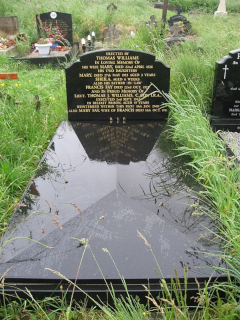
Williams is hanged in Crumlin Road Gaol in Belfast on the morning of September 2, 1942. The executioner is the official English hangman Thomas Pierrepoint, assisted by his nephew Albert Pierrepoint. Afterwards Williams’ body is interred in unhallowed ground in an unmarked grave within the grounds of the prison. His remains are only released in January 2000 after the closure of the prison in 1996 and a lengthy campaign by the National Graves Association, Belfast.
Williams’s funeral is held on January 19, 2000, and is attended by thousands, with burial at Milltown Cemetery. Joe Cahill, Williams’s cell mate, and John Oliver, sentenced to death with Williams but later reprieved, as well as Madge McConville, who had been arrested with Williams, Greta McGlone, Billy McKee, Eddie Keenan and perhaps least known, Nell Morgan, Williams’s girlfriend at the time of his death, are all present. Six senior Sinn Féin members including Gerry Adams are also present in St. Paul’s Church on the Lower Falls Road for the Mass.
Williams is remembered in a ballad Tom Williams. Various recordings have been made, most notably by the Flying Column and Éire Óg, who preamble their version with the story of the campaign to release his body. The now disbanded, Volunteer Tom Williams Republican Flute Band from Glasgow, Scotland is named in his memory as is the Tom Williams Camogie Club in Belfast.
(Pictured: Tom Williams’ headstone at Milltown Cemetery after being reinterred)




 seamus dubhghaill