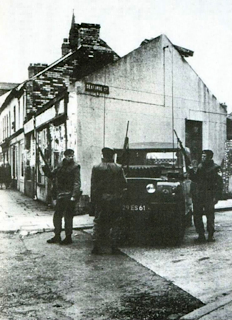
The Battle of St. Matthew’s, also known as the Battle of Short Strand, is a gun battle that takes place on the night of June 27-28, 1970, in Belfast, Northern Ireland. It is fought between the Provisional Irish Republican Army (IRA), and Ulster loyalists in the area around St. Matthew’s Roman Catholic church. This lies at the edge of the Short Strand, a Catholic enclave in a mainly-Protestant part of the city. Violence erupts there, and in other parts of Belfast, following marches by the Orange Order. The battle lasts about five hours and ends at dawn when loyalists withdraw. The British Army and police are deployed nearby but do not intervene. Three people are killed and at least 26 wounded in the fighting, while another three are killed in north Belfast.
The battle is the Provisional IRA’s first major action during the Troubles, and a propaganda victory for the Irish nationalist organization. It presents itself as successfully defending a vulnerable Catholic enclave from armed loyalist mobs. Loyalists, however, argue that the IRA lured them into a carefully prepared trap.
During the Northern Ireland riots of August 1969 in Belfast, Catholic Irish republicans clash with Protestant Ulster loyalists and the mainly-Protestant Royal Ulster Constabulary (RUC), Northern Ireland’s police force. Catholics believe that they are about to become “victims of a Protestant pogrom” and Protestants believe they are on the “eve of an IRA insurrection.” Hundreds of Catholic homes and businesses are burned out and more than 1,000 families, mostly Catholic, are forced to flee. The Irish Republican Army (IRA) has few weapons or members and is unable to adequately defend the Catholic areas. The rioting ends with the deployment of British troops. In December 1969, the IRA splits into the Official Irish Republican Army and the Provisional Irish Republican Army—with the Provisionals vowing to defend Catholic areas in future.
The Short Strand is a Catholic/nationalist enclave in East Belfast, a mainly Protestant/Ulster unionist part of the city. In the early years of the Troubles, Catholics in Short Strand number about 6,000, while their Protestant neighbours total about 60,000.
On Saturday, June 27, 1970, a large march by the Orange Order takes place in west Belfast, which is joined by loyalist bands from other parts of the city. Violence breaks out as the march enters the Catholic Springfield Road area on its way to Whiterock Orange Hall. Missiles are thrown by both sides, a bakery is set ablaze, and the British Army fires CS gas to disperse crowds. The riot sparks violence in other parts of Belfast.
In north Belfast, another Orange march proceeds along the Crumlin Road, the boundary between the Catholic Ardoyne and the Protestant Shankill areas. According to Crown prosecutors, a crowd emerges from Ardoyne throwing bottles and stones. As the riot descends into a gun battle, the IRA—who according to Gerry Adams were “ready and waiting”—kill three Protestants: William Kincaid (28), Daniel Loughins (32) and Alexander Gould (18). Others are wounded, including a Royal Navy petty officer who is shot in the jaw while driving a field ambulance. Earlier in the month, British troops divert an Orange march away from Ardoyne, leading to serious rioting by Protestants in the Shankill.
In the predominantly Protestant east of the city, an Orange parade also takes place along the Newtownards Road. At the bottom of the road is the Catholic enclave of the Short Strand, and here a gun battle breaks out between the IRA and Protestants, though the cause of it is disputed by both sides.
Violence erupts at St. Matthew’s Catholic church on the evening of June 27. It begins after a loyalist band and supporters march through the area on their return from the main parade. Rival groups gather, taunting leads to stone-throwing, and eventually, shots are fired.
As the situation worsens, Catholic residents fear that the gathering crowds of loyalists will attempt to invade the Short Strand and burn them from their homes. Local IRA members retrieve weapons from arms dumps. A young resident, Jim Gibney, recalls, “I saw neighbours, people I knew, coming down the street carrying rifles. I was just dumbstruck by this experience. I’d never seen such a thing before.”
The battle begins at about 10:00 p.m. and continues for the next five hours. Loyalists begin attacking the church and surrounding property with petrol bombs. A small house on the church grounds, where the sexton lives with his family, is set ablaze. A nearby Catholic pub is also looted and burned.
A small group of IRA members and members of the Citizens’ Defence Committee take up positions in the church grounds and in adjoining streets. The IRA members are armed with M1 carbines and are led by Billy McKee, commander of the IRA’s Belfast Brigade. Also present is Billy Kelly, commander of the Belfast Brigade’s 3rd Battalion. The IRA members fire at the loyalists, some of whom are positioned on the roofs opposite. Jim Magee, a local loyalist, sees wounded people lying on the road and asks the police (RUC) for help. According to Magee, “[they] said ‘if you have anything, get it out and protect your people.’ So we got an old rifle and went into Frazer Street and started firing back.”
The security forces are deployed in the area at the time but do not intervene to end the fighting. Shortly after the shooting begins, Stormont MP Paddy Kennedy goes with Short Strand residents to the local RUC base and demands protection for their homes. Across the River Lagan, in the Markets area, other IRA members assemble and prepare to reinforce the Short Strand should it be invaded. British soldiers eventually arrive in armoured vehicles and cordon off the roads around the Short Strand, which denies the IRA “any hope of reinforcement.” At the time, the British Army says that its soldiers fired no shots because “owing to the confused situation, it was impossible to identify targets.” British Army Colonel Mike Dewar later says, “The whole incident had taken its course because the Army was so chronically overstretched that night in Belfast. The one spare platoon in the whole of west Belfast was not able to get through rioting Protestants to the Short Strand.” Journalist Tony Geraghty writes that sometimes “The gunfire eased long enough to allow an occasional British Army personnel carrier (a ‘Pig‘) to whine past, illuminated by the flames in a token gesture of law-and-order.”
Another journalist who witnesses the battle, Peter Taylor, later says, “The shooting intensified but the soldiers still declined to intervene and separate the two sides – either because they felt they were not numerically strong enough or because they did not wish to get caught up in the middle of a sectarian fight, in the darkness, with shots being fired by both sides.”
Liz Maskey, who is a volunteer nurse that night, says that the Short Strand is surrounded by loyalists and claim they attacked her ambulance as it tried to leave the area.
The loyalists withdraw after about five hours, as dawn breaks. IRA leader Billy McKee claims that his unit had fired 800 rounds during the battle.
Three people are killed in the fighting. At least 26 are wounded, including Billy McKee, who is shot five times.
- Robert Neill, a 38-year-old Protestant, died instantly when a shot fired from the church bounced off the pavement and hit him in the spine.
- James McCurrie, a 34-year-old Protestant, is shot dead on Beechfield Street.
- Henry McIlhone, a 33-year-old Catholic, is helping to defend Short Strand when he is accidentally shot from the republican side. He dies on June 29. However, McKee maintains that McIlhone is shot by loyalists. Tírghrá, the IRA’s official list of its fallen, lists McIlhone as a “volunteer” but adds “although not a member of the IRA, Henry McIlhone was included in the republican roll of honour as a mark of respect for this great Irishman by republican comrades he fought alongside.”
Republicans and loyalists disagree over who started the violence and fired the first shots. Republicans claim that the violence was started by a mob of loyalists returning from an Orange march. They say that the loyalists tried to set the church alight and invade Short Strand, with the intention of burning the residents from their homes. Hence, republicans argue that they were defending the Short Strand from a loyalist attack. Loyalists claim the violence was begun by republicans, allegedly when the returning Orangemen and supporters were attacked on Newtownards Road. They argue that republicans attacked Protestants to lure them into “a carefully prepared trap.”
The following day, loyalists expel 500 Catholic workers from the nearby Harland & Wolff shipyard. Shortly after, the British government’s representative at Stormont says that the decision to allow Orange marches to go ahead on that day was “the greatest single miscalculation I have ever seen made in the course of my life.”
Many Catholics and nationalists believe that the IRA had been unable to defend them during the August 1969 riots. However, it is argued that the IRA’s defence of Short Strand redeemed it in the eyes of many Catholics and nationalists. Prior to the gun battle, the IRA had been waiting for an opportunity to portray themselves as defenders of the Catholic community. Among republicans, the battle is seen as a key event in the growth of the Provisional IRA.
Less than a week later, the British Army seizes a large haul of Official IRA weapons during a three-day operation in west Belfast. Nationalists see this as a confiscation of their defences.