seamus dubhghaill

Promoting Irish Culture and History from Little Rock, Arkansas, USA


Leave a comment

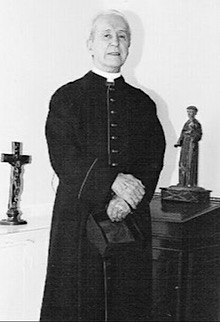
Death of Malachi Martin, Irish American Catholic Priest

Malachi Brendan Martin, also known under the pseudonym of Michael Serafian, Irish-born American Traditionalist Catholic priestbiblical archaeologistexorcistpalaeographerprofessor, and writer on the Catholic Church, dies in New York City on July 27, 1999.

Martin is born on July 23, 1921, in BallylongfordCounty Kerry, to a middle-class family in which the children are raised speaking Irish at the dinner table. His parents, Conor and Katherine Fitzmaurice Martin, have five sons and five daughters. Four of the five sons become priests, including his younger brother, Francis Xavier Martin.

Martin attends Belvedere College in Dublin, then studies philosophy for three years at University College Dublin (UCD). On September 6, 1939, he becomes a novice with the Society of Jesus. He teaches for three years, spending four years at Milltown Park, Dublin, and is ordained in August 1954.

Upon completion of his degree course in Dublin, Martin is sent to the Catholic University of Leuven in Belgium, where he takes a doctorate in archaeologyOriental history, and Semitic languages. He starts postgraduate studies at both the Hebrew University of Jerusalem and at the University of Oxford. He specializes in intertestamentary studiesJesus in Jewish and Islamic sources, Ancient Hebrew and Arabic manuscripts. He undertakes additional study in rational psychologyexperimental psychologyphysics, and anthropology.

Martin participates in the research on the Dead Sea Scrolls and publishes 24 articles on Semitic palaeography. He does archaeological research and works extensively on the Byblos syllabary in Byblos, in Tyre, and in the Sinai Peninsula. He assists in his first exorcism while working in Egypt for archaeological research. In 1958, he publishes a work in two volumes, The Scribal Character of the Dead Sea Scrolls.

Martin’s years in Rome coincide with the beginning of the Second Vatican Council (1962–65), which is to transform the Catholic Church in a way that the initially liberal Martin begins to find distressing. He becomes friends with Monsignor George Gilmary Higgins and Father John Courtney Murray.

In Rome, Martin becomes a professor at the Pontifical Biblical Institute, where he teaches Aramaic, Hebrew, palaeography, and Sacred Scripture. He also teaches theology, part-time, at Loyola University Chicago‘s John Felice Rome Center. He works as a translator for the Eastern Orthodox Churches and Ancient Oriental Churches Division of the Secretariat for Promoting Christian Unity under Bea. He becomes acquainted with Jewish leaders, such as Rabbi Abraham Joshua Heschel, in 1961 and 1962. He accompanies Pope Paul VI on a trip to Jordan in January 1964. He resigned his position at the Pontifical Institute in June 1964.

In 1964, Martin requests a release from his vows and from the Jesuit Order. He receives a provisional release in May 1965 and a dispensation from his vows of poverty and obedience on June 30, 1965. Even if dispensed from his religious vow of chastity, he remains under the obligation of chastity if still an ordained secular priest. He maintains that he remains a priest, saying that he had received a dispensation from Paul VI to that effect.

Martin moves to New York City in 1966, working as a dishwasher, a waiter, and taxi driver, while continuing to write. He co-founds an antiques firm and is active in communications and media for the rest of his life.

In 1967, Martin receives his first Guggenheim Fellowship. In 1970, he publishes the book The Encounter: Religion in Crisis, winning the Choice Book Award of the American Library Association. He then publishes Three Popes and the Cardinal: The Church of Pius, John and Paul in its Encounter with Human History (1972) and Jesus Now (1973). In 1970, he becomes a naturalized U.S. citizen.

In 1969, Martin receives a second Guggenheim Fellowship, allowing him to write his first of four bestsellersHostage to the Devil: The Possession and Exorcism of Five Living Americans (1976). In the book, he calls himself an exorcist, claiming he assisted in several exorcisms. According to McManus Darraugh, William Peter Blatty “wrote a tirade against Malachi, saying his 1976 book was a fantasy, and he was just trying to cash in.” Darraugh also says that Martin became “an iconic person in the paranormal world.”

Martin serves as religious editor for the National Review from 1972 to 1978. He is interviewed twice by William F. Buckley, Jr. for Firing Line on PBS. He is an editor for the Encyclopædia Britannica.

Martin is a periodic guest on Art Bell‘s radio program, Coast to Coast AM, between 1996 and 1998. The show continues to play tapes of his interviews on Halloween.

Martin’s The Keys of This Blood: The Struggle for World Dominion between Pope John Paul II, Mikhail Gorbachev, and the Capitalist West is published in 1990. It is followed in 1996 by Windswept House: A Vatican Novel.

The Vatican restores Martin’s faculty to celebrate Mass in 1989, at his request. He is strongly supported by some Traditionalist Catholic sources and severely criticized by other sources, such as the National Catholic Reporter. He serves as a guest commentator for CNN during the live coverage of the visit of Pope John Paul II to the United States in October 1995.

On July 27, 1999, Martin dies in Manhattan of an intracerebral haemorrhage, four days after his 78th birthday. It is caused by a fall in his Manhattan apartment. The documentary Hostage to the Devil claims that Martin says he was pushed from a stool by a demonic force.

Martin’s funeral takes place in St. Anthony of Padua Catholic Church in West Orange, New Jersey, before burial at Gate of Heaven Cemetery, in Hawthorne, New York.


1 Comment

Birth of Ciaran McKeown, Northern Irish Peace Activist

Ciaran McKeown, Northern Irish peace activist, is born into a Roman Catholic family in Derry, County Londonderry, Northern Ireland, on January 19, 1943.

McKeown is born to Sean and Mary (née Shevlin) McKeown. His father is a school principal. He serves as a Dominican novice for eight months in his youth. He attends Queen’s University Belfast (QUB), where he studies philosophy, becoming the first Catholic to be elected president of the university’s student council. He is also elected chair of the National Democrats, a ginger group linked with the National Democratic Party. He becomes president of the Union of Students in Ireland (USI) in 1969, based in Dublin, and stands in Dublin South-West at the 1969 Irish general election, taking last place, with only 154 votes.

In 1970, McKeown becomes a reporter for The Irish Times, then later works for The Irish Press, as their Belfast correspondent. Given his experience of reporting on the emergence of The Troubles, he supports the 1976 creation of “Women for Peace,” a Northern Ireland-based movement, by Betty Williams and Mairead Corrigan. When his involvement becomes more widely known, the movement changes its name to “Community of Peace People,” or simply “Peace People.” After the events of 1976-77, he finds it difficult to return to full-time journalism.

Although McKeown becomes known as a thoughtful and calm presence in the leadership of the organisation, his criticisms of the reluctance of church authorities to speak out on sectarian issues causes some tensions. Corrigan and Williams win the 1976 Nobel Peace Prize, but he is not made a party to it. However, the Ford Foundation makes a grant to the group, which includes a salary for him, enabling him to become full-time editor of Peace by Peace, the group’s newspaper, also completing a year as editor of Fortnight in 1977.

McKeown, Corrigan and Williams all step down from the leadership posts in 1978, although he continues to edit Peace by Peace. His articles bring him into conflict with the group’s new leadership, while financial disagreements massively reduce the group’s membership. Ultimately, his belief that the group should call for special status for paramilitary prisoners leads to a split, with Williams and her leading supporter, Peter McLachlan, resigning in February 1980. He can no longer survive on the group’s salary, nor can he find work as a journalist, so he retrains as a typesetter.

In 1984, McKeown publishes his autobiography, The Passion of Peace. This is almost immediately withdrawn following a claim that it libels a journalist, although it is later reissued with an additional note.

In addition to his activism and his work in journalism, McKeown is deeply involved in the Belfast theater scene. He serves in a number of offices, including executive secretary and chairman, at the city’s renowned Lyric Theatre.

McKeown dies peacefully at his home in Belfast on September 1, 2019, following a battle with cancer.


Leave a comment

Birth of Harry Boland, Politician & President of the Irish Republican Brotherhood

Harry Boland, Irish republican politician who serves as President of the Irish Republican Brotherhood (IRB) from 1919 to 1920, is born at 6 Dalymount Terrace, Phibsborough, Dublin, on April 27, 1887. He serves as a Teachta Dála (TD) from 1918 to 1922.

Boland is the son of Irish Republican Brotherhood member James Boland and Kate Woods. He was active in GAA circles in early life and referees the 1914 All-Ireland Senior Football Championship Final. He joins the IRB at the same time as his older brother Gerald in 1904, following in the footsteps of his father, uncle and probably grandfather. He is educated at the Synge Street CBS, but hads a personality clash with one of the brothers so he refuses to carry on his attendance at the school. He then goes to De la Salle College, County Laois, as a novice.

Boland later joins the Irish Volunteers along with Gerry and his younger brother Ned. They take an active part in the Easter Rising of 1916.

At the 1918 Irish general election, Boland is elected as an MP for South Roscommon. In line with all the Sinn Féin MPs elected at that election, he does not take his seat in the British House of Commons but withdraws to sit in the declared independent Dáil Éireann (the First Dáil) and is named by Éamon de Valera as special envoy to the United States, a role his uncle Jack had played 25 years earlier. He leaves Ireland for the United States along with de Valera as part of a campaign to raise awareness and support for their cause in America. He negotiates a loan of $20,000 from the Irish Republic to the Russian Soviet Federative Socialist Republic through the head of the Soviet Bureau, Ludwig Martens, using some Russian jewelry as collateral. These jewels are transferred to Ireland when he returns. His sister Kathleen and her mother are entrusted with the safekeeping of jewels.

During the Irish War of Independence (1919-21), Boland operates alongside Michael Collins, who is a close friend.

At the 1921 Irish elections, Boland is elected to the Second Dáil as one of the TDs for the Mayo South–Roscommon South. He opposes the Anglo-Irish Treaty. In the ensuing Irish Civil War (1922-23), he sides with the Anti-Treaty Irish Republican Army.

In the 1922 Irish general election, Boland is re-elected to the Dáil representing Mayo South–Roscommon South. Six weeks later, on July 31, he is shot by soldiers of the National Army when they attempt to arrest him at the Skerries Grand Hotel. Two officers enter his room and, although unarmed, he is shot and mortally wounded during a struggle.

The following day, August 1, 1922, Boland dies in St. Vincent’s Hospital in Dublin. As he lay dying, he refuses to give the name of his attacker to his sister, Kathleen. He is buried at Glasnevin Cemetery. The service takes place from the Whitefriar Street Carmelite Church. The hearse is followed by Cumann na mBan, Clan na Gael and the Irish Citizen Army women’s section.

Boland’s death affects Collins and possibly spurs him toward peace negotiations with Éamon de Valera.

Boland’s brother, Gerald Boland, is a prominent member of Fianna Fáil and later serves as Minister for Justice. His nephew, Kevin Boland, serves as a Minister until he resigns in solidarity with the two ministers, Charles Haughey and Neil Blaney, who are sacked from the government in May 1970 during the Arms Crisis. Kevin Boland’s resignation from Fianna Fáil and the subsequent loss of his seat marks the end of an era for the Boland political dynasty.

Boland’s nephew, Harry Boland, is a basketball player who competes in the 1948 Summer Olympics in London. He dies on December 18, 2013, at the age of 88.

In the 1991 TV movie The Treaty, Boland is portrayed by Malcolm Douglas. In the 1996 film Michael Collins, he is portrayed by American actor Aidan Quinn. The film is criticised for fictionalising both Boland’s death and Collins’ life.