Doyle is born on May 17, 1923, in Dundrum, Dublin, to Michael and Eileen Doyle (née Lawlor), one of seven children. In 1945, at the age of 22, he builds a pub and leisure complex called the County Club in Churchtown, Dublin. Following the success of this venture, he moves into the hotel business.
The first hotel that Doyle develops is the South County Hotel in Stillorgan, now called the Stillorgan Park Hotel, which opens in 1964. He officially registers his hotel company as P. V. Doyle Hotels Limited on September 4, 1969.
Doyle marries Margaret Ellen Briody, a nurse, in Ballynarry Church, Kilnaleck, County Cavan in 1947. They have five children together: sons Michael, David and daughters Anne, Eileen and Bernie.
Allen is born on July 6, 1936, in a nursing home at 37 Lower Leeson Street, Dublin, the youngest of three sons of (Gerard John) Cullen Tynan Allen, journalist, manager of The Irish Times, and raconteur, and his wife Jean Ballantyne (née Archer), an English-born nurse. His paternal grandmother, Nora Tynan O’Mahony, is the first women’s features editor of the Freeman’s Journal, and the poet Katharine Tynan is his great-aunt. Allen loses half a finger on his left hand in a childhood accident which becomes a favourite theme (and occasional prop) in his shows.
After initially attending Beaumont convent school, Allen goes to Firhousenational school, County Dublin, near the family residence outside Templeogue. For a period during World War II, he lives with his mother and brothers at Keenagh, County Longford, where they had moved for fear that Dublin might be targeted by air raids. On returning to Dublin, he goes to Terenure College, run by the Carmelite fathers. His reminiscences in later life often centre on memories of frequent and sadistic corporal punishment, and warnings from priests that adolescent male sexuality is a device of Satan leading straight to hell. His resentment is formative in his lifelong and outspoken atheism.
Allen, who is close to his father, is severely affected emotionally by his death in 1948, after which his relations with the school deteriorate further. The discovery that his father’s drinking and gambling had left the family heavily indebted means that, notwithstanding assistance from journalistic friends, his elder brothers are obliged to leave school and work as journalists to support the family. Restless and even more discontented at school than previously, he often plays truant to visit museums and art galleries. Expelled from Terenure College, he briefly attends the Catholic University School before leaving school at the age of 16. After working as a clerk for the Irish Independent, in 1954 he becomes a journalist on the Drogheda Argus, reporting weddings and gymkhanas. He later attributes this career path to the contemporary tradition of following a family profession.
Moving to London but failing to secure a job on a Fleet Street newspaper, Allen follows his brother John by becoming a “redcoat” attendant at Butlin’s holiday camps in Filey (Yorkshire), Skegness, Margate, and Brighton, performing various functions and telling jokes and stories during intervals between stage acts. In the winters he sells educational toys in Sheffield. Acquiring an agent, he becomes a professional comedian, adopting the stage name Dave Allen. He initially works the declining club and variety circuit, later claiming that he had toured with the last old-style nude tableaux show. In 1959, he makes his first television appearance on the BBC talent show New Faces and realises that television is the medium of the future. He tours with pop singer Helen Shapiro in 1963 and 1964, joined in the latter year by an emerging support band, the Beatles. At this period, he models himself on American stand-up comedians such as Jerry Lewis, focusing his act on discrete gags leading up to a punchline.
While performing in support of the singer Helen Traubel in Australian nightclubs, Allen often reminisces to her off stage about his early life. Traubel suggests that he incorporate such material into his act. Such is the genesis of his mature style of rambling absurdist monologues, which he describes as influenced by the Irish storytelling tradition in general, and his father’s stories in particular. After appearing in Melbourne and Sydney, he becomes the host of a ninety-minute chat show, Tonight with Dave Allen, on Sydney-based Channel 9. Eighty-four episodes are recorded of what becomes one of Australian television’s most successful programmes ever, its popularity boosted by the rumour that he is having an affair with singer Eartha Kitt, his hilarious interviews with eccentrics, and the frequent deployment of dangerous animals onstage.
Allen marries the English actress Judith Stott in Australia on March 9, 1964, a divorcée with one son. They have two children, including the comedian Ed Allen (Edward James Allen). After separating in 1980, the couple divorces in 1983. Returning to England in December 1964 to be with his wife, he establishes a reputation there through well-received performances as a compère at the televised Sunday Night at the London Palladium (1967) and The Blackpool Show (1966). After a slot as resident comedian on The Val Doonican Show (1965–67), he obtains his first stand-alone show, Tonight with Dave Allen, in 1967 on ITV, a mixture of sketches with the monologues for which he becomes best known. He usually performs seated on a barstool, smoking a cigarette, and sipping from a presumed glass of whiskey (actually ginger ale), while musing on the oddities of life, often expressing his suspicion of authority figures. His signature farewell phrase is “Goodnight, and may your God go with you.”
On BBC television Allen headlines two programmes: The Dave Allen Show (1968–69), and Dave Allen at Large (1971–79). He writes much of his own material, compulsively scouring newspapers for items that he can work into his act. He resists suggestions that he should move to an early evening slot, as this would entail restrictions on his material. In the 1970s and 1980s he tours widely with a one-man stage show, “An evening with Dave Allen,” containing more “adult” material than would be allowed on television at the time. His stage performances are less well-received in the United States than elsewhere.
Allen’s treatment of sex and religion involves him in frequent controversies. Priests and the confessional are frequent targets. In 1975, he provokes widespread protests from Catholics over a sketch in which the pope, played by Allen himself, and his cardinals perform a striptease on the steps of St. Peter’s Basilica. In 1977, his shows are banned from RTÉ. In 1984, the British anti-indecency campaigner Mary Whitehouse formally complains about his televised act, with particular reference to a simulated post-coital conversation. As with many stage comedians, his angry and outspoken stage persona contrasts with a reserved offstage life. He keeps his stage persona distinct from his private life and does not allow his children to attend his shows.
Allen gives occasional straight performances, notably in Edna O’Brien‘s plays A Pagan Place (1972) and Flesh and Blood (1985); in the dual roles of Captain Hook and Mr. Darling in a production of Peter Pan (1973); and in Alan Bennett‘s television play One Fine Day (1979). He has a supporting role in the Australian comedy film Squeeze a Flower (1970). He also presents several documentaries, notably Dave Allen in the Melting Pot (1969); surveying life in New York City, he discusses racism and drug addiction and conducts one of the first television interviews with openly gay men. Other documentaries for ITV include Dave Allen in Search of the Great English Eccentric (1974), and Dave Allen (1978), which deals with American eccentrics. Long fascinated with ghost stories, he publishes an anthology of horror stories, A Little Night Reading (1974).
In the 1980s, Allen is regarded by many fans of the new, politically engaged “alternative comedians” as old-fashioned. His leisurely style contrasts with their quick-fire delivery, and some of his references to the Irish and other ethnic groups are seen as demeaning. He makes a partial television comeback with a six-part BBC One series, Dave Allen (1990), using considerably more outspoken material than he had previously deployed on television.
In 1993, Allen appears in a six-part series for the new ITV London franchise, Carlton Television. Thereafter he moves into semi-retirement, partly because of health problems, while continuing to make guest television appearances. At the British Comedy Awards he is named best comedy performer (1993) and is granted a lifetime achievement award (1996). He occasionally releases videos of older material “to keep myself in the style to which I had become accustomed – a bit of an Irish retirement, actually.” He maintains tight editorial control over his recordings, having been annoyed when his first television shows were chopped and changed when re-broadcast by American networks. They are released on DVD after his death. He presents a six-part BBC series based on his old material, The Unique Dave Allen (1998). After giving his last performance on BBC Radio 4 in 1999, he retires and devotes himself to his hobby as an amateur painter.
After a seventeen-year relationship, Allen marries secondly Karin Stark, a theatrical producer, on December 9, 2003. Their one son is born three weeks after Allen dies peacefully in his sleep as a result of sudden arrhythmic death syndrome on March 10, 2005, in Kensington, London.
A selection of his routines, edited by Graham McCann, is published as The Essential Dave Allen (2005). His obituarists see him as prefiguring the aggressive mocking of authority by the alternative comedians who had once criticised him, and as paving the way for such irreverent and anti-deferential satire of political and religious authority as Not the Nine O’Clock News and Father Ted. The widespread use of the monologue by Irish dramatists such as Conor McPherson in the first decade of the twenty-first century also owes something to his influence.
(From: “Allen, Dave” by Patrick Maume, Dictionary of Irish Biography, http://www.dib.ie, June 2011)
Valerie Place, Irish nurse and overseas aid worker, is killed on February 22, 1993, while serving in Somalia. She is the second western aid worker to be killed there during the conflict and famine in the early 1990s.
Place is born at 20 St. Brendan’s Crescent, Walkinstown, Dublin, on March 24, 1969. She is the third child of Patrick Place, coachbuilder, and his wife Margaret (née Byrne). She has three brothers and two sisters. She attends St. Paul’s secondary school, Greenhills, Dublin, and is trained as a nurse at St. James’s Hospital, Dublin, from 1987 to 1990. She works for a period with Caring and Sharing Association (CASA).
Place goes to Somalia in September 1992 as a volunteer worker on a two-year contract with Concern Worldwide, Ireland’s largest aid and humanitarian agency. Concern has been part of the international emergency response in Somalia since May 1992. She is one of seventy Irish aid workers based in seventeen locations across Somalia. She is the supervisor of a feeding station for 2,500 children and an adjoining school in Mogadishu. The aid workers work with local guards, and later the Unified Task Force (UNITAF) of 30,000 troops to secure the areas for the distribution of humanitarian relief. The task force struggles to protect the aid convoys from attacks from armed groups.
Place is traveling in a party, which includes Rev. Aengus Finucane, on February 22, 1993, to attend the opening of a school in Wanlewein for 1,200 when the party is ambushed. She is fatally wounded when her car, the last in the convoy, is ambushed at Afgooye. She is airlifted to a military hospital in Mogadishu by a United States Air Forcehelicopter but dies within minutes of her arrival there. Her funeral at the Church of the Holy Spirit, Greenhills, Dublin, is attended by 2,000 people, including Irish PresidentMary Robinson, who had met Place during her visit to Somalia in October 1992.
At the time of her death, Place is the second western aid worker killed in Somalia, after the death of Sean Devereux in January 1993. Her death causes demands that the task force do more to protect aid workers and to disarm the Somali factions, as well as prompting fresh criticism of the United Nations mandate in its failure to support military intervention with political initiatives. As the situation worsens, American troops withdraw in March 1994, and the United Nations disengages in March 1995.
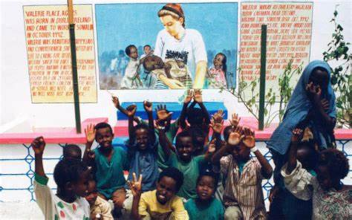
The Irish Department of Foreign Affairs founds the Valerie Place commemorative scholarship in March 1993, which brings Somali teachers and nurses to train in Ireland. In June 1997, St. James’s Hospital school of nursing unveils a portrait and a classroom dedicated to her memory. There is also a mural to Place in Mogadishu (pictured above).
The Magee Campus gains its name from Martha Magee, the widow of a Presbyterian minister, who, in 1845, bequeathed £20,000 to the Presbyterian Church in Ireland to found a college for theology and the arts. It opens in 1865 primarily as a theological college but accepts students from all denominations to study a variety of subjects. It is a college of the Royal University of Ireland from 1880 and later becomes associated with Trinity College, Dublin when the Royal University is dissolved in 1909 and replaced by the National University of Ireland.
During World War II, the college is taken over by the Admiralty for Royal NavyRoyal Navy operational use, becoming with Ebrington Barracks (HMS Ferret), a major facility in the Battle of the Atlantic. A 2013 BBC report describes a secret major control bunker, later buried beneath the lawns of the college. From 1941 this bunker, part of Base One Europe, together with similar bunkers in Derby House, Liverpool and Whitehall is used to control one million Allied personnel and fight the NaziU-boat threat.
In 1984, the New University merges with the Ulster Polytechnic, and Magee becomes the early focus of development of a new four-campus university, the University of Ulster. Student and faculty numbers recover and grow rapidly over the next ten to fifteen years, accompanied by numerous construction projects. Magee grows from just 273 students in 1984 to over 4,000 undergraduates in 2012. In 2012, the University continues to lobby the Northern Ireland Executive for an additional 1,000 full-time undergraduate places, leading to 6,000 students at Magee in 2017.
On September 14, 2013, Magee hosts, for the first time on the island of Ireland, the 23rd International Loebner Prize Contest in Artificial Intelligence based on the Turing test proposed by the renowned British computer scientist Alan Turing in 1950. Turing also works on cracking the Enigma machine code at Bletchley Park which is instrumental in the Battle of the Atlantic.
In October 2014 the University of Ulster is rebranded as Ulster University.



 seamus dubhghaill