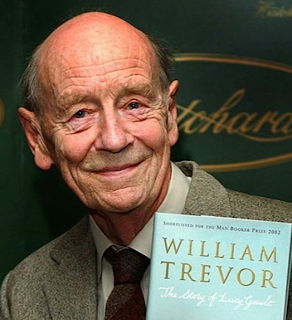
Trevor wins the 2008 International Nonino Prize in Italy. In 2014, he is bestowed with the title of Saoi within Aosdána. He resides in England from 1954 until his death in 2016, at the age of 88.
Trevor is educated at a succession of schools including St Columba’s College, Dublin (where he is taught by Oisín Kelly) and at Trinity College Dublin (TCD), from which he receives a degree in history. He works as a sculptor under the name Trevor Cox following his graduation from TCD, supplementing his income by teaching.
Trevor marries Jane Ryan in 1952 and emigrates to England, working as a teacher, a sculptor and then as a copywriter for an advertising agency. During this time he and his wife have their first son. In 1952, he becomes an art teacher at Bilton Grange, a prep school near Rugby. He is commissioned to carve reliefs for several churches, including All Saints’ Church, Braunston, Northamptonshire. In 1956, he moves to Somerset to work as a sculptor and carries out commissions for churches. He stops wood carving in 1960.
Trevor’s first novel, A Standard of Behaviour, is published in 1958 by Hutchinson & Co. of London, but receives little critical success. He later disowns this work, and, according to his obituary in The Irish Times, “refused to have it republished.” It is, in fact, republished in 1982 and in 1989.
In 1964, at the age of 36, Trevor is awarded the Hawthornden Prize for The Old Boys. This success encourages him to become a full-time writer.
In 1971, he and his family move from London to Devon in South West England, first to Dunkeswell, then in 1980 to Shobrooke, where he lives until his death. Despite having spent most of his life in England, he considers himself to be “Irish in every vein”.
Trevor dies peacefully in his sleep, at the age of 88, at Crediton, Devon, England, on November 20, 2016.
When Oisín Kelly completes his statue of the union leader James Larkin in 1978, he does not know that it is to be among his final works. He is at the height of his power, the go-to sculptor for public commissions in Ireland.
That Larkin would be commemorated by a monument in Dublin is proposed in 1959 by the Workers’ Union of Ireland (WUI), which Larkin had set up in 1924, after his expulsion from the Irish Transport and General Workers’ Union (ITGWU), which he had also established. But it is 1974, the centenary of Larkin’s birth, before the commemoration gets under way. Larkin had claimed to be two years younger than he was, which results in his centenary celebrations taking place in 1976 and the date of his birth inscribed on the monument having to be corrected to read 1874.
The memorial committee, comprising the great and the good of the union, includes Donal Nevin, who is instrumental in choosing the sculptor. Kelly is an inspired choice, as the resulting statue is one of the most dynamic public works in the centre of Dublin. Only John Henry Foley’s representation of Henry Grattan, from 1876, on College Green, exudes a similar energy. In these two works, emphatic gesture and naturalistic treatment of the men’s clothing create a liveliness in the figures. Foley’s 19th-century concern is to create a contrast with his statues of Oliver Goldsmith and Edmund Burke, positioned opposite, in the grounds of Trinity College Dublin (TCD). Kelly’s 20th-century aspiration is to please both his patron and the public.
Kelly, who had not known Larkin, chooses to use a familiar image of the man. Joseph Cashman had photographed Larkin addressing a crowd in Dublin in 1923. He looked so vital and passionate that the photograph has become iconic.
Once his maquette is approved, Kelly begins work on the plaster model in the backyard of his family home, in Firhouse, outside Dublin. His neighbour Eddie Golden, the actor, poses for the statue. When the full-size model is completed, it is transferred to Dublin Art Foundry, where it is cast in bronze by Leo Higgins and John Behan.
Although ready for unveiling in 1978, a delay ensues while attempts are made to quarry a colossal stone for the pedestal. Larkin’s son Denis is keen that it be carved from a single piece of granite, which proves impossible. Also, PresidentPatrick Hillery’s decision to perform the unveiling necessitates careful consideration of his speech. The writing of several drafts ensures that his language is neither controversial nor ambiguous. The word “comrades,” present in early drafts, does not appear in the final text. The statue is unveiled on June 15, 1979.
The sculpture has a commanding presence on O’Connell Street, where it has become one of the most popular monuments in Dublin. It regularly serves as a site of celebration and demonstration and is often a central motif in photographs of union members and politicians of the left gathering for anniversaries, or of crowds of the aggrieved and dissatisfied marching past.
The quotation on the pedestal, in French, Irish and English, dates back to the French Revolution: “The great appear great because we are on our knees. Let us rise.”
(From: “Modern Ireland in 100 Artworks: 1978 – James Larkin statue, by Oisín Kelly” by Paula Murphy, The Irish Times, http://www.irishtimes.com, January 30, 2016)
Larkin is born to Irish parents in Liverpool, England, on January 21, 1876. He and his family later move to a small cottage in Burren, County Down. Growing up in poverty, he receives little formal education and begins working in a variety of jobs while still a child.
In 1905, Larkin is one of the few foremen to take part in a strike on the Liverpool docks. He is elected to the strike committee, and although he loses his foreman’s job as a result, his performance so impresses the National Union of Dock Labourers (NUDL) that he is appointed a temporary organiser.
Larkin moves to Belfast in 1907 to organise the city’s dock workers for the NUDL. He succeeds in unionising the workforce, and as employers refuse to meet the wage demands, he calls the dockers out on strike in June. Carters and coal men soon join in, the latter settling their dispute after a month.
In 1908, Larkin moves south and organises workers in Dublin, Cork, and Waterford, with considerable success. His involvement, against union instructions, in a dispute in Dublin results in his expulsion from the NUDL. The union later prosecutes him for diverting union funds to give strike pay to Cork workers engaged in an unofficial dispute. After trial and conviction for embezzlement in 1910, he is sentenced to prison for a year. This is widely regarded as unjust, and the Lord Lieutenant of Ireland, Lord Aberdeen, pardons him after he has served three months in prison.
After his expulsion from the NUDL, Larkin founds the Irish Transport and General Workers’ Union (ITGWU) at the end of December 1908. The organisation exists today as the Services Industrial Professional & Technical Union (SIPTU). In early 1909, Larkin moves to Dublin, which becomes the main base of the ITGWU and the focus of all his future union activity in Ireland.
In June 1911, Larkin establishes a newspaper, The Irish Worker and People’s Advocate, as a pro-labour alternative to the capitalist-owned press. In 1912, in partnership with James Connolly, Larkin helps form the Irish Labour Party.
In early 1913, Larkin achieves some successes in industrial disputes in Dublin. Two major employers, Guinness and the Dublin United Tramway Company, are the main targets of Larkin’s organising ambitions. The chairman of the Dublin United Tramway Company, industrialist and newspaper proprietor William Martin Murphy, is determined not to allow the ITGWU to unionise his workforce. On August 15, he dismisses 40 workers he suspects of ITGWU membership, followed by another 300 over the next week. On August 26, 1913, the tramway workers officially go on strike.
The resulting industrial dispute is the most severe in Ireland’s history. Employers in Dublin engage in a sympathetic lockout of their workers when the latter refuses to sign the pledge, employing blackleg labour from Britain and from elsewhere in Ireland. Guinness, the largest employer in Dublin, refuses the employers’ call to lock out its workers but it sacks 15 workers who struck in sympathy.
For seven months the lockout affects tens of thousands of Dublin workers and employers, with Larkin portrayed as the villain by Murphy’s three main newspapers, the Irish Independent, the Sunday Independent, and the Evening Herald, and by other bourgeois publications in Ireland. The lockout eventually concludes in early 1914 when calls by James Connolly and Larkin for a sympathetic strike in Britain are rejected by the British Trades Union Congress (TUC). Larkin’s attacks on the TUC leadership for this stance also lead to the cessation of financial aid to the ITGWU.
Some months after the lockout ends, Larkin leaves for the United States. He intends to recuperate from the strain of the lockout and raise funds for the union. Once there he becomes a member of the Socialist Party of America and is involved in the Industrial Workers of the World union (the Wobblies). He becomes an enthusiastic supporter of the Soviet Union and is expelled from the Socialist Party of America in 1919 along with numerous other sympathisers of the Bolsheviks during the Red Scare of that year.
Upon his return to Ireland in April 1923, Larkin receives a hero’s welcome and immediately sets about touring the country meeting trade union members and appealing for an end to the Irish Civil War. In September 1923, Larkin forms the Irish Worker League (IWL), which is soon afterwards recognised by the Communist International as the Irish section of the world communist movement.
James Larkin dies in his sleep on January 30, 1947, in the Meath Hospital in Dublin. Fr. Aloysius Travers, OFM, who had administered last rites to James Connolly in 1916, also administers extreme unction to Larkin. His funeral mass is celebrated by the Catholic Archbishop of Dublin, John Charles McQuaid, who had visited him in hospital before he died, and thousands line the streets of the city as the hearse passes through on the way to Glasnevin Cemetery.
Today a statue of “Big Jim” stands on O’Connell Street in Dublin, completed by Oisín Kelly and unveiled in 1979.
Although not a composer in the classical sense, O’Carolan is considered by many to be Ireland’s first great composer. Harpers in the old Irish tradition are still living as late as 1792, and ten, including Arthur O’Neill, Patrick Quin and Donnchadh Ó hAmhsaigh, attend the Belfast Harp Festival. Ó hAmhsaigh plays some of O’Carolan’s music but dislikes it for being too modern. Some of O’Carolan’s own compositions show influences of the style of continental classical music, whereas others such as O’Carolan’s Farewell to Music reflect a much older style of “Gaelic Harping.”
O’Carolan is born in 1670 in Nobber, County Meath, where his father is a blacksmith. The family moves from Meath to Ballyfarnon in 1684. In Roscommon, his father takes a job with the MacDermott Roe family of Alderford House. Mrs. MacDermott Roe gives Turlough an education, and he shows talent in poetry. After being blinded by smallpox at the age of eighteen O’Carolan is apprenticed by Mrs. MacDermott Roe to a good harper. At the age of twenty-one, being given a horse and a guide, he sets out to travel Ireland and compose songs for patrons.
For almost fifty years, O’Carolan journeys from one end of Ireland to the other, composing and performing his tunes. One of his earliest compositions is about Brigid Cruise, with whom he is infatuated. Brigid is the teenage daughter of the schoolmaster at the school for the blind attended by O’Carolan in Cruisetown. In 1720, at age 50, O’Carolan marries Mary Maguire. Their first family home is a cottage on a parcel of land near the town of Manachain, now Mohill, in County Leitrim, where they settle. They have seven children, six daughters and one son. Mary dies in 1733.
Turlough O’Carolan dies at Alderford House on March 25, 1738. He is buried in the MacDermott Roe family crypt in Kilronan Burial Ground near Ballyfarnon, County Roscommon. The annual O’Carolan Harp Festival and Summer School commemorates his life and work in Keadue, County Roscommon.
A bronze monument by sculptor Oisín Kelly depicting Turlough O’Carolan playing his harp is erected on a plinth at the Market Square, Mohill, on August 10, 1986, and is unveiled by Patrick Hillery, President of Ireland.
A statue is erected to him at his place of birth in 2002, during the Annual O’Carolan Harp Festival, the first of which is held in Nobber in 1988.



 seamus dubhghaill