seamus dubhghaill

Promoting Irish Culture and History from Little Rock, Arkansas, USA


Leave a comment

Apprentice Boys Parade Ends Without Incident

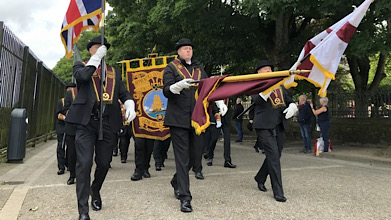
An Apprentice Boys parade down the Ormeau Road in Belfast, Northern Ireland, passes off without incident on April 13, 1998, after the organisers accept a ruling by the Parades Commission banning them from a nationalist section of the road.

It is the first parade of the marching season along the controversial route where nationalist residents oppose loyal order marches through their area.

One band and some fifteen members of the Apprentice Boys take part in the parade from Ballynafeigh to the Ormeau Bridge, where police have erected barriers across the road. The Apprentice Boys then board buses to go to the organisation’s main parade in Ballymena, County Antrim.

The police presence on the bridge is low-key as the Apprentice Boys previously said they would abide by the ruling and the Lower Ormeau Concerned Community group (LOCC) said it would not hold any protest.

The Apprentice Boys hand in a letter of protest to the Royal Ulster Constabulary (RUC), and Worthington McGrath, of the Ballynafeigh Walkers Club of the Apprentice Boys, saying they are “bitterly disappointed” they cannot walk into the city centre through the lower Ormeau.

“We have gone to great lengths to try and meet the wishes of the Parades Commission, and we have been rebuffed,” McGrath says. He hopes they might be able to walk down the Lower Ormeau Road on another occasion this year. They are having “ongoing meetings with the greater community in the Ormeau area” in an attempt to satisfy the Commission, he says.

Gerard Rice, of the LOCC, welcomes the Apprentice Boys’ action, but says the loyal orders will have to meet his group if the issue is to be resolved. “Turning away at the bridge will not resolve the issue. Direct dialogue is necessary.”

Rice says that if the Parades Commission followed its own guidelines, there could be no marches on the Ormeau Road in 1998 because the loyal orders refused to talk to residents.

The Parades Commission banned the march ten days earlier on the basis that it would have harmful effects on “relationships with the community.” In the ruling, the Commission says it hopes at least one parade will go ahead on the Ormeau Road this year.

The chairman of the Parades Commission, Alistair Graham, who watches the parade, says he is encouraged by the “mature and sensible action” taken by the Apprentice Boys. Alisdair McDonnell, a Social Democratic and Labour Party (SDLP) councillor, says he welcomes the Commission’s decision and urges the Apprentice Boys and the Orange Order to talk to residents’ groups about future marches. The RUC’s sub-divisional commander in the area, Supt. Steven Graham, says the Apprentice Boys have shown “a high degree of integrity.”

(From: “Apprentice Boys parade passes off without incident” by Theresa Judge, The Irish Times, http://www.irishtimes.com, April 14, 1998)


Leave a comment

Beginning of the Belfast City Hall Flag Protests

On the evening of December 3, 2012, hundreds of protesters gather outside Belfast City Hall as the Belfast City Council votes to limit the days that the Union Jack, the flag of the United Kingdom, flies from City Hall. Since 1906, the flag has been flown every day of the year. This is reduced to eighteen specific days a year, the minimum requirement for UK government buildings. The move to limit the number of days is backed by the council’s Irish nationalists while the Alliance Party abstains from the vote. It is opposed by the unionist councillors.

Minutes after the vote, protesters break into the back courtyard and try to force open the doors of the building. Two security staff and a press photographer are injured, and windows of cars in the courtyard are smashed. Protesters then clash with the police, injuring fifteen officers.

Ulster loyalists and British nationalists hold street protests throughout Northern Ireland. They see the council’s decision as part of a wider “cultural war” against “Britishness” in Northern Ireland. Throughout December and January, protests are held almost daily and most involve the protesters blocking roads while carrying Union Flags and banners. Some of these protests lead to clashes between loyalists and the police, sparking riots. Rioters attack police with petrol bombs, bricks, stones and fireworks. Police respond with plastic bullets and water cannon. Alliance Party offices and the homes of Alliance Party members are attacked, while Belfast City Councillors are sent death threats. According to police, some of the violence is orchestrated by high-ranking members of the Ulster Volunteer Force (UVF) and Ulster Defence Association (UDA). Loyalists also put up thousands of Union flags in public places, which further heightened tension.

After February 2013, the protests become smaller and less frequent, and lead to greater loyalist protests about related issues, such as restrictions on traditional loyalist marches.

Prime Minister of the United Kingdom David Cameron condemns the protests, saying “violence is absolutely unjustified in those and in other circumstances.” MP Naomi Long says that Northern Ireland is facing “an incredibly volatile and extremely serious situation.” She also calls on Cameron to intervene after a police car outside her office is firebombed with a policewoman escaping injury in early December.

The Police Service of Northern Ireland‘s (PSNI) Chief Constable Matt Baggott blames the violence on the UVF for “orchestrating violence for their own selfish motives. Everyone involved needs to step back. The lack of control is very worrying. The only answer is a political solution. Otherwise, this will eat into our ability to deal with drugs, into our ability to deal with alcohol issues, and deal with what is a very severe dissident threat.”

United States Secretary of State Hillary Clinton calls for an end to the protests during a trip to Belfast on December 7.

In September 2013, business representatives in Belfast reveal that the flag protests had resulted in losses totaling £50 million in the year to July 2013.

(Pictured: The Union Flag flying atop Belfast City Hall in 2006. The statue of Queen Victoria is in the foreground.)