seamus dubhghaill

Promoting Irish Culture and History from Little Rock, Arkansas, USA


3 Comments

Birth of Irish Historian Gerard Anthony Hayes-McCoy

Gerard Anthony Hayes-McCoy, an Irish historian regarded as one of the leading Irish historians of his generation, is born in Galway, County Galway, on August 15, 1911.

Hayes-McCoy is born to Thomas Hayes-McCoy and Mary Kathleen Hayes-McCoy (née Wallace). His grandfather, Thomas Hayes-McCoy, is a Dubliner who as a child came to Galway in 1834 and is later a well-known Parnellite. His maternal grandfather, Thomas Burke, is a Galway artist. He grows up on Eyre Square where his father runs a gentleman’s hairdressing business. His two older siblings are Ignatius and Marguerite. The latter receives a PhD-degree in History at University College Galway (UCG), and later teaches at the Galway Technical School.

Hayes-McCoy receives his early education from the Patrician Brothers, Galway. His earliest notebook of 1927 and a manuscript history of Poland of the same year, now at the National Library of Ireland (NLI), testify to an early interest in history and heritage. From 1928 to 1932 he is a student scholarship holder at University College Galway, graduating in 1932 with a Bachelor of Commerce, and a Bachelor of Arts, with first-class honours in both, and a specialisation in “History, Ethics, Politics” for the latter. Mary Donovan O’Sullivan is one of his professors of history, and Liam Ó Briain, professor of Romance languages, is a stimulating influence. At this time, Hayes-McCoy is a member of the Republican Club, a committee member of the Literary and Debating Society, and in 1931 he is one of the founding members of a new Irish Students’ Association.

Hayes-McCoy pursues his PhD at the University of Edinburgh, and then spends two years at the Institute of Historical Research, London, in the Tudor seminar of J. E. Neale, rewriting his PhD and eventually publishing it as Scots mercenary forces in Ireland, 1565–1603 (Dublin and London, 1937), with a foreword by Eoin MacNeill. This is characterised by meticulous archival research, and it anticipates by sixty years the much-vaunted New British History of the late twentieth century by tracing the interconnections between events in England, Ireland, and Scotland.

In the absence of an academic post, Hayes-McCoy becomes an assistant keeper in the Art and Industrial Division at the National Museum of Ireland (1939–1959), with a responsibility for the Military History, and the Irish War of Independence collections. One of his first tasks is to prepare a standing exhibition on Irish history before 1916. His research, long-standing personal interest in the military, and his curatorial experience, helps form an expert knowledge of historical Irish warfare. This leads to his role in co-founding The Military History Society of Ireland in 1949 whose journal, The Irish Sword, he edits. He describes the vagaries of setting up such a body, its reception, and the historiographical considerations attendant on it, in a paper published posthumously in The Irish Sword.

On August 19, 1941, Hayes-McCoy marries Mary Margaret “May” O’Connor, daughter of C.J. and M.B. O’Connor of New Ross/Enniscorthy. They have three daughters and two sons: Mary, Ann, Ian, Robert, Felicity. The family home is in Dublin.

Earning high reputation by continued research and by publishing leads to Hayes-McCoy’s receipt of the D.Litt. degree from the National University, and to his membership in the Royal Irish Academy in 1950. In his professional career, apart from the broad spectrum of press publications, he publishes prolifically. The works that are judged most influential, are his Scots mercenary forces in Ireland 1565–1603 (1937), the papers “The early history of guns in Ireland” (1938–1939), “Strategy and tactics in Irish warfare, 1593–1601” (1941), “The army of Ulster, 1593–1601” (1951), the controversial “Gaelic society in Ireland in the late sixteenth century” (1963), and the monographs “Irish battles” (London 1969), and “A history of Irish flags from earliest times” (Dublin 1979). A member of the Irish Manuscripts Commission, his most notable contribution is the publication “Ulster and other Irish maps, c.1600” (Dublin 1964).

In 1946, Hayes-McCoy is appointed to a committee of eight historians to advise on setting up the Bureau of Military History, a body established for the creation and compilation of material on the history of the Irish movements for independence, 1913–1921, specifically from witness statements. The committee is also to further offer guidance and oversee progress of the Bureau in coordination with the Ministry of Defence. It subsequently expresses concerns about the state’s role and methods in the collection of statements.

Having begun writing for the press at an early stage, Hayes-McCoy’s public position at the Museum encourages him to go further. He has broad involvement with local history groups to whom he presents papers, and also works for newspapers and for radio and television. To the national and Galway press he usually contributes articles on military aspects of Irish history, as well as book reviews, but he also uses them as a platform to engage with what he sees are flaws in the education of history in Ireland which during his lifetime is constrained by a certain degree of political and cultural state control.

During the 1940s and 1950s, Hayes-McCoy becomes involved in a number of paratheatrical events of national significance one of which – the “Pageant of St.Patrick” for which he writes the script (An Tóstal 1954) – is realised on an immense scale. He scripts these works to begin with and is later principally engaged as historical consultant. In that capacity, he collaborates in 1955 and 1956 with Micheál Mac Liammóir and Denis Johnston on their scripts for pageants on St. Patrick and on the Táin Bó Cuailgne, at times finding it difficult to square the historical liberties taken by these artists with his own role.

On Irish radio and television Hayes-McCoy is most active in the mid-1960s, editing and contributing to Thomas Davis lectures series, writing scripts for a series of thirty children’s programmes on all aspects of Irish history, and preparing/contributing on air to the television series “Irish battles” and “The long winter.” As well as writing for RTÉ, Ireland’s national broadcaster, he contributes scripts to BBC Northern Ireland‘s schools radio programmes.

In 1959, Hayes-McCoy succeeds to the chair of his former history professor at UCG with the full remit of lecturing, administering examinations to undergraduates, and supervising postgraduate theses. Among his students who continue in the field of history are Nicholas Canny, Martin Coen, Patrick Melvin, Peter Toner, Tony Claffey, and Breandán Ó Bric. After his appointment to UCG, the family home remains in Dublin, and he commutes to Galway weekly during term time.

In the early 1960s, Hayes-McCoy becomes a spokesperson for the movement rekindled by the Old Galway Society to preserve the landmark “Lion’s Tower” in the city. The ultimate failure of the campaign informs his regret, expressed a year later, that Ireland is forgetful about its past and that “we don’t bother to find out about it or to maintain our ancient heritage,” and, on a perceived spirit of conformity, “take my own city of Galway, it is now more prosperous than it was, but it is no longer distinctive. I do not believe that it is essential for progress that we should lose our heritage.”

While at one time member and secretary of the London Sinn Féin office and informed by a pride of country and place, Hayes-McCoy’s professional and private outlook are marked by a distrust of nationalism or of any antagonising national agendas compromising genuine scholarship. In a paper drafted on tendencies in modern historical studies, he criticises the two historiographical extremes, each to be avoided, each unfortunately characteristic of the moment – extreme de-bunking and extreme “adding for effect.” “A history is a record of fact; to add pseudo-facts is as grave a sin as to leave out real facts that may change the colour of the whole.”

Hayes-McCoy’s abiding pastime is drawing. Among his papers in the James Hardiman Library, NUI Galway are approximately 40 items with predominantly maritime subjects, and he has a special regard for the history of ships, and a romantic liking of the sea. He also has a lifelong interest in Robert Louis Stevenson, Sir Walter Scott, and their works, and in the Pre-Raphaelite movement.

Hayes-McCoy’s middle age is marked by intermittent ill health. He dies on November 27, 1975, in his room at the Great Southern Hotel, Eyre Square, Galway.

Hayes-McCoy’s papers are held at the James Hardiman Library, National University of Ireland, Galway.

Leave a comment

Birth of Singer-Songwriter Luka Bloom

Kevin Barry Moore, Irish folk singer-songwriter best known as Luka Bloom, is born on May 23, 1955 in Newbridge, County Kildare. He is the younger brother of folk singer Christy Moore.

Moore’s parents are Andy Moore and Nancy Power, who had already raised three daughters and two other sons. He attends a Patrician Brothers primary school and later studies at Newbridge College, run by the Dominican Order. In college he forms the group Aes Triplex with his brother Andy and a school friend. He later attends a college in Limerick, but he drops out after a couple of years to pursue a music career.

In 1969, 14-year-old Moore embarks on a tour supporting his eldest brother, Christy Moore, at various English folk clubs. After the tour he spends all of his time practising and writing music. In 1976, Christy records one of his songs “Wave up to the Shore.” In 1977, he tours Germany and England as part of the group Inchiquin.

In 1978, Moore releases his debut album, Treaty Stone. In 1979, having normally played guitar using a finger-picking technique, he is afflicted with tendonitis and is forced to learn to play with a plectrum, which alters his guitar style. That same year, he moves to Groningen in the Netherlands. In 1980, he records and releases his second album, In Groningen. In 1982, he releases his third album, No Heroes, which contains songs all written by Moore himself. For three years, from 1983 to 1986, he is the front-man for the Dublin-based band Red Square. During this time, in 1984, his son Robbie is born.

In 1987, Moore moves to the United States and begins performing using the stage name of “Luka Bloom.” He chooses the name “Luka” from the title of Suzanne Vega‘s song about child abuse and “Bloom” from the main character in James Joyce‘s novel Ulysses. Initially he lives and performs primarily in Washington D.C., but in late 1987 he moves to New York City. The following year, he releases his first album – later withdrawn – under the name Luka Bloom.

In 1990, Bloom releases his album Riverside, which includes the song “The Man Is Alive.” The album is recorded in New York, with its lyrics reflecting his experiences living and performing in that city. In 1991, he returns to Dublin to record The Acoustic Motorbike, which includes a cover version of LL Cool J‘s “I Need Love.” The cover song is reviewed by Rolling Stone magazine, noting that “the prospect of a folksy Irish rocker covering a rap ballad may seem strange, but experimenting with different forms is precisely what keeps established traditions vital.”

In 1993, Bloom again returns to Ireland to record the album Turf, this time with producer Brian Masterson and sound engineer Paul Ashe-Browne. The album attempts to capture the sound of a live performance, and is recorded in front of an audience that is asked to remain as quiet as possible. In 1998, he releases Salty Heaven, an album inspired by his return to Ireland.

Bloom’s early albums showcase his frenetic strumming style, including “Delirious,” the debut track on Riverside, and his penchant for thoughtful cover songs, an affinity that he maintains even in more recent work. In addition to his LL Cool J cover, he also covers Elvis Presley‘s “Can’t Help Falling in Love” on the album The Acoustic Motorbike.

Released in 2000, Keeper of the Flame is an album of cover versions featuring renditions of ABBA‘s “Dancing Queen,” Bob Marley‘s “Natural Mystic,” and the Hunters & Collectors‘ “Throw Your Arms Around Me,” among others. His 2004 acoustic mini-album, Before Sleep Comes, is recorded while he is recovering from tendinitis. He states that the purpose of the album is “to help bring you closer to sleep, our sometimes elusive night-friend.”

In 2005, Bloom releases the album Innocence. Some of the songs feature a new-found interest in Eastern European Romani music and other world music. The album features him playing classical guitar, and the resonant plucking associated with that style of instrument. In his previous work, he relies almost exclusively on steel-stringed acoustic guitars that created his distinctive style. In 2007, he releases the album Tribe, a collaboration with County Clare musician Simon O’Reilly. O’Reilly composes the music and sends the recordings to Bloom for him to complete with lyrics and singing.

In February 2008, Bloom releases a DVD titled The Man is Alive, featuring footage filmed in Dublin and at his home in Kildare, a question and answer session with fans, the documentary My Name is Luka, and a CD of music taken from the two performances. In September of that year, he releases the album Eleven Songs, which features an expanded ensemble of instrumentation, giving the album a distinct sound within his catalogue.


Leave a comment

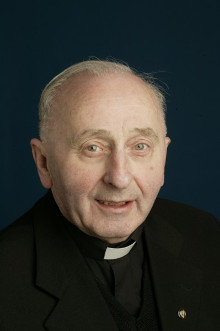
Death of James McLoughlin, Bishop of Galway & Kilmacduagh

James McLoughlin, the Roman Catholic Bishop of Galway and Kilmacduagh and Apostolic Administrator of Kilfenora for twelve years from 1993 to 2005, dies on November 25, 2005.

McLoughlin is born in Cross Street in the centre of Galway on April 9, 1929. His parents run a small wholesale grocery business. He attends the Patrician Brothers primary school in Nuns’ Island and St. Mary’s College, Galway. He studies for the priesthood at Maynooth and is ordained on June 20, 1954.

After ordination McLoughlin is appointed to the teaching staff of St. Mary’s College, Galway where he develops interests in basketball and amateur dramatics. He is appointed diocesan secretary in September 1965, bringing to that role a reserved dedication to duty, meticulous planning and financial acumen. He leaves full-time teaching in 1983 and is appointed parish priest of Galway Cathedral.

On February 10, 1993, the year after the sensational resignation of Bishop Eamon Casey, McLoughlin is appointed by Pope John Paul II as Bishop of Galway and Kilmacduagh. His consecration takes place in Galway Cathedral on March 28, 1993. After his death one obituary notes that McLouglhin’s “quiet demeanour…intimate knowledge of Galway and his being a native son, made him the ideal man to assume responsibility for the diocese when Bishop Eamonn Casey resigned.”

McLoughlin serves as chairman of the finance and general planning committee of the Irish Catholic Bishops’ Conference. In 2003 he is one of the first Irish bishops to announce the clustering of parishes in recognition of the falling number of priests, his diocese having had very few vocations or ordinations in the decade up to 2003.

McLoughlin announces his retirement on May 23, 2005, and on July 3 is succeeded as bishop of Galway and Kilmacduagh by Martin Drennan. He lives in Claregalway during his retirement, and dies on November 25, 2005, in Galway Clinic. His funeral is held in Galway Cathedral, and he is interred in the crypt beneath the cathedral.

McLoughlin’s successor, Bishop Martin Drennan, says he is deeply saddened and shocked by the news of McLoughlin’s death and that the late bishop was deeply loved and admired by the people and priests of his native city and diocese.

Dr. Seán Brady, Archbishop of Armagh and Primate of All Ireland, also pays tribute to the late bishop. He says Bishop McLoughlin was a gentle and humble man who radiated great joy, friendship and happiness to all whom he met.


Leave a comment

Birth of Thomas Burke, Irish Dominican Preacher

thomas-nicholas-burke-statue

Thomas Nicholas Burke, Irish Dominican preacher, is born in Galway, County Galway on September 8, 1830.

Burke’s parents, though in moderate circumstances, gave him a good education. He studies at first under the care of the Patrician Brothers and is afterwards sent to a private school. An attack of typhoid fever when he is fourteen years old, and the famine year of 1847 have a sobering effect. Toward the end of that year, he asks to be received into the Order of Preachers and is sent to Perugia in Italy to make his novitiate. On December 29, he is clothed there in the habit of St. Dominic and receives the name of Thomas.

Shortly afterward Burke is sent to Rome to begin his studies at the College of St. Thomas, the future Pontifical University of Saint Thomas Aquinas, where he is a student of philosophy and theology. He passes thence to the Roman convent of Santa Sabina. His superiors send him, while yet a student, as novice-master to Woodchester, the novitiate of the resuscitated English Province. He is ordained into the priesthood on March 26, 1853. On August 3, 1854, he defends publicly the theses in universâ theologiâ. He is made lector at the College of St. Thomas in 1854.

Early in the following year Burke is recalled to Ireland to found the novitiate of the Irish Province at Tallaght, near Dublin. In 1859 he preaches his first notable sermon on “Church Music.” It immediately lifts him into fame.

Elected Prior of Tallaght in 1863, Burke goes to Rome the following year as Rector of the Dominican Convent of San Clemente and attracts great attention by his preaching. He returns to Ireland in 1867 and delivers his oration on Daniel O’Connell at Glasnevin before fifty thousand people.

Bishop Leahy takes him as his theologian to the First Vatican Council in 1870, and the following year he is sent as Visitor to the Dominican convents in America. He is besieged with invitations to preach and lecture. The seats are filled hours before he appears, and his audiences overflow the churches and halls in which he lectures. In New York City he delivers the discourses in refutation of the English historian James Anthony Froude.

In an eighteen-month period Burke gives four hundred lectures, exclusive of sermons, with the proceeds amounting to nearly $400,000. His mission is a triumph, but the triumph is dearly won. When he arrives in Ireland on March 7, 1873, he is spent and broken.

During the next decade Burke preaches in Ireland, England, and Scotland. He begins the erection of the church in Tallaght in 1883, and the following May preaches a series of sermons in the new Dominican church, London. In June he returns to Tallaght in a dying condition and preaches his last sermon in the Jesuit church, Dublin, in aid of the starving children of Donegal. A few days afterwards, on July 2, 1882, he dies. He is buried in the church of Tallaght, now a memorial to him.

(Pictured: Statue of Thomas Nicholas Burke by John Francis Kavanagh by Nimmo’s Pier in Galway)