seamus dubhghaill

Promoting Irish Culture and History from Little Rock, Arkansas, USA


Leave a comment

Death of John Daly, Leading Member of the Irish Republican Brotherhood

John Daly, Irish republican and a leading member of the Irish Republican Brotherhood (IRB), dies in Limerick, County Limerick, on June 30, 1916. He is uncle to Kathleen Clarke, wife of Tom Clarke who is executed for his part in the 1916 Easter Rising and who is a leading member of the IRB, and her brother Edward “Ned” Daly who is also executed in 1916. Daly briefly serves as a member of the British Parliament but is resented for having previously been convicted for treason against the British state. He also serves as Mayor of Limerick for three years at the turn of the century.

Daly is born in Limerick on October 18, 1845. His father works in James Harvey & Son’s Timber Yard. At the age of sixteen, he joins his father working as a lath splitter. At eighteen he is sworn in as a member of the IRB, also known as the Fenians, and becomes fully involved in Republican activities. When he is refused absolution in confession because he admits to being a Fenian, he decides that from then on, his loyalty will no longer be to “faith and Fatherland” but to “God and Fatherland.”

On November 22, 1866, Daly and his brother Edward are arrested at their family home having been betrayed by an informer, for running a munitions factory in the Pennywell district close to their home. He is released on bail in February 1867 toughened and more dedicated by the experience.

On March 5, 1867, the ill-prepared Fenian Rising takes place. Daly takes charge of the Limerick detachment of the IRB. Limerick is one of the few areas where the Fenians are able to make some show of force, however weak. Through lack of numbers, they fail to make a significant impact on the vastly superior forces arrayed against them. Moving out of the city, he moves his men into the country and joins up with other Fenians in an attack on the Royal Irish Constabulary (RIC) barracks at Kilmallock. The attack is repelled, and Daly disperse his men.

After this Daly flees the country by stowing away first on a boat, the Hollywood, to England, and from London then on board the Cornelius Grenfel to the United States.

Life in America for working class immigrants is particularly tough and Daly’s first job on leaving the ship is digging a cellar. He then obtains work in a white lead factory and works for a while as a mason’s helper before getting a reasonably good job as a brakeman on a tram system. He is to recall these experiences in his Recollections of Fenians and Fenianism.

In 1869, Daly return to Ireland and takes up his old job in the timber yard, and also his Republican activities. He begins to help reorganise the IRB and takes part in a number of agitations to keep the IRB agenda in the public view. He becomes a leading voice in the Amnesty Association to help in the release of those Fenians still in jail.

In November 1869, a major tenants’ right meeting takes place in the city. The IRB objects to the meeting because the issue of the prisoners is not on the agenda. In what comes to be known as “The Battle of the Markets,” the IRB charges the platform and succeeds in dismantling it. Though the organisers of the meeting attempt to hold some form of gathering, Daly and the IRB refuse to relent. It is Daly’s opinion that “it was one of the greatest moral victories ever achieved.” The issue of the political prisoners is to keep him occupied for much of the 1870s. In 1876, he is again arrested for disturbing another home rule gathering, though on being brought before the court he is acquitted.

During the Land War Daly is a member of the Supreme Council of the IRB and becomes organiser for Connacht and Ulster.

In the summer of 1883, Daly moved to Birmingham, England, and settles in the home of James Egan, an old friend from Limerick and a generally inactive IRB man. E.G. Jenkinson, head of Special Branch, is informed that Daly is on his way to Britain from the United States. He has been asked by the Supreme Council to deliver the graveside oration at the funeral of Charles J. Kickham while in the United States. When he arrives, a plain-clothes detective is assigned to follow him at all times. As a result of this, Special Branch are alerted to the importance of John Torley in Glasgow, Robert Johnston in Belfast and Mark Ryan in London of the IRB.

Jenkinson uses agent provocateurs in his attempts to convict Republicans. One such recruit is a publican and local IRB man named Dan O’Neill. Both Jenkinson and a Major Nicholas Gosselin persuade O’Neill to betray Daly. O’Neill then asks Daly to deliver sealed cases to some associates in London, and on April 11, he is arrested as he is about to board the train for London, and explosives are found in the case he is carrying. The police then raid the home of James Egan where explosives are “allegedly found buried” in Egan’s garden in addition to some documents.

In Chatham prison Daly becomes friends with Tom Clarke, who would later marry his niece Kathleen and who was a leader of the 1916 Easter Rising. While in prison he claims that he is being poisoned with belladonna which causes an investigation by a commission of inquiry in 1890. It is admitted by prison officials as an error by a warder. A series of articles in the Daily Chronicle in 1894 analyse prison methods. Daly gives an interview to the Chronicle which appears on September 12, 1896.

Daly is elected unopposed as a member of parliament (MP) for Limerick City at the 1895 United Kingdom general election in Ireland, as a member of the Parnellite Irish National League (INL). However, he is disqualified on August 19, 1895, as a treason-felon. In August 1896, he goes on a lecture tour of England with Maud Gonne and in 1897 on a tour of the United States which is organised by John Devoy. He later founds a prosperous bakery business in Limerick and goes on to become Mayor of his native city.

Daly is elected three times as Mayor of Limerick City, from 1899 to 1901. He jointly finances with Patrick McCartan the IRB newspaper Irish Freedom in 1910.

Daly dies on June 30, 1916, at his home, 15 Barrington Street, Limerick. He never marries. A tall, energetic, and gregarious man, he is a simple but often effective propagandist for the separatist cause.

In 1928, Madge Daly, a niece of Daly, presents the Daly cup to William P. Clifford, the then-chairman of the Limerick GAA county board. Since then, the Daly cup is presented to the winners of the Limerick Senior Hurling Championship.

(Pictured: Irish Republican and Fenian John Daly in the ceremonial garb of the Mayor of Limerick, circa 1900)

Leave a comment

The 1918 Irish General Election & Rise of Sinn Féin

The 1918 Irish general election is the part of the 1918 United Kingdom general election which takes place in Ireland on December 14, 1918. It is a key moment in modern Irish history because it sees the overwhelming defeat of the moderate nationalist Irish Parliamentary Party (IPP), which had dominated the Irish political landscape since the 1880s, and a landslide victory for Sinn Féin. Sinn Féin had never previously stood in a general election but had won six seats in by-elections in 1917–18. The party vows in its manifesto to establish an independent Irish Republic. In Ulster, however, the Irish Unionist Alliance (IUA) is the most successful party.

In 1918, a system called plural voting is in place in both Britain and Ireland. Plural voting is a practice whereby one person might be able to vote multiple times in an election. Property and business owners can vote both in the constituency where their property lay and that in which they live, if the two are different. In the newly formed Irish Free State this system is ended by the Electoral Act 1923 and is abolished in the United Kingdom by the Representation of the People Act 1948. Plural voting remains in effect in Northern Ireland until 1969.

The 1918 election is held in the aftermath of World War I, the Easter Rising and the Conscription Crisis. It is the first general election to be held after the Representation of the People Act 1918. It is thus the first election in which women over the age of 30, and all men over the age of 21, can vote.

Sinn Féin is founded by Arthur Griffith in 1905. He believes that Irish nationalists should emulate the Ausgleich of Hungarian nationalists who, in the 19th century under Ferenc Deák, had chosen to boycott the imperial parliament in Vienna and unilaterally establish their own legislature in Budapest.

Griffith initially favours a peaceful solution based on “dual monarchy” with Britain, that is two separate states with a single head of state and a limited central government to control matters of common concern only. However, by 1918, under its new leader, Éamon de Valera, Sinn Féin has come to favour achieving separation from Britain by means of an armed uprising if necessary and the establishment of an independent republic.

In the aftermath of the 1916 Easter Rising, the party’s ranks are swelled by participants and supporters of the rebellion as they are freed from British gaols and internment camps. At its 1917 Ardfheis (annual conference) de Valera is elected leader, and the new, more radical policy is adopted.

Prior to 1916, Sinn Féin had been a fringe movement having a limited cooperative alliance with William O’Brien‘s All-for-Ireland League and enjoyed little electoral success. However, between the Easter Rising of that year and the 1918 general election, the party’s popularity increases dramatically. This is due to the failure to have the Home Rule Bill implemented when the IPP resists the partition of Ireland demanded by Ulster Unionists in 1914, 1916 and 1917, but also popular antagonism towards the British authorities created by the execution of most of the leaders of the 1916 rebels and by their botched attempt to introduce Home Rule on the conclusion of the Irish Convention linked with military conscription in Ireland (see Conscription Crisis of 1918).

Sinn Féin demonstrates its new electoral capability in four by-election successes in 1917 in which George Noble Plunkett, Joseph McGuinness, de Valera and W. T. Cosgrave are each elected, although it loses three by-elections in early 1918 before winning two more with Patrick McCartan and Arthur Griffith. In one case there are unproven allegations of electoral fraud. The party benefits from a number of factors in the 1918 elections, including demographic changes and political factors.

In the aftermath of the elections, Sinn Féin’s elected members refuse to attend the British Parliament in Westminster, and instead form a parliament in Dublin, Dáil Éireann (“Assembly of Ireland”), which declares Irish independence as a republic. The Irish War of Independence is conducted under this revolutionary government which seeks international recognition and sets about the process of state-building. The next election is part of 1921 Irish elections.

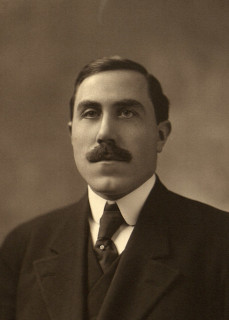
(Pictured: L to R, Éamon de Valera of Sinn Féin, Sir Edward Carson on the Irish Unionist Alliance, and John Dillon of the Irish Parliamentary Party)


Leave a comment

Death of Joseph McGarrity, Irish American Political Activist

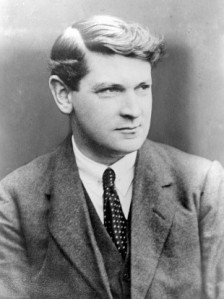
Joseph McGarrity, Irish American political activist best known for his leadership in Clan na Gael in the United States and his support of Irish republicanism back in Ireland, dies of cancer on September 4, 1940.

McGarrity is born on March 28, 1874, in Carrickmore, County Tyrone. His family grows up in poverty, motivating his need to immigrate later in life. He grows up hearing his father discussing Irish politics, including topics such as the Fenians, the Irish Parliamentary Party (IPP), and Irish Home Rule. By the time he is an adult, he has developed a keen interest in politics himself.

McGarrity immigrates to the United States in 1892 at the age of 18. He is reputed to have walked to Dublin before boarding a cattle boat to Liverpool disguised as a drover, and then sailing to the United States using a ticket belonging to someone else. He settles in Philadelphia, Pennsylvania and becomes successful in the liquor business. His business fails, however, on three occasions, twice due to embezzlement by his business partner.

In 1893 McGarrity joins Clan na Gael, an Irish organisation based in the United States committed to aiding the establishment of an independent Irish state. Clan na Gael had been heavily involved with the Fenian Brotherhood that McGarrity had grown up hearing about, and by the latter half of the 19th century had become a sister organisation of the Irish Republican Brotherhood (IRB). In the decade just before McGarrity joins, Clan na Gael and the Fenian movement had waged the Fenian dynamite campaign, where they attempted to force the British state to make concessions in Ireland by bombing British infrastructure. However, this had caused a split within Clan na Gael that is not mended until seven years after McGarrity joins when, in 1900, the factions reunite and plead to support “the complete independence of the Irish people, and the establishment of an Irish republic.” In the years that follow the 1880s and 1890s, he is, amongst others, credited with helping to stitch the organisation back together and bring it renewed strength.

McGarrity helps sponsor several Irish Race Conventions and founds and runs a newspaper called The Irish Press from 1918-22 that supports the Irish War of Independence. He is the founder of the Philadelphia chapter of Clan Na Gael.

During World War I, while the United States is still neutral, McGarrity is involved in the Hindu–German Conspiracy. He arranges the Annie Larsen arms purchase and shipment from New York to San Diego for India.

When Éamon de Valera arrives in the United States in 1919 they strike up an immediate rapport and McGarrity manages de Valera’s tour of the country. He persuades de Valera of the benefits of supporting him and the Philadelphia branch against the New York branch of the Friends of Irish Freedom organisation led by John Devoy and Judge Daniel F. Cohalan. He becomes president of the American Association for the Recognition of the Irish Republic. He christens his newborn son Éamon de Valera McGarrity, although their relationship becomes strained upon de Valera’s entry back into Dáil Éireann in the Irish Free State.

McGarrity opposes the Anglo-Irish Treaty and travels to Dublin in 1922 and assists the development of the short-lived Collins/De Valera Pact by bringing de Valera and Michael Collins together before the 1922 Irish general election.

The Irish Civil War sees a split in Clan na Gael just as it had split Sinn Féin back in Ireland. McGarrity and a minority of Clan na Gael members support the anti-treaty side but a majority support the pro-treaty side, including John Devoy and Daniel Cohalan. Furthermore, in October 1920 Harry Boland informs the Clan na Gael leadership that the IRB will be cutting their ties to the Clan unless the IRB is given more influence over their affairs. Devoy and Cohalan resist this, but McGarrity sees the Clan’s connection with the IRB as vital. While McGarrity’s faction is initially labelled “Reorganised Clan na Gael,” they are able to inherit total control of the Clan na Gael name as Devoy is not able to keep effective organisation of the group. In general, however, the in-fighting amongst the Irish on both sides of the Atlantic is quite disheartening for Irish Americans and in the years to come neither pro nor anti-treaty sides of Clan na Gael see much in the way of donations.

With the scope of Clan na Gael now narrowed, and Devoy and Cohalan removed from the picture, McGarrity becomes chairman of the organisation. He does not support the founding of Fianna Fáil in 1926 and opposes the party’s entry into the Dáil in 1927. Even after the Irish Civil War, he still supports the idea that a 32-county Irish Republic can be achieved through force. in the spring of 1926, he receives Chief of Staff of the Irish Republican Army Andrew Cooney to the United States. Cooney and Clan na Gael formally agree that each organisation will support the other and that Clan na Gael will raise funds, purchase weapons and build support for the IRA in the United States.

Going into the late 1920s though Clan na Gael, as are most Irish American organisations, is struggling. Having limped past the split caused by the Irish Civil War, the rejection of Fianna Fáil has caused a second split in the membership. Many Irish Americans see the IRA and Fianna Fáil as one and the same at that point and Clan na Gael and McGarrity’s hostility to them causes much friction.

By July 1929, the Clan’s membership in one of its strongholds, New York City, is down to just 620 paid members. Then in October of that same year Wall Street crashes and the Great Depression hits. In 1933 McGarrity is left almost bankrupt after he is found guilty of “false bookkeeping entries.” His livelihood is saved when he becomes one of the main ticket agents in the United States for the Irish Hospitals’ Sweepstake. He is a personal friend of Joseph McGrath, one of the founders of the Sweepstake. The sweepstakes allow him to turn his fortunes around.

Despite the trying times of both Clan na Gael and his personal life, McGarrity holds fast in his belief in physical force Irish Republicanism. In 1939 he supports the demand from Seán Russell for the “S-Plan” bombing campaign in Britain, which proves disastrous. He allegedly meets Hermann Göring in Berlin in 1939 to ask for aid for the IRA, which leads indirectly to “Plan Kathleen.”

McGarrity is a lifelong friend of fellow Carrickmore native and avid Republican, Patrick McCartan. When he dies on September 4, 1940 a mass is held in the St. Mary’s Pro-Cathedral in Dublin. He remains an unrepentant physical force republican all his life. A number of McGarrity’s papers are in the National Library of Ireland. He donates his personal Library to Villanova University.

The IRA signs all its statements ‘J.J. McGarrity’ until 1969 when the organisation splits into the ‘Official‘ and ‘Provisional‘ movements. Thereafter the term continues to be used by the Officials while the Provisionals adopt the moniker ‘P.O’Neill.’


Leave a comment

Birth of Joseph McGarrity, Irish American Political Activist

Joseph McGarrity, Irish American political activist best known for his leadership in Clan na Gael in the United States and his support of Irish republicanism back in Ireland, is born on March 28, 1874, in Carrickmore, County Tyrone.

McGarrity’s family grows up in poverty, motivating his need to immigrate later in life. He grows up hearing his father discussing Irish politics, including topics such as the Fenians, the Irish Parliamentary Party (IPP), and Irish Home Rule. By the time he is an adult, he has developed a keen interest in politics himself.

McGarrity immigrates to the United States in 1892 at the age of 18. He is reputed to have walked to Dublin before boarding a cattle boat to Liverpool disguised as a drover, and then sailing to the United States using a ticket belonging to someone else. He settles in Philadelphia, Pennsylvania and becomes successful in the liquor business. His business fails, however, on three occasions, twice due to embezzlement by his business partner.

In 1893 McGarrity joins Clan na Gael, an Irish organisation based in the United States committed to aiding the establishment of an independent Irish state. Clan na Gael had been heavily involved with the Fenian Brotherhood that McGarrity had grown up hearing about, and by the latter half of the 19th century had become a sister organisation of the Irish Republican Brotherhood (IRB). In the decade just before McGarrity joins, Clan na Gael and the Fenian movement had waged the Fenian dynamite campaign, where they attempted to force the British state to make concessions in Ireland by bombing British Infrastructure. However, this had caused a split within Clan na Gael that is not mended until seven years after McGarrity joins when, in 1900, the factions reunite and plead to support “the complete independence of the Irish people, and the establishment of an Irish republic.” In the years that follow the 1880s and 1890s, he is, amongst others, credited with helping to stitch the organisation back together and bring it renewed strength.

McGarrity helps sponsor several Irish Race Conventions and founds and runs a newspaper called The Irish Press from 1918-22 that supports the Irish War of Independence. He is the founder of the Philadelphia chapter of Clan Na Gael.

During World War I, while the United States is still neutral, McGarrity is involved in the Hindu–German Conspiracy. He arranges the Annie Larsen arms purchase and shipment from New York to San Diego for India.

When Éamon de Valera arrives in the United States in 1919 they strike up an immediate rapport and McGarrity manages de Valera’s tour of the country. He persuades de Valera of the benefits of supporting him and the Philadelphia branch against the New York branch of the Friends of Irish Freedom organisation led by John Devoy and Judge Daniel F. Cohalan. He becomes president of the American Association for the Recognition of the Irish Republic. He christens his newborn son Éamon de Valera McGarrity, although their relationship becomes strained upon de Valera’s entry back into Dáil Éireann in the Irish Free State.

McGarrity opposes the Anglo-Irish Treaty and travels to Dublin in 1922 and assists the development of the short-lived Collins/De Valera Pact by bringing de Valera and Michael Collins together before the 1922 Irish general election.

The Irish Civil War sees a split in Clan na Gael just as it had split Sinn Féin back in Ireland. McGarrity and a minority of Clan na Gael members support the anti-treaty side but a majority support the pro-treaty side, including John Devoy and Daniel Cohalan. Furthermore, in October 1920 Harry Boland informs the Clan na Gael leadership that the IRB will be cutting their ties to the Clan unless the IRB is given more influence over their affairs. Devoy and Cohalan resist this, but McGarrity sees the Clan’s connection with the IRB as vital. While McGarrity’s faction is initially labelled “Reorganised Clan na Gael,” they are able to inherit total control of the Clan na Gael name as Devoy is not able to keep effective organisation of the group. In general, however, the in-fighting amongst the Irish on both sides of the Atlantic is quite disheartening for Irish Americans and in the years to come neither pro or anti-treaty sides of Clan na Gael see much in the way of donations.

With the scope of Clan na Gael now narrowed, and Devoy and Cohalan removed from the picture, McGarrity becomes chairman of the organisation. He does not support the founding of Fianna Fáil in 1926 and opposes the party’s entry into the Dáil in 1927. Even after the Irish Civil War, he still supports the idea that a 32-county Irish Republic can be achieved through force. in the spring of 1926, he receives Chief of Staff of the Irish Republican Army Andrew Cooney to the United States. Cooney and Clan na Gael formally agree that each organisation will support the other and that Clan na Gael will raise funds, purchase weapons and build support for the IRA in the United States.

Going into the late 1920s though Clan na Gael, as are most Irish American organisations, is struggling. Having limped past the split caused by the Irish Civil War, the rejection of Fianna Fáil has caused a second split in the membership. Many Irish Americans see the IRA and Fianna Fáil as one and the same at that point and Clan na Gael and McGarrity’s hostility to them causes much friction.

By July 1929, the Clan’s membership in one of its strongholds, New York City, is down to just 620 paid members. Then in October of that same year Wall Street crashes and the Great Depression hits. In 1933 McGarrity is left almost bankrupt after he is found guilty of “false bookkeeping entries.” His livelihood is saved when he becomes one of the main ticket agents in the United States for the Irish Hospitals’ Sweepstake. He is a personal friend of Joseph McGrath, one of the founders of the Sweepstake. The sweepstakes allow him to turn his fortunes around.

Despite the trying times of both Clan na Gael and his personal life, McGarrity holds fast in his belief in physical force Irish Republicanism. In 1939 he supports the demand from Seán Russell for the “S-Plan” bombing campaign in Britain, which proves disastrous. He allegedly meets Hermann Göring in Berlin in 1939 to ask for aid for the IRA, which leads indirectly to “Plan Kathleen.”

McGarrity is a lifelong friend of fellow Carrickmore native and avid Republican, Patrick McCartan. When he dies on September 4, 1940, a mass is held in the St. Mary’s Pro-Cathedral in Dublin. He remains an unrepentant physical force republican all his life. A number of McGarrity’s papers are in the National Library of Ireland. He donates his personal Library to Villanova University.

The IRA signs all its statements ‘J.J. McGarrity’ until 1969 when the organisation splits into the ‘Official‘ and ‘Provisional‘ movements. Thereafter the term continues to be used by the Officials while the Provisionals adopt the moniker ‘P.O’Neill.’


Leave a comment

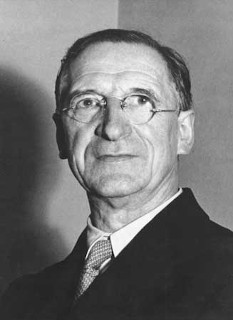
Éamon de Valera Elected 3rd President of Ireland

president-eamon-de-valeraThe 1959 Irish presidential election is held on June 17, 1959. Éamon de Valera, then Taoiseach, is elected as President of Ireland. A referendum proposed by de Valera to replace the electoral system of proportional representation by means of the single transferable vote with first-past-the-post voting which is held on the same day is defeated by 48.2% to 52.8%.

Under Article 12 of the Constitution of Ireland, a candidate for president may be nominated by:

  • at least twenty of the then 207 serving members of the Houses of the Oireachtas, or
  • at least four of 31 councils of the administrative counties, including county boroughs, or
  • themselves, in the case of a former or retiring president.

Outgoing president Seán T. O’Kelly had served two terms, and is ineligible to serve again. On April 27, the Minister for Local Government, Neal Blaney, signs the ministerial order opening nominations, with noon on May 19 as the deadline for nominations, and June 17 set as the date for a contest. All Irish citizens on the Dáil electoral register are eligible to vote.

De Valera who had served as President of Dáil Éireann and President of the Irish Republic from 1919 to 1922 during the Irish revolutionary period, as President of the Executive Council of the Irish Free State from 1932 to 1937, and as Taoiseach from 1937 to 1948, from 1951 to 1954, and again from 1957 until his election as president, is nominated by Fianna Fáil on May 12. He had served as Fianna Fáil’s leader since its foundation in 1926.

Seán Mac Eoin, a Fine Gael TD who had been the party’s candidate in the 1945 Irish presidential election, is nominated again by the party on May 15.

Patrick McCartan, who had also been a candidate in the 1945 election and had served as a senator for Clann na Poblachta from 1948 to 1951, is nominated by two county councils only, short of the four required for nomination. Eoin O’Mahony also seeks and fails to secure a nomination by county councils.

De Valera wins the popular vote with 538,003 votes (56.3%) to Mac Eoin’s 417,536 votes (43.7%).

Éamon de Valera is inaugurated as the third President of Ireland on June 25, 1959.


Leave a comment

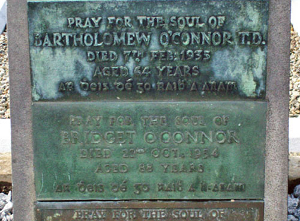
Birth of Bartholomew “Batt” O’Connor

Bartholomew “Batt” O’Connor, Cumann na nGaedheal and Fine Gael politician, is born in Brosna, County Kerry, on July 4, 1870. He serves as a Teachta Dála (TD) for Dublin County from 1924 to 1935.

At seventeen O’Connor leaves school to become a stonemason. In October 1893, at the age of 23, he goes to Boston, where he stays five years. On his return to Ireland, he moves to Dublin, where he soon establishes himself as a “speculative builder” constructing houses in Anglesea Road, Dolphin’s Barn, Eglington Road, Brendan Road, and Donnybrook.

O’Connor joins the Gaelic League in 1900, through which he comes into contact with many of the future leaders of the Independence movement, including Tom Clarke and Seán Mac Diarmada. He is sworn into the Irish Republican Brotherhood (IRB) in 1909 and enrolls in the Irish Volunteers in 1913, the same night as Éamon de Valera.

While not directly involved during the Easter Rising, O’Connor is recognised and arrested on his return to Dublin and sent to Kilmainham Gaol, then to Richmond Barracks, Wandsworth Prison, and finally to Frongoch internment camp, in North Wales.

On his release in September 1916, O’Connor re-establishes his business and takes up his political activities. He reconnects with members of the Keating Branch of the Gaelic League at 46 Parnell Square and takes part in the re-organising of the fragmented IRB. He canvasses for by-elections in Kilkenny and Armagh on behalf of Sinn Féin candidates W. T. Cosgrave and Patrick McCartan.

O’Connor is involved with the revolutionary Sinn Féin party during the time of the First Dáil, handling money and hiding documents for Michael Collins. He purchases 76 Harcourt Street for Michael Collins, following a raid on the Sinn Féin Office at No. 6. There he installs a secret recess for private papers and means of escape through the skylight. When the recess escapes discovery following a raid, he goes on to construct hiding places in many of the other houses used by the movement. He is one of the shareholders of the National Land Bank which is set up in March 1920 at 68 Lower Leeson Street.

O’Connor plays a role in the “National Loan,” raised by Collins to fund the fledgling Dáil Éireann. The loan, which had been declared illegal, is lodged in the individual bank accounts of the trustees. The gold is kept under the floor of O’Connor’s house until 1922.

O’Connor takes the pro-Treaty side during the subsequent split over the Anglo-Irish Treaty. He is an unsuccessful candidate for Dáil Éireann at the 1923 Irish general election, in the Dublin County constituency.

After the death in November 1923 of Cumann na nGaedheal TD Michael Derham, O’Connor is the Cumann na nGaedheal candidate at the Dublin County by-election on March 19, 1924, when he is elected to the 4th Dáil ahead of Seán MacEntee. He retains his seat at the next four general elections, joining Fine Gael when Cumann na nGaedheal merges in 1933 with the National Centre Party and the Blueshirts. He serves as a Trustee of Cumann na nGaedheal.

After his death on February 7, 1935, the 1935 Dublin County by-election is won by Cecil Lavery of Fine Gael.


2 Comments

Michael Collins Made President of the IRB

michael-collins

Michael Collins, who is also a leader in the Irish Republican Army, is made president of the Irish Republican Brotherhood (IRB) on June 28, 1919.

At the start of the 20th century, the IRB is a stagnating organisation, concerned more with Dublin municipal politics than the establishment of a republic. A younger generation of Ulster republicans aim to change this and, in 1905, Denis McCullough and Bulmer Hobson found the Dungannon Clubs, whose purpose is to discourage enlistment into the British Army and encourage enlistment into the IRB.

In 1909, Michael Collins is introduced to the brotherhood by Sam Maguire. By 1914, the Supreme Council is largely purged of its older, tired leadership, and is dominated by enthusiastic men such as Hobson, McCullough, Patrick McCartan, John MacBride, Seán Mac Diarmada, and Tom Clarke. The latter two are to become the primary instigators of the Easter Rising in 1916.

Following the Rising some republicans, notably Éamon de Valera and Cathal Brugha, leave the organization as they view it as no longer necessary since the Irish Volunteers now perform its function. The IRB, during the War of Independence (1919-1921), is under the control of Michael Collins, who initially is secretary and subsequently, on June 28, 1919, is made president of the Supreme Council.

When the Anglo-Irish Treaty is signed on December 6, 1921, it is debated by the Supreme Council, which votes to accept it by an 11-4 vote. Those who oppose the Treaty include former leader Harry Boland, Austin Stack, and Liam Lynch. Anti-Treaty republicans like Ernie O’Malley, who fought during the Civil War against the Treaty, see the IRB as being used to undermine the Irish Republic.

The IRB becomes quiescent during the Irish Civil War, which ends in May 1923, but it emerges again later that year as a faction within the National Army. It supports Minister for Defence Richard Mulcahy against the “Old IRA,” which fights against the recruitment of ex-British Army personnel and the demobilization of old IRA men. This comes to a head with the Army Mutiny of 1924, in the wake of which Mulcahy resigns and other IRB members of the army are dismissed by acting President of the Executive Council Kevin O’Higgins. The IRB subsequently dissolves itself, although it is not known whether a formal decision is made, or it simply ceases to function.