seamus dubhghaill

Promoting Irish Culture and History from Little Rock, Arkansas, USA


Leave a comment

Birth of Mick Moloney, Irish American Musician & Scholar

Michael “Mick” Moloney, Irish-born American musician and scholar, is born in Limerick, County Limerick, on November 15, 1944. He is the artistic director of several major arts tours and co-founds Green Fields of America.

Moloney is the son of Michael Moloney, the head air traffic control officer of Shannon Airport, and his wife, Maura, who works as the principal of a Limerick primary school. He first plays tenor banjo during his teenage years. He studies at University College Dublin (UCD), graduating with a bachelor’s degree in economics. He then relocates to London to be a social worker assisting immigrant communities, before joining The Johnstons. After playing with the group for five years, he immigrates to the United States in 1973. He initially settles in Philadelphia, Pennsylvania, and eventually becomes an American citizen.

Three years after moving to the United States, Moloney co-founds Green Fields of America, an ensemble of Irish musicians, singers, and dancers which tour across the country on several occasions. He also serves as the artistic director for several major arts tours. One of these is the 1985 festival in Manhattan titled “Cherish the Ladies” to highlight female musicians in the area of Irish traditional music, which had been dominated by men until that decade. He produces an album for the female group by the same name titled Irish Women Musicians in America. The group’s leader, Joanie Madden, is one of several future fellows of the National Endowment for the Arts (NEA) to be mentored by Moloney. He produces and performs on over 70 albums and serves as advisor for numerous festivals and concerts across America, with ethnomusicologist and musician Daniel T. Neely putting the figure as high as 125 albums.

Moloney undertakes postgraduate studies at the University of Pennsylvania, obtaining a master’s degree before being awarded a Doctor of Philosophy in folklore and folk life in 1992. He goes on to teach ethnomusicology, folklore, and Irish studies at Penn, Georgetown University, and Villanova University. He is also global distinguished professor of music and Irish studies at New York University (NYU) until his death. In recognition of his work in public folklore, he receives a 1999 National Heritage Fellowship from the NEA.

In addition to music performance, Moloney writes Far from the Shamrock Shore: The Story of Irish American History Through Song, which is published by Crown Publications in February 2002 with a supplementary CD on Shanachie Records. He hosts three nationally syndicated series covering folk music on American Public Television (APT). He works as a consultant, performer, and interviewee on the RTÉ special Bringing It All Back Home, and is also a participant, consultant, and music arranger for Out of Ireland, a documentary film by PBS. He performs on the PBS special The Irish in America: Long Journey Home.

Moloney is married three times over the course of his life. His first marriage is to Miriam Murphy. His second marriage is to Philomena Murray. Together, they have one child but eventually divorce. His third marriage to Judy Sherman also ends in divorce. He is in a domestic partnership with Sangjan Chailungka at the time of his death. During his later years, he divides his time between Bangkok, where he resides with Chailungka, and his apartment in Greenwich Village. In Bangkok, he volunteers as a music therapist and teacher for abandoned children with HIV at the Mercy Center in the Khlong Toei district, which is founded by the Redemptorist priest Joseph H. Maier.

Moloney dies at the age of 77 on July 27, 2022, at his home in Manhattan, having played at the Maine Celtic Festival less than a week before. The cause of death is not announced.

Leave a comment

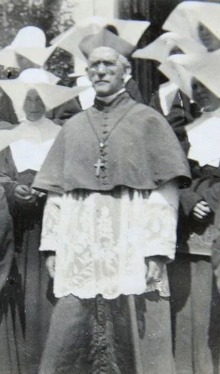
Birth of Daniel Cohalan, Bishop of Cork

Daniel Cohalan, Irish Roman Catholic clergyman who serves as the Bishop of Cork from 1916 to 1952, is born on July 14, 1858, in Kilmichael, County Cork.

After graduating at St. Patrick’s College, Maynooth, Cohalan is ordained a priest at the Cathedral of St. Mary and St. Anne, Cork on July 25, 1882. His first pastoral appointment is a curate at Kilbrittain, County Cork, from October 1883 to January 1884. He briefly resumes his post-graduate studies at St. Finbarr’s Seminary (now College), Cork, from January to November 1884. His second curacy is at Tracton, County Cork, from November 1884 to September 1896. He returns to St. Patrick’s College, Maynooth, as a professor of Theology from September 7, 1896, to June 7, 1914.

Cohalan is appointed Auxiliary Bishop of Cork and Titular Bishop of Vaga on May 25, 1914. He is consecrated bishop at the Cathedral of St. Mary and St. Anne on June 7, 1914, by John Harty, Archbishop of Cashel and Emly. Two years later, he is appointed Diocesan Bishop of Cork on August 29, 1916.

Cohalan is an outspoken critic during the Irish War of Independence, condemning acts of violence on both sides. In particular, he denounces the policy of reprisals. In July 1920, he pronounces an interdict on the killers of a Royal Irish Constabulary (RIC) sergeant, shot dead in the church porch in Bandon. He declares that anyone killing from ambush will be excommunicated. On December 12, 1920, Cohalan issues a decree saying that “anyone within the diocese of Cork who organises or takes part in ambushes or murder, or attempted murder, shall be excommunicated.” In turn, his life is threatened by the Irish Republican Army (IRA). In August 1928, he condemns the British government which had allowed Terence MacSwiney to die on hunger strike in 1920.

The Bessborough Home in Cork is run by the Sisters of the Sacred Hearts of Jesus and Mary and when the department “sought a change of superior in Bessborough because of the appallingly high death rate, he [Catholic Bishop of Cork Dr. Daniel Cohalan] denounced the request. The replacement of the Bessborough superior was delayed for four years after the department requested it, and many infants died during that time. It seems probable that the bishop’s intervention was elicited by the congregation.” In general, the report finds that the major causes of infant mortality in the homes were respiratory infections and gastroenteritis, while “public attention has focused on marasmus [malnutrition]” suggesting “willful neglect.” However, it says that “the term marasmus is best seen as indicating that a child was failing to thrive, but medical experts suggest that this was due to an underlying, undiagnosed medical condition.”

Cohalan dies in office at the age of 94 at Bon Secours Hospital, Cork, on August 24, 1952. A story, current at the time in Cork, refers to his antipathy towards bishops of the Church of Ireland who styled themselves “Bishop of Cork.” A month before his death, and on his deathbed, word is brought to him of the death of the Church of Ireland Bishop of Cork, Cloyne and Ross, Robert Hearn. The response of Cohalan, known “affectionately” as “Danny Boy”, is reputedly, “now he knows who’s Bishop of Cork.”

Originally buried at St. Finbarr’s College, Farranferris, Cohalan is reinterred in the grounds of St. Mary and St. Anne’s Cathedral, Cork, in 1996. His nephew of the same name, Daniel Cohalan, is Bishop of Waterford and Lismore from 1943 to 1965.


Leave a comment

Magee College Opens in Derry, County Londonderry

magee-college-1870

Magee College opens on October 10, 1865, as a Presbyterian Christian arts and theological college in Derry, County Londonderry, Northern Ireland. Since 1953, it has had no religious affiliation and provides a broad range of undergraduate and postgraduate academic degree programmes in disciplines ranging from business, law, social work, creative arts & technologies, cinematic arts, design, computer science and computer games to psychology and nursing.

The Magee Campus gains its name from Martha Magee, the widow of a Presbyterian minister, who, in 1845, bequeathed £20,000 to the Presbyterian Church in Ireland to found a college for theology and the arts. It opens in 1865 primarily as a theological college but accepts students from all denominations to study a variety of subjects. It is a college of the Royal University of Ireland from 1880 and later becomes associated with Trinity College, Dublin when the Royal University is dissolved in 1909 and replaced by the National University of Ireland.

During World War II, the college is taken over by the Admiralty for Royal NavyRoyal Navy operational use, becoming with Ebrington Barracks (HMS Ferret), a major facility in the Battle of the Atlantic. A 2013 BBC report describes a secret major control bunker, later buried beneath the lawns of the college. From 1941 this bunker, part of Base One Europe, together with similar bunkers in Derby House, Liverpool and Whitehall is used to control one million Allied personnel and fight the Nazi U-boat threat.

In 1953, Magee Theological College separates from the remainder of the college, eventually moving to Belfast in a 1978 merger that forms Union Theological College. Also in 1953, Magee College breaks its ties with Dublin and becomes Magee University College. It is hoped by groups led by the University for Derry Committee that this university college would become Northern Ireland’s second university after Queen’s University Belfast. However, in the 1960s, following the recommendations in The Lockwood Report by Sir John Lockwood, Master of Birkbeck College, London and former Vice-Chancellor of the University of London, the Parliament of Northern Ireland makes a controversial decision to pass it over in favour of a new university in Coleraine. Instead it is incorporated into the two-campus New University of Ulster in 1969. The next fourteen years see the college halve in size, while development focuses on the main Coleraine campus.

In 1984, the New University merges with the Ulster Polytechnic, and Magee becomes the early focus of development of a new four-campus university, the University of Ulster. Student and faculty numbers recover and grow rapidly over the next ten to fifteen years, accompanied by numerous construction projects. Magee grows from just 273 students in 1984 to over 4,000 undergraduates in 2012. In 2012, the University continues to lobby the Northern Ireland Executive for an additional 1,000 full-time undergraduate places, leading to 6,000 students at Magee in 2017.

On September 14, 2013, Magee hosts, for the first time on the island of Ireland, the 23rd International Loebner Prize Contest in Artificial Intelligence based on the Turing test proposed by the renowned British computer scientist Alan Turing in 1950. Turing also works on cracking the Enigma machine code at Bletchley Park which is instrumental in the Battle of the Atlantic.

In October 2014 the University of Ulster is rebranded as Ulster University.

(Pictured: Magee College, c. 1870)