seamus dubhghaill

Promoting Irish Culture and History from Little Rock, Arkansas, USA


Leave a comment

The Proclamation of Dungannon

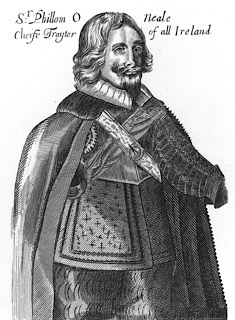
The Proclamation of Dungannon is a document produced by Sir Phelim O’Neill on October 24, 1641, in the Irish town of Dungannon. O’Neill is one of the leaders of the Irish Rebellion of 1641, which was launched the previous day. O’Neill’s Proclamation sets out a justification of the uprising. He claims to have been given a commission signed and sealed on October 1 by the King of England, Scotland and Ireland Charles I that commands him to lead Irish Catholics in defence of the Kingdom of Ireland against Protestants who sympathise with Charles’s opponents in the Parliament of England.

Following the trial and execution of the Lord Deputy of IrelandThomas Wentworth, 1st Earl of Strafford, in May 1641, Ireland is in a state of turmoil. There is growing tension between Catholics and Protestants (particularly those of a Puritan tendency) with the former generally sympathetic to King Charles while the latter supports the English Parliament and the Scottish Covenanters in the dispute that shortly leads to the outbreak of the English Civil War. This forms part of the wider War of the Three Kingdoms.

On October 23, a major uprising breaks out in Ulster organised by leading members of the Gaelic aristocracy. The rebels attack Protestant plantation settlements as well as native Irish Protestants and take garrison towns held by the Irish Army. Irish government authorities in Dublin struggle to contain the insurgency with the limited number of troops they have at their disposal. A last-minute warning saves Dublin Castle from a surprise attack, although O’Neill is clearly unaware of the failure of the Dublin plot when he issues his proclamation.

After seizing several key strategic points in Ulster over the previous twenty-four hours, O’Neill makes his proclamation in Dungannon, a town that has symbolic importance as the traditional capital of the O’Neill dynasty.

In support of his actions, O’Neill claims to have a document from King Charles commissioning him. The Commission is supposedly signed under the Great Seal of Scotland. By declaring their loyalty to the Crown and defence of the Catholic religion, O’Neill and his followers adopt a political stance which is taken up by the subsequent Irish Confederation which governs rebel-controlled territory in the name of the King from 1642 until 1649. The Proclamation encourages many Catholics to believe they can lawfully join the rising with the King’s blessing, while Protestants are left demoralised.

O’Neill’s second and more trenchant proclamation is made “from our camp at Newry” on November 4, 1641 alongside Rory Maguire. He also publishes the actual royal commission that gives authority for his earlier proclamation. It is subtly different, in that it empowers him to arrest and seize property from all of Charles’s English Protestant subjects living in Ireland, but exempts his Irish and Scottish subjects.

Until the late nineteenth century historians generally accept that the commission is genuine, or at the very least Charles had secretly encouraged the Irish Catholics to launch a rising. Since then, for a variety of reasons, it has been considered to be a forgery produced by O’Neill and his associates without the knowledge of the King. They may well have acquired a copy of the Great Seal of Scotland when they captured the garrison town of Charlemont on October 23.

The historian David Stevenson notes that it would be unlikely that the commission would have been addressed to O’Neill. Had it been genuine it would almost certainly have been issued to more senior Irish Royalists such as the James Butler, 1st Duke of Ormond, or the leading Catholic noble of Ulster, Randal MacDonnell, 1st Marquess of Antrim. It is also unlikely to have been issued at Edinburgh as O’Neill claimed. However, King Charles was in Edinburgh on October 1, dealing with Scottish political matters.

Forgery or not, King Charles publicly proclaims all the Irish rebels as traitors on January 1, 1642.

That the Commission is genuine is widely accepted in England and Scotland by the King’s opponents and even some of his own supporters. It seems to tie in with earlier rumours of an army plot which had suggested that Charles might bring over the New Irish Army, made up largely of Ulster Catholics, to impose his will on England and Scotland. Anger at the King’s alleged links with the insurgents grow – particularly as horror stories of atrocities committed, such as the Portadown Massacre, begin to filter across the Irish Sea. Tensions arising from news of the Irish rebellion is a factor in the English push to Civil War in early 1642.

The Scottish authorities dispatch an Army which quickly retakes much of Ulster from the insurgents. Once the English Civil War breaks out in October 1642, Charles’ emissaries begin negotiations with the Irish rebels for their support, which seems to present further evidence to his opponents of his links with the Catholic Ulster leaders. Many of these later dealings are exposed when Charles private letters are captured during the Battle of Naseby (1645) and published as King’s Cabinet Opened.

When O’Neill is captured in 1653 following the Cromwellian conquest of Ireland, he is put on trial for his life. The authorities offer to spare him if he will repeat his earlier claims that Charles had ordered the Catholics to rise in 1641. O’Neill now refuses to implicate the King, who had been executed four years earlier, and is put to death himself. Nonetheless, the English Republicans continue to use O’Neill’s earlier claims of the King’s involvement to justify their decision to commit regicide.

Leave a comment

Birth of John Cole, Northern Irish Journalist & BBC Broadcaster

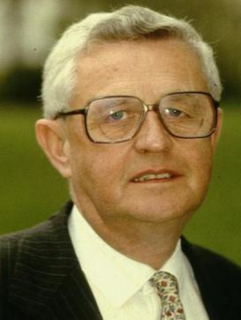
John Morrison Cole, Northern Irish journalist and broadcaster best known for his work with the BBC, is born in Belfast, Northern Ireland, on November 23, 1927. He serves as deputy editor of The Guardian and The Observer and, from 1981 to 1992, is the BBC’s political editor. Donald Macintyre, in an obituary in The Independent, describes him as “the most recognisable and respected broadcast political journalist since World War II.”

Cole is the son of George Cole, an electrical engineer, and his wife Alice. The family is Ulster Protestant, and he identifies himself as British. He receives his formal education at the Belfast Royal Academy.

Cole starts his career in print journalism in 1945, joining the Belfast Telegraph as a reporter and industrial correspondent. He subsequently works as a political reporter for the paper. He gains a scoop when he interviews the then Prime Minister, Clement Attlee, who is holidaying in Ireland.

Cole joins The Guardian, then The Manchester Guardian, in 1956, reporting on industrial issues. He transfers to the London office in 1957 as the paper’s labour correspondent. Appointed news editor in 1963, succeeding Nesta Roberts, he takes on the task of reorganising the paper’s “amateurish” system for gathering news. He heads opposition to a proposed merger with The Times in the mid-1960s, and later serves as deputy editor under Alastair Hetherington. When Hetherington leaves in 1975, Cole is in the running for the editorship, but fails to secure the post, for reasons which may include his commitment to the cause of unionism in Northern Ireland, as well as what is seen by some as inflexibility and a lack of flair. Unwilling to continue at The Guardian, he then joins The Observer as deputy editor under Donald Trelford, remaining there for six years.

After Tiny Rowland takes over as proprietor of The Observer in 1981, Cole gives evidence against him at the Monopolies Commission. The following day he receives a call from the BBC offering him the job of political editor, succeeding John Simpson. He has little previous television experience but proves a “natural broadcaster.” Reporting through most of the premiership of Margaret Thatcher, he becomes a familiar figure on television and radio.

Cole’s health is put under strain by the workload, and he suffers a heart attack in February 1984. Returning to report on that year’s conference season, he covers the Brighton hotel bombing, getting a “memorable” interview with Thatcher on the pavement in its immediate aftermath, in which she declares that the Tory conference will take place as normal. An astute observer of the political scene, he is one of the earliest to forecast Thatcher’s resignation as Prime Minister in 1990, in what colleague David McKie refers to as “perhaps his greatest exclusive.”

Cole establishes a strong reputation for his “gentle but probing” interviewing style, for his political assessments, and for presenting analysis rather than “bland reporting.” Held in enormous affection by viewers, he is trusted by both politicians and the public. He is known for speaking in the language used by ordinary people rather than so-called Westminster experts. His distinctive Northern Irish accent leads the way for BBC broadcasters with regional accents.

Cole retires as political editor in 1992 at the age of 65, compulsory at the time, but continues to appear on television, including making programmes on golf and travel. He also continues to appear on the BBC programme Westminster Live for several years after he retired as political editor.

In addition to his journalistic writing, Cole authors several books. The earliest are The Poor of the Earth, on developing countries, and The Thatcher Years (1987). After his retirement as BBC political editor, he spends more time writing. His political memoir, As It Seemed to Me, appears in 1995 and becomes a best-seller. He also publishes a novel, A Clouded Peace (2001), set in his birthplace of Belfast in 1977.

In 2007, Cole writes an article for the British Journalism Review, blaming both politicians and the media for the fact that parliamentarians are held in such low esteem, being particularly scathing of Alastair Campbell‘s influence during Tony Blair‘s premiership.

In 1966, the Eisenhower Fellowships selects Cole to represent Great Britain. He receives the Royal Television Society‘s Journalist of the Year award in 1991. After his retirement in 1992, he is awarded an honorary degree from the Open University as Doctor of the University and receives the Richard Dimbleby Award from BAFTA in 1993. He turns down a CBE in 1993, citing the former The Guardian newspaper rule that journalists can only accept gifts which can be consumed within 24 hours.

In his private life Cole is a supporter of the Labour Party and is a believer in the trades union movement. He considers that the combating of unemployment is one of the most important political issues. He is a British Republican and a committed Christian, associating in the latter part of his life with the United Reformed Church at Kingston upon Thames.

Cole suffers health problems in retirement including heart problems and two minor strokes. In 2009, he is diagnosed with cancer. He subsequently develops aphasia. He dies at his home at Claygate in the county of Surrey on November 7, 2013.

Tributes are paid by journalists, broadcasters and politicians across the political spectrum. Prime Minister David Cameron calls Cole a “titan at the BBC” and an “extraordinary broadcaster.” Labour Party leader Ed Miliband says that “my generation grew up watching John Cole. He conveyed the drama and importance of politics.” The Scottish First Minister Alex Salmond says that Cole is “an extremely able journalist but also extraordinarily helpful and generous to a young politician.” The BBC’s political editor at the time, Nick Robinson, writes that Cole “shaped the way all in my trade do our jobs.”


Leave a comment

Birth of British Labour Politician Kevin McNamara

Joseph Kevin McNamara KSG, British Labour Party politician who serves as a Member of Parliament (MP) for almost 40 years, is born on September 5, 1934.

McNamara is educated by the Irish Christian Brothers at St. Mary’s College, Crosby and he studies for an LLB at the University of Hull. He is head of department in History at St. Mary’s Grammar School (now called St. Mary’s College) in Kingston upon Hull from 1958–64 and a law lecturer at Hull College of Commerce from 1964–66.

After unsuccessfully contesting Bridlington in 1964, McNamara is elected to the House of Commons as Member of Parliament (MP) for Kingston upon Hull North, in a by-election in January 1966 following the death of sitting Labour MP Henry Solomons. Labour’s hold of a former marginal seat with a significantly increased majority is widely considered to have helped to convince Prime Minister Harold Wilson to call the 1966 election to seek a larger majority.

McNamara retains his seat at the 1966 general election, and at subsequent elections until the constituency is abolished for the February 1974 general election, when he transfers to the new Kingston upon Hull Central constituency. When that constituency is abolished for the 1983 election, he is re-elected for the re-created Kingston upon Hull North constituency.

McNamara campaigns in his last years in parliament on many issues, protesting against the Act of Succession which prohibits a Roman Catholic or the spouse of a Roman Catholic to be the British monarch. He steps down at the 2005 general election, with the local Constituency Labour Party choosing Diana Johnson to stand in his place.

During the 2005 general election campaign McNamara claims some of the policies regarding illegal travelers’ sites of the leader of the Conservative Party, Michael Howard, had a “whiff of the gas chambers” about them. Howard’s grandmother died at Auschwitz.

McNamara is known throughout his parliamentary career as a supporter of Irish nationalism and favours a United Ireland. After entering parliament, he soon becomes interested in reports of discrimination against the Catholic minority in Northern Ireland and supports the Campaign for Democracy in Ulster (CDU). He serves as a frontbench spokesman for the Labour Party, including Shadow Secretary of State for Northern Ireland under Neil Kinnock, 1987–94, an appointment that is widely criticised by Unionists.

After Tony Blair becomes Labour leader, he replaces McNamara as Northern Ireland spokesman with Mo Mowlam. In 1997, he helps persuade the newly elected Labour government to donate £5,000 (thereby matching the contribution of the Irish government) for the erection of a memorial in Liverpool to the victims of the Great Irish Famine. He also supports Republicanism in the United Kingdom and joins the All-Party Parliamentary Republic Group.

McNamara is a Roman Catholic and a Knight of the Pontifical Order of Saint Gregory the Great. He is married to Nora McNamara, and is the father of four sons and a daughter.

In 2006, McNamara receives the honorary degree of Doctor of Laws from the University of Hull in recognition of his long service in politics. He graduates with a Ph.D from the University of Liverpool in 2007 having completed a thesis on the MacBride Principles at the Institute of Irish Studies, where he gives the 2008 John Kennedy Lecture in Irish Studies, Perhaps It Will All Go Away – an Examination of the British Response to the Civil Rights Movement in Northern Ireland.

In 2017, McNamara is diagnosed with pancreatic cancer while on holiday in Spain. He dies on August 6, 2017 at Formby, England, at the age of 82.