seamus dubhghaill

Promoting Irish Culture and History from Little Rock, Arkansas, USA


Leave a comment

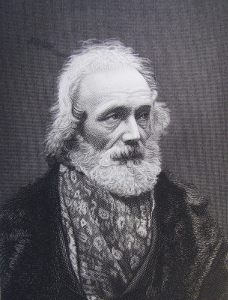
Birth of Edward Dowden, Critic, Professor & Poet

Edward Dowden, Irish critic, professor and poet, is born in Cork, County Cork, on May 3, 1843.

Dowden is the son of John Wheeler Dowden, a merchant and landowner, and is born three years after his brother John, who becomes Bishop of Edinburgh in 1886. His literary tastes emerge early, in a series of essays written at the age of twelve. His home education continues at Queen’s College, Cork and at Trinity College, Dublin. He contributes to the literary magazine Kottabos.

Dowden has a distinguished career, becoming president of the University Philosophical Society, and wins the vice-chancellor’s prize for English verse and prose, and the first senior moderatorship in ethics and logic. In 1867 he is elected professor of oratory and English literature in Dublin University.

Dowden’s first book, Shakespeare: A Critical Study of His Mind and Art (1875), results from a revision of a course of lectures, and makes him widely known as a critic: translations appear in German and Russian; his Poems (1876) goes into a second edition. His Shakespeare Primer (1877) is translated into Italian and German. In 1878 the Royal Irish Academy awards him the Cunningham gold medal “for his literary writings, especially in the field of Shakespearian criticism.”

Later works by Dowden in this field include an edition of The Sonnets of William Shakespeare (1881), Passionate Pilgrim (1883), Introduction to Shakespeare (1893), Hamlet (1899), Romeo and Juliet (1900), Cymbeline (1903), and an article entitled “Shakespeare as a Man of Science” (in the National Review, July 1902), which criticizes T. E. Webb’s Mystery of William Shakespeare. His critical essays “Studies in Literature” (1878), “Transcripts and Studies” (1888), “New Studies in Literature” (1895) show a profound knowledge of the currents and tendencies of thought in various ages and countries; but his The Life of Percy Bysshe Shelley (1886) makes him best known to the public at large. In 1900 he edits an edition of Shelley‘s works.

Other books by Dowden which indicate his interests in literature include: Southey (1879), his edition of Southey’s Correspondence with Caroline Bowles (1881), and Select Poems of Southey (1895), his Correspondence of Sir Henry Taylor (1888), his edition of William Wordsworth‘s Poetical Works (1892) and of his Lyrical Ballads (1890), his French Revolution and English Literature (1897), History of French Literature (1897), Puritan and Anglican (1900), Robert Browning (1904) and Michel de Montaigne (1905). His devotion to Johann Wolfgang von Goethe leads to his succeeding Max Müller in 1888 as president of the English Goethe Society.

In 1889 Dowden gives the first annual Taylorian Lecture at the University of Oxford, and from 1892 to 1896 serves as Clark lecturer at Trinity College, Cambridge. To his research are due, among other matters of literary interest, the first account of Thomas Carlyle‘s Lectures on periods of European culture; the identification of Shelley as the author of a review (in The Critical Review of December 1814) of a romance by Thomas Jefferson Hogg; a description of Shelley’s Philosophical View of Reform; a manuscript diary of Fabre d’Églantine; and a record by Dr Wilhelm Weissenborn of Goethe’s last days and death. He also discovers a Narrative of a Prisoner of War under Napoleon (published in Blackwood’s Magazine), an unknown pamphlet by Bishop George Berkeley, some unpublished writings of William Hayley relating to William Cowper, and a unique copy of the Tales of Terror.

Dowden’s wide interests and scholarly methods make his influence on criticism both sound and stimulating, and his own ideals are well described in his essay on The Interpretation of Literature in his Transcripts and Studies. As commissioner of education in Ireland (1896–1901), trustee of the National Library of Ireland, secretary of the Irish Liberal Union and vice-president of the Irish Unionist Alliance, he enforces his view that literature should not be divorced from practical life. His biographical/critical concepts, particularly in connection with Shakespeare, are played with by Stephen Dedalus in the library chapter of James Joyce‘s Ulysses. Leslie Fiedler is to play with them again in The Stranger in Shakespeare.

Dowden marries twice, first to Mary Clerke in 1866, and secondly in 1895 to Elizabeth Dickinson West, daughter of the dean of St Patrick’s. His daughter by his first wife, Hester Dowden, is a well-known spiritualist medium.

Dowden dies in Dublin on April 4, 1913. His Letters are published in 1914 by Elizabeth and Hilda Dowden.

A Dublin City Council plaque commemorating Dowden is unveiled on November 29, 2016.

Leave a comment

Birth of Richard Rowley, Poet, Playwright & Writer

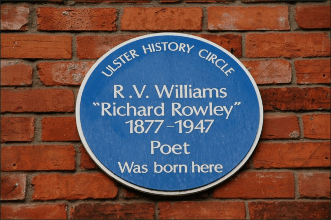
Richard Valentine Williams, who writes poetry, plays and stories under the pseudonym of Richard Rowley, is born on April 2, 1877, at 79 Dublin Road in Belfast, in what is now Northern Ireland.

At the age of sixteen, Rowley enters the family firm, McBride and Williams, which manufactures cotton handkerchiefs and eventually becomes its managing director. After the collapse of the company in 1931 he is Chairman of the Northern Ireland Unemployment Assistance Board. His early poems, in The City of Refuge and Other Poems (1917), are rhetorical celebrations of industry. His next volume, City Songs and Others (1918), includes his most quoted poem, The Islandmen, and is regarded as containing his most original work: “Browning-like monologues straight from the mouths of Belfast’s working-class.”

In 1918, Rowley goes to live in the Mourne country, residing in Brook Cottage, Bryansford Rd., Newcastle, County Down. He writes short stories, including Tales of Mourne (1937), as well as at least one highly successful play, Apollo In Mourne (1926). During World War II, he founds, and runs from his Newcastle home, the short-lived Mourne Press. He publishes first collections of Sam Hanna Bell and Michael McLaverty, but the press fails in 1942.

With Bell, Rowley is one of a set of Linen Hall Library members who retires regularly to Campbell’s Cafe. The regulars, at various points, include writers John Boyd and Denis Ireland, actors Joseph Tomelty, Jack Loudon and J. G. Devlin, poets John Hewitt and Robert Greacen, artists Padraic Woods, Gerard Dillon, and William Conor and the Rev. Arthur Agnew, an outspoken opponent of sectarianism. The ebullient atmosphere the circle creates is a backdrop for the appearance of Campbell’s Cafe in Brian Moore‘s wartime Bildungsroman, The Emperor of Ice-Cream.

In 1946, Rowley sells Brook Cottage, which has since been demolished, and moves with his wife, the former Margaret Pollock, to Drumilly, Loughgall, County Armagh, as paying guests of their friends, Mr. and Mrs. Ralph Cope. He dies there on April 25, 1947.

George MacCann and Jack Loudan presents a commemoration of Rowley’s life on the radio in 1952. The programme uses recordings of his friends Lady Mabel Annesley, who illustrated several of his publications, along with the poet John Irvine, the playwright Thomas Carnduff and William Conor. In Newcastle, Rowley’s name is remembered through the Rowley Meadows housing development and the Rowley Path, which runs along the southern boundary of the Islands Park.

(Pictured: Blue plaque at Richard Rowley’s birthplace in Belfast, Northern Ireland)


Leave a comment

Birth of Patrick Kavanagh, Poet & Writer

Patrick Kavanagh, Irish poet and novelist whose best-known works include the novel Tarry Flynn, and the poems “On Raglan Road” and “The Great Hunger,” is born in rural Inniskeen, County Monaghan, on October 21, 1904. He is known for his accounts of Irish life through reference to the everyday and commonplace.

Kavanagh is the fourth of ten children of James Kavanagh, a cobbler and farmer, and Bridget Quinn. He is a pupil at Kednaminsha National School from 1909 to 1916, leaving in the sixth year at the age of 13. He becomes apprenticed to his father as a shoemaker and works on his farm. He is also goalkeeper for the Inniskeen Gaelic football team.

Kavanagh’s first published work appears in 1928 in the Dundalk Democrat and the Irish Independent. In 1931, he walks 80 kilometres to meet George William Russell in Dublin, where Kavanagh’s brother is a teacher. Russell gives him books, among them works by Feodor Dostoyevsky, Victor Hugo, Walt Whitman, Ralph Waldo Emerson and Robert Browning, and becomes Kavanagh’s literary adviser.

Kavanagh’s first collection, Ploughman and Other Poems, is published in 1936. It is notable for its realistic portrayal of Irish country life, free of the romantic sentiment often seen at the time in rural poems, a trait he abhors. Two years after his first collection is published, he has yet to make a significant impression. The Times Literary Supplement describes him as “a young Irish poet of promise rather than of achievement.”

In 1938 Kavanagh goes to London and remains there for about five months. The Green Fool, a loosely autobiographical novel, is published in 1938 and Kavanagh is accused of libel by Oliver St. John Gogarty who sues Kavanagh for his description of mistaking Gogarty’s “white-robed maid for his wife or his mistress.” Gogarty is awarded £100 in damages. The book, which recounts Kavanagh’s rural childhood and his attempts to become a writer, receives international recognition and good reviews.

Patrick Kavanagh dies on November 30, 1967, from an attack of bronchitis, bringing to a close the life of one of Ireland’s most controversial and colorful literary figures. Kavanagh’s reputation as a poet is based on the lyrical quality of his work, his mastery of language and form and his ability to transform the ordinary into something of significance.


Leave a comment

Death of Isabella Augusta, Lady Gregory

lady-gregory

Isabella Augusta, Lady Gregory, an Irish playwright, folklorist and theatre manager, dies at her home in Galway on May 22, 1932.

Augusta is born at Roxborough, County Galway, the youngest daughter of the Anglo-Irish gentry family Persse. She is educated at home, and her future career is strongly influenced by the family nanny, Mary Sheridan, a Catholic and a native Irish speaker, who introduces her to the history and legends of the local area.

Augusta marries Sir William Henry Gregory on March 4, 1880, in St Matthias’ Church, Dublin. He is a well-educated man with many literary and artistic interests, and the house at Coole Park houses a large library and extensive art collection. He also owns a house in London, where the couple spends a considerable amount of time, holding weekly salons frequented by many leading literary and artistic figures of the day, including Robert Browning, Lord Tennyson, John Everett Millais and Henry James.

Augusta’s earliest work to appear under her own name is Arabi and His Household (1882), a pamphlet in support of Ahmed Orabi Pasha, leader of what has come to be known as the Urabi Revolt. In 1893 she publishes A Phantom’s Pilgrimage, or Home Ruin, an anti-Nationalist pamphlet against William Ewart Gladstone‘s proposed second Home Rule Act.

Augusta continues to write prose during the period of her marriage. She also writes a number of short stories in the years 1890 and 1891, although these never appear in print. A number of unpublished poems from this period have also survived. When Sir William Gregory dies in March 1892, Lady Gregory goes into mourning and returns to Coole Park. There she edits her husband’s autobiography, which she publishes in 1894.

A trip to Inisheer in the Aran Islands in 1893 re-awakes for Lady Gregory an interest in the Irish language and in the folklore of the area in which she lives. She organises Irish lessons at the school at Coole and begins collecting tales from the area around her home. This activity leads to the publication of a number of volumes of folk material, including A Book of Saints and Wonders (1906), The Kiltartan History Book (1909) and The Kiltartan Wonder Book (1910).

With William Butler Yeats and Edward Martyn, she co-founds the Irish Literary Theatre and the Abbey Theatre and writes numerous short works for both companies. Lady Gregory produces a number of books of retellings of stories taken from Irish mythology. Born into a class that identifies closely with British rule, she turns against it. Her conversion to cultural nationalism, as evidenced by her writings, is emblematic of many of the political struggles to occur in Ireland during her lifetime.

Lady Gregory, whom George Bernard Shaw once described as “the greatest living Irishwoman” dies at home at the age of 80 from breast cancer on May 22, 1932. She is buried in the New Cemetery in Bohermore, County Galway. The entire contents of Coole Park are auctioned three months after her death, and the house is demolished in 1941.

Lady Gregory is mainly remembered for her work behind the Irish Literary Revival. During her lifetime her home at Coole Park in County Galway serves as an important meeting place for leading Revival figures. Her early work as a member of the board of the Abbey Theatre is at least as important as her creative writings for that theatre’s development. Lady Gregory’s motto is taken from Aristotle: “To think like a wise man, but to express oneself like the common people.”


Leave a comment

Birth of James Henry, Scholar & Poet

james-henry

James Henry, Irish classical scholar and poet, is born in Dublin on December 13, 1798.

Henry is the son of a woolen draper, Robert Henry, and his wife Kathleen Elder. He is educated by Unitarian schoolmasters and then at Trinity College, Dublin. At age 11 he falls in love with the poetry of Virgil and gets into the habit of always carrying a copy of the Aeneid in his left breast-pocket.

Henry graduates from Trinity with the gold medal for Classics. He then turns to medicine and practises as a physician in Dublin until 1845. In spite of his unconventionality and unorthodox views on religion and his own profession, he is very successful. He marries Anne Jane Patton, from Donegal, and has three daughters, only one of whom, Katherine, born in 1830, survives infancy.

His accession to a large fortune in 1845 enables him to devote himself entirely to the absorbing occupation of his life – the study of Virgil. Accompanied by his wife and daughter, he visits all those parts of Europe where he is likely to find rare editions or manuscripts of the poet. When his wife dies in Tyrol he continues his work with his daughter, who becomes quite a Virgil expert in her own right, and crosses the Alps seventeen times. After the death of his daughter in 1872 he returns to Dublin and continues his research at Trinity College, Dublin.

As a commentator on Virgil, Henry will always deserve to be remembered, notwithstanding the occasional eccentricity of his notes and remarks. The first fruits of his researches are published at Dresden in 1853 under the quaint title Notes of a Twelve Years Voyage of Discovery in the first six Books of the Eneis. These are embodied, with alterations and additions, in the Aeneidea, or Critical, Exegetical and Aesthetical Remarks on the Aeneis (1873-1892), of which only the notes on the first book are published during Henry’s lifetime. As a textual critic Henry is exceedingly conservative. His notes, written in a racy and interesting style, are especially valuable for their wealth of illustration and references to the less-known classical authors.

Henry is also the author of five collections of verse plus two long narrative poems describing his travels, and various pamphlets of a satirical nature. At its best his poetry has something of the flavour of Robert Browning and Arthur Hugh Clough while at its worst it resembles the doggerel of William McGonagall. His five volumes of verse are all published at his own expense and receive no critical attention either during or after his lifetime.

James Henry dies at Dalkey, County Dublin, on July 14, 1876.


Leave a comment

Death of Poet & Novelist Patrick Kavanagh

Patrick Kavanagh, Irish poet and novelist whose best-known works include the novel Tarry Flynn, and the poems “On Raglan Road” and “The Great Hunger,” dies in Dublin on November 30, 1967. He is known for his accounts of Irish life through reference to the everyday and commonplace.

Kavanagh was born in rural Inniskeen, County Monaghan, on October 21, 1904, the fourth of ten children of James Kavanagh, a cobbler and farmer, and Bridget Quinn. He is a pupil at Kednaminsha National School from 1909 to 1916, leaving in the sixth year at the age of 13. He becomes apprenticed to his father as a shoemaker and works on his farm. He is also goalkeeper for the Inniskeen Gaelic football team.

Kavanagh’s first published work appears in 1928 in the Dundalk Democrat and the Irish Independent. In 1931, he walks 80 kilometres to meet George William Russell in Dublin, where Kavanagh’s brother is a teacher. Russell gives him books, among them works by Feodor Dostoyevsky, Victor Hugo, Walt Whitman, Ralph Waldo Emerson and Robert Browning, and becomes Kavanagh’s literary adviser.

Kavanagh’s first collection, Ploughman and Other Poems, is published in 1936. It is notable for its realistic portrayal of Irish country life, free of the romantic sentiment often seen at the time in rural poems, a trait he abhorred. Two years after his first collection is published, he has yet to make a significant impression. The Times Literary Supplement describes him as “a young Irish poet of promise rather than of achievement.”

In 1938 Kavanagh goes to London and remains there for about five months. The Green Fool, a loosely autobiographical novel, is published in 1938 and Kavanagh is accused of libel by Oliver St. John Gogarty who sues Kavanagh for his description of mistaking Gogarty’s “white-robed maid for his wife or his mistress.” Gogarty is awarded £100 in damages. The book, which recounts Kavanagh’s rural childhood and his attempts to become a writer, receives international recognition and good reviews.

Patrick Kavanagh dies on November 30, 1967, from an attack of bronchitis, bringing to a close the life of one of Ireland’s most controversial and colorful literary figures. Kavanagh’s reputation as a poet is based on the lyrical quality of his work, his mastery of language and form and his ability to transform the ordinary into something of significance.