seamus dubhghaill

Promoting Irish Culture and History from Little Rock, Arkansas, USA


Leave a comment

Postponement of the Easter Rising

general-post-office

On Saturday, April 22, 1916, the Easter Rising, originally planned for the following day, Easter Sunday, is postponed for one day.

At dawn a messenger from the Kerry Volunteers arrives in Dublin and informs James Connolly, Commandant of the Dublin Brigade, that Roger Casement had been arrested in County Kerry the previous day during a failed attempt to smuggle arms into Ireland on board the German ship Aud. A meeting of the Military Council is hastily organised, and the decision is made not to inform Chief-of-Staff of the Irish Volunteers, Eoin MacNeill, about Casement’s arrest.

Later in the morning, after attempting to escape the area, Karl Spindler, captain of the Aud, makes the decision to scuttle his ship after it is intercepted by the Royal Navy. Although Spindler and the crew are rescued, the armaments on board the Aud are lost. By early afternoon the Military Council is made aware of the loss of their arms shipment.

At 6:00 PM, Sean Fitzgibbon, Colm O’Loughlin, and Michael Joseph O’Rahilly arrive at Woodtown Park and inform MacNeill of the arrests and the loss of the Aud. After confronting Patrick Pearse at St. Enda’s School, a bilingual school for boys founded by Pearse, MacNeill and others, including O’Rahilly and Bulmer Hobson, gather at the house of Seumas O’Kelly on Rathgar Road and a decision is made to issue countermanding orders cancelling the Rising planned for Easter Sunday. To make sure that the countermanding order is received and understood, James Ryan is sent overnight to Cork, Colm O’Loughlin to Dundalk and Coalisland, Sean Fitzgibbon to Waterford, and Min Ryan to Wexford. O’Rahilly travels to Limerick, Kerry, Cork, and Tipperary. This succeeds in delaying the rising for only one day, although it greatly reduces the number of Volunteers who turn out.

During the evening, Major-General Sir Lovick Friend, General Officer Commanding of British forces in Ireland, travels to London on leave in wake of the capture of the Aud believing that any potential insurgency has been stopped. Chief Secretary Augustine Birrell is also in London having attended a Cabinet meeting. Both men remain in London through Easter, leaving Under Secretary Matthew Nathan as the most senior British official remaining in Dublin. Lord Lieutenant of Ireland, Ivor Churchill Guest, 1st Viscount Wimborne, urges Nathan to order the arrest of a large number of rebel leaders however he is unwilling to do so without the authorisation of Chief Secretary Birrell.


Leave a comment

Roger Casement’s Remains Returned to the Republic of Ireland

roger-casement

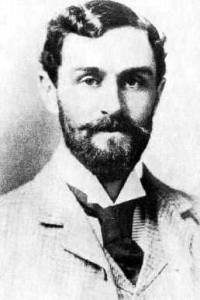
Irish patriot Roger Casement‘s body is returned to Ireland from the United Kingdom on February 23, 1965, forty-nine years after his execution for treason.

In October 1914, Roger Casement sails for Germany where he spends most of his time seeking to recruit an Irish Brigade from among more than 2,000 Irish prisoners-of-war taken in the early months of World War I and held in the prison camp of Limburg an der Lahn. His plan is that they will be trained to fight against Britain in the cause of Irish independence.

In April 1916, Germany offers the Irish 20,000 Mosin–Nagant 1891 rifles, ten machine guns and accompanying ammunition, but no German officers. It is a fraction of the quantity of arms that Casement has hoped. Casement does not learn of the Easter Rising until after the plan is fully developed. The German weapons never land in Ireland as the Royal Navy intercepts the ship transporting them.

In the early hours of April 21, 1916, three days before the beginning of the rising, Casement is taken by a German submarine and is put ashore at Banna Strand in Tralee Bay, County Kerry. Suffering from a recurrence of malaria and too weak to travel, he is discovered at McKenna’s Fort in Rathoneen, Ardfert, and arrested on charges of treason, sabotage, and espionage against the Crown. He is imprisoned in the Tower of London.

Casement’s trial for treason is highly publicized and he is ultimately convicted and sentenced to be hanged. He unsuccessfully appeals the conviction and death sentence. Among the many people who plead for clemency are Sir Arthur Conan Doyle, W. B. Yeats, and George Bernard Shaw.

On the day of his execution, Casement is again received into the Catholic Church at his request. He is attended by two Irish Catholic priests, Dean Timothy Ring and Father James Carey, from the East London parish of St. Mary and St. Michael’s. Casement is hanged at Pentonville Prison in London on August 3, 1916. His body is buried in quicklime in the prison cemetery at the rear of the prison.

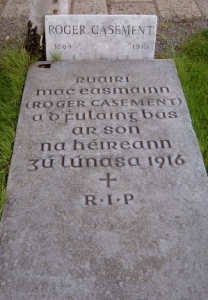
roger-casement-glasnevin-grave

During the decades after his execution, many formal requests for repatriation of Casement’s remains are refused by the U.K. government. Finally, February 23, 1965, Casement’s remains are repatriated to the Republic of Ireland. Casement’s last wish, to be buried at Murlough Bay on the North Antrim coast, in what is now Northern Ireland, may never be satisfied as U.K. Prime Minister Harold Wilson‘s government releases the remains only on condition that they cannot be brought into Northern Ireland, as “the government feared that a reburial there could provoke Catholic celebrations and Protestant reactions.”

Casement’s remains lay in state at Arbour Hill in Dublin for five days, during which time an estimated half a million people file past his coffin. After a state funeral on March 1, the remains are buried with full military honours in the Republican plot in Glasnevin Cemetery in Dublin, with other militant republican heroes. The President of the Republic of Ireland, Éamon de Valera, who is in his mid-eighties and the last surviving leader of the Easter Rising, defies the advice of his doctors and attends the ceremony, along with an estimated 30,000 others.