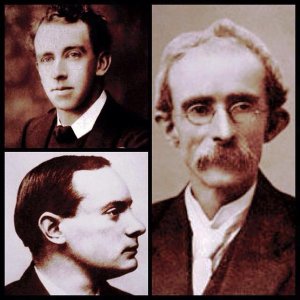
Johanna Mary “Hanna” Sheehy-Skeffington, Republican activist and feminist, is born in Kanturk, County Cork, on May 24, 1877.
Sheehy is the eldest daughter of Elizabeth McCoy and David Sheehy, an ex-Fenian and Member of Parliament (MP) for the Irish Parliamentary Party, representing South Galway. One of her uncles, Father Eugene Sheehy, is known as the Land League Priest, and his activities land him in prison. He is also one of Éamon de Valera‘s teachers in Limerick. When Hanna’s father becomes an MP in 1887, the family moves to Drumcondra, Dublin.
Sheehy is educated at the Dominican Convent on Eccles Street, where she is a prize-winning pupil. She then enrolls at St. Mary’s University College, a third level college for women established by the Dominicans in 1893, to study modern French and German. She sits for examinations at Royal University of Ireland and receives a Bachelor of Arts degree in 1899, and a Master of Arts Degree with first-class honours in 1902. This leads to a career as a teacher in Eccles Street and an examiner in the Intermediate Certificate examination.
Sheehy marries Francis Skeffington in 1903, and they both take the surname Sheehy Skeffington, which they do not hyphenate but use as a double name. In 1908, they found the Irish Women’s Franchise League, a group aiming for women’s voting rights.
Sheehy-Skeffington gets into numerous scuffles with the law. She is jailed in 1912 for breaking windows of government buildings in support of suffrage as part of an IWFL campaign. That same year she also throws a hatchet at visiting British Prime Minister Herbert Asquith. She loses her teaching job in 1913 when she is arrested and imprisoned for three months after throwing stones at Dublin Castle and assaulting a police officer in a feminist action. While in jail she goes on hunger strike and is released under the Prisoner’s Temporary Discharge of Ill Health Act but is soon rearrested.
Being free from her teaching job enables Sheehy-Skeffington to devote more time to the fight for suffrage. She is influenced by James Connolly and during the 1913 lock-out works with other suffragists in Liberty Hall, providing food for the families of the strikers.
She strongly opposes participation in World War I which breaks out in August 1914 and is prevented by the British government from attending the International Congress of Women held in The Hague in April 1915. The following June her husband is imprisoned for anti-recruiting activities. He is later shot dead during the 1916 Easter Rising after having been arrested by British soldiers.
Sheehy-Skeffington refuses compensation for her husband’s death, which is offered on condition of her ceasing to speak and write about the murder. Rather, she travels to the United States to publicise the political situation in Ireland. In October 1917, she is the sole Irish representative to League for Small and Subject Nationalities where, along with several other contributors, she is accused of pro-German sympathies. She publishes British Militarism as I Have Known It, which is banned in the United Kingdom until after the World War I. Upon her return to Britain she is once again imprisoned, this time in Holloway prison. After release, Sheehy-Skeffington attends the 1918 Irish Race Convention in New York City and later supports the anti-Treaty Irish Republican Army (IRA) during the Irish Civil War.
In 1926, Sheehy-Skeffington becomes a founding member of Fianna Fáil and is elected to the party’s Ard Comhairle. During the 1930s, she is assistant editor of An Phoblacht. In January 1933, she is arrested in Newry for breaching an exclusion order banning her from Northern Ireland. At her trial she says, “I recognize no partition. I recognize it as no crime to be in my own country. I would be ashamed of my own name and my murdered husband’s name if I did…Long live the Republic!” She is sentenced to a month’s imprisonment.
Sheehy-Skeffington is a founding member of the Irish Women Workers’ Union and an author whose works deeply oppose British imperialism in Ireland. Her son, Owen Sheehy-Skeffington, becomes a politician and Irish Senator.
Hanna Sheehy-Skeffington dies in Dublin on April 20, 1946, at the age of 68 and is buried with her husband in Glasnevin Cemetery, Dublin.