seamus dubhghaill

Promoting Irish Culture and History from Little Rock, Arkansas, USA


Leave a comment

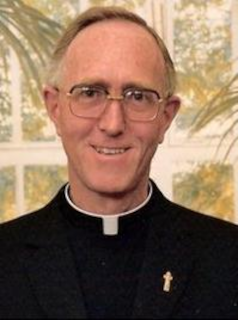
Birth of Brendan Smyth, Priest & Convicted Sex Offender

Brendan Smyth, O.Praem, a Catholic priest and convicted sex offender, is born on June 8, 1927, in Belfast, Northern Ireland. He becomes notorious as a child molester, using his position in the Catholic Church to obtain access to his victims. During a period of over 40 years, he sexually abuses and indecently assaults at least 143 children in parishes in Belfast, Dublin and the United States. His actions are frequently hidden from police and the public by Roman Catholic officials. Controversy surrounding his case contributes to the downfall of the government of the Republic of Ireland in December 1994.

Born John Gerard Smyth, upon joining the Norbertine Roman Catholic religious order in 1945, he changes his name to Brendan. The Norbertines, also known as the “Premonstratensians,” are aware of Smyth’s crimes as early as the late 1970s, yet they do not report him to either the Garda Síochána or the Royal Ulster Constabulary (RUC). He is moved from parish to parish and between dioceses and countries whenever allegations are made. In some cases, the order does not inform the diocesan bishop that Smyth has a history of sexual abuse and should be kept away from children. He abuses children in parishes in Rhode Island and North Dakota and at one time works in Boston and is suspected of similar actions while on pastoral work in Wales and Italy. Norbertine Father Bruno Mulvihill makes several attempts to alert church authorities about the abuse committed by Smyth.

Smyth’s first conviction follows the reporting to police of his abuse of four siblings in Belfast’s Falls Road. After his arrest in 1991, he flees to the Republic of Ireland, where he spends the next three years on the run, staying mostly at Kilnacrott Abbey. This leads to the collapse of the Fianna Fáil–Labour Party coalition government in December 1994 when the poor handling of an extradition request from the RUC by the Irish Attorney General‘s office leads to a further delay of Smyth’s trial. An award-winning UTV Counterpoint programme on the scandal by journalist Chris Moore, followed by a book, accuses the head of the Norbertines and the Archbishop of Armagh of mishandling the case, and the Norbertines of negligence and a failure to tell others of Smyth’s crimes, enabling him to sexually abuse large numbers of children for 40 years.

Smyth dies in prison of a heart attack at the age of 70 on August 22, 1997, after collapsing in the exercise yard, one month into a 12-year prison sentence. The Norbertines hold his funeral before dawn and cover his grave with concrete to deter vandalism. He is buried in Kilnacrott Abbey, which is later put up for sale with 44 acres of land, including the grave.

On October 27, 2005, the title “Reverend” is removed from his gravestone following a campaign by one of Smyth’s victims.

Reviewers of the case differ as to whether there is a deliberate plot to conceal Smyth’s behaviour, incompetence by his superiors at Kilnacrott Abbey, or some combination of factors. Cahal Daly, both as Bishop of Down and Connor, a diocese where some of the abuse takes place, and later as Cardinal Archbishop of Armagh, is recorded as having been privately furious at the Norbertine “incompetence.” Smyth’s activities are investigated by the Northern Ireland Historical Institutional Abuse Inquiry, finding that: “…despite knowing his history of abusing children, the Norbertine religious order moved Smyth to different dioceses where he abused more children…”

In 2010, Daly’s successor as Roman Catholic Archbishop of Armagh, Cardinal Seán Brady, faces “huge pressure to resign” after he admits that in 1975, he witnessed two teenage boys sign oaths of silence after testifying in a Church inquiry against Smyth. Survivor groups see this as evidence of collusion, but Brady says he “did not have the authority” to turn Smyth in. On March 17, 2010, the Deputy First Minister of Northern Ireland, Martin McGuinness, calls for Brady to resign.

In 2013, some of Smyth’s alleged Rhode Island victims between 1965 and 1968, both male and female, call for the Diocese of Providence to investigate Smyth. As of 2019, he is among those listed by the Diocese of Providence as being “credibly accused” of committing sex abuse.

Module 6 of the 2014-2016 Northern Ireland Historical Institutional Abuse Inquiry is dedicated to Smyth’s crimes in Northern Ireland.

A two-part dramatisation of the Smyth case, Brendan Smyth: Betrayal of Trust, is broadcast by the BBC on March 13, 2011, with Ian Beattie in the title role and Richard Dormer as Chris Moore.

(Pictured: Father Brendan Smyth, Our Lady of Mercy, East Greenwich, Rhode Island, USA, c. 1965)

Leave a comment

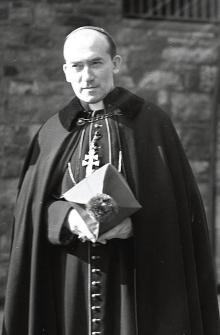
Death of Dermot Ryan, Roman Catholic Archbishop of Dublin

Dermot Joseph Ryan, the Roman Catholic Archbishop of Dublin from 1972 until 1984, dies in Rome, Italy, on February 21, 1985.

Ryan is born on June 26, 1924, to Andrew Ryan, a medical doctor, and Therese (née McKenna), in Clondalkin, Dublin. In 1932 he goes to Belvedere College, Dublin. In 1942 he enters Holy Cross College, Drumcondra, and graduates with a first in Hebrew and Aramaic at University College Dublin in 1945. He spends a year at St. Patrick’s College, Maynooth before attending the Pontifical Irish College in Rome gaining his BD in 1948 at the Pontifical Lateran University, Rome. He returns to Clonliffe to complete his formation, and where he is ordained a priest on May 28, 1950. He returns to Rome to study at the Pontifical Gregorian University, gaining a Licentiate in Sacred Theology in 1952. In 1954 he is awarded an MA in Semitic Languages from the National University of Ireland (NUI), followed by a licentiate in sacred scripture at the Pontifical Biblical Institute.

Ryan is Professor of Oriental Languages at University College Dublin before his appointment by Pope Paul VI as Archbishop of Dublin and Primate of Ireland on December 29, 1971. Maintaining his connection and interest in oriental studies, he serves as chairman of the trustees of the Chester Beatty Library from 1978 to 1984.

Ryan is ordained a bishop by Pope Paul VI in Rome, assisted by Cardinals Bernardus Johannes Alfrink and William Conway (Archbishop of Armagh and Primate of All Ireland), on February 13, 1972. At the time of his appointment, he is seen as a liberal and a reformer in the Church.

During his term, Ryan consolidates much of the expansion of the archdiocese which had taken place during the term of his predecessor. He also oversees the fuller implementation of the reforms of Vatican II. He is particularly interested in liturgical reform.

Seen as a Liberal, following the episcopacy of John Charles McQuaid, in November 1972, Ryan becomes the first Roman Catholic archbishop to attend a Church of Ireland service in Christ Church Cathedral, Dublin, and holds an interdenominational service in St. Mary’s Pro-Cathedral. He also supports “Ballymascanlon talks,” an inter-church initiative to try to bring communities together and bring peace to Northern Ireland.

Ryan also takes a traditional stand on social issues, including poverty, family life and opposition to abortion. He strongly promotes the Eighth Amendment of the Constitution of Ireland in 1983, granting the equal right to life to mother and unborn.

As Archbishop, Ryan gives the people of Dublin a public park on a site earmarked by his predecessors for a proposed cathedral. It is named “Archbishop Ryan Park” in his honour. The land, at Merrion Square, is a gift from the archbishop to the city of Dublin.

Ryan also serves as Pro-Prefect of Congregation for the Evangelization of Peoples from April 8, 1984, until his death in Rome on February 21, 1985, following a heart attack at the age of sixty.

Ryan is named in the Murphy Report, released in 2009, on sexual abuse of children in Dublin. His actions in respect of complaints against priest Fr. McNamee are described in the report as “an example of how, throughout the 1970s, the church authorities were more concerned with the scandal that would be created by revealing Fr. McNamee’s abuse rather than any concern for the abused.” He also does not act on complaints against other priests who are also subsequently confirmed to be abusers.

In January 2010, after Ryan has been criticised in the Murphy Report the previous year, Dublin City Council seeks public views on renaming “Archbishop Ryan Park.” Later that same year it is renamed “Merrion Square Park” by the City Council.


Leave a comment

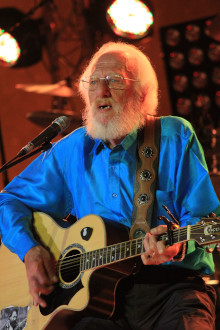
Birth of Eamonn Campbell of The Dubliners

Eamonn Campbell, Irish musician who is a member of The Dubliners from 1987 until his death, is born in Drogheda, County Louth on November 29, 1946. He is also in The Dubliners when they record their 25th anniversary show on The Late Late Show hosted by Gay Byrne.

Campbell is known as a guitarist and has a rough voice similar to the late founding member of The Dubliners, Ronnie Drew. He tour with three other ex-Dubliners as “The Dublin Legends,” now that the group name has been retired with the death of Barney McKenna. Although originally from Drogheda in County Louth, he later lives in Walkinstown, a suburb of Dublin.

It was Campbell’s suggestion that The Dubliners work with London-based Irish band The Pogues in the mid-1980s, thus giving them their second biggest UK hit to date, “The Irish Rover.” Their biggest hit is “Seven Drunken Nights” which reaches number 7 in the charts in 1967 and an appearance on Top of the Pops.

Campbell produces all of The Dubliners’ albums from 1987 onwards, as well as albums for many other Irish artists, including Foster and Allen, Brendan Shine, Daniel O’Donnell and Paddy Reilly. He plays locally with the Delta Showband, The Bee Vee Five and the Country Gents before joining Dermot O’Brien and the Clubmen and first meets The Dubliners when both acts tour England together in 1967. In the mid to late 1970s he more or less retires from the road and becomes involved in the growing Irish recording scene, first as a session musician and later moving to production.

In 2002, Campbell puts a complaint to a commission to inquire into sexual abuse as he says he was abused by the Christian Brothers as a child. In an interview he says “I felt emotional with hate at what this arsehole had got away with. He was abusing the whole class. I still haven’t heard anything back.”

Campbell is the Grand Master for the 2009 Drogheda St. Patrick’s Day Parade. In his younger years he teaches guitar lessons at the “Music Shop” in Drogheda. His granddaughter Megan Campbell is a Republic of Ireland international footballer.

While on tour in the Netherlands with The Dublin Legends, Campbell feels unwell during his final performance. He returns to his hotel at around 1:00 AM and goes to bed. He dies during the early hours of the morning of October 18, 2017. His body is flown back to Dublin where his funeral takes place on October 26, 2017.

(Pictured: Eamonn Campbell during the Festival Interceltique de Lorient in 2014 | This file is licensed under the Creative Commons Attribution-Share Alike 4.0 International license)