seamus dubhghaill

Promoting Irish Culture and History from Little Rock, Arkansas, USA


Leave a comment

Whigs Adopt Non-Interference Policy with Food Markets During Famine

On August 17, 1846, Lord John Russell’s Whig administration formally adopts a policy of non-interference with internal and export markets for food in Ireland during the Great Famine. This decision reflects the prevailing laissez-faire economic philosophy of the time, which holds that markets should operate freely without government intervention.

The Great Famine devastates the 1845 potato harvest, and by 1846 the blight returns with greater severity, destroying the autumn crop. Many Irish peasants have no money to buy imported grain, meat, or dairy, which are being exported to Britain under the Corn Laws. While the repeal of these laws in 1846 lowers grain prices, it does little to help Ireland because of the lack of purchasing power.

Russell’s government, influenced by figures like Charles Trevelyan, believes that internal markets (local food supply) should be left to private merchants, who are often reluctant to import food for Ireland; export markets for Irish grain should not be restricted, as the Whigs see no need to interfere with trade; government relief should focus on employment schemes (e.g., road and canal building) to give people income to buy food, rather than direct food distribution.

Relief depots are opened only in areas of greatest need, such as West Cork, Kerry, and Donegal, where local merchants are few. Imported maize is distributed in these limited areas, but most of Ireland remains without direct food aid. Work schemes are introduced, but wages are low (8–10 pence per day) and often delayed, making them insufficient for survival.

This policy means that Ireland’s food crisis worsens as exports continue and local shortages deepen, causing many people to starve despite the availability of food in Ireland. The government’s role is minimal, focusing on indirect measures rather than direct relief.

In short, the August 17, 1846 decision marks a shift from Robert Peel’s limited relief efforts to a hands-off approach, prioritizing free markets over direct intervention, which critics argue prolonged the famine’s suffering.

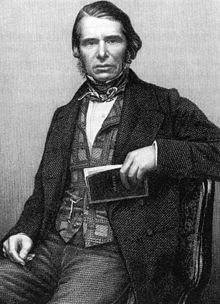
(Pictured: Photograph of John Russell, by Edwin Mayal, 1861. Source: The National Portrait Gallery)

Leave a comment

Birth of Sir Charles Edward Trevelyan

charles-edward-trevelyan

Sir Charles Edward Trevelyan, 1st Baronet, KCB, British civil servant and colonial administrator, is born in Taunton, Somerset, United Kingdom on April 2, 1807.

Trevelyan is the son of a Cornish clergyman, the Venerable George Trevelyan, who becomes Archdeacon of Taunton, and his wife Harriet, daughter of Sir Richard Neave. As a young man, he works with the colonial government in Calcutta, India. In the late 1850s and 1860s he serves there in senior-level appointments.

Trevelyan’s most enduring mark on history may be the quasi-genocidal anti-Irish racial sentiment he expresses during his term in the critical position of administrating relief to the millions of Irish peasants suffering under the Great Famine, an Gorta Mór, as Assistant Secretary to HM Treasury (1840–1859) under the Whig administration of Lord John Russell.

During the height of the famine Trevelyan deliberately drags his feet in disbursing direct government food and monetary aid to the Irish due to his strident belief in laissez-faire economics and the free hand of the market. In a letter to an Irish peer, Thomas Spring Rice, 1st Baron Monteagle of Brandon, a former Chancellor of the Exchequer, he describes the famine as an “effective mechanism for reducing surplus population” as well as “the judgement of God” and writes that “The real evil with which we have to contend is not the physical evil of the Famine, but the moral evil of the selfish, perverse and turbulent character of the people.”

Trevelyan never expresses remorse for his comments, even after the full dreadful scope of the Irish famine becomes known. His defenders claim that other factors than Trevelyan’s personal acts and beliefs are more central to the problem.

Sir Charles Trevelyan dies at the age of 70 at 67 Eaton Square, London, on June 19, 1886.

Trevelyan is referred to in the modern Irish folk song The Fields of Athenry about an Gorta Mór. For his actions, or lack thereof, during the Great Famine, he is commonly considered one of the most detested figures in Irish history, along with the likes of Oliver Cromwell.