seamus dubhghaill

Promoting Irish Culture and History from Little Rock, Arkansas, USA


Leave a comment

Death of Katy French, Socialite, Model & TV Personality

Katy Ellen French, Irish socialite, model, writer, television personality and charity worker, dies on December 6, 2007, in Navan, County Meath, after collapsing at a friend’s house on December 2. According to the BBC, “in the space of less than two years, she had become one of Ireland’s best-known models and socialites.” Her cause of death is given as hypoxic ischemic brain injury caused by cocaine and ephedrine.

French is born on October 31, 1983, in Basel, Switzerland, to John and Janet French, from Australia and Britain respectively. At the age of two, she moves with her family to Ireland, briefly living in the Sandyford area before settling in Enniskerry, County Wicklow, and later to Stillorgan, County Dublin. She attends Alexandra College in Milltown, Dublin, from the age of seven. While still in school she works part-time as a hostess at the Dublin branch of the Planet Hollywood restaurant chain.

French studies psychology and marketing before working for the Assets Modelling Agency and later writing articles for several Dublin magazines and newspapers. She represents Sony Ericsson and Suzuki among many other brands, becoming more famous in 2007 as a result of her fiancé, restaurateur Marcus Sweeney, ending their relationship in a very public fashion after she is photographed for a lingerie shoot for the Sunday Independent in his restaurant in January of that year. As a result of this publicity, her image appears more regularly in daily Irish tabloid newspapers, and she makes numerous television appearances on shows such as RTÉ‘s The Podge and Rodge Show in April 2007 and Tubridy Tonight a week before her death.

French is known for deliberately courting controversy to promote her career. On Tubridy Tonight she speaks of her appearance on Celebrities Go Wild as well as her relationship break up with Sweeney. Mention is also made of her birthday party which she is to celebrate the following week, having missed her birthday due to Celebrities Go Wild. Host Ryan Tubridy is invited to the event. Footage is shown of the charity single “Down in the Bog” which is to be released as a Christmas single. She works for several Irish charities including Our Lady’s Children’s Hospital, Crumlin and GOAL in Calcutta, India. She writes a column for Social & Personal magazine.

In an interview with Hot Press‘s Jason O’Toole, French says that she would consider having an abortion if she became pregnant during the peak of her career, a controversial statement in Ireland where abortion is at that time effectively illegal, and that she loves fur despite being a “massive animal lover.” She also airs her religious beliefs, being a member of the Church of England as well as a practising Catholic and speaks highly of Islam and her Muslim friends saying, “When you read the Koran, you realise that Islam is a beautiful religion.” In the same interview she is asked if she has ever used cocaine and denies ever having done so. In November 2007, she tells an Irish tabloid that she has used cocaine but has stopped. A week before she dies, she celebrates her 24th birthday with celebrity and media friends.

French dies on the evening of December 6, 2007, in Our Lady’s Hospital, Navan, County Meath, having collapsed at a house in Kilmessan, County Meath, in the early hours of Sunday, December 2. There is widespread speculation in the media that her death is the result of a drug overdose. A postmortem finds she has suffered brain damage, and that traces of cocaine are found in her body. A senior Garda states, “We strongly suspect that drugs contributed to her death. This was a previously healthy person being brought to hospital in a collapsed state.” In 2010 two people are charged with supplying cocaine to French and in failing to get medical assistance in a timely fashion. She is buried in her hometown of Enniskerry, County Wicklow, on December 10. Taoiseach Bertie Ahern‘s aide de camp, Captain Michael Tracey, attends her funeral.

On November 13, 2012, two friends of French, Kieron Ducie and Ann Corcoran, plead guilty to possession of cocaine with intent to supply on the weekend of French’s death. Trim Circuit Court is told that a second charge against the pair is not being pursued, that they had intentionally or recklessly engaged in behaviour relating to the supply of cocaine to French and failed to get medical assistance in a timely fashion. In July 2013 the pair are sentenced to a 2-1⁄2 year suspended sentence and three-year good behaviour bond, and a two-year suspended sentence and two-year good behaviour bond respectively. At the verdict, French’s cause of death is given as hypoxic ischemic brain injury caused by cocaine and ephedrine.

Leave a comment

First Edition of the “Irish Press” Published

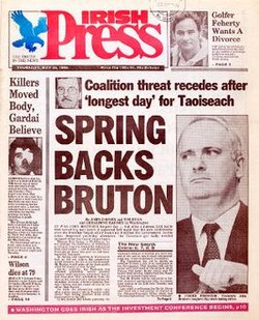
irish-press-may-25-1995

The first edition of the Irish Press, a Dublin daily newspaper founded by Éamon de Valera as a platform for Fianna Fáil, is published on September 5, 1931.

Irish Press Ltd. is officially registered on September 4, 1928, three years before the paper is first published, to create a newspaper independent of the existing media where the Independent Newspapers group is seen as supporting Cumann na nGaedheal/Fine Gael, and The Irish Times being pro-union, and with a mainly middle-class or Protestant readership.

The paper’s first issue is published on the eve of the 1931 All-Ireland Senior Hurling Championship Final between Cork and Kilkenny. Other newspapers do not cover GAA sports in any detail at the time. Margaret Pearse, the mother of Patrick and Willie Pearse, presses the button to start the printing presses. The initial aim of its publisher is to achieve a circulation of 100,000 which it quickly accomplishes. It goes on to list 200,000 subscribers at its peak.

The money to launch the Irish Press is raised in the United States during the Irish War of Independence by a bond drive to finance the First Dáil. Five million dollars is raised; however, 60 percent of this money is left in various banks in New York City. No one knows why de Valera ordered the bulk of the money to be left in New York when he returned to Ireland in late 1920.

In 1927, as a result of legal action between the Irish Free State government and de Valera, a court in New York orders that the bond holders be paid back outstanding money due to them. However, de Valera’s legal team has anticipated the ruling and has prepared for the outcome. A number of circulars are sent to the bond holders asking them to sign over their holdings to de Valera. The bond holders are paid 58 cents to the dollar. This money is then used as startup capital to launch the Irish Press. Following the 1933 Irish General Election, de Valera uses his Dáil Éireann majority to pass a measure allowing the bond holders to be paid the remaining 42 percent of the money still owed.

In December 1931, editor Frank Gallagher is prosecuted by an Irish Free State military tribunal for publishing articles alleging that Garda Síochána had mistreated the Anti-Treaty republicans of the Irish Free State government. This is facilitated by Amendment 17 of the Constitution of the Irish Free State and Gallagher is convicted and fined £50. An example of animosity from those who support Independent Newspapers and the Free State government is that the Irish Press is excluded from the special train which delivers newspapers from Dublin to the countryside. As a result, it is circulated throughout Ireland by a specially rented train.

The Irish Press sustains itself with its own resources until The Sunday Press is founded in 1949. In its heyday, the Irish Press has a number of first-rate reporters and columnists. One notable section, New Irish Writing is edited by David Marcus.

In the 1970s, the Minister for Posts and Telegraphs, Conor Cruise O’Brien, tries to use and amend The Emergency Powers Act and Section 31 of the Broadcasting Authority Act, to censor coverage of the Troubles in Northern Ireland. The Irish Press editor, Tim Pat Coogan, publishes editorials attacking the Bill. The Fine Gael/Labour Coalition Government tries to prosecute the Irish Press for its coverage of the maltreatment of republican prisoners by the Garda “Heavy Gang,” with the paper winning the case.

The Irish Press starts two further newspapers, the Evening Press (1954), and The Sunday Press. The Evening Press is aimed at an urban readership and achieves a daily circulation of 100,000. The new newspapers subsidise the Irish Press when its circulation sags. Its adoption of a tabloid format does not rescue its declining circulation.

The final issue of the Irish Press and Evening Press is on Thursday, May 25, 1995. The newspapers close because of a bizarre industrial dispute over the sacking of the group business editor, Colm Rapple. The group has not been in a healthy financial state for several years. When it eventually closes, with indebtedness of £20 million, 600 people lose their jobs.

(Pictured: Cover of last ever edition of the Irish Press from May 25, 1995)


Leave a comment

Catherine Nevin Found Guilty of Murder

catherine-nevin

On April 11, 2000, Catherine Nevin (née Scully), in a dramatic end to the two-month trial, is found guilty by a jury at the Central Criminal Court of all four charges against her arising out of the 1996 shooting death of her husband, Tom Nevin, at Jack White’s Inn, a pub owned by the couple in County Wicklow. The jury also finds her guilty on three charges of soliciting others to kill him after five days of deliberation, then the longest period of deliberation in the history of the Republic of Ireland. She is subsequentlty dubbed the “Black Widow” by the press. She is the subject of significant coverage by the tabloid press and Justice Mella Carroll orders a ban on the press commenting on Nevin’s appearance or demeanour during the trial.

Catherine Scully meets Tom Nevin in Dublin in 1970 and they are married in Rome in 1976. Within ten years, they own two houses and manage a pub in Finglas, Dublin. In 1986 they open Jack White’s Inn near Brittas Bay in County Wicklow.

On March 19, 1996, Tom Nevin is killed with a shot from a nine pellet shotgun while counting the day’s takings in Jack White’s Inn. According to Catherine Nevin, she is awakened by someone pressing her face into a pillow. She claims it was a man shouting profanities and holding a knife in his left hand. IR£13,000 is taken from the pub, and the Nevins’ car is stolen. It is later found abandoned in Dublin.

After her conviction, Nevin serves her sentence at the Dóchas Centre, Dublin. She loses an appeal in 2003 and, in 2010, also loses an application to have her conviction declared a miscarriage of justice.

Catherine Nevin is diagnosed with a brain tumor in 2016 and given only months to live by doctors at Dublin’s Mater Private Hospital. She receives compassionate release in late 2017 and dies on February 19, 2018. She denies any involvement in her husband’s murder to the very end.