Derrig is born on November 26, 1897, in Westport, County Mayo. He is educated locally and later at University College Galway. During his time in college, he organises a corps of the Irish Volunteers. After the 1916 Easter Rising, he is arrested and imprisoned, and sent to the prisons of Woking, Wormwood Scrubs and Frongoch internment camp. He is arrested in 1918 and is accused of attempting to disarm a soldier. He is sentenced to five months imprisonment by a court in Belfast. When he is released, he supports Joseph MacBride at the 1918 Irish general election. He also graduates from college and becomes headmaster in a technical college in Mayo.
At the June 1927 Irish general election Derrig is elected to Dáil Éireann as a Fianna Fáil TD for Carlow–Kilkenny. In Éamon de Valera‘s first government in 1932 Derrig is appointed Minister for Education. He initiates a review of industrial and reformatory schools and the rules under the Children Act 1908, resulting in the critical 1936 Cussen Report that follows which he shelves, and a report in 1946-48 by the Irish American priest Father Edward J. Flanagan, which is also shelved. His lack of action wis noted in 2009 when the Ryan Report examines the subsequent management of these “residential institutions.” He is the first Minister to seek a report that could result in much-needed reforms. It is suggested that he does not want to follow British law reforms in the 1920s and 1930s, because of his strong anti-British views, and that Irish children have suffered needlessly as a result. From 1939 to 1943, he serves as Minister for Lands. He is re-appointed to Education in 1943 until 1948. During this period a bitter teachers’ strike, involving the Irish National Teachers Organisation (INTO), takes place, lasting from March 20 to October 30. Between 1951 and 1954, he becomes Minister for Lands again.
In the 1960s Gallagher changes allegiance and becomes a member of Fianna Fáil. He is elected to Mayo County Council in 1967 and is elected to Dáil Éireann on his third attempt at the 1973 Irish general election for the Mayo West constituency. He does not remain on the backbenches for very long. He joins the Fianna Fáil front bench in 1974 as spokesperson on Fisheries. He remains in that position until 1977 when the party returns to power, and he is appointed Minister for the Gaeltacht. He is an active Minister with an interest in Irish language affairs.
Following the 1987 Irish general election, Gallagher is not appointed to cabinet. He is, however, appointed as Minister of State at the Department of the Gaeltacht, while Haughey has appointed himself as Minister for the Gaeltacht. As a result, he retires from politics at the following general election in 1989. After his retirement, he works to advance the Irish language cause and also serves as chairman of the Gaelic Athletic Association in Mayo.
Gallagher dies on November 4, 2001, at the age of 78 in Castlebar, County Mayo. He is buried at Polranny Cemetery, Achill Sound, County Mayo. He is survived by his wife Hannah, twelve children and thirty grandchildren.
Cyril James Cusack, Irish actor who appears in numerous films and television productions in a career lasting more than 70 years, dies in Chiswick, London, England on October 7, 1993. In 2020, he is listed at number 14 on The Irish Times‘s list of Ireland’s greatest film actors.
Cusack is born in Durban, Natal, South Africa, on November 26, 1910. His mother, Alice Violet (née Cole), is an English Cockney actress and chorus girl, and his father, James Walter Cusack, is an Irish mounted policeman in the Colony of Natal, South Africa. His parents separate when he is young and his mother takes him to England, and then to Ireland. His mother and her partner, Brefni O’Rorke, join the O’Brien and Ireland Players.
Cusack makes his first stage performance at the age of seven. He is educated at Newbridge College in Newbridge, County Kildare, then reads law at University College Dublin. He leaves without a degree and joins the Abbey Theatre in 1932. Between then and 1945, he performs in over 60 productions, particularly excelling in the plays of Seán O’Casey. He also performs Irish playwright Teresa Deevy‘s plays Katie Roche and The King of Spain’s Daughter. In 1932 he also joins the Gate Theatre company, appearing with them in many notable productions over the years. In 1947, he forms his own company and stages productions in Dublin, Paris and New York.
In 1963, Cusack joins the Royal Shakespeare Company in London and appears there for several seasons. By this stage he has established a successful career in films, which had started at the age of eight. Also in 1963, he wins a Jacob’s Award for his performance in the Telefís Éireann production of Triptych. He receives honorary degrees in 1977 and 1980 from the National University of Ireland (NUI) and the University of Dublin respectively.
Cusack, who is bilingual in English and Irish, has a leading role in the controversial Irish language film Poitín (1977). He is also offered the role of the First Doctor in Doctor Who.
Cusack’s last stage performance is in Anton Chekhov‘s Three Sisters (1990), in which three of his daughters play the sisters.
Cusack is twice married, firstly to Mary Margaret “Maureen” Kiely (1920–1977), on April 5, 1945. Together they have five children: Paul (1946), Sinéad (1948), Sorcha (1949), Niamh (1959), and Pádraig (1962). He and his second wife, Mary Rose Cunningham (1979–1993), have one daughter, Catherine (1968).
In later life, Cusack becomes a campaigner for conservative causes in Ireland, notably in his opposition to abortion, where he becomes a frequent letter-writer to the main liberal Irish newspaper, The Irish Times. Regarding his Catholic faith, he comments “Religion promotes the divine discontent within oneself, so that one tries to make oneself a better person and draw oneself closer to God.” His religious credentials come under scrutiny following his death and the revelation that he had been unfaithful in his first marriage, with a long-term mistress, Mary Rose Cunningham. He marries Cunningham following his first wife’s death.
On October 7, 1993, Cusack dies at the age of 82 at home in Chiswick, Greater London, from amyotrophic lateral sclerosis (ALS). His acting career had lasted 75 years.
Stagg is the seventh child in a family of thirteen children. His father, Henry, and his uncle had both fought in the Irish War of Independence and Irish Civil War. His brother, Emmet Stagg, becomes a Labour Party politician and a Teachta Dála (TD) for Kildare North. He is educated to primary level at Newbrook Primary School and at CBS Ballinrobe to secondary level. After finishing his schooling, he works as an assistant gamekeeper with his uncle prior to emigrating to England in search of work. Once in England, he gains employment as a bus conductor in North London and later becomes a bus driver. While in England he meets and marries fellow Mayo native, Bridie Armstrong from Carnacon in 1970.
In 1972, Stagg joins the Lutoncumann of Sinn Féin and soon after becomes a volunteer in the Provisional Irish Republican Army (IRA).
In April 1973, Stagg is arrested with six others alleged to comprise an IRA unit planning bombing attacks in Coventry. He is tried at BirminghamCrown Court. The jury finds three of the seven not guilty. The remaining four are all found guilty of criminal damage and conspiracy to commit arson. Stagg and English-born priest, Father Patrick Fell, are found to be the unit’s commanding officers. Stagg is given a ten-year sentence and Fell is given twelve years. Thomas Gerald Rush is given seven years and Anthony Roland Lynch, who is also found guilty of possessing articles with intent to destroy property, namely nitric acid, balloons, wax and sodium chlorate, is given ten years.
Following the hunger strike that results in the death of Michael Gaughan, the Price sisters, Feeney and Kelly are granted repatriation to Ireland. Stagg is denied repatriation and is transferred to Long Lartin Prison. During his time there he is subject to solitary confinement for refusing to do prison work and is also subjected, along with his wife and sisters during visits, to humiliating body searches. In protest against this, he begins a second hunger strike that lasts for thirty-four days. This ends when the prison governor agrees to an end of the strip-searches on Stagg and his visitors. He is bed-ridden for the rest of his incarceration in Long Lartin, due to a kidney complaint.
In 1975 Stagg is transferred to Wakefield Prison, where it is demanded that he again do prison work. He refuses and is placed in solitary confinement. On December 14, 1975, he embarks on a hunger strike in Wakefield, along with a number of other republican prisoners, after being refused repatriation to Ireland during the IRA/British truce. His demands are an end to solitary confinement, no prison work and repatriation to prison in Ireland. The British government refuses to meet any of these demands and Stagg dies on February 12, 1976, after 62 days on hunger strike.
Stagg’s burial causes considerable controversy. Republicans and two of his brothers seek to have him buried in the republican plot in Ballina beside the grave of Michael Gaughan, in accordance with his wishes. His widow, his brother Emmet Stagg and the Irish government wish to have him buried in the family plot in the same cemetery and to avoid republican involvement in the funeral.
In order to prevent the body from being disinterred and reburied by republicans, the grave is covered with concrete. Local Gardaí keep an armed guard by the grave for six months. However, unknown to them, the plot beside the grave is available for purchase. Stagg’s brother George purchases the plot and places a headstone over it, with it declaring that the “pro-British Irish government” had stolen Frank’s body. In November 1977, a group of republicans dig down into the plot that George had purchased, then dig sideways and recover Stagg’s coffin from the adjacent plot under cover of darkness, before reburying it in the republican plot beside the body of Michael Gaughan. The Republicans hold their own version of a funeral ceremony before disappearing back into the night.
The IRA swears revenge over Stagg’s death, warning the British public it is going to attack indiscriminately. They explode about 13 bombs throughout England within a month after his death.
McCreevy is educated locally at Naas by the Congregation of Christian Brothers, and later at the fee paying Franciscan Gormanston College. He studies Commerce at University College Dublin and goes on to become a chartered accountant. His family background is modest, his father and ancestors since the late 18th century are lockkeepers on the Grand Canal, a job carried on by his mother after the death of his father, when McCreevy is four years old.
McCreevy’s political career begins with when he wins a seat in the Kildare constituency at the 1977 Irish general election, which is a landslide for Charles Haughey‘s supporters in Fianna Fáil and he is re-elected at every subsequent election until he joins the European Commission. Between 1979 and 1985, he serves as an elected member of the Kildare County Council.
In the 1979 Fianna Fáil leadership election, McCreevy strongly supports the controversial Charles Haughey, who narrowly wins the post. However, in a time of severe budgetary difficulties for Ireland, he soon becomes disillusioned with the new Taoiseach and his fiscal policies. In October 1982, he launches a motion of no-confidence in the party leader, which evolves into a leadership challenge by Desmond O’Malley. In an open ballot and supported by only 21 of his 79 colleagues, the motion fails and McCreevy is temporarily expelled from the parliamentary party.
In later years O’Malley is expelled from Fianna Fáil itself and forms the Progressive Democrats (PDs), espousing conservative fiscal policies. Although considered ideologically close to the PDs, and a personal friend of its erstwhile leader, Mary Harney, McCreevy chooses to remain a member of Fianna Fáil, where he eventually serves in joint FF-PD Governments.
For his first 15 years as TD, while Haughey remains leader, McCreevy remains a backbencher. In 1992, Albert Reynolds becomes Taoiseach and McCreevy is appointed Minister for Social Welfare. In this role, he is principally remembered for a set of 12 cost-cutting measures, collectively termed the “dirty dozen”, which are arguably minor in their direct impact but provide a major political headache for his party in the 1992 Irish general election.
In 1993, McCreevy becomes Minister for Tourism, Transport and Communication, which he holds until the government falls in December 1994. In opposition under new Fianna Fáil leader Bertie Ahern, he is appointed Opposition Spokesperson for Finance. In this role he is viewed as actively pro-enterprise, anti-spending and a key advocate for tax cuts.
In 1997, Fianna Fáil returns to power and McCreevy becomes Minister for Finance. His period coincides with the era of the “Celtic Tiger,” which sees the rapid growth of the Irish economy due to social partnership between employers, government and unions, increased female participation in the labour force, decades of tuition-free secondary education, targeting of foreign direct investment, a low corporation tax rate, an English-speaking workforce only five time-zones from New York City, and membership of the European Union – which provides payments for infrastructural development, export access to the European Single Market and a Eurozone country. He is a consistent advocate of cutting taxes and spending.
In 2004, McCreevy is selected by the Government of Ireland to replace David Byrne as Ireland’s European Commissioner. He is appointed to the Internal Market and Services portfolio, by President of the European CommissionJosé Manuel Barroso. At his confirmation hearings in the European Parliament MEPs describe him as “fluent and relaxed.” He also informs them that he has campaigned for the ratification of every European Treaty since 1972.
In October 2007, McCreevy, commenting on the Northern Rock bank’s loss of investor confidence, claims that banking regulations in the UK, which forces banks to be open to scrutiny from outside investors, caused the panic. He says if access to the bank’s dealings had been restricted, then the trouble could have been avoided.
Irish constitutional law requires a referendum to alter the constitution for such a major change as the adoption of the Treaty of Lisbon. Interviewed beforehand, McCreevy says that he has not read the Treaty in full himself, though he understands and endorses it. The referendum is held on June 12, 2008, and the Irish electorate does not approve the Treaty. He is heavily criticised in the European Parliament and by the leader of the Socialist group in the European Parliament, Martin Schulz, who demands on June 17, 2008, that McCreevy be removed as a European Commissioner. Schulz slightly misquotes McCreevy, whom he stated had contributed to Ireland’s rejection of the Treaty of Lisbon with remarks during the referendum campaign that no “sane person” would read the document.
Following McCreevy’s departure from the commission, he is forced to resign from the board of a new banking firm, NBNK Investments, after an EU ethics committee finds a conflict of interest with his work as a European Commissioner in charge of financial regulation.
The Free State’s Provisional Government puts the “Public Safety Bill” before Dáil Éireann on September 27, 1922, which passes by 41 votes to 18. This is emergency legislation which allows for the execution of those captured bearing arms against the State. The legislation passes to the National Army powers of punishment for anyone “taking part in or aiding and abetting attacks on the National Forces,” having possession of arms or explosives “without the proper authority” or disobeying an Army General Order.
The legislation gives the Military Courts the right to impose the sentence of death, imprisonment or penal servitude on those found to be guilty of such offences, the sentence only requiring the signatures of two officers. By time the bill is a year old, 81 men are executed under its terms and over 12,000 men and women imprisoned.
The reason for such punitive legislation is the dragging on of the Irish Civil War caused by the Anglo-Irish Treaty. A pro-Treaty offensive against the anti-Treaty Irish Republican Army (IRA) in the summer of 1922 appears to have won the war for the government but the anti-Treatyites or republicans subsequently fall back on guerrilla tactics which the newly formed Free State or National Army have great difficulty in suppressing. Ernest Blythe, the Minister for Finance in the Provisional Government, later recalls, “there was for some time a feeling that the Civil War would speedily end as major resistance was broken, but actually it began to assume a chronic character.”
In the week preceding the Dáil’s motion, on September 21, six National Army soldiers are killed in a prolonged engagement with Republican fighters near Ballina, County Mayo. On the same day, the Free State barracks in Drumshambo, County Leitrim, is attacked and taken and one soldier is killed. On September 22, a National Army soldier is killed and several soldiers and three civilians injured in a gun and grenade attack by Republicans on Free State troops on Eden Quay in central Dublin. And on the day of the Bill itself coming before the Dáil, in County Kerry several hundred anti-Treaty IRA guerrillas attack the town of Killorglin and are only repulsed after 24 hours of fighting, when Free State troops arrive from Tralee.
At the time and since, the legislation passed in 1922 is known as the Public Safety Bill. However, no such Bill or Act can be found in the records of the Irish state. The Provisional Government have no legal right under the Treaty to enact new legislation without royal assent, the King being represented in the person of the Governor-General. And in theory the Provisional Government’s powers do not apply after the Treaty formally passes into law on December 6, 1922.
So technically speaking the Public Safety Bill is not a law but simply a resolution passed in the Dáil. However, since there was, as yet no Governor-General who could give his assent and as the government felt the situation was too grave for legal niceties, the legislation setting up military courts was passed anyway. It is not until August 1923, when the Free State passes an Act of Indemnity for all actions committed during the Irish Civil War and also pass new, formal special powers legislation – The Emergency Powers Act – that retrospectively legalises what it had enacted in the autumn of 1922.
After an amnesty of two weeks, in which anti-Treaty fighters could surrender without consequences, the legislation comes into force in mid-October. Republicans at first do not believe that the government is serious about enforcing what its foes term “the Murder Bill.” It is in practice nearly two months before it is used in earnest.
On November 17, 1922, four IRA men who had been captured in Dublin are shot by firing squad. By the end of the week, Erskine Childers, who had served as secretary to the delegation which signed the Treaty but later organized Republican propaganda against it, is also dead. He had been captured at his home in County Wicklow on November 11 in possession of a small pistol Michael Collins had given him before he departed for Treaty negotiations in London. He is sentenced and shot on November 24. On November 30 another three Republican prisoners are executed in Dublin.
Liam Lynch, IRA Chief of Staff, issues a general order that Teachtaí Dála (TDs) who had voted for the Bill be shot on sight. On December 6, in retaliation for the executions, IRA members assassinate the TD Sean Hales in Dublin. In reprisal for that four senior republicans, Rory O’Connor, Liam Mellows, Richard Barrett and Joe McKelvey, who had been captured long before the Public Safety legislation is passed are summarily shot.
The legislation passed on September 27, 1922, may well have helped, as its supporters claimed, to break anti-Treaty resistance and to bring the Irish Civil War to an end. However, it also helped to convert the conflict into a feud as bitter and as personal as a vendetta.
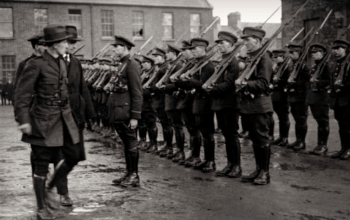
(From: “The passing of legislation allowing for executions during the Irish Civil War” by John Dorney, The Irish Story (www.theirishstory.com), September 27, 2013 | Photo: Richard Mulcahy, shown inspecting soldiers in Dublin, argued that permitting official executions would prevent National Army troops from carrying out unofficial killings)
Between 1932 and 1937, Dillon serves as a TD for the Donegal constituency for the National Centre Party and after its merger with Cumann na nGaedheal, for the new party of Fine Gael. He plays a key role in instigating the creation of Fine Gael and becomes a key member of the party in later years. He remains as TD for Monaghan from 1937 to 1969. He becomes deputy leader of Fine Gael under W. T. Cosgrave.
Dillon temporarily resigns from Fine Gael in 1942 over its stance on Irish neutrality during World War II. While Fine Gael supports the government’s decision to stay out of the war, he urges the government to side with the Allies. A passionate anti-Nazi, he describes the Nazi creed as “the devil himself with twentieth-century efficiency.” His zeal against Adolf Hitler draws him the ire of the German Minister to Ireland Eduard Hempel, who denounces him as a “Jew” and “German-hater.” Even Éamon de Valera, then Taoiseach, is not spared the fierceness of Dillon’s rhetoric. When the Taoiseach ridicules his stark support for the Allies, noting this means he has to adopt a Pro-British stance, Dillon defiantly retorts, “My ancestors fought for Ireland down the centuries on the continent of Europe while yours were banging banjos and bartering budgies in the backstreets of Barcelona.”
In 1942, while holidaying in Carna, County Galway, Dillon meets Maura Phelan of Clonmel on a Friday. By that Monday the two are engaged and six weeks after that the pair are married. He is 40 and Maura is 22 years of age.
Dillon is one of the independents who supports the first inter-party government (1948–1951) and is appointed Minister for Agriculture. As Minister, he is responsible for huge improvements in Irish agriculture. Money is spent on land reclamation projects in the areas of less fertile land while the overall quality of Irish agricultural produce increases.
Dillon rejoins Fine Gael in 1953. He becomes Minister for Agriculture again in the second inter-party government (1954–1957). In 1959, he becomes leader of Fine Gael, succeeding Richard Mulcahy. He becomes president of the party in 1960. In 1965, Fine Gael loses the general election to Seán Lemass and Fianna Fáil. The non-Fianna Fáil parties win 69 seats to Fianna Fáil’s 72. Had the other parties won four more seats between them, they would have been able to form a government. Having narrowly failed to become Taoiseach, Dillon stands down as Fine Gael leader after the election.
On Northern Ireland, while Dillon stands against Partition, he equally opposes any “armed solution” or militant nationalist policy, stating, “We have got to win, not only the barren acres of Ulster, but the hearts of the people who live in it.”
Dillon is a colourful contributor to Dáil proceedings and is noted for his high standard of oratory. He remains a TD until 1969, when he retires from politics. He dies in Malahide, Dublin on February 10, 1986, at the age of 83.
Boland is born in Dublin on October 15, 1917. He attends St. Joseph’s, Fairview, leaving in 1933. He is the son of Gerald Boland, a founder-member of Fianna Fáil, and the nephew of Harry Boland. Despite this, he fails to get elected to Dáil Éireann on his first two attempts, standing in the Dublin County constituency at the 1951 Irish general election and again at the 1954 Irish general election. Double success follows at the 1957 Irish general election, when he is not only elected to the 16th Dáil but is appointed to the cabinet as Minister for Defence on his very first day in the Dáil. This is due to the retirement of his father who had served in every Fianna Fáil government since 1932.
The Defence portfolio is largely considered a safe and uncontroversial position, so Boland makes only a small impact. As a Minister, he proudly displays a fáinne (gold ring) on the lapel of his jacket, which indicates that he is able and willing to speak the Irish language. He frequently conducts his governmental business in Irish. In 1961, he is moved from Defence to become the Minister for Social Welfare. He remains there until the retirement in 1966 of the Taoiseach, Seán Lemass, when Fianna Fáil faces the first leadership contest in its history. He is then appointed Minister for Local Government which post he holds until he leaves government in 1970.
The leadership race immediately erupts as a two-horse battle between Charles Haughey and George Colley. Both of these men epitomise the new kind of professional politician of the 1960s. Things change when Neil Blaney indicates his interest in running. Boland supports him in his campaign, as both men hail from the republican and left wing of the party. There is talk at one point of Boland himself entering the leadership race. In the end Jack Lynch is chosen as a compromise, and he becomes the new Taoiseach. Boland is made Minister for Local Government in the new cabinet.
In 1969, events in Northern Ireland cause political chaos over the border in Ireland. It is the start of The Troubles in Northern Ireland and Fianna Fáil’s policy with regard to the North is coming into question. One crisis meeting is held after another, in which the possibility of decisive action is discussed. The “hawks” in the cabinet urge a symbolic invasion of Northern Ireland to protect nationalists near the border, and to draw international attention, while the “doves”, who ultimately prevail, urged caution. These cabinet meetings are heated events. On one occasion Boland is alleged to have been so angry that he resigns not only his cabinet position but also his Dáil seat and goes home to his farm in County Dublin to make hay. The resignations are rejected by Taoiseach Jack Lynch after a calming-down period. In what becomes known as the Arms Crisis, two ministers, Charles Haughey and Neil Blaney, are sacked from the government in May 1970, for allegedly being involved in a plot to import arms for Republicans in the North. Boland resigns in solidarity with them and in protest about the government’s position on the North. Later that year his criticism of the Taoiseach (whom Boland and many others within the Party maintain had authorized the arms importation) leads to his expulsion from the Fianna Fáil party.
One of Boland’s most famous incidents takes place at the Fianna Fáil Ardfheis in 1971. Just before Jack Lynch’s speech Boland storms a nearby podium, interrupting Patrick Hillery in the middle of his speech. He openly defies the party leadership and his opponents, holding his arms wide open and shouting to the crowd, “Come on up and put me down.” While there is a lot of booing and clapping in an effort to drown him out, many of his supporters start cheering and chanting “We want Boland.” An enraged Patrick Hillery grabs his microphone and famously replies, “If you want a fight, you can have it…You can have Boland, but you can’t have Fianna Fáil.” At this point the government supporters are ecstatic with cheering and Boland is carried out of the hall.
After this episode Boland founds his own political party, Aontacht Éireann (Irish Unity). It wins very little support, and he fails to be elected to the Dáil in 1973, which effectively ends his political career. He and his colleagues resign from the party in 1976 after it is taken over by a number of far-right individuals. He remains an outspoken critic of the Republic’s Northern Ireland policy, particularly the Sunningdale Agreement. He makes one last attempt to reclaim a Dáil seat, standing unsuccessfully in the Dublin South-West constituency at the 1981 Irish general election. He then retires from public life completely.
In 1996, Boland sues the Irish Independent for libel after a January 20, 1993, article incorrectly states that he had appeared before the court in the Arms Trial in 1970 and had been dismissed as a Minister by Taoiseach Jack Lynch. He is awarded £75,000 in damages.
Kevin Boland dies at the age of 83 in Dublin on September 23, 2001, following a short illness.
Boland is born to Patrick Boland (1840–1877), businessman, and Mary Donnelly. Following the death of his mother in 1882, he is placed with his six siblings under the guardianship of his uncle Nicholas Donnelly, auxiliary bishop of Dublin.
Boland is educated at two private Catholic schools, one Irish, the second English, and both of whose existence and evolution are influenced by John Henry Newman – the Catholic University School, Dublin, and The Oratory School, Birmingham. His secondary education at the two schools helps give him the foundation and understanding to play an influential role in the politics of Great Britain and Ireland at the beginning of the 20th century, when he is a member of the Irish Parliamentary Party which pursues constitutional Home Rule.
In 1892 Boland graduates with a BA from London University. He studies for a semester in Bonn, Germany, where he is a member of Bavaria Bonn, a student fraternity that is member of the Cartellverband. He studies law at Christ Church, Oxford, graduating with a BA in 1896 and MA in 1901. Although called to the Bar in 1897, he never practises.
Boland is the first Olympic champion in tennis for Great Britain and Ireland at the first modern Olympics, which takes place in Athens in 1896. He visits his friend Thrasyvoulos Manos in Athens during the Olympics, and Manos, a member of the organising committee, enters Boland in the tennis tournament. Boland promptly wins the singles tournament, defeating Friedrich Traun of Germany in the first round, Evangelos Rallis of Greece in the second, Konstantinos Paspatis of Greece in the semifinals, and Dionysios Kasdaglis of Greece in the final.
Boland then enters the doubles event with Traun, the German runner whom he had defeated in the first round of the singles. Together, they win the doubles event. They defeat Aristidis and Konstantinos Akratopoulos of Greece in the first round, have a bye in the semifinals, and defeat Demetrios Petrokokkinos of Greece and Dimitrios Kasdaglis in the final. When the Union Flag and the German flag are run up the flagpole to honour Boland and Traun’s victory, Boland points out to the man hoisting the flags that he is Irish, adding “It’s a gold harp on a green ground, we hope.” The officials agree to have an Irish flag prepared.
Following a visit to Kerry, Boland becomes concerned about the lack of literacy among the native population, as he also has a keen interest in the Irish language.
In 1908, Boland is appointed a member of the commission for the foundation of the National University of Ireland (NUI). From 1926 to 1947, he is General Secretary of the Catholic Truth Society. He receives a papal knighthood, becoming a Knight of St. Gregory in recognition for his work in education, and in 1950 he is awarded an honorary doctorate of Laws by the NUI.
Boland marries Eileen Moloney (1876–1937), daughter of an Australian Dr. Patrick Moloney, at SS Peter and Edward, Palace-street, Westminster, on October 22, 1902. They have one son and five daughters. His daughter Honor Crowley (née Boland) succeeds her husband, Frederick Crowley, upon his death sitting as Fianna FáilTD for South Kerry from 1945 until her death in 1966. His daughter Bridget Boland is a playwright who writes The Prisoner.
Boland dies at the age of 87 at his home in London on Saint Patrick’s Day, March 17, 1958.
Barry is first elected to Dáil Éireann as a Fine Gael Teachta Dála (TD) for the Cork City South-East constituency at the 1969 Irish general election. He goes go on to win a Dáil seat at eight successive general elections, changing constituency to Cork City in 1977 and Cork South-Central in 1981. When Fine Gael comes to power following the 1973 Irish general election, he is appointed Minister for Transport and Power. In 1976, he becomes Minister for Education. In 1979, after Garret FitzGerald becomes leader of Fine Gael, he is elected deputy leader. From June 1981 to March 1982, he serves as Minister for the Environment.
From December 1982 to 1987, Barry is Minister for Foreign Affairs. In this capacity he is heavily involved in the negotiations which result in the 1985 Anglo-Irish Agreement. He also becomes the first joint chairman of the Anglo-Irish Intergovernmental Conference, established under the Agreement by the Irish and British governments. Following the Labour Party‘s withdrawal from the coalition government in 1987, he becomes Tánaiste, for a brief period. He is the first member of Fine Gael to hold the office of Tánaiste.
When FitzGerald resigns as Fine Gael leader after the 1987 Irish general election, Barry is one of three candidates, along with Alan Dukes and John Bruton, who contest the party leadership. Dukes is the eventual victor.
Barry dies in Cork at the age of 88 on August 26, 2016, following a short illness. Irish PresidentMichael D. Higgins says Barry will be deeply missed. “His view of Irish history was a long one and he brought all that wisdom to bear in his contributions to achieving the Anglo-Irish Agreement. As a person he was immensely popular across all parties and, of course, he had a deep commitment to Cork city and its heritage.”




 seamus dubhghaill