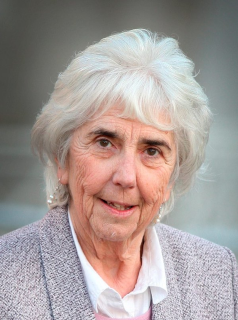
MacSwiney Brugha is the daughter of the former Lord Mayor of Cork Terence MacSwiney and his wife Muriel Frances Murphy. Her father dies on hunger strike when she is two years old. Her father is in jail when she is born and does not see her until she is brought to see him when she is three months old. Her family’s republican and political activities leave a strong mark on her life.
Following the death of her father, her mother moves to Dublin. MacSwiney Brugha goes to live with Madame O’Rahilly, widow of The O’Rahilly, and sees her mother intermittently. Although as a child her parents decide she would speak the Irish language, her father’s death and her mother’s health results in her move to Germany in 1923 and there she is moved around a lot. She learns German and speaks no English and little or no Irish. In 1930 she is moved to Grainau in Bavaria, where she attends school. Her aunt, Mary MacSwiney, a legal guardian of hers, eventually comes to collect her and takes her back to Ireland. This causes a court case when it is claimed her aunt had kidnapped her. As a result of the court case her aunt is given custody, and she and her mother became estranged.
MacSwiney Brugha attends Scoil Íte and then St. Louis Secondary School in Monaghan where, in 1936, she completes her Leaving Certificate and gets a scholarship to University College Cork to study arts. In 1937 she plays the lead role in a play, The Revolutionist, published in 1914 and written by her father and produced by her aunt. She returns to Germany in 1938 to keep up her German and graduates with a first-class honours degree. She goes on to get her higher diploma and becomes a teacher. She spends some time teaching in Scoil Íte and then goes to Dublin in 1942 to get a master’s degree. She meets Ruairí Brugha while in Dublin. His father, Cathal Brugha, was killed in the Irish Civil War in 1922. They marry on July 10, 1945. The marriage produces four children: Deirdre, Cathal, Traolach and Ruairí.
MacSwiney Brugha’s husband has a strong political career with her support. He is a senator, a TD, and a member of the European Parliament. She leads her Fianna Fáilcumann and volunteers with the aid agency Gorta. With her husband as Official Opposition Spokesman on Northern Ireland from 1975 to 1977, the couple are very much involved in creating the policy of developing conciliation rather than aimed more at ending partition which they previously have been focused on.
At the age of 85 and after her sight has failed MacSwiney Brugha dictates her story to her daughter-in-law, Catherine Brugha. History’s Daughter: A Memoir from the Only Child of Terence MacSwiney is launched in 2005. Her own story is recorded in Irish Life and Lore. Her story is also the subject of a radio production. She dies unexpectedly at her home in Clonskeagh, County Dublin, at the age of 93 on May 20, 2012. She is buried in Glasnevin Cemetery.
Fianna Fáil leader Micheál Martin describes her as having made a “strong and valued” contribution to the development of Fianna Fáil while Gerry Adams says she “made her mark” on Irish history.
(Pictured: Máire MacSwiney Brugha on her wedding day, July 10, 1945)
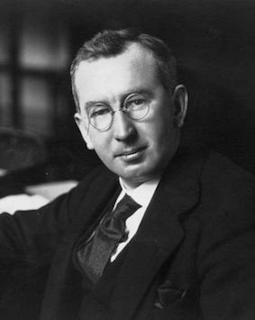
Béaslaí is born Percy Frederick Beazley in Liverpool, England on February 15, 1881, to Irish Catholic parents, Patrick Langford Beazley, originally from Killarney, County Kerry, and Nannie Hickey, from Newcastle West, County Limerick. During his summer holidays in his younger years, he spends time in Ireland (near Kenmare, County Kerry) with his paternal uncle, Father James Beazley, where he begins to learn the Irish language. He is educated at St. Francis Xavier’s College in Liverpool, where he develops his keen interest in Irish. By the time he is aged 17 his Irish proficiency is exceptional.
After finishing his education at St. Francis Xavier’s, Béaslaí is encouraged to begin Irish poetry by Tadhg Ó Donnchadha. He follows his father’s footsteps into journalism, initially working for the local Wallasey News. In 1906 he moves to Dublin, and within a year becomes a freelance writer for the Irish Peasant, Irish Independent, Freeman’s Journal and Express. He is offered a permanent position with Independent Newspapers, as assistant leader writer and special reporter for the Dublin Evening Telegraph. He writes regularly for the Freeman’s Journal, including a daily half-column in Irish.
After his early introduction to Irish poetry Béaslaí becomes involved in staging Irish-language amateur drama at the Oireachtas annual music festival. He begins to write both original works and adaptations from foreign languages. One of these works, Eachtra Pheadair Schlemiel (1909), is translated from German into Irish.
Later Béaslaí continues to write poetry, such as the collection “Bealtaine 1916” agus Dánta Eile (1920), and short stories such as “Earc agus Aine agus Scéalta Eile.” Between 1913 and 1939 he writes many plays, including Cliuche Cartaí (1920), An Sgaothaire agus Cúig Drámaí Eile (1929), An Danar (1929) and An Bhean Chródha (1931). He writes two books about his comrade Michael Collins: Michael Collins and the Making of a New Ireland (2 volumes, 1926) and Michael Collins: Soldier and Statesman (1937).
Béaslaí’s works revolve around the Irish language movement and the Irish Republican Army (IRA), focusing on the independence struggle of Ireland. He writes about these topics in newspapers such as the Standard and The Kerryman. His most notable work in newspapers during his later life includes his contribution to the Irish Independent, which publishes a section called ‘A Veteran Remembers’ five days a week from May 16 to June 1957, as well as a weekly section called ‘Moods and Memories’ on Wednesdays from May 24, 1961, to June 16, 1965.
One of the awards Béaslaí gains during his career is on August 14, 1928, a gold medal at the Tailteann Literary Awards. While in Dublin, he joins the Keating Branch of the Gaelic League, and after he moves to Ireland, he begins using the Irish form of his name, Piaras Béaslaí, rather than Percy Beazley.
Béaslaí is a founding member of the Irish Volunteers in 1913. In January 1916 he serves as a courier for political activist and revolutionary leader Seán Mac Diarmada. By the time of the Easter Rising that year, he is deputy commanding officer of the 1st Dublin Battalion. In an audio recording to which he contributes in 1958, he details his experience in the Rising, describing the rebels assembling before noon in Blackhall Street at battalion headquarters. After midday they march out to the Four Courts, erecting barricades as they do so. The Four Courts is his main station.
In the audio, Béaslaí recalls a green flag with a gold harp in the centre. This is the non-Sinn Féin flag at the time. He is in direct charge of the Four Courts area, and at one point during the fight he orders a complete blackout. He recalls, “things were going badly for the English soldiers” and describes the whole event as “a weird experience.” He remembers the streets being lit up with fires in the darkness as if it were bright as day. He speaks of the intensity of the firing line and then how it suddenly ceases on the Friday. He remembers falling asleep and when he awakens being presented with Patrick Pearse‘s order to surrender. The rebels are brought to Richmond Barracks. He then spends fifteen months in English prisons.
Béaslaí serves three years of penal servitude divided between a stringent HM Prison Portland and a more lenient HM Prison Lewes. He is then imprisoned two times within four months during 1919, both terms ending in celebrated escapes. After his final prison release, Michael Collins approaches him about editing An tOglach, the Irish Volunteer newspaper. This sees communication between GHQ and local volunteers drastically improve.
Later, Béaslaí becomes director of publicity for the Irish Republican Army, and at the 1918 Irish general election he is elected to the First Dáil as Sinn Féin MP for East Kerry. Sinn Féin MPs elected in the Westminster elections of 1918 refuse to recognise the Parliament of the United Kingdom, and instead assemble the following January at the Mansion House in Dublin as a revolutionary parliament, Dáil Éireann. Béaslaí is noted for his translation of the democratic programme of the First Dáil, which he reads aloud at the inaugural sitting.
Béaslaí and Con Collins share the distinction of having been elected in three Irish general elections unopposed by any other candidates.
During Béaslaí’s time in London, he gives a lot of his time to the Gaelic League. In the Keating branch of the league, in Ireland, he develops an interest in the IRB. Cathal Brugha, a branch member, asks him to join the IRB. The Keating branch is where Béaslaí meets Michael Collins, eventually introducing Collins to his cousin and fellow branch member, Elizabeth Mernin. He is also instrumental in establishing An Fáinne, an Irish-speaking league whose members vow to speak solely Irish among themselves and wear a membership badge of a circle. This coincides with his involvement in the IRB. His love of the Irish language gives him an opportunity to delve into his other hobbies. He writes for Banba, an Irish journal published by the Gaelic League. He is able to express his love for theatre, in the Gaelic League, forming a group of men called “Na hAisteoirí.”
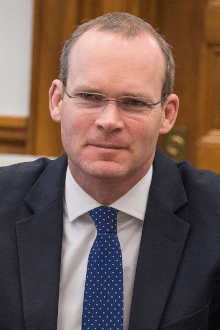
A keen fan of all competitive sport, Coveney plays rugby for Garryowen, Cork Constitution and Crosshaven Rugby Club. In 1997-98, he leads the “Sail Chernobyl Project” which involves sailing a boat 30,000 miles around the world and raising €650,000 for charity. He is a qualified sailing instructor and lifeguard. He spends several years working as an agriculture adviser and farm manager.
Coveney is first elected to Dáil Éireann in a 1998 by-election as a Fine Gael candidate for Cork South-Central. He holds Shadow Ministries in the areas of Drugs and Youth Affairs, Communications, Marine and Natural Resources, and Transport. He chairs the Fine Gael Policy Development Committee prior to the 2011 Irish general election.
Coveney is a member of Cork County Council and the Southern Health Board from 1999 to 2003.
Coveney is elected to the European Parliament in 2004 and is a member of the EPP-ED group. He is a member of the Committee on Foreign Affairs and the Internal Market and Consumer Protection Committee. He is the author of the European Parliament’s Annual Report on Human Rights in the World for the year 2004 and again for 2006.
Coveney is named Tánaiste by Leo Varadkar, replacing Frances Fitzgerald, on November 30, 2017, a position he holds until June 27, 2020. He also serves as Minister for Housing, Planning and Local Government as well as Minister for Agriculture, Food and the Marine. For the six-month period ending June 2013, he chairs the EU Council of Agriculture & Fisheries Ministers where he is at the forefront regarding EU efforts in respect of Common Agricultural (CAP) as well as Common Fisheries (CFP) Policy reforms. Under his chairmanship both dossiers are progressed significantly, with a reform package for CFP agreed in May 2013 and a reform package for CAP agreed at the end of the Irish Presidency in July. The Defence portfolio is added to his brief on July 11, 2014.
In July 2008, Simon marries his long-time girlfriend Ruth Furney, an IDA Ireland employee. They have three daughters and currently live in Carrigaline, County Cork.
Lynch returns to Ireland in 1909, where he starts training as a teacher in St Patrick’s College, Dublin. He graduates in 1911 as a primary school teacher. In April 1912 he begins working as a national schoolteacher at St. Michan’s School, Dublin, becomes an active member of the Keating branch of the Gaelic League, and is recruited into the Irish Republican Brotherhood (IRB) by Seán Mac Diarmada. He also joins the Irish Volunteers in 1913, and becomes captain of F Company, 1st Battalion, Dublin Brigade. With Piaras Béaslaí he founds Na hAisteoirí, a drama company dedicated to the production of plays in Irish, with many of its members fighting during the 1916 Easter Rising. In the months before the rising Lynch temporarily stands down from the Volunteers after his school manager tells him he will be sacked if he does not. Learning that a rising was imminent, he rejoins the Volunteers, and over the Easter weekend commands the detachment that guards Bulmer Hobson to prevent him from interfering with Volunteer mobilisation. During the rising he is involved in heavy fighting in the North King Street area and is subsequently imprisoned.
Held at Lewes Prison, Lynch is released under the general amnesty. In August 1916 he is reimprisoned for making an inflammatory speech, and in September leads the Mountjoy Prisonhunger strike with Austin Stack and Thomas Ashe. He is released in November following a further hunger strike at Dundalk prison. He is imprisoned again in May 1918 on the same charge during the ‘German Plot’ allegations and is released in August 1919, after which he helps to plan the escape of other prisoners.
Elected a Sinn FéinTD for South Kerry in December 1918 and for Kerry–Limerick West in May 1921, Lynch serves as assistant secretary to the Anglo-Irish Treaty delegation in London (October–December 1921), where he is largely responsible for organising the living arrangements at the two Irish headquarters. A supporter of the treaty, he addresses Pro-Treaty rallies with Michael Collins, and from January to August 1922 is Minister for Education with the Provisional Government, at the same time as Michael Hayes is Minister for Education for Dáil Éireann. Possible conflict is avoided by the pragmatic division of duties, under which Hayes takes responsibility for intermediate and higher education, and Lynch for primary education. It is also left for Lynch to clarify the relationship between the new Provisional Government and the board of commissioners of intermediate education, which is not abolished until 1923. These developments, however, are overshadowed by the beginning of the Irish Civil War, where military considerations take precedence over civic responsibilities.
Required to serve in the army, in July 1922 Lynch is appointed a vice-commandant of the south-western division with the rank of commandant-general, commanding a unit of Dublin soldiers in County Kerry, where on occasion he has to endure being ambushed, leading a fellow commandant to note ironically that his constituents do not seem to think much of him. However, the reluctance of former colleagues to attack him possibly ensure his survival during the war. Frank Henderson of Dublin’s No. 1 brigade of the Irish Republican Army (IRA) tells Ernie O’Malley of his reluctance to become involved in reprisal shootings after Free State executions, commenting, “I didn’t like that order. I could have shot Eamonn Duggan and Fionán Lynch, for they went home every night drunk, but I left them alone.”
After the Irish Civil War Lynch is elected a Cumann na nGaedheal TD for Kerry, a seat he holds until 1937, after which he represents the constituency of Kerry South (1937–44). He serves as Minister for Fisheries (1922–28) and Minister for Lands and Fisheries (1928–32) and retains his interest in education. He supports the Irish National Teachers‘ Organisation policy on the Irish language during the 1920s, commenting that he is entirely opposed to attempting to teach subjects through Irish where Irish is not the known language.
In 1931 Lynch qualifies as a barrister. After Fianna Fáil comes to power and during the rise of the Blueshirts he speaks at public meetings with Eoin O’Duffy, and they are attacked by a crowd in Tralee in October 1933. After the fall of O’Duffy and the reorganisation of Fine Gael, W. T. Cosgrave appoints a front bench designed to represent the various groups in the party, which witness former ministers, including Desmond FitzGerald, Patrick Hogan, and Lynch, relegated to the back benches. Lynch serves as Leas-Cheann Comhairle of the Dáil (1938–39). Having built up a legal practice, he retires from politics in October 1944 and is subsequently appointed a circuit court judge in the north-west district, retiring from the bench in 1959.
Lynch dies suddenly at his home in Dartry, County Dublin, on June 3, 1966, shortly after celebrating the 50th anniversary of the Easter Rising. He is survived by his wife Brighid (née Slattery), a native of Tralee, and by their five sons and one daughter. His papers are on permanent loan to Kerry County Library archives.
(From: “Lynch, Fionán (Finian)” by Diarmaid Ferriter, Dictionary of Irish Biography, http://www.dib.ie)
In 1987, O’Rourke is appointed Minister for Education by Charles Haughey. She and her brother, Brian Lenihan Snr, become the first brother and sister in Irish history to serve in the same cabinet. In the November 1991 cabinet reshuffle, she becomes Minister for Health. In February 1992, Charles Haughey resigns as Taoiseach and Fianna Fáil leader, and she contests the subsequent leadership election along with Michael Woods and Albert Reynolds. Reynolds wins the election, and she is subsequently dropped from her ministerial position, but is appointed to a junior ministry as Minister of State for Labour Affairs at the Departments of Industry and Commerce, and later Enterprise and Employment.
In 1994, Bertie Ahern becomes party leader, and he appoints O’Rourke as deputy leader of Fianna Fáil, serving in the position until 2002. Following Ahern’s election as Taoiseach in June 1997, she becomes Minister for Public Enterprise, holding this position until she loses her Dáil seat at the 2002 Irish general election. This follows a vote management strategy from Fianna Fáil head office which restricts her from campaigning in her traditional areas around Kilbeggan, in an attempt to win 2 of the 3 seats in Westmeath. The loss of her Dáil seat is also attributed to her association with and the championing of, the privatisation of Telecom Éireann, which proves a financial disaster for many small investors, due to the share price falling radically, post privatisation. During this term as Minister, she also becomes the subject of public criticism by Ryanair chief executive Michael O’Leary. Following the loss of her Dáil seat, she is nominated to Seanad Éireann as a Senator by Taoiseach Bertie Ahern where she becomes Leader of the Seanad and leader of Fianna Fáil in the Seanad.
In January 2006, O’Rourke receives the party nomination to stand at the 2007 Irish general election. She narrowly defeats her nearest rival and Dáil election running mate, Kevin “Boxer” Moran of Athlone Town Council, causing a controversy when she thanks her election team for working “like blacks.” She is re-elected to the Dáil at the May 2007 Irish general election, with her highest ever vote.
In November 2008, during a march against the re-introduction of college fees, students from the Athlone Institute of Technology lay a funeral wreath at the door of O’Rourke’s constituency office. The card in the wreath states “Sincere sympathies on the death of free fees. We will remember this.” She describes the act as “heinous.” The wreath is placed there because she is not speaking at a rally against the fees.
In July 2010, O’Rourke concedes that she does not expect the party to be in power after the next general election. On RTÉ Radio‘s Today with Pat Kenny programme, she says the government is taking tough decisions to steer the country through the financial crisis and this will make it easy for the opposition. She says there is a general air of “crossness” within the Fianna Fáil party over their standing in the polls, but nobody is harboring leadership ambitions to challenge Brian Cowen.
In November 2010, O’Rourke says there is then more to unite her party and Fine Gael than to divide them. She points to the common approach of the two parties to Northern Ireland, Europe and the current financial crisis. In an address to the 1916–1921 Club in Dublin Castle, she says that most voters no longer defined themselves in terms of Civil War politics.
O’Rourke’s senior years lead her to often being referred to as the “Mammy of the Dáil.”
O’Rourke contests the 2011 Irish general election but is defeated on the poll. She had been critical of former Taoiseach Brian Cowen, saying that he should have resigned after his infamous “congested” radio interview. She supports the attack on Cowen by her nephew, former Finance Minister Brian Lenihan Jnr, who says he is “disappointed” by Cowen’s performance, and he had to provide the leadership when the Taoiseach did not.
As well as being a well-known politician, O’Rourke makes regular appearances in the media in a non-political capacity. She has been a contestant on RTÉ‘s reality series Celebrity Bainisteoir, as well as other shows such as Sex & Sensibility. She has guest presented Tonight with Vincent Browne.
In 2012, Just Mary: My Memoir is published. It wins the 2012 Irish Book Award in the “Listeners’ Choice” category.
O’Rourke comes from a strong political family, her father Patrick Lenihan serves as a TD for Longford–Westmeath from 1965 to 1970. Her brother Brian Lenihan is a senior government Minister and Tánaiste. Another brother, Paddy Lenihan, is a County Councillor in Roscommon, but resigns from Fianna Fáil in 1983 and becomes associated with Neil Blaney‘s Independent Fianna Fáil party. Two of her nephews, Brian Lenihan Jnr and Conor Lenihan, both sons of her brother Brian, serve as Ministers. Brian Lenihan Jnr is the Minister for Finance. Conor Lenihan is a Minister of State.
O’Rourke is widowed in January 2001, following the death of her husband, Enda. She has two sons. Aengus O’Rourke, her adopted son, runs for Athlone Town Council in 2009. The other son, Feargal O’Rourke, becomes Managing Partner of PricewaterhouseCoopers in Ireland in 2015 and is considered the “grand architect” of the Double Irish tax system, a major contributor to Ireland’s economic success in attracting U.S. multinationals to Ireland.
Patrick John Hillery, Irish politician and the sixth President of Ireland, dies in Glasnevin, Dublin, at the age of 84 on April 12, 2008, following a short illness. He serves two terms in the presidency and, though widely seen as a somewhat lacklustre President, is credited with bringing stability and dignity to the office. He also wins widespread admiration when it emerges that he has withstood political pressure from his own Fianna Fáil party during a political crisis in 1982.
Following Ireland’s successful entry into the European Economic Community in 1973, Hillery is rewarded by becoming the first Irishman to serve on the European Commission, serving until 1976 when he becomes President. In 1976 the Fine Gael–Labour Party National Coalition under Liam Cosgrave informs him that he is not being re-appointed to the Commission. He considers returning to medicine; however, fate takes a turn when Minister for DefencePaddy Donegan launches a ferocious verbal attack on President Cearbhall Ó Dálaigh, calling him “a thundering disgrace” for referring anti-terrorist legislation to the courts to test its constitutionality. When a furious President Ó Dálaigh resigns, a deeply reluctant Hillery agrees to become the Fianna Fáil candidate for the presidency. Fine Gael and Labour decide it is unwise to put up a candidate in light of the row over Ó Dálaigh’s resignation. As a result, Hillery is elected unopposed, becoming President of Ireland on December 3, 1976.
When Hillery’s term of office ends in September 1983, he indicates that he does not intend to seek a second term, but he changes his mind when all three political parties plead with him to reconsider. He is returned for a further seven years without an electoral contest. After leaving office in 1990, he retires from politics.
Hillery’s two terms as president, from 1976 to 1990, end before the 1998 Good Friday Agreement, which sets terms for an end to violence in Northern Ireland. But he acts at crucial moments as an emollient influence on the republic’s policies toward the north and sets a tone that helps pave the way for eventual peace.
Patrick Hillery dies on April 12, 2008, in his Dublin home following a short illness. His family agrees to a full state funeral for the former president. He is buried at St. Fintan’s Cemetery, Sutton, near Dublin. In the graveside oration, TánaisteBrian Cowen says Hillery was “A humble man of simple tastes, he has been variously described as honourable, decent, intelligent, courteous, warm and engaging. He was all of those things and more.”
McGrath is born in Dublin on August 12, 1888. By 1916 he is working with his brother George at Craig Gardiner & Co., a firm of accountants in Dawson Street, Dublin. He works with Michael Collins, a part-time fellow clerk and the two strike up a friendship. In his spare time he works as secretary for the Volunteer Dependents’ Fund.
McGrath soon joins the Irish Republican Brotherhood. He fights in Marrowbone Lane in the 1916 Easter Rising. He is arrested after the rising, and jailed in Wormwood Scrubs and Brixton prisons in England. In the 1918 Irish general election, he is elected as Sinn Féin TD for the Dublin St. James’s constituency, later sitting in the First Dáil. He is also a member of the Irish Republican Army (IRA), and successfully organises many bank robberies during the Irish War of Independence (1919–1921), where a small percentage of the proceeds is retained as a reward by him and his fellow-soldiers. During this time he is interred briefly at Abercorn Barracks but escapes by dressing in army uniform and walking out of the gate with soldiers going on leave. He is eventually recaptured and spends time in jail in Belfast.
In October 1921 McGrath travels with the Irish Treaty delegation to London as one of Michael Collins’ personal staff. When the Provisional Government of Ireland is set up in January 1922, he is appointed Minister for Labour. In the Irish Civil War of 1922–1923, he takes the pro-Treaty side and is made Director of Intelligence, replacing Liam Tobin. In a strongly worded letter, written in red ink, he warns Collins not to take his last, ill-fated trip to County Cork.
McGrath is later put in charge of the police Intelligence service of the new Irish Free State, the Criminal Investigation Department (CID). It is modelled on the London Metropolitan Police department of the same name, but is accused of the torture and killing of a number of republican (anti-Treaty) prisoners during the civil war. It is disbanded at the war’s end with the official reason given that it is unnecessary for a police force in peacetime. He goes on to serve as Minister for Labour in the Second Dáil and the Provisional Government of Ireland. He also serves in the 1st and 2nd Executive Councils holding the Industry and Commerce portfolio.
In September 1922 McGrath uses strikebreakers to oppose a strike by Trade Unionists in the Post Office service, despite having threatened to resign in the previous March of the same year when the government threatened to use British strikebreakers.
McGrath resigns from office in April 1924 because of dissatisfaction with the government’s attitude to the Army Mutiny officers and as he says himself, “government by a clique and by the officialdom of the old regime.” By this he means that former IRA fighters are being overlooked and that the Republican goals on all Ireland has been sidelined. He and eight other TDs, who had resigned from Cumann na nGaedheal, resign their seats in the Dáil and form a new political party, the National Party. However, the new party does not contest the subsequent by-elections for their old seats. Instead, Cumann na nGaedheal wins seven of the seats and Sinn Féin wins the other two.
In 1927, McGrath takes a libel case against the publishers of The Real Ireland by poet Cyril Bretherton, a book that claims he is responsible for the abduction and murder of Noel Lemass, the brother of Seán Lemass, in June 1923 during the civil war, as well as a subsequent coverup. He wins the court case. During the 1930s, he and Seán Lemass reconcile and regularly play poker together.
Following his political career, McGrath goes on to become involved in the building trade. In 1925 he becomes labour adviser to Siemens-Schuckert, German contractors for the Shannon hydroelectric scheme near Limerick. He founds the Irish Hospitals’ Sweepstake in 1930, and the success of its sweepstakes makes him an extremely wealthy man. He has other extensive and successful business interests always investing in Ireland and becomes Ireland’s best-known racehorse owner and breeder, winning The Derby with Arctic Prince in 1951.
McGrath dies at his home, Cabinteely House, in Ballsbridge, Dublin on March 26, 1966. Cabinteely House is donated to the state in 1986 and the land is developed as a public park. His son, Patrick W. McGrath, inherits many of his father’s business interests, and also serves as Fine Gael Senator from 1973 to 1977.
(Pictured: Screenshot of a film of Irish politician Joseph McGrath shot in 1922)
Traynor is born into a strongly nationalist family in Dublin. He is educated by the Christian Brothers. In 1899, he is apprenticed to John Long, a famous woodcarver. As a young man he is a noted footballer and tours Europe as a goalkeeper with Belfast Celtic F.C. whom he plays with from 1910 to 1912. He rejects claims soccer is a foreign sport calling it “a Celtic game, pure and simple, having its roots in the Highlands of Scotland.”
When the Irish Civil War breaks out in June 1922, Traynor takes the Anti-Treaty IRA side. The Dublin Brigade is split, however, with many of its members following Michael Collins in taking the pro-Treaty side. During the Battle of Dublin, he is in charge of the Barry’s Hotel garrison, before making their escape. He organises guerilla activity in south Dublin and County Wicklow, before being captured by Free State troops in September. He is then imprisoned for the remainder of the war.
In 1936, Traynor is first appointed to the Cabinet as Minister for Posts and Telegraphs. In September 1939, he is appointed Minister for Defence and holds the portfolio to February 1948. In 1948, he becomes President of the Football Association of Ireland, a position he holds until his death. He serves as Minister for Defence in several Fianna Fáil governments and as Minister for Justice, where he is undermined by his junior minister, and later Taoiseach, Charles Haughey, before he retires in 1961.
Traynor dies in Dublin at the age of 77 on December 15, 1963. He has a road named in his memory, running from the Malahide Road through Coolock to Santry in Dublin’s northern suburbs.
(Pictured: Minister for Defence Oscar Traynor at his desk, June 1940)
Briscoe is born in Dublin on September 25, 1894, the son of Abraham William Briscoe and Ida Yoedicke, both of whom are Lithuanian-Jewish immigrants. The original family name in Lithuania is believed to have been Cherrick or Chasen. His brother Wolfe Tone Briscoe is named after Theobald Wolfe Tone, one of the leaders of the Irish Rebellion of 1798. His father is the proprietor of Lawlor Briscoe, a furniture factory on Ormond Quay which makes, refurbishes, imports, exports and sells furniture, trading all over Ireland and abroad.
Briscoe is active in the Irish Republican Army (IRA) and Sinn Féin during the Irish War of Independence and accompanies Éamon de Valera to the United States. He speaks for the Sinn Féin cause at public meetings there and is adamant that being a “Hebrew” does not lessen his Irishness. He is sent by Michael Collins to Germany in 1919 to be the chief agent for procuring arms for the IRA. While in Germany in 1921 he purchases a small tugboat named Frieda to be used in transporting guns and ammunition to Ireland. On October 28, 1921, the Frieda slips out to sea with Charles McGuinness at the helm and a German crew with a cargo of 300 guns and 20,000 rounds of ammunition. Some sources cite this shipment as “the largest military shipment ever to reach the IRA” consisting of 1,500 rifles, 2,000 pistols and 1.7 million rounds of ammunition. On November 2, 1921, the Frieda successfully lands its cargo near Waterford Harbour.
In June 1922 during the Irish Civil War, Briscoe is involved in an incident with fellow anti-treaty IRA members who attack pro-treaty politician Darrell Figgis at his home. They enter the house and assault Figgis, cutting off his well-prized beard in the process. This traumatises Figgis’ wife Millie, who had been under the impression Briscoe and his fellow assistants had come to kill Figgis. In November 1924 Millie commits suicide, expressing in a suicide note that she was suffering from depression as a result of the 1922 attack. Figgis himself commits suicide in 1926.
In his biography, Briscoe recalls an incident of being recognised by a pro-Treaty opponent during the Civil War. He merely turns and walks away, confident that his enemy will not shoot him in the back.
Elected to the Dáil in the newly independent Ireland, Briscoe works with Patrick Little to bring through a law limiting the interest that can be charged by moneylenders and also, as he writes, “made it illegal for a married woman to borrow money without the knowledge and consent of her husband, for these foolish ones are always the easiest prey of the moneylenders.”
During World War II, Briscoe, at this time a member of Dáil Éireann, comes under close scrutiny from the Irish security services. His support for Zionism and his lobbying on behalf of refugees is considered potentially damaging to the interests of the state by officials from the Department of Justice. He is an admirer and friend of Ze’ev Jabotinsky and his campaign to liberate the Jews. Between 1939 and 1940, he along with John Henry Patterson, a former commander of both the Zion Mule Corps and later the 38th Battalion of the Royal Fusiliers, are involved in fund raising for the Irgun in the United States. Jabotinsky while head of Irgun visits Dublin to receive training in guerrilla warfare tactics against the British under the instruction of Briscoe. During the period Briscoe describes himself as the “Chair of Subversive Activity against England.” He wishes for Ireland to give asylum to Jews fleeing Nazi Germany but does so discreetly in order not to be accused of compromising the neutrality policy of the Fianna Fáil government.
After World War II Briscoe acts as a special advisor to Menachem Begin in the transformation of Irgun from a paramilitary group to a parliamentary political movement in the form of Herut in the new Israeli state. The party later becomes Likud. As he had already been a key figure in the formation in his own Fianna Fáil party out of the Anti-treaty IRA post Irish independence but not before a bitter Civil War, he prompts Begin to make the transition immediately after the Altalena Affair in order to avoid a similar civil conflict.
Briscoe serves in Dáil Éireann for 38 years and is elected 12 times in the Dublin South and from 1948, Dublin South-West constituencies. He retires at the 1965 Irish general election, being succeeded by his son, Ben, who serves for a further 37 years. In 1956, he becomes the first Jewish Lord Mayor of Dublin, although he is not the first Jewish Mayor in Ireland. That title belongs to William Annyas, who was elected Mayor of Youghal, County Cork in 1555. He serves a one-year term and is re-elected in 1961. His son Ben is also a Fianna Fáil TD, and he too serves as Lord Mayor of Dublin from 1988–1989.
Briscoe’s memoir, For the Life of Me, is published in 1958.
O’Sullivan is educated locally at Mount Carmel school. After completing a BA at University College Dublin (UCD), she then goes on to work as an English and History teacher and guidance counsellor in a secondary school in Baldoyle, a position she holds for thirty years.
O’Sullivan is a member of Tony Gregory‘s local political organisation in the 1970s, first canvassing for him and later serving as his election agent. She is co-opted onto Dublin City Council for the North Inner City local electoral area from September 2008 to June 2009, after the retirement of Mick Rafferty. After the death of Tony Gregory, she wins the resulting by-election which is held on the same day as the local elections where she also wins a seat on Dublin City Council, for the North Inner City local electoral area. Marie Metcalfe is co-opted to take the seat due to the dual mandate rule. Subsequently Anna Quigley replaces Metcalfe on Dublin City Council, who is in turn replaced by Mel MacGiobúin in March 2014. MacGiobúin fails to be elected at the local elections held in May.
O’Sullivan is re-elected to the Dáil at the 2011 Irish general election. She joins the Dáil technical group which gives independents and minor parties more speaking time in Dáil debates. She describes a proposal for political gender quota legislation as “tokenistic” and that women are able to get themselves nominated for election.
In December 2015, O’Sullivan and fellow independent TDs Clare Daly and Mick Wallace each put forward offers of a €5,000 surety for a 23-year-old man being prosecuted under terrorism legislation in the Special Criminal Court in Dublin charged with membership of an illegal dissident republican terrorist organisation.
After the 2016 Irish general election O’Sullivan unsuccessfully stands for election as Ceann Comhairle. She joins a technical group aligned with Independents 4 Change, while remaining outside the Independents 4 Change party. She is criticised by the brother of late TD Tony Gregory, over an allegedly false claim made in her election literature.
On January 16, 2020, O’Sullivan announces she will not be standing in the 2020 Irish general election in February.