seamus dubhghaill

Promoting Irish Culture and History from Little Rock, Arkansas, USA


1 Comment

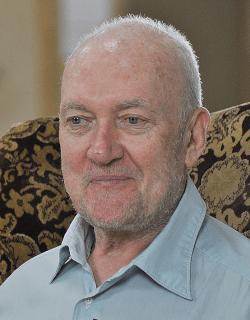
Birth of Ciaran McKeown, Northern Irish Peace Activist

Ciaran McKeown, Northern Irish peace activist, is born into a Roman Catholic family in Derry, County Londonderry, Northern Ireland, on January 19, 1943.

McKeown is born to Sean and Mary (née Shevlin) McKeown. His father is a school principal. He serves as a Dominican novice for eight months in his youth. He attends Queen’s University Belfast (QUB), where he studies philosophy, becoming the first Catholic to be elected president of the university’s student council. He is also elected chair of the National Democrats, a ginger group linked with the National Democratic Party. He becomes president of the Union of Students in Ireland (USI) in 1969, based in Dublin, and stands in Dublin South-West at the 1969 Irish general election, taking last place, with only 154 votes.

In 1970, McKeown becomes a reporter for The Irish Times, then later works for The Irish Press, as their Belfast correspondent. Given his experience of reporting on the emergence of The Troubles, he supports the 1976 creation of “Women for Peace,” a Northern Ireland-based movement, by Betty Williams and Mairead Corrigan. When his involvement becomes more widely known, the movement changes its name to “Community of Peace People,” or simply “Peace People.” After the events of 1976-77, he finds it difficult to return to full-time journalism.

Although McKeown becomes known as a thoughtful and calm presence in the leadership of the organisation, his criticisms of the reluctance of church authorities to speak out on sectarian issues causes some tensions. Corrigan and Williams win the 1976 Nobel Peace Prize, but he is not made a party to it. However, the Ford Foundation makes a grant to the group, which includes a salary for him, enabling him to become full-time editor of Peace by Peace, the group’s newspaper, also completing a year as editor of Fortnight in 1977.

McKeown, Corrigan and Williams all step down from the leadership posts in 1978, although he continues to edit Peace by Peace. His articles bring him into conflict with the group’s new leadership, while financial disagreements massively reduce the group’s membership. Ultimately, his belief that the group should call for special status for paramilitary prisoners leads to a split, with Williams and her leading supporter, Peter McLachlan, resigning in February 1980. He can no longer survive on the group’s salary, nor can he find work as a journalist, so he retrains as a typesetter.

In 1984, McKeown publishes his autobiography, The Passion of Peace. This is almost immediately withdrawn following a claim that it libels a journalist, although it is later reissued with an additional note.

In addition to his activism and his work in journalism, McKeown is deeply involved in the Belfast theater scene. He serves in a number of offices, including executive secretary and chairman, at the city’s renowned Lyric Theatre.

McKeown dies peacefully at his home in Belfast on September 1, 2019, following a battle with cancer.
Leave a comment

Birth of Sean Scully, Painter, Printmaker, Sculptor & Photographer

Sean Scully, Irish-born American-based artist working as a painter, printmaker, sculptor and photographer, is born in Dublin on June 30, 1945. His work is held in museum collections worldwide and he has twice been named a Turner Prize nominee.

Four years after his birth, Scully’s family moves to London where they live in a working-class part of South London, moving from lodging to lodging for a number of years. By the age of 9, he knows he wants to become an artist. From the age of 15 until he is 17, he is apprenticed at a commercial printing shop in London as a typesetter, an experience that greatly influences his future artwork.

Scully studies at Croydon School of Art between 1965-67 and at Newcastle University between 1967-71. He is awarded the Frank Knox Memorial Fellowship in 1972 to attend Harvard University. It is during this first stay in the United States that he begins to experiment with new techniques such as tape and spray paint. In 1975 he is awarded a Harkness Fellowship and establishes a studio in New York, where he settles, becoming an American citizen in 1983.

Over the years, Scully develops and refines his own recognisable style of geometric abstraction and most notably his characteristic motif of the ‘stripe.’ Although he is predominately known for his monumental paintings, he is also a gifted printmaker who has made a notable body of woodcuts and etchings.

Scully has his first solo exhibition at the Rowan Gallery, London in 1973. He has his first retrospective at the Ikon Gallery in Brindleyplace, Birmingham, in 1981, which travels throughout the United Kingdom. In 1989 his first solo exhibition in a European museum travels from the Whitechapel Gallery in London to Palacio Velázquez in Madrid and Städtische Galerie im Lenbachhaus in Munich. He has further solo exhibitions at Kunstsammlung Nordrhein Westfalen in Düsseldorf (2001) which travels to Haus der Kunst in Munich and the Institut Valencià d’Art Modern in Valencia; The Phillips Collection in Washington, D.C. (2005) travels to the Modern Art Museum of Fort Worth in Texas, the Cincinnati Art Museum in Ohio and finally the Metropolitan Museum of Art in New York City. A major retrospective tours multiple venues in China between 2015 and 2017.

Scully’s paintings and prints are held in the collections of Tate in London, the Albertina in Vienna, Museo Nacional Centro de Arte Reina Sofía in Madrid, Instituto Valencia d’Arte Modern in Valencia, the Metropolitan Museum of Art and the Solomon R. Guggenheim Museum in New York City, the National Gallery of Art in Washington D.C., Modern Art Museum of Fort Worth in Texas, Guangzhou Museum of Art in Guangzhou, China, and the Central Academy of Fine Arts in Beijing, China.

Scully has held teaching positions at Chelsea College of Arts and Goldsmith’s College of Art and Design, both in London, Princeton University in New Jersey, Parsons School of Design in New York, and most recently at the Akademie der Bildenden Künste in Munich. He is shortlisted for the Turner Prize in 1989 and in 1993, and is elected a Royal Academician in 2013. He participates for the first time at the Venice Biennale in 2014.

Sean Scully lives and works in New York and in Bavaria, Germany.


Leave a comment

Publication of the First Issue of “Sinn Féin”

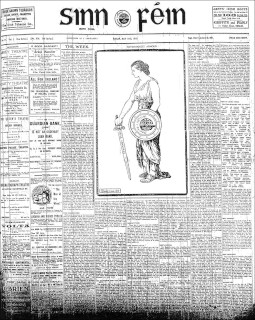
File source: http://en.wikipedia.org/wiki/File:Sinn_F%C3%A9in_Newspaper.jpgThe first issue of Sinn Féin, a weekly Irish nationalist newspaper edited by the Dublin typesetter, journalist and political thinker Arthur Griffith, is published on May 5, 1906. It is published by the Sinn Féin Printing & Publishing Company, Ltd. (SFPP) between 1906 and 1914, and replaces an earlier newspaper called The United Irishman which is liquidated after a libel suit. Initially, Sinn Féin is a large format (slightly larger than a modern broadsheet), 4-page newspaper with 7 columns per page.

Trained as he was in the graphic side of newspaper production, Arthur Griffith has both a professional interest in and a profound understanding of visual culture. He is also very much aware of how visual discourses can be used to defend the Irish nation against cultural Anglicisation. In his newspaper propaganda he continually promotes the use of such discourses to develop a strong brand awareness for the Irish nation.

The most important graphic element of the Sinn Féin newspaper is the Déanta i nÉirinn symbol. This distinctive logo is created by the Irish Industrial Development Association (IIDA). The text in Irish means “Made in Ireland.” From the autumn of 1909, Griffith’s newspapers displays it proudly and very prominently on their front page between the words ‘sinn’ and ‘féin’ in the title-piece. It can also frequently be seen in advertisements and cartoons throughout. Both a trade description and a statement of Sinn Féin‘s industrial politics, this mark plays a fundamental role in the newspaper propaganda published by the SFPP.

For the first few years of its existence the circulation of Sinn Féin is limited. From January 1909 onwards, however, Griffith attempts to attract new readers by publishing a daily newspaper, the Sinn Féin Daily, with sensational articles from overseas, a fashion column aimed at women readers, and a new graphic approach. The daily newspaper is abandoned by the SFPP when it plunges the company into enormous debt.

Thanks to the purchase of two brand new Linotype machines, the newspaper becomes more attractive from a typographical point of view and easier to read. The addition of images give Sinn Féin a far less austere look and at the same time significantly improve its commercial appeal, with sales reaching a peak of 64,000 in September 1909. Foremost among these images are the large political cartoons which regularly appear on the front page. This user-friendly graphic discourse translates the National question into a series of emotionally charged life and death struggles set against familiar mythical and literary backdrops. At the same time, it illustrates Griffith’s instructions to the individual Sinn Féiner, indicating the path to follow and the dangers to avoid.

The man responsible for these cartoons is the Dublin-born designer, illustrator, and stained glass artisan Austin V. Molloy. At the age of twenty-two Molloy is hired by the SFPP to provide cartoons at a rate of 1 shilling and 6 pence per week. His work appears in the newspaper between August 1909 and April 1911. As is the case for many of the contributors to Sinn Féin, Molloy uses the Irish version of his name, Maolmhuidhe, to sign his contributions. His cartoons provide a snapshot of the issues preoccupying Sinn Féin’s propagandists between 1909 and 1911, namely the status of the Irish language, the development of Irish industry and the prevention of emigration.

Through The United Irishman and Sinn Féin Griffith demonstrates the need to arrogate legislature from the hands of the British by transferring Irish Parliament back to Dublin. However, Irish Parliamentary parties quite clearly cannot agree to Griffith’s urgings, as such a move would undermine the foundation of their existence in Westminster. Sinn Féin thus serves as conduit for Griffith’s opposition to the Acts of Union 1800.

The Sinn Féin weekly and the SFPP both come to an end when they are suppressed by the British Government in 1914.