seamus dubhghaill

Promoting Irish Culture and History from Little Rock, Arkansas, USA


Leave a comment

Irish Nationalists Protest Across Northern Ireland

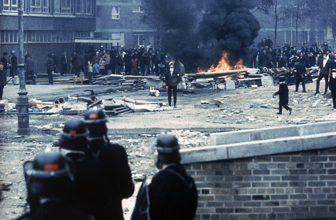
On August 14, 1969, in response to the escalating violence in Derry, County Londonderry, Irish nationalists hold protests across Northern Ireland, marking a turning point in the region’s political and sectarian conflict.

The unrest begins on August 12 with the Battle of the Bogside in Derry’s predominantly Catholic Bogside district. Tensions have been building for over a year due to long-standing nationalist grievances, including political discrimination and gerrymandering that has kept the city under Unionist control since 1925. The violence erupts during the annual Apprentice Boys’ march, when Protestant marchers pass through the Catholic area, provoking clashes with residents.

Thousands of Catholic/nationalist residents, organised under the Derry Citizens’ Defence Association, resist the Royal Ulster Constabulary (RUC) and loyalist attacks. They build barricades, set up first aid posts, and even petrol bomb workshops. The RUC uses tear gas for the first time in United Kingdom police history, and residents fear the arrival of the armed Ulster Special Constabulary (B-Specials). The Bogside becomes a no-go area known as “Free Derry.”

On August 13, nationalist protests spread to other towns, including Belfast, Armagh, Dungannon, and Newry. In Belfast, seven people are killed and hundreds wounded, with many Catholic civilians shot by police. Loyalists attack Catholic homes, and both republican and loyalist paramilitaries are involved. Over 150 homes are destroyed, and 1,800 families are displaced.

By August 14, the British government deploys 300 troops from the 1st Battalion, Prince of Wales’s Own Regiment of Yorkshire to County Londonderry, replacing the exhausted RUC. The move is initially welcomed by some residents, but it remains clear that the violence has not been contained. The deployment marks the start of Operation Banner, the British Army’s long-term presence in Northern Ireland.

The riots and protests are widely regarded as the beginning of the Troubles, a 30-year conflict. The British Army’s presence, the establishment of peace lines to separate Catholic and Protestant areas, and the Republic of Ireland’s call for a United Nations peacekeeping force reflect the deepening crisis.

In short, August 14, 1969, is the day British troops enter Northern Ireland to restore order after days of nationalist-led protests and riots, events that define the region’s political landscape for decades.

Leave a comment

Tribunal of Inquiry Into Bloody Sunday 1972 Announced

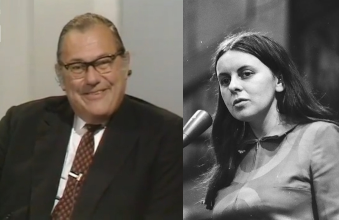
On January 31, 1972, the day after Bloody Sunday, British Home Secretary Reginald Maudling announces a tribunal of inquiry “into the circumstances of the march and the incidents leading up to the casualties which resulted.”

The official British Army position, backed by Maudling in the House of Commons, is that the paratroopers reacted to gun and nail bomb attacks from suspected Irish Republican Army (IRA) members. Apart from the soldiers, all eyewitnesses — including marchers, local residents, and British and Irish journalists present — maintain that soldiers fired into an unarmed crowd or were aiming at fleeing people and those tending the wounded, whereas the soldiers themselves were not fired upon. No British soldier is wounded by gunfire or reports any injuries, nor are any bullets or nail bombs recovered to back up their claims.

On February 2, 1972, the day that twelve of those killed are buried, there is a general strike in the Republic of Ireland, the biggest such strike in Europe since World War II relative to population. Memorial services are held in Catholic and Protestant churches, as well as synagogues, throughout the Republic. The same day, irate crowds burn down the British embassy in Merrion Square in Dublin. Anglo-Irish relations hit one of their lowest ebbs with the Irish Minister for Foreign Affairs, Patrick Hillery, going to the United Nations Security Council to demand the involvement of a UN peacekeeping force in the Northern Ireland conflict.

In the days following Bloody Sunday, Bernadette Devlin, the independent Irish nationalist Member of Parliament (MP) for Mid Ulster, expresses anger at what she perceives as British government attempts to stifle accounts being reported about the shootings. Having witnessed the events firsthand, she is infuriated that the Speaker of the House of Commons, Selwyn Lloyd, consistently denies her the chance to speak in Parliament about the shootings, although parliamentary convention decrees that any MP witnessing an incident under discussion will be granted an opportunity to speak about it in Parliament. Devlin slaps Reginald Maudling and calls him a “murdering hypocrite” when he makes a statement to Parliament that the British Army had fired only in self-defence. She is temporarily suspended from Parliament as a result.

An inquest into the deaths is held in August 1973. The city’s coroner, Hubert O’Neill, a retired British Army major, issues a statement at the completion of the inquest. He declares:

“This Sunday became known as Bloody Sunday and bloody it was. It was quite unnecessary. It strikes me that the Army ran amok that day and shot without thinking what they were doing. They were shooting innocent people. These people may have been taking part in a march that was banned but that does not justify the troops coming in and firing live rounds indiscriminately. I would say without hesitation that it was sheer, unadulterated murder. It was murder.”

(Pictured: Home Secretary Reginald Maudling (left) and Member of Parliament for Mid Ulster Bernadette Devlin)