
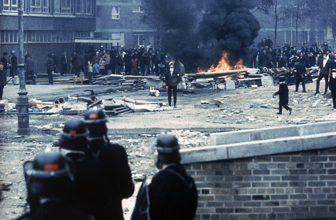
On August 14, 1969, in response to the escalating violence in Derry, County Londonderry, Irish nationalists hold protests across Northern Ireland, marking a turning point in the region’s political and sectarian conflict.
The unrest begins on August 12 with the Battle of the Bogside in Derry’s predominantly Catholic Bogside district. Tensions have been building for over a year due to long-standing nationalist grievances, including political discrimination and gerrymandering that has kept the city under Unionist control since 1925. The violence erupts during the annual Apprentice Boys’ march, when Protestant marchers pass through the Catholic area, provoking clashes with residents.
Thousands of Catholic/nationalist residents, organised under the Derry Citizens’ Defence Association, resist the Royal Ulster Constabulary (RUC) and loyalist attacks. They build barricades, set up first aid posts, and even petrol bomb workshops. The RUC uses tear gas for the first time in United Kingdom police history, and residents fear the arrival of the armed Ulster Special Constabulary (B-Specials). The Bogside becomes a no-go area known as “Free Derry.”
On August 13, nationalist protests spread to other towns, including Belfast, Armagh, Dungannon, and Newry. In Belfast, seven people are killed and hundreds wounded, with many Catholic civilians shot by police. Loyalists attack Catholic homes, and both republican and loyalist paramilitaries are involved. Over 150 homes are destroyed, and 1,800 families are displaced.
By August 14, the British government deploys 300 troops from the 1st Battalion, Prince of Wales’s Own Regiment of Yorkshire to County Londonderry, replacing the exhausted RUC. The move is initially welcomed by some residents, but it remains clear that the violence has not been contained. The deployment marks the start of Operation Banner, the British Army’s long-term presence in Northern Ireland.
The riots and protests are widely regarded as the beginning of the Troubles, a 30-year conflict. The British Army’s presence, the establishment of peace lines to separate Catholic and Protestant areas, and the Republic of Ireland’s call for a United Nations peacekeeping force reflect the deepening crisis.
In short, August 14, 1969, is the day British troops enter Northern Ireland to restore order after days of nationalist-led protests and riots, events that define the region’s political landscape for decades.

