
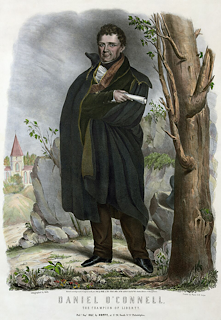
The Catholic Association, an Irish Roman Catholic political organization, is founded by Daniel O’Connell on May 12, 1823, to campaign for Catholic emancipation within the United Kingdom of Great Britain and Ireland. It is one of the first mass-membership political movements in Europe. It organizes large-scale public protests in Ireland.
The Catholic Association is the latest in a series of similar associations formed over the previous ten years or so, none of which had prospered. Like the other associations, this new association is composed mainly of the middle class elite: an annual subscription amounting to a guinea, an amount equivalent to what an average farmer would pay for six months’ rent. In 1824, the Catholic Association begins to use the money that it has raised to campaign for Catholic emancipation.
In 1824, the association creates a new category of associate members at the cost of a penny per month, the so-called Catholic Rent. The reasoning behind the creation of this new membership category is to stimulate a swelling in association numbers. This new, cheaper category ensures Catholics from a poorer background can join, and thus the association’s initial class-based entry barriers are removed. The Catholic rent transforms the association and Catholic political advocacy more broadly. In terms of the association, the rent catalyzes a transformation in a number of ways. Firstly, as previously mentioned, it gives the Catholic Association a constant source of money, which enables O’Connell to run a consistent campaign. Secondly, it facilitates easy calculation of total association membership numbers so that O’Connell can say with confidence that he has the support of so many people. This is important as it can be used to apply pressure against the British government. Third, and perhaps most importantly, however, it announces the arrival of mass mobilization politics, being the first such populist movement in Europe. O’Connell decides to add this additional membership level, at a reduced price of a penny a month, deliberately. The benefits are clear. With the membership subscription set at a relatively cheap price, a large number of the peasant and working classes can join. Affordability ensures large numbers. In effect, it becomes a universal Catholic organization that is transparent and populist. The fact that each member contributes financially to the association also ensures that they are more deeply involved in pushing the cause of Catholic emancipation. People want value for their money. Thus, this ensures a cheap method for O’Connell to get the message of Catholic emancipation spread throughout Ireland.
The Catholic Association’s funds are diffused widely in a variety of areas. Some is spent campaigning for Catholic emancipation, defraying the costs of sending petitions to Westminster, and training of priests. Following the 1826 election campaign, funds are used to support the members of the organization who had voted against their landlords. The money is used for those who have been evicted from land by the landlords because of their connection to the Catholic organization or for those who were boycotting absentee landlord. For the Catholic peasants that are in this situation, the future would be grim as they would be unable to continue the boycott without food and money, and they would be unable to lease land from any landlord as the peasants would be boycotted against in return. The Catholic Association’s funds are used to support these boycotts so that they can continue and live well enough to have enough food to survive.
The Catholic Association is originally aristocratic in its composition, and some of the gentry (such as Richard Lalor Sheil) hold relatively conservative views. However, O’Connell holds an enormous influence over society and largely dictates the policies it pursues. It is radical in nature but also extremely loyal to the Crown in appearance. This had been the strategy of the previous major Catholic group, the Catholic Committee of the 1790s, which achieved major Catholic Relief in 1793.
Since the aims of the Catholic Association are fairly moderate and the organization remains loyal to the monarch, British MPs are conceptually more willing to pass Catholic emancipation. The matter had been discussed in London since the Acts of Union 1800, when Prime Minister William Pitt and most of his colleagues resign from the cabinet when emancipation is denied by the king. Henry Grattan continues to support the cause, and Catholic emancipation had been passed by the House of Commons previously by a majority of six, but it is rejected in the House of Lords and generally by King George III, who reigns until 1820.
The biggest strength of the Catholic Association is that the Catholic Church helps in the collection of the Catholic rent. Catholic priests also hold sermons in favor of Catholic emancipation. This means that it is easy for the members to pay the Catholic rent, and it will attract more members as the message of Catholic emancipation is being spread throughout Ireland. Sir Robert Peel believes the alliance of the Catholic Association and the Catholic Church is a “powerful combination.”
In 1826, the Catholic Association begins to use its funds to support pro-emancipation MPs in elections. They use their money and manpower to campaign for the candidate to be elected into parliament to pressure the government from within to pass Catholic emancipation.
The turning point comes in 1828, when two factors come into play. The first is that the Catholic Church takes over the collection of the Catholic Rent and effectively the Catholic Association itself. The other is that by 1828, O’Connell’s reputation has increased dramatically. He is an internationally recognized figure and is seen as one of the leading figures in liberal thinking. This successful campaign leads on to, but is distinguished from, his later efforts to end the union with Britain, to increase the franchise, and to end the payment of tithes. His particular talent is to push the emancipation process along in an organized way.
In May 1828, the Sacramental Test Act 1828 repeals the Test Acts 1673 & 1678 against non-Anglican Protestants. This gives non-Catholic non-conformists greater political freedom and equality in Britain. The repeal has two effects: it gives Catholics hope that a similar act will be passed that will include Catholics; it also alienates Catholics, as they have become the only Christians not to have political freedom and equality.
In May 1828, William Huskisson resigns from the cabinet, and William Vesey-Fitzgerald is chosen as the President of the Board of Trade. According to the law, there is to be a by-election in his constituency of Clare. O’Connell decides to exploit a loophole in the Acts of Union 1800. It requires MPs to take the Oath of Allegiance, but the oath is not required of candidates for election. He stands in the by-election and wins. Since he is a Catholic, he cannot take his seat in parliament. Demand rises to allow him to become an MP for Clare, as it does not have representation.
Sir Robert Peel and Arthur Wellesley, 1st Duke of Wellington, see that if O’Connell is not allowed to take his seat, then there could be a revolution in Ireland. While using non-violent methods, O’Connell hints that he will get more Catholics elected to force the situation. In an emotive speech, he says, “They must crush us or conciliate us.”
Peel decides to change the government’s approach and submits the Roman Catholic Relief Act 1829 in February 1829. The bill is passed. It is a momentous victory for O’Connell and the Catholic middle class, and he becomes known as “the liberator” and the “uncrowned king of Ireland.” However, the simultaneous enactment of the Parliamentary Elections (Ireland) Act 1829 restricts the franchise in the county constituencies in Ireland. The archive of the Catholic Association is housed with the archives of Dublin Diocese in Holy Cross College, Dublin.
(Pictured: “Daniel O’Connell: The Champion of Liberty” poster published in Pennsylvania, 1847)

