seamus dubhghaill

Promoting Irish Culture and History from Little Rock, Arkansas, USA


Leave a comment

Founding of the Catholic Association by Daniel O’Connell

The Catholic Association, an Irish Roman Catholic political organization, is founded by Daniel O’Connell on May 12, 1823, to campaign for Catholic emancipation within the United Kingdom of Great Britain and Ireland. It is one of the first mass-membership political movements in Europe. It organizes large-scale public protests in Ireland.

The Catholic Association is the latest in a series of similar associations formed over the previous ten years or so, none of which had prospered. Like the other associations, this new association is composed mainly of the middle class elite: an annual subscription amounting to a guinea, an amount equivalent to what an average farmer would pay for six months’ rent. In 1824, the Catholic Association begins to use the money that it has raised to campaign for Catholic emancipation.

In 1824, the association creates a new category of associate members at the cost of a penny per month, the so-called Catholic Rent. The reasoning behind the creation of this new membership category is to stimulate a swelling in association numbers. This new, cheaper category ensures Catholics from a poorer background can join, and thus the association’s initial class-based entry barriers are removed. The Catholic rent transforms the association and Catholic political advocacy more broadly. In terms of the association, the rent catalyzes a transformation in a number of ways. Firstly, as previously mentioned, it gives the Catholic Association a constant source of money, which enables O’Connell to run a consistent campaign. Secondly, it facilitates easy calculation of total association membership numbers so that O’Connell can say with confidence that he has the support of so many people. This is important as it can be used to apply pressure against the British government. Third, and perhaps most importantly, however, it announces the arrival of mass mobilization politics, being the first such populist movement in Europe. O’Connell decides to add this additional membership level, at a reduced price of a penny a month, deliberately. The benefits are clear. With the membership subscription set at a relatively cheap price, a large number of the peasant and working classes can join. Affordability ensures large numbers. In effect, it becomes a universal Catholic organization that is transparent and populist. The fact that each member contributes financially to the association also ensures that they are more deeply involved in pushing the cause of Catholic emancipation. People want value for their money. Thus, this ensures a cheap method for O’Connell to get the message of Catholic emancipation spread throughout Ireland.

The Catholic Association’s funds are diffused widely in a variety of areas. Some is spent campaigning for Catholic emancipation, defraying the costs of sending petitions to Westminster, and training of priests. Following the 1826 election campaign, funds are used to support the members of the organization who had voted against their landlords. The money is used for those who have been evicted from land by the landlords because of their connection to the Catholic organization or for those who were boycotting absentee landlord. For the Catholic peasants that are in this situation, the future would be grim as they would be unable to continue the boycott without food and money, and they would be unable to lease land from any landlord as the peasants would be boycotted against in return. The Catholic Association’s funds are used to support these boycotts so that they can continue and live well enough to have enough food to survive.

The Catholic Association is originally aristocratic in its composition, and some of the gentry (such as Richard Lalor Sheil) hold relatively conservative views. However, O’Connell holds an enormous influence over society and largely dictates the policies it pursues. It is radical in nature but also extremely loyal to the Crown in appearance. This had been the strategy of the previous major Catholic group, the Catholic Committee of the 1790s, which achieved major Catholic Relief in 1793.

Since the aims of the Catholic Association are fairly moderate and the organization remains loyal to the monarch, British MPs are conceptually more willing to pass Catholic emancipation. The matter had been discussed in London since the Acts of Union 1800, when Prime Minister William Pitt and most of his colleagues resign from the cabinet when emancipation is denied by the king. Henry Grattan continues to support the cause, and Catholic emancipation had been passed by the House of Commons previously by a majority of six, but it is rejected in the House of Lords and generally by King George III, who reigns until 1820.

The biggest strength of the Catholic Association is that the Catholic Church helps in the collection of the Catholic rent. Catholic priests also hold sermons in favor of Catholic emancipation. This means that it is easy for the members to pay the Catholic rent, and it will attract more members as the message of Catholic emancipation is being spread throughout Ireland. Sir Robert Peel believes the alliance of the Catholic Association and the Catholic Church is a “powerful combination.”

In 1826, the Catholic Association begins to use its funds to support pro-emancipation MPs in elections. They use their money and manpower to campaign for the candidate to be elected into parliament to pressure the government from within to pass Catholic emancipation.

The turning point comes in 1828, when two factors come into play. The first is that the Catholic Church takes over the collection of the Catholic Rent and effectively the Catholic Association itself. The other is that by 1828, O’Connell’s reputation has increased dramatically. He is an internationally recognized figure and is seen as one of the leading figures in liberal thinking. This successful campaign leads on to, but is distinguished from, his later efforts to end the union with Britain, to increase the franchise, and to end the payment of tithes. His particular talent is to push the emancipation process along in an organized way.

In May 1828, the Sacramental Test Act 1828 repeals the Test Acts 1673 & 1678 against non-Anglican Protestants. This gives non-Catholic non-conformists greater political freedom and equality in Britain. The repeal has two effects: it gives Catholics hope that a similar act will be passed that will include Catholics; it also alienates Catholics, as they have become the only Christians not to have political freedom and equality.

In May 1828, William Huskisson resigns from the cabinet, and William Vesey-Fitzgerald is chosen as the President of the Board of Trade. According to the law, there is to be a by-election in his constituency of Clare. O’Connell decides to exploit a loophole in the Acts of Union 1800. It requires MPs to take the Oath of Allegiance, but the oath is not required of candidates for election. He stands in the by-election and wins. Since he is a Catholic, he cannot take his seat in parliament. Demand rises to allow him to become an MP for Clare, as it does not have representation.

Sir Robert Peel and Arthur Wellesley, 1st Duke of Wellington, see that if O’Connell is not allowed to take his seat, then there could be a revolution in Ireland. While using non-violent methods, O’Connell hints that he will get more Catholics elected to force the situation. In an emotive speech, he says, “They must crush us or conciliate us.”

Peel decides to change the government’s approach and submits the Roman Catholic Relief Act 1829 in February 1829. The bill is passed. It is a momentous victory for O’Connell and the Catholic middle class, and he becomes known as “the liberator” and the “uncrowned king of Ireland.” However, the simultaneous enactment of the Parliamentary Elections (Ireland) Act 1829 restricts the franchise in the county constituencies in Ireland. The archive of the Catholic Association is housed with the archives of Dublin Diocese in Holy Cross College, Dublin.

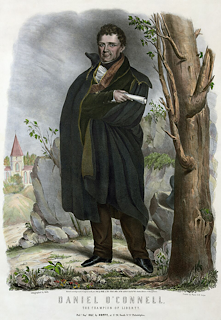
(Pictured: “Daniel O’Connell: The Champion of Liberty” poster published in Pennsylvania, 1847)


Leave a comment

The Popery Act 1704 Receives Royal Assent

An Act to prevent the further Growth of Popery, commonly known as the Popery Act or the Gavelkind Act, is an act of the Parliament of Ireland that receives royal assent on March 4, 1704. It is designed to suppress Roman Catholicism in Ireland (“Popery“). William Edward Hartpole Lecky calls it the most notorious of the Irish Penal Laws.

Inheritance in traditional Irish law uses gavelkind, whereby an estate is divided equally among a dead man’s sons. In contrast, English common law uses male primogeniture, with the eldest son receiving the entire estate. The 1704 act enforces gavelkind for Catholics and primogeniture for Protestants.

Two separate bills “to prevent the further Growth of Popery” are introduced in the parliamentary session of 1703–04. One originates with the Privy Council of Ireland and is referred on July 4, 1703, to the Attorney-General for Ireland. The other is introduced as heads of a bill in the Irish House of Commons on September 28, 1703, and is sent to the Lord Lieutenant of Ireland on November 19. Under Poynings’ Law, both bills are transmitted to the Privy Council of England for approval. Formally, one bill is vetoed, and the other is returned to Dublin with amendments. A lack of surviving documentation makes it impossible to determine which of the two has which fate. The approved bill is engrossed on January 20, 1704, presented in the Commons on February 14, sent to the Irish House of Lords on February 25, and given royal assent on March 4.

Sir Theobald “Toby” Butler, the former Solicitor-General for Ireland, a Roman Catholic, makes a celebrated speech at the bar of the Commons denouncing the act as being “against the laws of God and man… against the rules of reason and justice.” Other eminent Catholic lawyers like Stephen Rice also denounce the measure but to no avail.

Charles Ivar McGrath says that while the Popery Act has “evident … negative effects,” specific research is lacking, and that it is intended more to prevent an increase in Catholic landholding than encourage further decrease. The Catholic share of land had already fallen from 60% before the Irish Rebellion of 1641 to 22% before the Williamite War in Ireland to 14% in 1704. The figure of 5% in 1776 given in Arthur Young‘s Tour in Ireland is probably an underestimate, although in 1778 only 1.5% of rent is paid to Catholics.

Catholic gavelkind cements a tradition of farm subdivision, which persists beyond the act’s repeal and contributes to the Great Famine of the 1840s.

The act is “explained and amended” by a 1709 act, 8 Anne c. 3 (I), which specifies certain time limits left ambiguous by the original act, and closes some loopholes used by Catholics to remain beneficial owners of nominally Protestant property.

A 1719 act, 6 Geo. 1. c. 9 (I), indemnifies officials who have not hitherto subscribed to the oath required by the Popery Act. The time period for Dissenters subscribing to the oath is routinely extended, initially by an Indemnity Act at the start of each biennial parliamentary session. Similar acts are passed by the British parliament, and after the union the UK parliament continues the practice.

From the late 18th century Roman Catholic relief bills ease the Penal Laws, by explicit or implicit repeal and replacement. In 1772, Catholics are allowed to lease up to fifty Irish acres of bog-land for up to 61 years. The 1704 oath of allegiance for Catholics is replaced in 1774. Gardiner’s Act, the Leases for Lives Act 1777, implicitly repeals many other provisions of the 1704 act. Some are replaced with less onerous restrictions. The sacramental test is repealed for Dissenters in 1780. The Roman Catholic Relief Act 1782 repeals section 23 of the 1704 act. Another act of 1782 allows lay Catholics to be guardians of Protestants. Most restrictions on intermarriage are removed by the Roman Catholic Relief Act 1792. Many Penal Laws are repealed in general terms by the Roman Catholic Relief Act 1793. The sacramental test for Catholics is effectively replaced by the 1774 oath.

The Roman Catholic Relief Act 1829 abolishes the declaration against transubstantiation and specifies a new public oath for Catholics, explicitly permitting Catholics to hold Irish civil or military offices other than Lord Lieutenant and Lord Chancellor of Ireland, with the same oaths as required of non-Catholics (in addition to the new Catholic oath).

The Criminal Law Commission‘s 1845 report on oaths says sections 1, 3, and 6 of the 1704 act have fallen into disuse and should be repealed. The Religious Disabilities Act 1846, passed in consequence of the committee’s report, explicitly repeals provisions of sections 1, 3, and 4 of the 1704 act.

The Popery Act is explicitly repealed as obsolete by the Promissory Oaths Act 1871, with the exception of section 25, which is made redundant by the coming into force in 1871 of the Irish Church Act 1869 and is repealed by the Statute Law Revision (Ireland) Act 1878.


Leave a comment

The Roman Catholic Relief Act 1829 Receives Royal Assent

The Roman Catholic Relief Act 1829, also known as the Catholic Emancipation Act 1829, receives royal assent on April 13, 1829. The act removes the sacramental tests that bar Roman Catholics in the United Kingdom from Parliament and from higher offices of the judiciary and state. It is the culmination of a fifty-year process of Catholic emancipation which had offered Catholics successive measures of “relief” from the civil and political disabilities imposed by Penal Laws in both Great Britain and in Ireland in the seventeenth and early eighteenth centuries.

Convinced that the measure is essential to maintain order in Catholic-majority Ireland, Arthur Wellesley, 1st Duke of Wellington, helps overcome the opposition of King George IV and of the House of Lords by threatening to step aside as Prime Minister and retire his Tory government in favour of a new, likely-reform-minded Whig ministry.

In Ireland, the Protestant Ascendancy has the assurance of the simultaneous passage of the Parliamentary Elections (Ireland) Act 1829. Its substitution of the British ten-pound for the Irish forty-shilling freehold qualification disenfranchises over 80% of Ireland’s electorate. This includes a majority of the tenant farmers who had helped force the issue of emancipation in 1828 by electing to parliament the leader of the Catholic Association, Daniel O’Connell.

O’Connell had rejected a suggestion from “friends of emancipation,” and from the English Roman Catholic bishop, John Milner, that the fear of Catholic advancement might be allayed if the Crown were accorded the same right exercised by continental monarchs: a veto on the confirmation of Catholic bishops. O’Connell insists that Irish Catholics would rather “remain forever without emancipation” than allow the government “to interfere” with the appointment of their senior clergy. Instead, he relies on their confidence in the independence of the priesthood from Ascendancy landowners and magistrates to build his Catholic Association into a mass political movement. On the basis of a “Catholic rent” of a penny a month (typically paid through the local priest), the Association mobilises not only the Catholic middle class, but also poorer tenant farmers and tradesmen. Their investment enables O’Connell to mount “monster” rallies that stay the hands of authorities and embolden larger enfranchised tenants to vote for pro-emancipation candidates in defiance of their landlords.

O’Connell’s campaign reaches its climax when he himself stands for parliament. In July 1828, he defeats a nominee for a position in the British cabinet, William Vesey-FitzGerald, in a County Clare by-election, 2057 votes to 982. This makes a direct issue of the parliamentary Oath of Supremacy by which, as a Catholic, he will be denied his seat in the Commons.

As Lord Lieutenant of Ireland, Wellington’s brother, Richard Wellesley, had attempted to placate Catholic opinion, notably by dismissal of the long-serving Attorney-General for Ireland, William Saurin, whose rigid Ascendancy views and policy made him bitterly unpopular, and by applying a policy of prohibitions and coercion against not only the Catholic Ribbonmen but also the Protestant Orangemen. But now both Wellington and his Home Secretary, Robert Peel, are convinced that unless concessions are made, a confrontation is inevitable. Peel concludes, “though emancipation was a great danger, civil strife was a greater danger.” Fearing insurrection in Ireland, he drafts the Relief Bill and guides it through the House of Commons. To overcome the vehement opposition of both the King and of the House of Lords, Wellington threatens to resign, potentially opening the way for a new Whig majority with designs not only for Catholic emancipation but also for parliamentary reform. The King initially accepts Wellington’s resignation and the King’s brother, Ernest Augustus, Duke of Cumberland, attempts to put together a government united against Catholic emancipation. Though such a government would have considerable support in the House of Lords, it would have little support in the Commons and Ernest abandons his attempt. The King recalls Wellington. The bill passes the Lords and becomes law.

The key, defining, provision of the Acts is its repeal of “certain oaths and certain declarations, commonly called the declarations against transubstantiation and the invocation of saints and the sacrifice of the mass, as practised in the Church of Rome,” which had been required “as qualifications for sitting and voting in parliament and for the enjoyment of certain offices, franchises, and civil rights.” For the Oath of Supremacy, the act substitutes a pledge to bear “true allegiance” to the King, to recognise the Hanoverian succession, to reject any claim to “temporal or civil jurisdiction” within the United Kingdom by “the Pope of Rome” or “any other foreign prince … or potentate,” and to “abjure any intention to subvert the present [Anglican] church establishment.”

This last abjuration in the new Oath of Allegiance is underscored by a provision forbidding the assumption by the Roman Church of episcopal titles, derived from “any city, town or place,” already used by the United Church of England and Ireland. (With other sectarian impositions of the Act, such as restrictions on admittance to Catholic religious orders and on Catholic-church processions, this is repealed with the Roman Catholic Relief Act 1926.)

The one major security required to pass the Act is the Parliamentary Elections (Ireland) Act 1829. Receiving its royal assent on the same day as the relief bill, the act disenfranchises Ireland’s forty-shilling freeholders, by raising the property threshold for the county vote to the British ten-pound standard. As a result, “emancipation” is accompanied by a more than five-fold decrease in the Irish electorate, from 216,000 voters to just 37,000. That the majority of the tenant farmers who had voted for O’Connell in the Clare by-election are disenfranchised as a result of his apparent victory at Westminster is not made immediately apparent, as O’Connell is permitted in July 1829 to stand unopposed for the Clare seat that his refusal to take the Oath of Supremacy had denied him the year before.

In 1985, J. C. D. Clark depicts England before 1828 as a nation in which the vast majority of the people still believed in the divine right of kings, and the legitimacy of a hereditary nobility, and in the rights and privileges of the Anglican Church. In Clark’s interpretation, the system remained virtually intact until it suddenly collapsed in 1828, because Catholic emancipation undermined its central symbolic prop, the Anglican supremacy. He argues that the consequences were enormous: “The shattering of a whole social order. … What was lost at that point … was not merely a constitutional arrangement, but the intellectual ascendancy of a worldview, the cultural hegemony of the old elite.”

Clark’s interpretation has been widely debated in the scholarly literature, and almost every historian who has examined the issue has highlighted the substantial amount of continuity before and after the period of 1828 through 1832.

Eric J. Evans in 1996 emphasises that the political importance of emancipation was that it split the anti-reformers beyond repair and diminished their ability to block future reform laws, especially the great Reform Act of 1832. Paradoxically, Wellington’s success in forcing through emancipation led many Ultra-Tories to demand reform of Parliament after seeing that the votes of the rotten boroughs had given the government its majority. Thus, it was an ultra-Tory, George Spencer-Churchill, Marquess of Blandford, who in February 1830 introduced the first major reform bill, calling for the transfer of rotten borough seats to the counties and large towns, the disfranchisement of non-resident voters, the preventing of Crown officeholders from sitting in Parliament, the payment of a salary to MPs, and the general franchise for men who owned property. The ultras believed that a widely based electorate could be relied upon to rally around anti-Catholicism.

In Ireland, emancipation is generally regarded as having come too late to influence the Catholic-majority view of the union. After a delay of thirty years, an opportunity to integrate Catholics through their re-emerging propertied and professional classes as a minority within the United Kingdom may have passed. In 1830, O’Connell invites Protestants to join in a campaign to repeal the Act of Union and restore the Kingdom of Ireland under the Constitution of 1782. At the same, the terms under which he is able to secure the final measure of relief may have weakened his repeal campaign.

George Ensor, a leading Protestant member of the Catholic Association in Ulster, protests that while “relief” bought at the price of “casting” forty-shilling freeholders, both Catholic and Protestant, “into the abyss,” might allow a few Catholic barristers to attain a higher grade in their profession, and a few Catholic gentlemen to be returned to Parliament, the “indifference” demonstrated to parliamentary reform will prove “disastrous” for the country.

Seeking, perhaps, to rationalise the sacrifice of his freeholders, O’Connell writes privately in March 1829 that the new ten-pound franchise might actually “give more power to Catholics by concentrating it in more reliable and less democratically dangerous hands.” The Young Irelander John Mitchel believes that the intent is to detach propertied Catholics from the increasingly agitated rural masses.

In a pattern that had been intensifying from the 1820s as landlords clear land to meet the growing livestock demand from England, tenants have been banding together to oppose evictions and to attack tithe and process servers.

One civil disability not removed by 1829 Act are the sacramental tests required for professorships, fellowships, studentships and other lay offices at universities. These are abolished for the English universities – Oxford, Cambridge and Durham – by the Universities Tests Act 1871, and for Trinity College Dublin by the “Fawcett’s Act” 1873.

Section 18 of the 1829 act, “No Roman Catholic to advise the Crown in the appointment to offices in the established church,” remains in force in England, Wales and Scotland, but is repealed with respect to Northern Ireland by the Statute Law Revision (Northern Ireland) Act 1980. The entire act is repealed in the Republic of Ireland by the Statute Law Revision Act 1983.