seamus dubhghaill

Promoting Irish Culture and History from Little Rock, Arkansas, USA


Leave a comment

Birth of Evie Hone, Painter & Stained Glass Artist

Eva Sydney Hone RHA, Irish painter and stained glass artist usually known as Evie, is born at Roebuck Grove, County Dublin, on April 22, 1894. She is considered to be an early pioneer of cubism, although her best known works are stained glass. Her most notable pieces are the East Window in the Chapel at Eton College, which depicts the Crucifixion, and My Four Green Fields, which is now in the Government Buildings in Dublin.

Hone is the youngest daughter of Joseph Hone, of the Hone family, and Eva Eleanor (née Robinson), daughter of Sir Henry Robinson and granddaughter of Arthur Annesley, 10th Viscount Valentia. Her mother dies two days after her birth. She is related to artists Nathaniel Hone and Nathaniel Hone the Younger.

Shortly before her twelfth birthday, Hone suffers from polio (infant paralysis), suffering a fall while helping to decorate the Taney parish church for Easter. Her resulting ill health leads to her seeking treatment in Harley Street, Marylebone, Central London. She is educated by a governess, continuing her education in Switzerland, and goes on tours to Spain and Italy before moving to London in 1913. Her three sisters all marry British Army officers, and all are widowed in World War I.

Hone studies at the Byam Shaw School of Art in London and then under Bernard Meninsky at the Central School of Arts and Crafts. She meets Mainie Jellett when both are studying under Walter Sickert at the Westminster Technical Institute. She works under André Lhote and Albert Gleizes in Paris before returning to become influential in the modern movement in Ireland and becoming one of the founders of the Irish Exhibition of Living Art. She is considered an early pioneer of Cubism but in the 1930s turns to stained glass, which she studies with Wilhelmina Geddes.

Hone is extremely devout. She spends time in an Anglican Convent in 1925 at Truro in Cornwall and converts to Catholicism in 1937. This possibly influences her decision to begin working in stained glass. Initially, she works as a member of the An Túr Gloine stained glass co-operative before setting up a studio of her own in Rathfarnham.

Hone’s most important works are probably the East Window, depicting the Crucifixion, for the Chapel at Eton College, Windsor (1949–1952) and My Four Green Fields, now located in Government Buildings, Dublin. This latter work, commissioned for the Irish Government’s Pavilion, wins first prize for stained glass in the 1939 New York World’s Fair. It graces CIÉ‘s Head Office in O’Connell Street from 1960 to about 1983. The East Window of Eton College is commissioned following the destruction of the building after a bomb is dropped in 1940 on the school during World War II. She is commissioned to design the East Window in 1949, and the new window is inserted in 1952. This work is featured on an Irish postage stamp in 1969. From December 2005 to June 2006, an exhibition of her work is on display at the National Gallery of Ireland. Saint Mary’s church in Clonsilla also features her stained glass windows.

Despite ill health, Hone continues to produce a huge number of small stained glass panels as well as oils, watercolours, and gouache landscapes. In 1953, she is represented at the Contemporary Irish Art exhibition at Aberystwyth, Wales, and at the Tate gallery in London, receiving as well an honorary LLD from Trinity College Dublin (TCD). In 1954, she is elected an honorary member of the Royal Hibernian Academy (RHA).

Unmarried, Hone dies on March 13, 1955, while entering her parish church at Rathfarnham. She is survived by two of her sisters. Over 20,000 people visit a memorial exhibition of her work at University College Dublin (UCD), Earlsfort Terrace, Dublin, in 1958.

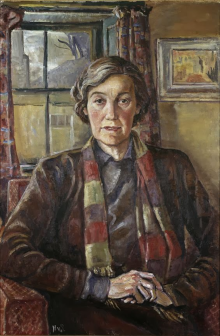
(Pictured: Portrait of Evie Hone by Hilda van Stockum)


Leave a comment

Death of Theatrical Producer Hilton Edwards

Hilton Edwards, an English-born Irish actor, lighting designer, and theatrical producer, dies in a Dublin hospital on November 18, 1982, following a short illness.

Edwards is born in London on February 2, 1903. He begins his career acting with the Charles Doran Shakespeare Company in 1920 in Windsor and then joins The Old Vic in London, playing in all but two of Shakespeare‘s plays before leaving the company a few years later. Trained in music, he also sings baritone roles with the Old Vic Opera company.

After touring with various companies in Britain and South Africa, Edwards goes to Ireland in 1927 for a season with Anew McMaster‘s company and meets McMaster’s brother-in-law, Micheál Mac Liammóir. As he tells an interviewer once, both men want a theater of their own. Mac Liammóir wants it to be in Ireland and Edwards does not care. “I don’t care about nationalism, I care about the theater,” he says.

Edwards and Mac Liammóir co-found the Gate Theatre in Dublin in 1928. The two men’s talents are complementary. Mac Liammóir is an actor, designer, and writer. Edwards is a director, actor, producer, and lighting designer. Edwards produces and directs more than 300 plays at the Gate, ranging from the works of Aeschylus and Sophocles, Johann Wolfgang von Goethe and Henrik Ibsen to the comedies of George Bernard Shaw and Richard Brinsley Sheridan and new Irish plays, by such authors as W. B. Yeats, Brian Friel, and Mac Liammóir.

In New York City in 1948 Edwards plays in and directs John Bull’s Other Island and directs The Old Lady Says No and Where Stars Walk. In 1961, Edwards takes a two-year leave from the Gate to become the first Head of Drama at Telefís Éireann. A year later, he wins a Jacob’s Award for his television series Self Portrait.

Edwards appears in 15 films, including Captain Lightfoot (1955), David and Goliath (1960), Victim (1961), and Half a Sixpence (1967). He also writes and directs Orson Welles‘s Return to Glennascaul (1951). However, he is primarily known for his theatre work. He is nominated for a Tony Award in 1966 for Best Director of a Drama for Philadelphia, Here I Come!

Hilton Edwards dies in a Dublin hospital on November 18, 1982. Edwards and Mac Liammóir are the subject of a biography, titled The Boys by Christophor Fitz-Simon.


Leave a comment

The Treaty of Windsor (1175)

The Treaty of Windsor, a territorial agreement made during the time of the Norman invasion of Ireland, is signed in Windsor, Berkshire on October 6, 1175, by King Henry II of England and the High King of Ireland, Rory O’Connor (Ruaidrí Ua Conchobair). The witnesses are Richard of Ilchester, Bishop of Winchester; Geoffrey Ridel, Bishop of Ely; Lorcán Ua Tuathail, Archbishop of Dublin; William de Mandeville, 3rd Earl of Essex; Justiciar Richard de Luci; Geoffrey de Purtico, Reginald de Courtenea (Courtenay) and three of Henry’s court chaplains.

Under the Treaty, O’Connor recognizes King Henry II as his overlord and agrees to collect tribute for him from all parts of Ireland. Henry agrees that O’Connor can be king of the areas not conquered by the Normans. But O’Connor cannot control the territories of which he is nominally king. Henry and his barons annex further land without consulting O’Connor.

Overall, the agreement leaves O’Connor with a kingdom consisting of Ireland outside the provincial kingdom of Leinster (as it was then), Dublin and a territory from Waterford Dungarvan, as long as he paid tribute to Henry II, and owed fealty to him. All of Ireland is also subject to the new religious provisions of the papal bull Laudabiliter and the Synod of Cashel (1172).

O’Connor is obliged to pay one treated cow hide for every ten cattle. The other “kings and people” of Ireland are to enjoy their lands and liberties so long as they remain faithful to the kings of England and are obliged to pay their tribute in hides through O’Connor.

The Annals of Tigernach record that: “Cadla Ua Dubthaig came from England from the Son of the Empress, having with him the peace of Ireland, and the kingship thereof, both Foreigner and Gael, to Ruaidhrí Ó Conchobhair, and to every provincial king his province from the king of Ireland, and their tributes to Ruaidhrí.” The Annals also list the ongoing violence in Ireland at the time. The text reveals a misunderstanding of the scope of the treaty and the matters agreed by the two kings that soon prove fatal to the peace of Ireland. Henry sees O’Connor as his subordinate within the feudal system, paying him an annual rent on behalf of all his sub-kings. O’Connor sees himself as the restored High King of Ireland, subject only to a very affordable annual tribute to Henry.

The treaty breaks down very quickly, as O’Connor is unable to prevent Norman knights from carving out new territories on a freelance basis, starting with assaults on Munster and Ulaid in 1177. For his part Henry is by now too distant to suppress them and is preoccupied with events in France. In 1177 he replaces William FitzAldelm with his 10-year-old son Prince John and names him as Lord of Ireland.


Leave a comment

Birth of Theatrical Producer Hilton Edwards

hilton-edwards

Hilton Edwards, an English-born Irish actor, lighting designer, and theatrical producer, is born in London on February 2, 1903.

Edwards begins his career acting with the Charles Doran Shakespeare Company in 1920 in Windsor and then joins The Old Vic in London, playing in all but two of Shakespeare‘s plays before leaving the company a few years later. Trained in music, he also sings baritone roles with the Old Vic Opera company.

After touring with various companies in Britain and South Africa, Edwards goes to Ireland in 1927 for a season with Anew McMaster’s company and meets McMaster’s brother-in-law, Micheál Mac Liammóir. As he tells an interviewer once, both men want a theater of their own. Mac Liammóir wants it to be in Ireland and Edwards does not care. “I don’t care about nationalism, I care about the theater,” he says.

Edwards and Mac Liammóir co-found the Gate Theatre in Dublin in 1928. The two men’s talents are complementary. Mac Liammóir is an actor, designer, and writer. Edwards is a director, actor, producer, and lighting designer. Edwards produces and directs more than 300 plays at the Gate, ranging from the works of Aeschylus and Sophocles, Johann Wolfgang von Goethe and Henrik Ibsen to the comedies of George Bernard Shaw and Richard Brinsley Sheridan and new Irish plays, by such authors as W.B. Yeats, Brian Friel, and Mac Liammóir.

In New York City in 1948 Edwards plays in and directs John Bull’s Other Island and directs The Old Lady Says No and Where Stars Walk. In 1961 Edwards takes a two-year leave from the Gate to become the first Head of Drama at Telefís Éireann. A year later, he wins a Jacob’s Award for his television series Self Portrait.

Edwards appears in 15 films, including Captain Lightfoot (1955), David and Goliath (1960), Victim (1961), and Half a Sixpence (1967). He also writes and directs Orson Welles‘s Return to Glennascaul (1951). However, he is primarily known for his theatre work. He is nominated for a Tony Award in 1966 for Best Director of a Drama for Philadelphia, Here I Come!

Hilton Edwards dies in a Dublin hospital on November 18, 1982. Edwards and Mac Liammóir are the subject of a biography, titled The Boys by Christophor Fitz-Simon.