seamus dubhghaill

Promoting Irish Culture and History from Little Rock, Arkansas, USA


Leave a comment

Birth of Actress Maureen O’Sullivan

maureen-osullivan

Maureen Paula O’Sullivan, Irish American actress best known for playing Jane in the Tarzan series of films starring Johnny Weissmuller, is born in Boyle, County Roscommon on May 17, 1911.

O’Sullivan is the daughter of Evangeline “Mary Eva” Lovatt and Charles Joseph O’Sullivan, an officer in the Connaught Rangers who serves in World War I. She attends a convent school in Dublin, then the Convent of the Sacred Heart at Roehampton, England. One of her classmates there is Vivian Mary Hartley, future Academy Award-winning actress Vivien Leigh. After attending finishing school in France, O’Sullivan returns to Dublin to work with the poor.

O’Sullivan’s film career begins when she meets motion picture director Frank Borzage, who is doing location filming on Song o’ My Heart for 20th Century Fox. He suggests she take a screen test, which she does, and wins a part in the movie, which stars Irish tenor John McCormack. She travels to the United States to complete the movie in Hollywood. O’Sullivan appears in six movies at Fox, then makes three more at other movie studios.

In 1932, she signs a contract with Metro-Goldwyn-Mayer. After several roles there and at other movie studios, she is chosen by Irving Thalberg to appear as Jane Parker in Tarzan the Ape Man, opposite co-star Johnny Weissmuller. She is one of the more popular ingenues at MGM throughout the 1930s and appears in a number of other productions with various stars. In all, O’Sullivan plays Jane in six features between 1932 and 1942.

She stars with William Powell and Myrna Loy in The Thin Man (1934) and plays Kitty in Anna Karenina (1935) with Greta Garbo and Basil Rathbone. After co-starring with the Marx Bros. in A Day At The Races (1937), she appears as Molly Beaumont in A Yank at Oxford (1938), which is written partly by F. Scott Fitzgerald. At her request, he rewrites her part to give it substance and novelty.

She plays another Jane in Pride and Prejudice (1940) with Laurence Olivier and Greer Garson and supports Ann Sothern in Maisie Was a Lady (1941). After appearing in Tarzan’s New York Adventure (1942), O’Sullivan asks MGM to release her from her contract so she can care for her husband who has just left the Navy with typhoid. She retreats from show business, devoting her time to her family. In 1948, she re-appears on the screen in The Big Clock, directed by her husband for Paramount Pictures. She continues to appear occasionally in her husband’s movies and on television. However, by 1960 she believes she has permanently retired. In 1958, Farrow’s and O’Sullivan’s eldest son, Michael, dies in a plane crash in California.

Actor Pat O’Brien encourages her to take a part in summer stock, and the play A Roomful of Roses opens in 1961. That leads to another play, Never Too Late, in which she co-stars with Paul Ford in what is her Broadway debut. Shortly after it opens on Broadway, John Farrow dies of a heart attack. O’Sullivan sticks with acting after Farrow’s death. She is also an executive director of a bridal consulting service, Wediquette International. In June and July 1972, O’Sullivan is in Denver, Colorado, to star in the Elitch Theatre production of Butterflies are Free with Karen Grassle and Brandon deWilde. The show ends on July 1, 1972. Five days later, while still in Denver, deWilde is killed in a motor vehicle accident.

When her daughter, actress Mia Farrow, becomes involved with Woody Allen both professionally and romantically, she appears in Hannah and Her Sisters, playing Farrow’s mother. She has roles in Peggy Sue Got Married (1986) and the science fiction oddity Stranded (1987). Mia Farrow names one of her own sons Ronan O’Sullivan Farrow for her mother. In 1994, she appears with Robert Wagner and Stefanie Powers in Hart to Hart: Home Is Where the Hart Is, a feature-length made-for-TV movie with the wealthy husband-and-wife team from the popular weekly detective series Hart to Hart.

Maureen O’Sullivan dies in Scottsdale, Arizona, of complications from heart surgery on June 23, 1998, at the age of 87. O’Sullivan is buried at Most Holy Redeemer Cemetery, Niskayuna, New York. She is survived by six of her children, 32 grandchildren, and 13 great-grandchildren. Michael, her oldest son, is killed at age 19 in a plane crash in 1958.
Leave a comment

The Beginning of the 1916 Easter Rising

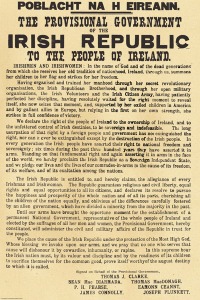
proclamation-of-independence

The Easter Rising, also known as the Easter Rebellion, begins in Dublin on April 24, 1916, and lasts for six days. The Rising, organised by seven members of the Military Council of the Irish Republican Brotherhood, is launched to end British rule in Ireland and establish an independent Irish Republic while the United Kingdom is heavily engaged in World War I. It is the most significant uprising in Ireland since the Irish Rebellion of 1798, and the first armed action of the Irish revolutionary period.

Shortly before midday, members of the Irish Volunteers, led by schoolmaster and Irish language activist Patrick Pearse and joined by the smaller Irish Citizen Army of James Connolly and 200 women of Cumann na mBan, seize key locations in Dublin and proclaim an Irish Republic. The rebels’ plan is to hold Dublin city centre, a large, oval-shaped area bounded by the Grand Canal to the south and the Royal Canal to the north, with the River Liffey running through the middle.

The rebels march to the General Post Office (GPO) on O’Connell Street, Dublin’s main thoroughfare, and occupy the building and hoist two republican flags. Pearse stands outside and reads the Proclamation of the Irish Republic.

Elsewhere in Dublin, some of the headquarters battalion under Michael Mallin occupy St. Stephen’s Green, where they dig trenches and barricade the surrounding roads. The 1st battalion, under Edward “Ned” Daly, occupy the Four Courts and surrounding buildings, while a company under Seán Heuston occupies the Mendicity Institution across the River Liffey from the Four Courts. The 2nd battalion, under Thomas MacDonagh, occupies Jacob’s Biscuit Factory. The 3rd battalion, under Éamon de Valera, occupy Boland’s Mill and surrounding buildings. The 4th battalion, under Éamonn Ceannt, occupy the South Dublin Union and the distillery on Marrowbone Lane. From each of these garrisons, small units of rebels establish outposts in the surrounding area.

There are isolated actions in other parts of Ireland, with attacks on the Royal Irish Constabulary barracks at Ashbourne, County Meath and in County Galway, and the seizure of the town of Enniscorthy, County Wexford. Due to a last-minute countermand issued on Saturday, April 22, by Volunteer leader Eoin MacNeill, the number of rebels who mobilise is much lower than expected.

The British Army brings in thousands of reinforcements as well as artillery and a gunboat. There is fierce street fighting on the routes into the city centre, where the rebels put up stiff resistance, slowing the British advance and inflicting heavy casualties. Elsewhere in Dublin, the fighting mainly consists of sniping and long-range gun battles. The main rebel positions are gradually surrounded and bombarded with artillery.

With much greater numbers and heavier weapons, the British Army suppresses the Rising, and Pearse agrees to an unconditional surrender on Saturday, April 29. Almost 500 people are killed during Easter Week. About 54% are civilians, 30% are British military and police, and 16% are Irish rebels. More than 2,600 are wounded. Many of the civilians are killed as a result of the British using artillery and heavy machine guns, or mistaking civilians for rebels. Others are caught in the crossfire in a crowded city. The shelling and the fires leave parts of inner-city Dublin in ruins.

After the surrender the country remains under martial law. About 3,500 people are taken prisoner by the British, many of whom have played no part in the Rising, with 1,800 of them being sent to internment camps or prisons in Britain. Most of the leaders of the Rising are executed following courts-martial. The Rising brings physical force republicanism back to the forefront of Irish politics, which for nearly 50 years has been dominated by constitutional nationalism. It, and the British reaction to it, leads to increased popular support for Irish independence. In December 1918, republicans, represented by the reconstituted Sinn Féin party, win a landslide victory in the general election to the British Parliament. They do not take their seats but instead convene the First Dáil and declare the independence of the Irish Republic, which ultimately leads to the Irish War of Independence.


3 Comments

Birth of Henry Wilfrid Brambell in Dublin

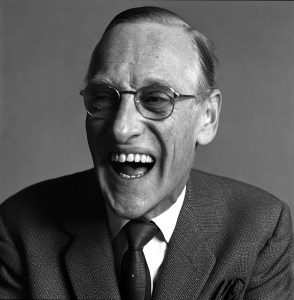
henry-wilfred-brambellHenry Wilfrid Brambell, Irish film and television actor best known for his role in the British television series Steptoe and Son, is born in Dublin on March 22, 1912.

Brambell is the youngest of three sons born to Henry Lytton Brambell, a cashier at the Guinness Brewery, and his wife, Edith Marks, a former opera singer. His first appearance is as a child, entertaining the wounded troops during World War I. Upon leaving school he works part-time as a reporter for The Irish Times and part-time as an actor at the Abbey Theatre before becoming a professional actor for the Gate Theatre. He also does repertory at Swansea, Bristol and Chesterfield. In World War II, he joins the British military forces entertainment organisation Entertainments National Service Association (ENSA).

His television career begins during the 1950s, when he is cast in small roles in three Nigel Kneale/Rudolph Cartier productions for BBC Television, The Quatermass Experiment (1953), Nineteen Eighty-Four (1954), and Quatermass II (1955). All of these roles earn him a reputation for playing old men, though he is only in his forties at the time.

It is this ability to play old men that leads to his casting in his best remembered role, as Albert Steptoe, the irascible father in Steptoe and Son. This begins as a pilot on the BBC’s Comedy Playhouse, and its success leads to a full series being commissioned, running from 1962 to 1974 including a five-year hiatus. There are two feature film spin-offs, a stage show, and an American incarnation entitled Sanford and Son, some episodes of which are almost exact remakes of the original British scripts.

The success of Steptoe and Son makes Brambell a high-profile figure on British television, and earns him the supporting role of Paul McCartney‘s grandfather in The Beatles‘ first film, A Hard Day’s Night (1964). In 1965, Brambell tells the BBC that he does not want to do another series of Steptoe and Son and, in September that year, he goes to New York City to appear in the Broadway musical Kelly at the Broadhurst Theatre, however, it closes after just one performance.

Apart from his role as the older Steptoe, Brambell achieves recognition in many films. His performance in The Terence Davies Trilogy wins him critical acclaim, far greater than any achieved for Steptoe and Son. Although he appears throughout the full 94-minute piece, Brambell does not speak a single word.

After the final series of Steptoe and Son is made in 1974, Brambell has some guest roles in films and on television. He and Harry H. Corbett also undertake a tour of Australia in 1977 in a Steptoe and Son stage show.

Brambell dies of cancer in Westminster, London, on January 18, 1985, at the age of 72. He is cremated on January 25, 1985 at Streatham Park Cemetery, where his ashes are scattered.


Leave a comment

Roger Casement’s Remains Returned to the Republic of Ireland

roger-casement

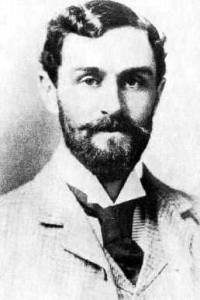
Irish patriot Roger Casement‘s body is returned to Ireland from the United Kingdom on February 23, 1965, forty-nine years after his execution for treason.

In October 1914, Roger Casement sails for Germany where he spends most of his time seeking to recruit an Irish Brigade from among more than 2,000 Irish prisoners-of-war taken in the early months of World War I and held in the prison camp of Limburg an der Lahn. His plan is that they will be trained to fight against Britain in the cause of Irish independence.

In April 1916, Germany offers the Irish 20,000 Mosin–Nagant 1891 rifles, ten machine guns and accompanying ammunition, but no German officers. It is a fraction of the quantity of arms that Casement has hoped. Casement does not learn of the Easter Rising until after the plan is fully developed. The German weapons never land in Ireland as the Royal Navy intercepts the ship transporting them.

In the early hours of April 21, 1916, three days before the beginning of the rising, Casement is taken by a German submarine and is put ashore at Banna Strand in Tralee Bay, County Kerry. Suffering from a recurrence of malaria and too weak to travel, he is discovered at McKenna’s Fort in Rathoneen, Ardfert, and arrested on charges of treason, sabotage, and espionage against the Crown. He is imprisoned in the Tower of London.

Casement’s trial for treason is highly publicized and he is ultimately convicted and sentenced to be hanged. He unsuccessfully appeals the conviction and death sentence. Among the many people who plead for clemency are Sir Arthur Conan Doyle, W. B. Yeats, and George Bernard Shaw.

On the day of his execution, Casement is again received into the Catholic Church at his request. He is attended by two Irish Catholic priests, Dean Timothy Ring and Father James Carey, from the East London parish of St. Mary and St. Michael’s. Casement is hanged at Pentonville Prison in London on August 3, 1916. His body is buried in quicklime in the prison cemetery at the rear of the prison.

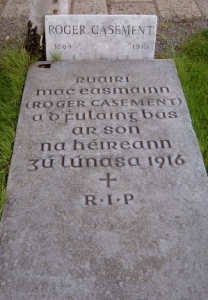
roger-casement-glasnevin-grave

During the decades after his execution, many formal requests for repatriation of Casement’s remains are refused by the U.K. government. Finally, February 23, 1965, Casement’s remains are repatriated to the Republic of Ireland. Casement’s last wish, to be buried at Murlough Bay on the North Antrim coast, in what is now Northern Ireland, may never be satisfied as U.K. Prime Minister Harold Wilson‘s government releases the remains only on condition that they cannot be brought into Northern Ireland, as “the government feared that a reburial there could provoke Catholic celebrations and Protestant reactions.”

Casement’s remains lay in state at Arbour Hill in Dublin for five days, during which time an estimated half a million people file past his coffin. After a state funeral on March 1, the remains are buried with full military honours in the Republican plot in Glasnevin Cemetery in Dublin, with other militant republican heroes. The President of the Republic of Ireland, Éamon de Valera, who is in his mid-eighties and the last surviving leader of the Easter Rising, defies the advice of his doctors and attends the ceremony, along with an estimated 30,000 others.


Leave a comment

Death of William Joseph “Wild Bill” Donovan

william-joseph-donovan

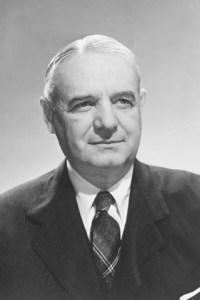
William Joseph “Wild Bill” Donovan, a United States soldier, lawyer, intelligence officer, and diplomat, dies on February 8, 1959. Donovan is best remembered as the wartime head of the Office of Strategic Services (OSS), a precursor to the Central Intelligence Agency, during World War II. He is also known as the “Father of American Intelligence” and the “Father of Central Intelligence.”

Of Irish descent, Donovan is born in Buffalo, New York, to first generation immigrants Anna Letitia “Tish” Donovan (née Lennon) of Ulster and Timothy P. Donovan of County Cork. His grandfather, Timothy O’Donovan, Sr., is from the town of Skibbereen, and marries Mary Mahoney, who belongs to a propertied family of substantial means who disapprove of him. They move first to Canada and then to New York, where their son Timothy, Jr., Donovan’s father, attempts to engage in a political career but with little success.

William attend St. Joseph’s Collegiate Institute and Niagara University before starring on the football team at Columbia University, where he earns the nickname “Wild Bill”, which remains with him for the rest of his life. He graduates from Columbia in 1905. He then attends and graduates from Columbia Law School, after which he becomes an influential Wall Street lawyer.

In 1912, Donovan forms and leads a troop of cavalry of the New York National Guard, which is mobilized in 1916 and serves on the U.S.-Mexico border during the American government’s campaign against Pancho Villa.

During World War I, Major Donovan organizes and leads the 1st battalion of the 165th Regiment of the 42nd Division. For his service near Landres-et-St. Georges, France, on October 14-15, 1918, he receives the Medal of Honor. By the end of the war, he receives a promotion to colonel, as well as the Distinguished Service Cross and Purple Heart.

Donovan serves as U.S. Attorney for the Western District of New York from 1922 to 1924. Due to his energetic enforcement of Prohibition in the United States, there are a number of threats to assassinate him and to dynamite his home, but he is not deterred. In 1924, President Calvin Coolidge names Donovan to the United States Department of Justice’s Antitrust Division as a deputy assistant to Attorney General Harry M. Daugherty. Donovan runs unsuccessfully for Lieutenant Governor of New York (1922) and for Governor of New York (1932) as a Republican.

During the years between the world wars, Donovan earns the attention and friendship of President Franklin D. Roosevelt. Although the two men were from opposing political parties, they were very similar in personality. In 1940 and 1941, Donovan traveled as an informal emissary to Britain, where he is urged by U.S. Secretary of the Navy Frank Knox and Roosevelt to gauge Britain’s ability to withstand Germany’s aggression. During these trips Donovan meets with key officials in the British war effort, including Winston Churchill and the directors of Britain’s intelligence services. Donovan returns to the U.S. confident of Britain’s chances and enamored of the possibility of founding an American intelligence service modeled on that of the British.

On July 11, 1941, Donovan is named Coordinator of Information (COI) where he is to oversee America’s foreign intelligence organizations which, at the time are fragmented and isolated from each other. He is plagued over the course of the next year with jurisdictional battles as few of the leaders in the intelligence community are willing to part with any of their power. Nevertheless, Donovan begins to lay the groundwork for a centralized intelligence program.

In 1942, the COI becomes the Office of Strategic Services (OSS) and Donovan is returned to active duty in the U.S. Army. He is promoted to brigadier general in March 1943 and to major general in November 1944. Under his leadership the OSS eventually conducts successful espionage and sabotage operations in Europe and parts of Asia. By 1943, relations with the British are becoming increasingly strained, partly due to British concerns that OSS operations are sometimes regarded as ill-disciplined and irresponsibly managed. MI6 chief Stewart Menzies is extremely hostile towards the idea of OSS operations anywhere in the British Empire and categorically forbids them to operate within the U.K.

After the end of World War II and the death of President Roosevelt in early April 1945, Donovan’s political position is substantially weakened as he finds himself opposed by President Harry S. Truman, J. Edgar Hoover, and others. Truman disbands the OSS in September 1945 and Donovan returns to civilian life. Several departments of the OSS survive the dissolution and, less than two years later, the Central Intelligence Agency is founded.

Donovan does not have an official role in the newly formed CIA, but he is instrumental in its formation. His opinions meet strong opposition from the State, War, and Navy Departments, as well as J. Edgar Hoover. President Truman is also unenthusiastic about some of Donovan’s arguments, but he prevails, and they are reflected in the National Security Act of 1947 and the Central Intelligence Agency Act of 1949.

After the end of the war ended, Donovan returns to his lifelong role as a lawyer and serves as special assistant to chief prosecutor Robert H. Jackson at the Nuremberg War Crimes Tribunal in Germany. On August 3, 1953, President Dwight Eisenhower appoints Donovan Ambassador to Thailand, and he serves in that capacity from September 4, 1953, until his resignation on August 21, 1954.

Donovan dies from complications of vascular dementia on February 8, 1959, at the age of 76, at Walter Reed Army Medical Center in Washington, D.C. He is buried in Section 2 of Arlington National Cemetery. President Eisenhower remarks, “What a man! We have lost the last hero.”