seamus dubhghaill

Promoting Irish Culture and History from Little Rock, Arkansas, USA


Leave a comment

Postponement of the Easter Rising

general-post-office

On Saturday, April 22, 1916, the Easter Rising, originally planned for the following day, Easter Sunday, is postponed for one day.

At dawn a messenger from the Kerry Volunteers arrives in Dublin and informs James Connolly, Commandant of the Dublin Brigade, that Roger Casement had been arrested in County Kerry the previous day during a failed attempt to smuggle arms into Ireland on board the German ship Aud. A meeting of the Military Council is hastily organised, and the decision is made not to inform Chief-of-Staff of the Irish Volunteers, Eoin MacNeill, about Casement’s arrest.

Later in the morning, after attempting to escape the area, Karl Spindler, captain of the Aud, makes the decision to scuttle his ship after it is intercepted by the Royal Navy. Although Spindler and the crew are rescued, the armaments on board the Aud are lost. By early afternoon the Military Council is made aware of the loss of their arms shipment.

At 6:00 PM, Sean Fitzgibbon, Colm O’Loughlin, and Michael Joseph O’Rahilly arrive at Woodtown Park and inform MacNeill of the arrests and the loss of the Aud. After confronting Patrick Pearse at St. Enda’s School, a bilingual school for boys founded by Pearse, MacNeill and others, including O’Rahilly and Bulmer Hobson, gather at the house of Seumas O’Kelly on Rathgar Road and a decision is made to issue countermanding orders cancelling the Rising planned for Easter Sunday. To make sure that the countermanding order is received and understood, James Ryan is sent overnight to Cork, Colm O’Loughlin to Dundalk and Coalisland, Sean Fitzgibbon to Waterford, and Min Ryan to Wexford. O’Rahilly travels to Limerick, Kerry, Cork, and Tipperary. This succeeds in delaying the rising for only one day, although it greatly reduces the number of Volunteers who turn out.

During the evening, Major-General Sir Lovick Friend, General Officer Commanding of British forces in Ireland, travels to London on leave in wake of the capture of the Aud believing that any potential insurgency has been stopped. Chief Secretary Augustine Birrell is also in London having attended a Cabinet meeting. Both men remain in London through Easter, leaving Under Secretary Matthew Nathan as the most senior British official remaining in Dublin. Lord Lieutenant of Ireland, Ivor Churchill Guest, 1st Viscount Wimborne, urges Nathan to order the arrest of a large number of rebel leaders however he is unwilling to do so without the authorisation of Chief Secretary Birrell.


Leave a comment

The SS Aud Begins Gun-Running Voyage to Ireland

the-ss-aud

The German merchant steam ship SS Libau, also known as SS Castro and masquerading under the cover name of SS Aud, sets sail from the Baltic port of Lübeck on April 9, 1916, loaded with guns and ammunition for the Irish Republican Brotherhood (IRB) as part of the preparation for the Easter Rising.

Masquerading as SS Aud, an existing Norwegian vessel of similar appearance, SS Libau sets sail from the port of Lübeck, under the command of Karl Spindler, bound for the southwest coast of Ireland. Under Spindler is a crew of 22 men, all of whom are volunteers. SS Libau, laden with an estimated twenty thousand rifles, one million rounds of ammunition, ten machine guns, and explosives under a camouflage of a timber cargo, evade patrols of both the British 10th Cruiser Squadron and local Auxiliary patrols.

After surviving violent storms off Rockall, SS Libau arrives in Tralee Bay on April 20. There they are due to meet Roger Casement and others, with Casement having been landed nearby by the German submarine U-19. The SS Libau has no communications equipment aboard, giving them no means of contacting the Irish while en route. As a result, they are unaware that the date for its arrival off Fenit has been altered from Thursday, April 20 to Sunday, April 23.

One of the two cars carrying Volunteers who are supposed to meet SS Libau crash into the River Laune, many miles away, at Ballykissane pier, Killorglin, resulting in the death of three of the four occupants of the car. This leads to no hope of an organised transfer of arms and the gun-running plan nears an end.

SS Libau, attempting to escape the area, is trapped by a blockade of British ships. Captain Spindler allows himself to be escorted towards Cork Harbour, in the company of the Acacia-class sloop HMS Bluebell. The German crew then scuttles the ship. Spindler and his crew are interned for the duration of the war. Roger Casement and his companions are captured in an old ringfort or rath between Ardfert and Tralee.

A number of rifles are recovered from SS Libau before the vessel is scuttled. Several examples exist in various museums in Britain and Ireland. Among these are the Cork Public Museum in Fitzgerald’s Park in Cork, a museum in Lurgan County Armagh, the National Museum of Ireland in Dublin, and the Imperial War Museum in London.


Leave a comment

Éamon de Valera Elected President of Dáil Éireann

eamon-de-valera

Éamon de Valera is elected President of Dáil Éireann (Príomh Aire) at the third meeting of the First Dáil on April 1, 1919.

The Declaration of Independence asserts that the Dáil is the parliament of a sovereign state called the “Irish Republic,” and so the Dáil establishes a cabinet called the Ministry or “Aireacht,” and an elected prime minister known both as the “Príomh Aire” and the “President of Dáil Éireann.”

When the First Dáil meets in the Round Room of the Mansion House in Dublin on January 21, 1919, de Valera is the president of Sinn Féin and thus the natural choice for leadership. However, he is imprisoned in England so, at the second meeting of the Dáil on January 22, Cathal Brugha is elected as the first Príomh Aire on a temporary basis. De Valera escapes Lincoln Gaol in February and is then elected to replace Brugha at the Dáil’s third meeting.

As leader, de Valera visits the United States from June 1919 to December 1920. His aim is to gain both popular and official recognition for the Republic and to obtain a loan to finance Dáil Éireann and the War of Independence. By the time of his return, de Valera has won public but not official support for the Republic and has raised a loan of $6 million.

After the election of the Second Dáil in 1921, de Valera resigns on August 26 and is immediately re-elected under the new title of President of the Republic. He then remains in office until January 1922 when, against his wishes, the Dáil votes to ratify the Anglo-Irish Treaty. De Valera resigns and submits his name for re-election but is rejected by the house, which instead elects Arthur Griffith, who supports the Treaty, by a vote of 60-58.

On January 16, 1922, the British government implements the Treaty and appoints a new Irish administration called the Provisional Government. The Dáil decides that the new administration will operate in parallel with the existing institutions of the Irish Republic, which the British do not recognise. Therefore, as the Irish Civil War begins the country has two leaders, Arthur Griffith as President of Dáil Éireann and Michael Collins as Chairman of the Provisional Government. Collins is also Minister for Finance in Griffith’s cabinet. This anomalous situation continues until Griffith and Collins both died suddenly in August 1922, Collins being assassinated by anti-Treaty irregulars and Griffith dying of natural causes. W.T. Cosgrave becomes Chairman of the Provisional Government on August 25 and, when he is also elected as President of Dáil Éireann in September, the two administrations are merged.

On December 6, both the Irish Republic and the Provisional Government come to an end as the new Constitution of the Irish Free State comes into force. The new Irish Free State has three leaders, the King as head of state, the Governor-General as the King’s representative, and the President of the Executive Council as head of government. W.T. Cosgrave is appointed as the first President of the Executive Council on the same day.


3 Comments

Birth of Henry Wilfrid Brambell in Dublin

henry-wilfred-brambell

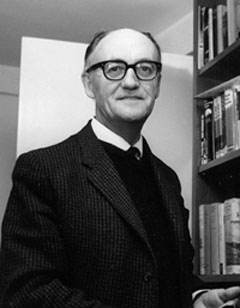
Henry Wilfrid Brambell, Irish film and television actor best known for his role in the British television series Steptoe and Son, is born in Dublin on March 22, 1912.

Brambell is the youngest of three sons born to Henry Lytton Brambell, a cashier at the Guinness Brewery, and his wife, Edith Marks, a former opera singer. His first appearance is as a child, entertaining the wounded troops during World War I. Upon leaving school he works part-time as a reporter for The Irish Times and part-time as an actor at the Abbey Theatre before becoming a professional actor for the Gate Theatre. He also does repertory at Swansea, Bristol and Chesterfield. In World War II, he joins the British military forces entertainment organisation Entertainments National Service Association (ENSA).

His television career begins during the 1950s, when he is cast in small roles in three Nigel Kneale/Rudolph Cartier productions for BBC Television, The Quatermass Experiment (1953), Nineteen Eighty-Four (1954), and Quatermass II (1955). All of these roles earn him a reputation for playing old men, though he is only in his forties at the time.

It is this ability to play old men that leads to his casting in his best remembered role, as Albert Steptoe, the irascible father in Steptoe and Son. This begins as a pilot on the BBC’s Comedy Playhouse, and its success leads to a full series being commissioned, running from 1962 to 1974 including a five-year hiatus. There are two feature film spin-offs, a stage show, and an American incarnation entitled Sanford and Son, some episodes of which are almost exact remakes of the original British scripts.

The success of Steptoe and Son makes Brambell a high-profile figure on British television, and earns him the supporting role of Paul McCartney‘s grandfather in The Beatles‘ first film, A Hard Day’s Night (1964). In 1965, Brambell tells the BBC that he does not want to do another series of Steptoe and Son and, in September that year, he goes to New York City to appear in the Broadway musical Kelly at the Broadhurst Theatre, however, it closes after just one performance.

Apart from his role as the older Steptoe, Brambell achieves recognition in many films. His performance in The Terence Davies Trilogy wins him critical acclaim, far greater than any achieved for Steptoe and Son. Although he appears throughout the full 94-minute piece, Brambell does not speak a single word.

After the final series of Steptoe and Son is made in 1974, Brambell has some guest roles in films and on television. He and Harry H. Corbett also undertake a tour of Australia in 1977 in a Steptoe and Son stage show.

Brambell dies of cancer in Westminster, London, on January 18, 1985, at the age of 72. He is cremated on January 25, 1985 at Streatham Park Cemetery, where his ashes are scattered.


Leave a comment

The Curragh Incident

curragh-incident

The Curragh Incident occurs in the Curragh, County Kildare, on March 20, 1914. The Curragh Camp is the main base for the British Army in Ireland, which at the time forms part of the United Kingdom of Great Britain and Ireland. Ireland was about to receive a measure of devolved government, which included Ulster.

In early 1912, the Liberal British government of H. H. Asquith introduces the Third Home Rule Bill for Ireland, which proposes the creation of an autonomous Irish Parliament in Dublin. Unionists have objected to being under the jurisdiction of the proposed Dublin Parliament. Ulster Unionists found the Ulster Volunteers (UVF) paramilitary group in 1912, aided by a number of senior retired British officers, to fight against the British government and/or against a future Irish Home Rule government proposed by the Bill.

In September 1913, with Irish Home Rule due to become law in 1914, the Chief of the Imperial General Staff (CIGS) Sir John French expresses his concerns to the government and to the King that the British Army, if ordered to act against the UVF, might split. The British Cabinet contemplates some kind of military action against the Ulster Volunteers who threaten to rebel against Home Rule. Many officers, especially those with Irish Protestant connections, of whom the most prominent is Hubert Gough, threaten to resign rather than obey, privately encouraged from London by senior officers including Major-General Henry Hughes Wilson.

Although the Cabinet issues a document claiming that the issue has been a misunderstanding, the Secretary of State for War J.E.B. Seely and French are forced to resign after amending it to promise that the British Army will not be used against the Ulster loyalists.

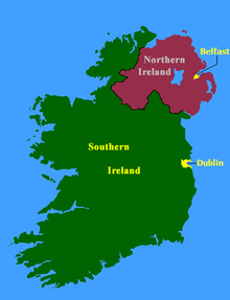
The event contributes both to unionist confidence and to the growing Irish separatist movement, convincing Irish nationalists that they cannot expect support from the British army in Ireland. In turn, this increases renewed nationalist support for paramilitary forces. The Home Rule Bill is passed but postponed, and the growing fear of civil war in Ireland leads on to the British government considering some form of partition of Ireland instead, which eventually takes place.

The event is also notable in being one of the few incidents since the English Civil War in which elements of the British military openly intervene, as it turns out successfully, in politics.


Leave a comment

The Burgery Ambush in County Waterford

burgery-ambush

The Burgery Ambush takes place during the Irish War of Independence on the night of March 18, 1921 near Dungarvan, County Waterford.

A British military convoy of Black and Tans and including a Royal Irish Constabulary Sergeant named Michael Hickey, sets off from Dungarvan Castle on the night of March 18, heading east for the coastal village of Clonea. Their goal that night is the arrest of Irish Republican Army (IRA) volunteer John Murphy, who has been involved in gun running between Clonmel, County Tipperary, and Dungarvan.

Irish Republican Army volunteers of the West Waterford flying column have plans that night to demolish Tarr’s Bridge over the Colligan River between Dungarvan and the Abbeyside. However, when they receive word of the British convoy heading east out of Dungarvan, a last-minute action is organized by the Active Service Unit (ASU) to intercept it on its way back to Dungarvan.

The IRA volunteers ambush the convoy at the Burgery, about a mile and a half northeast of Dungarvan. In overall command of the IRA unit is IRA General Headquarters (GHQ) Officer George Plunkett. Also present are West Waterford Brigade Commandant Pax Whelan, Active Service Unit (ASU) leader George Lennon, and Mick Mansfield.

A British Crossley tender is set on fire and prisoners are taken by the IRA, including Sergeant Hickey. Early on the morning of March 19, Hickey is executed by an IRA firing squad with a sign reading “police spy” affixed to his tunic. Hickey is later buried in an unmarked grave. Other prisoners, including Captain DV Thomas, the commander of the British garrison, are released.

After the ambush, a group of volunteers under Plunkett return to search for any armaments left behind by the British forces. Crown forces who are now searching the area engage the IRA party. IRA volunteers Seán Fitzgerald and Pat Keating are shot dead. Constable Sydney R. Redman, a Black and Tan, is shot dead during the return fire.


Leave a comment

Death of Katharine O’Shea Parnell

katharine-oshea

Katharine O’Shea, called Katie O’Shea by friends and Kitty O’Shea by enemies, dies on February 5, 1921 in Littlehampton, England. O’Shea is an English woman of aristocratic background whose decade-long secret affair with Charles Stewart Parnell leads to a widely publicized divorce in 1890 and, ultimately, his political downfall.

Katharine first meets Parnell in 1880, when she is separated from but still legally married to Captain William O’Shea, a Catholic Nationalist Member of Parliament (MP) for County Clare. As a result of her family’s connection to the Liberal Party, she acts as liaison between Parnell and William Gladstone during negotiations prior to the introduction of the First Irish Home Rule Bill in April 1886. During the summer of that year, Parnell moves into her home in Eltham, near the London-Kent border. Parnell fathers three of Katharine’s children.

Captain O’Shea is aware of the relationship and challenges Parnell to a duel in 1881, however, when Parnell accepts the challenge, O’Shea backs down. Initially, O’Shea forbids his ex-wife to see Parnell, although she says that he encourages her in the relationship. O’Shea keeps quiet publicly for several years, possibly in hopes of an inheritance from Katharine’s rich aunt who has been in failing health. When she dies in 1889, however, her money is left in trust to cousins.

Although their relationship is a subject of gossip in London political circles from 1881, later public knowledge of the affair in an England governed by “Victorian morality” with a “nonconformist conscience” creates a huge scandal, as adultery is prohibited by the Ten Commandments.

After the divorce proceedings in November 1890, in which Parnell is named as co-respondent, the court awards custody of Katharine’s two daughters by Parnell to her ex-husband. The divorce and eventual remarriage leads to Parnell being deserted by a majority of his own Irish Parliamentary Party and to his downfall as its leader in December 1890.

Catholic Ireland feels a profound sense of shock when Katharine breaks the vows of her previous Catholic marriage by marrying Parnell on June 25, 1891. The marriage, however, is short-lived. With Parnell’s political life and health essentially ruined, he dies in Katharine’s arms at the age of 45 in Hove, England, on October 6, 1891, less than four months after their marriage. The cause of death is determined to be cancer of the stomach, possibly complicated by coronary heart disease inherited from his grandfather and father.

Katharine publishes a biography of Parnell in 1914 as “Katharine O’Shea (Mrs. Charles Stewart Parnell),” though to her friends she is known as Katie O’Shea. Parnell’s enemies, in order to damage him personally, call her “Kitty O’Shea” because “kitty,” although a Hiberno-English version of Katharine, is also a slang term for a prostitute. After Parnell’s death, Katharine suffers from a nervous breakdown and disappears from public life. She dies on February 5, 1921 after spending her final years moving from rented house to rented house all over the south coast of England. Katharine O’Shea is buried in Littlehampton, Sussex, England.

Captain Henry Harrison, MP, who acts as Parnell’s bodyguard and aide-de-camp, devotes himself after Parnell’s death to the service of his widow. From her he hears a completely different version of the events surrounding the divorce issue from that which had appeared in the press in 1890. This forms the seed of two of Harrison’s later books defending Parnell which are published in 1931 and 1938. They have a major impact on Irish historiography, leading to a more favourable view of Parnell’s role in the O’Shea affair.


1 Comment

Tomás MacCurtain Elected Sinn Féin Lord Mayor of Cork

tomas-maccurtain

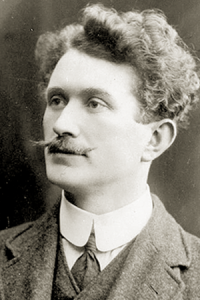
Tomás MacCurtain is elected Sinn Féin Lord Mayor of Cork on January 31, 1920.

MacCurtain is born at Ballyknockane in the Parish of Mourne Abbey on March 20, 1884. He attends Burnfort National School until the family moves to Blackpool on the north side of Cork city in 1897, where he attends The North Monastery School. He becomes active in numerous cultural and political movements and joins the Blackpool branch of the Gaelic League, becoming its secretary in 1902. He works in his early career as a clerk and in his free time teaches the Irish language. He joins the Fianna Éireann in 1911 and is a founding member of the Irish Volunteers.

At the outset of the Easter Rising in April 1916, MacCurtain commands a force of up to 1,000 men of the Irish Volunteers who assemble at various locations around County Cork. MacCurtain and his officers await orders from the volunteer leadership in Dublin, but conflicting instructions and confusion prevail, and the Cork volunteers never entered the fray. A tense week-long stand-off develops when British forces surround the volunteer hall. A negotiated agreement leads to the surrender of the volunteers’ arms to then Lord Mayor of Cork Thomas Butterfield on the understanding that they will be returned. The weapons are not returned and MacCurtain is jailed in the Frongoch Prisoner of War camp in Wales. Eighteen months later, after the general amnesty of participants in the Rising, MacCurtain returns to active duty as a Commandant of what is now the Irish Republican Army (IRA).

By 1918, MacCurtain is a brigade commander in the IRA. During the Conscription Crisis in the autumn 1918, he actively encourages the hiring of the women of Cumann na mBan to cater for Volunteers. MacCurtain is personally involved with Michael Collins‘ Squad that attempts to assassinate Lord John French, whose car is missed as the convoy passes through the ambush positions. Despite the setback he remains brigadier of No.1 Cork when he is elected the Sinn Féin councillor for NW Ward No. 3 of Cork in the January 1920 council elections and is chosen by his fellow councillors to be the Lord Mayor. He begins a process of political reform within the city.

On his 36th birthday, March 20, 1920, MacCurtain is shot dead in front of his wife and son by a group of men with blackened faces in retaliation for the shooting of a policeman. MacCurtain’s house in the city’s Blackpool area is also ransacked. The assassins are found to be members of the Royal Irish Constabulary (RIC) by the official inquest into the event.

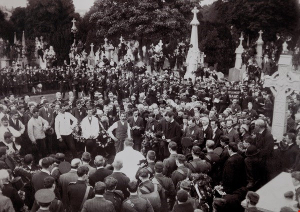
The killing causes widespread public outrage. The coroner’s inquest passes a verdict of wilful murder against British Prime Minister Lloyd George and against certain members of the RIC. Michael Collins later orders his personal assassination squad to hunt down and kill the police officers involved in the attack. RIC District Inspector Oswald Swanzy, who had ordered the attack, is fatally shot with MacCurtain’s own revolver while leaving a Protestant church in Lisburn, County Antrim on August 22, 1920, sparking a “pogrom” against the Catholic residents of the town. MacCurtain is buried in St. Finbarr’s Cemetery, Cork.


Leave a comment

Death of Irish Songwriter Percy French

percy-french

Percy French, one of Ireland’s foremost songwriters and entertainers of his day, dies of pneumonia in Formby, England, on January 24, 1920.

French is born at Cloonyquin House, near Tulsk, County Roscommon. He is educated at Foyle College, Derry, and writes his first successful song, Abdul Abulbul Amir, while studying at Trinity College Dublin in 1877. The song is sold for £5 to an unscrupulous publisher and later becomes hugely popular and is falsely claimed by other authors.

He graduates from Trinity as a civil engineer in 1881 and joins the Board of Works in County Cavan as an “Inspector of Drains.” It is said that he writes his best songs during this period. French is also a prolific painter of landscape watercolours and during this period he considers art to be his true vocation. When he becomes well-known later in his life, his paintings from his time as a civil engineer become fashionable and sought after.

When the Board of Works reduces its staff around 1887, French turns to journalism as the editor of The Jarvey, a weekly comic paper. Upon the failure of the paper, he embarks on a long and successful career as a songwriter and entertainer. It is around this time that he marries Ethel Kathleen Armitage-Moore, second daughter of William Armytage-Moore, brother of Countess of Annesley. Tragically, at the age of 20, she dies during childbirth along with her daughter.

percy-french-statue

French becomes renowned for composing and singing comic songs and gains considerable distinction with such songs as Phil the Fluther’s Ball, Slattery’s Mounted Foot, and The Mountains of Mourne. One of his most famous songs is Are Ye Right There Michael, a song that ridicules the state of the rail system in rural County Clare. The song causes such embarrassment to the rail company that it lead to an ultimately unsuccessful libel action against French. It is said that he arrives late for the libel hearing and, when questioned by the judge on his lateness, he responds, “Your honour, I travelled by the West Clare Railway,” which results in the case being thrown out.

French takes ill while performing in Glasgow and dies of pneumonia on January 24, 1920, at the age of 65 at the home of his cousin, Canon Richardson of Green Lea, in Formby. He is buried in the churchyard of St. Luke’s Parish Church, Formby in Merseyside. A statue of him sitting on a park bench can be found in the town center of Ballyjamesduff in honour of him and his famous song, Come Back Paddy Reilly to Ballyjamesduff.