seamus dubhghaill

Promoting Irish Culture and History from Little Rock, Arkansas, USA


Leave a comment

Birth of Dolores O’Riordan, Singer & Songwriter

dolores-o-riordan

Dolores Mary Eileen O’Riordan, Irish musician, singer and songwriter, is born in Ballybricken, County Limerick on September 6, 1971. She leads the rock band The Cranberries from 1990 until their break-up in 2003. They reunite in 2009. She is known for her lilting mezzo-soprano voice, her emphasised use of yodeling, and her strong Limerick accent.

O’Riordan is the youngest of nine children, two of whom die in infancy. Her father, Terence Patrick “Terry” O’Riordan (1937–2011), is a farm labourer who is left unable to work due to brain damage caused by a motorbike accident in 1968. Her mother, Eileen, is a school caterer. She attends Laurel Hill Coláiste FCJ school in Limerick. She leaves school without any qualifications.

In 1989, brothers Mike and Noel Hogan form The Cranberry Saw Us with drummer Fergal Lawler and singer Niall Quinn, in Limerick. Less than a year later, Quinn leaves the band. The remaining band members then place an advertisement for a female singer. O’Riordan responds to the advertisement and auditions by writing lyrics and melodies to some existing demos. When she returns with a rough version of “Linger,” she is hired, and they record Nothing Left At All, a three-track EP released on tape by local record label Xeric Records, which sells 300 copies. The group changes their name to “The Cranberries.” The owner of Xeric Studios, Pearse Gilmore, becomes their manager and provides the group with studio time to complete another demo tape, which he produces. It features early versions of “Linger” and “Dreams,” which are sent to record companies throughout the United Kingdom (UK).

This demo earns the attention of both the UK press and record industry and sparks a bidding war between major British record labels. Eventually, the group signs with Island Records. As part of The Cranberries she releases along with them five albums: Everybody Else Is Doing It, So Why Can’t We? (1993), No Need to Argue (1994), To the Faithful Departed (1996), Bury the Hatchet (1999), and Wake Up and Smell the Coffee (2001), and a greatest-hits compilation, Stars: The Best of 1992–2002. In 2003, the band decides to take a temporary time-out to experiment on solo projects.

In 2003, O’Riordan embarks on a solo career which includes an appearance with the Italian artist Zucchero Fornaciari on the album Zu & Co., with the song “Pure Love.” The album also features other artists such as Sting, Sheryl Crow, Luciano Pavarotti, Miles Davis, John Lee Hooker, Macy Gray, and Eric Clapton.

In 2005, O’Riordan appears on the Jam & Spoon‘s album Tripomatic Fairytales 3003 as a guest vocalist on the track “Mirror Lover.” She makes a cameo appearance in the 2006 Adam Sandler comedy Click as a wedding singer performing an alternate version of The Cranberries’ “Linger” set to strings. Her first single, “Ordinary Day,” is produced by BRIT Awards winner Youth, whose previous credits include The Verve, Embrace, Primal Scream, U2, and Paul McCartney.

Are You Listening? is released in Ireland on May 4, 2007, in Europe on May 7, and in North America on May 15. In 2008, O’Riordan wins a European Border Breakers Award (EBBA) which is presented annually to recognize the success of ten emerging artists or groups who reach audiences outside their own countries with their first internationally released album in the past year. Her second album, No Baggage, featuring eleven tracks, is released in August 2009.

In January 2009, the University Philosophical Society at Trinity College, Dublin invites The Cranberries to reunite for a concert celebrating O’Riordan’s appointment as an honorary member of the Society, which leads the band members to consider reuniting for a tour and a recording session. On August 25, 2009, while promoting her solo album No Baggage in New York City on 101.9 RXP radio, O’Riordan announces the reunion of the Cranberries for a world tour. The tour begins in North America in mid-November, followed by South America in mid-January 2010 and Europe in March 2010. She remains in the band until her unexpected death.

She appears as a judge on RTÉ‘s The Voice of Ireland during the 2013–2014 season. In April 2014, O’Riordan joins and begins recording new material with the trio D.A.R.K.

On January 15, 2018, at the age of 46, while in London for a recording session, O’Riordan dies suddenly at the London Hilton on Park Lane hotel in Mayfair. The cause of death is not immediately made public. Police say it is not being treated as suspicious. The coroner’s office says the results of its inquiry would not be released until April 3 at the earliest. On April 3 the inquest is cancelled with no new date announced.

A three-day memorial in her hometown, with O’Riordan lying in repose, lasts from January 20-22 at St. Joseph’s church. On January 23, she is buried after a service at Saint Ailbe’s Roman Catholic Church, Ballybricken, County Limerick. It begins with the studio recording of “Ave Maria” as sung by O’Riordan and Luciano Pavarotti. She is buried alongside her father.

Leave a comment

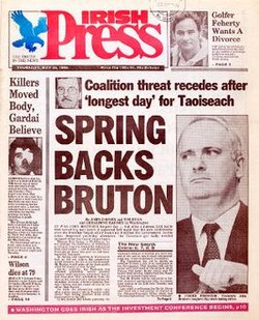
First Edition of the “Irish Press” Published

irish-press-may-25-1995

The first edition of the Irish Press, a Dublin daily newspaper founded by Éamon de Valera as a platform for Fianna Fáil, is published on September 5, 1931.

Irish Press Ltd. is officially registered on September 4, 1928, three years before the paper is first published, to create a newspaper independent of the existing media where the Independent Newspapers group is seen as supporting Cumann na nGaedheal/Fine Gael, and The Irish Times being pro-union, and with a mainly middle-class or Protestant readership.

The paper’s first issue is published on the eve of the 1931 All-Ireland Senior Hurling Championship Final between Cork and Kilkenny. Other newspapers do not cover GAA sports in any detail at the time. Margaret Pearse, the mother of Patrick and Willie Pearse, presses the button to start the printing presses. The initial aim of its publisher is to achieve a circulation of 100,000 which it quickly accomplishes. It goes on to list 200,000 subscribers at its peak.

The money to launch the Irish Press is raised in the United States during the Irish War of Independence by a bond drive to finance the First Dáil. Five million dollars is raised; however, 60 percent of this money is left in various banks in New York City. No one knows why de Valera ordered the bulk of the money to be left in New York when he returned to Ireland in late 1920.

In 1927, as a result of legal action between the Irish Free State government and de Valera, a court in New York orders that the bond holders be paid back outstanding money due to them. However, de Valera’s legal team has anticipated the ruling and has prepared for the outcome. A number of circulars are sent to the bond holders asking them to sign over their holdings to de Valera. The bond holders are paid 58 cents to the dollar. This money is then used as startup capital to launch the Irish Press. Following the 1933 Irish General Election, de Valera uses his Dáil Éireann majority to pass a measure allowing the bond holders to be paid the remaining 42 percent of the money still owed.

In December 1931, editor Frank Gallagher is prosecuted by an Irish Free State military tribunal for publishing articles alleging that Garda Síochána had mistreated the Anti-Treaty republicans of the Irish Free State government. This is facilitated by Amendment 17 of the Constitution of the Irish Free State and Gallagher is convicted and fined £50. An example of animosity from those who support Independent Newspapers and the Free State government is that the Irish Press is excluded from the special train which delivers newspapers from Dublin to the countryside. As a result, it is circulated throughout Ireland by a specially rented train.

The Irish Press sustains itself with its own resources until The Sunday Press is founded in 1949. In its heyday, the Irish Press has a number of first-rate reporters and columnists. One notable section, New Irish Writing is edited by David Marcus.

In the 1970s, the Minister for Posts and Telegraphs, Conor Cruise O’Brien, tries to use and amend The Emergency Powers Act and Section 31 of the Broadcasting Authority Act, to censor coverage of the Troubles in Northern Ireland. The Irish Press editor, Tim Pat Coogan, publishes editorials attacking the Bill. The Fine Gael/Labour Coalition Government tries to prosecute the Irish Press for its coverage of the maltreatment of republican prisoners by the Garda “Heavy Gang,” with the paper winning the case.

The Irish Press starts two further newspapers, the Evening Press (1954), and The Sunday Press. The Evening Press is aimed at an urban readership and achieves a daily circulation of 100,000. The new newspapers subsidise the Irish Press when its circulation sags. Its adoption of a tabloid format does not rescue its declining circulation.

The final issue of the Irish Press and Evening Press is on Thursday, May 25, 1995. The newspapers close because of a bizarre industrial dispute over the sacking of the group business editor, Colm Rapple. The group has not been in a healthy financial state for several years. When it eventually closes, with indebtedness of £20 million, 600 people lose their jobs.

(Pictured: Cover of last ever edition of the Irish Press from May 25, 1995)


Leave a comment

Birth of Film Director Roy William Neill

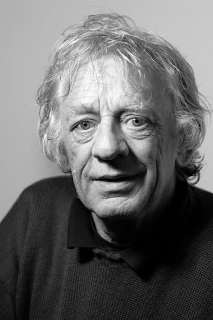
roy-william-neillRoy William Neill, English film director best known for directing the last eleven of the fourteen Sherlock Holmes films starring Basil Rathbone and Nigel Bruce, is born on September 4, 1887. These films were made between 1943 and 1946 and released by Universal Studios.

With his father as the captain, Neill is born on a ship off the coast of Ireland. His birth name is Roland de Gostrie. He begins directing silent films in 1917 and goes on to helm 107 films, 40 of them silent. Although most of his films are low-budget B-movies, he is known for directing films with meticulously lit scenes with carefully layered shadows that become the style of film noir in the late 1940s. In fact, his last film, Black Angel (1946), is considered a film noir.

Neill is also credited in some works as R. William Neill, Roy W. Neill, and Roy Neill. He lives in the United States for most of his career and is a U.S. citizen. He does go to London from 1935 until 1940 where better opportunities exist for American directors. During this period, British film producer Edward Black hires him to direct The Lady Vanishes. However, due to delays in production, Black hires Alfred Hitchcock to direct instead.

Roy William Neill dies at the age of 59 from a heart attack in London, England on December 14, 1946.


Leave a comment

Birth of James Hanley, Novelist & Playwright

james-hanley

James (Joseph) Hanley, British novelist, short story writer, and playwright of Irish descent, is born in Kirkdale, Liverpool, Lancashire on September 3, 1897. He publishes his first novel, Drift, in 1930. The novels and short stories about seamen and their families that he writes in the 1930s and 1940s include Boy (1931), the subject of an obscenity trial. He comes from a seafaring family and spends two years at sea himself. After World War II there is less emphasis on the sea in his works. While frequently praised by critics, his novels do not sell well. In the late 1950s, 1960s, and early 1970s he writes plays, mainly for the BBC, for radio and then for television, and also for the theatre. He returns to the novel in the 1970s. His last novel, A Kingdom, is published in 1978, when he is 80 years old.

Hanley is born to a working class family. Both his parents are born in Ireland, his father Edward Hanley around 1865, in Dublin, and his mother, Bridget Roache, in Queenstown, County Cork, around 1867. Both are well established in Liverpool by 1891, when they are married. Hanley’s father works most of his life as a stoker, particularly on Cunard Line liners, and other relatives have also gone to sea. He grows up living close to the docks. He leaves school in the summer of 1910 and works for four years in an accountants’ office. Then early in 1915 at the age of 17, he goes to sea for the first time. Thus life at sea is a formative influence and much of his early writing is about seamen.

In April 1917, Hanley jumps ship in Saint John, New Brunswick, Canada, and shortly thereafter joins the Canadian Expeditionary Force in Fredericton, New Brunswick. He fights in France in the summer of 1918, but is invalided out shortly thereafter. After the war he works as a railway porter in Bootle and devotes himself to a prodiguous range of autodidactic, high cultural activities – learning the piano, regularly attending concerts, reading voraciously and, above all, writing. However, it is not until 1930 that his novel Drift is accepted.

Hanley moves from Liverpool to near Corwen, North Wales in 1931, where he meets Dorothy Enid “Timothy” Thomas, neé Heathcote, a descendant of Lincolnshire nobility. They live together and have a child, Liam Powys Hanley, in 1933, but do not marry until 1947. In July 1939, as World War II is approaching, he moves to London to write documentaries and plays for the BBC. He moves back to Wales during the early years of the war, settling in Llanfechain on the other side of the Berwyn range from Corwen. In 1963, the Hanleys move to North London to be close to their son.

In 1937 Hanley publishes an autobiographical work, Broken Water: An Autobiographical Excursion, and while this generally presents a true overall picture of his life, it is seriously flawed, incomplete and inaccurate. Chris Gostick describes it as “a teasing palimpsest of truth and imagination.”

Hanley’s brother is the novelist Gerald Hanley and his nephew is the American novelist and playwright William Hanley. Hanley’s wife also publishes three novels, as Timothy Hanley. She dies in 1980. James Hanley himself dies in London on November 11, 1985 and is buried in Llanfechain, Wales.


2 Comments

Birth of Sir Lucius O’Brien, 3rd Baronet

lucius-obrien-3rd-baronet

Sir Lucius Henry O’Brien, 3rd Baronet PC (Ire), Irish baronet and politician for 34 years, is born on September 2, 1731.

O’Brien is the son of Sir Edward O’Brien, 2nd Baronet and his wife Mary Hickman, inheriting the baronetcy upon the death of his father in 1765. He is educated at Trinity College, Dublin and enters the Middle Temple in 1753, later becoming a barrister.

In 1761, O’Brien enters the Irish House of Commons as the member for Ennis, sitting until 1768. Subsequently he successfully runs for Clare, a seat previously held by his father, holding it until 1776. He is then again elected for Ennis, but following the unseating of Hugh Dillon Massy as Member of Parliament for Clare, he returns to represent that constituency in 1778. In the election of 1783, he becomes the representative for Tuam. He is sworn of the Privy Council of Ireland in 1786. He serves for the latter constituency until 1790, when he is re-elected for Ennis. He holds this seat finally until his death on January 15, 1795.

O’Brien is elected a Fellow of the Royal Society in 1773.

O’Brien marries Anne French, the daughter of Robert French, in 1768 and has by her seven children, three sons and four daughters. He is succeeded in the baronetcy as well as in the constituency of Ennis by his oldest son Edward.

O’Brien’s grandson James FitzGerald (1818–1896) is a prominent politician in New Zealand.


1 Comment

Birth of Marguerite Gardiner, Novelist & Journalist

marguerite-power-farmer-gardiner

Marguerite Gardiner, Countess of Blessington, Irish novelist, journalist, and literary hostess, is born near Clonmel, County Tipperary on September 1, 1789. She becomes acquainted with Lord Byron in Genoa and writes a book about him.

Born Margaret Power, she is a daughter of Edmund Power and Ellen Sheehy, small landowners. She is “haphazardly educated by her own reading and by her mother’s friend Ann Dwyer.” Her childhood is blighted by her father’s character and poverty, and her early womanhood made wretched by a compulsory marriage at the age of fifteen to Captain Maurice St. Leger Farmer, an English officer whose drunken habits finally bring him as a debtor to the King’s Bench Prison, where he dies by falling out of a window in October 1817. She had left him after three months of marriage.

Marguerite later moves to Hampshire, England to live for five years with the family of Thomas Jenkins, a sympathetic and literary sea captain. Jenkins introduces her to the Irishman Charles John Gardiner, 1st Earl of Blessington, a widower with four children and seven years her senior. They marry at St. Mary’s, Bryanston Square, Marylebone, on February 16, 1818, only four months after the death of her first husband.

Of rare beauty, charm and wit, Lady Blessington is no less distinguished for her generosity and for the extravagant tastes she shares with her second husband, which results in encumbering his estates with debt. On August 25, 1822, they set out for a continental tour with Marguerite’s youngest sister, the 21-year-old Mary Anne, and servants. On the way they meet Count Alfred D’Orsay, who had first become an intimate of Lady Blessington in London in 1821, in Avignon on November 20, 1822, before settling at Genoa for four months from March 31, 1823. There they meet Lord Byron on several occasions, giving Lady Blessington material for her Conversations with Lord Byron.

After that they settle for the most part in Naples, where she meets the Irish writer Richard Robert Madden, who is to become her biographer. They also spend time in Florence with their friend Walter Savage Landor, author of Imaginary Conversations which she greatly admires.

It is in Italy, on December 1, 1827, that Count D’Orsay marries Harriet Gardiner, Lord Blessington’s only daughter by his former wife. The Blessingtons and the newlywed couple move to Paris towards the end of 1828, taking up residence in the Hôtel Maréchal Ney, where the Earl suddenly dies at the age of 46 of an apoplectic stroke in 1829. D’Orsay and Harriet then accompanied Lady Blessington to England, but the couple separates soon afterwards amidst much acrimony. D’Orsay continues to live with Lady Blessington until her death. Their home, first at Seymour Place, and afterwards Gore House, Kensington, now the site of the Royal Albert Hall, become a centre of attraction for all that is distinguished in literature, learning, art, science and fashion. Benjamin Disraeli writes Venetia whilst staying there, and it is at her home that Hans Christian Andersen first meets Charles Dickens.

After her husband’s death Lady Blessington supplements her diminished income by contributing to various periodicals as well as by writing novels. She is for some years editor of The Book of Beauty and The Keepsake, popular annuals of the day. In 1834 she publishes her Conversations with Lord Byron. Her Idler in Italy (1839–1840), and Idler in France (1841) are popular for their personal gossip and anecdotes, descriptions of nature and sentiment.

Early in 1849, Count D’Orsay leaves Gore House to escape his creditors. Subsequently the furniture and decorations are sold in a public sale successfully discharging Lady Blessington’s debts. She joins the Count in Paris, where she dies on June 4, 1849, of a burst heart. On examination it is discovered that her heart is three times normal size.

(Pictured: Marguerite, Countess of Blessington, painted by Sir Thomas Lawrence in 1822)


Leave a comment

Death of Mick Lally, Stage, Film & Television Actor

mick-lally

Michael “Mick” Lally, Irish stage, film and television actor, dies in Dublin on August 31, 2010. He departs from a teaching career for acting during the 1970s. Though best known in Ireland for his role as Miley Byrne in the television soap Glenroe, his stage career spans several decades, and he is involved in feature films such as Alexander and the Academy Award-nominated The Secret of Kells. Many reports cite him as one of Ireland’s finest and most recognisable actors.

Born on November 10, 1945, and reared in the Gaeltacht village of Toormakeady, County Mayo, Lally is the eldest of a family of seven children. He goes to the local national school in Toormakeady and then to St. Mary’s College, Galway. After studying at University College Galway, he teaches history and Irish for six years in Archbishop McHale College in Tuam from 1969 to 1975 but quits teaching to pursue his career as a stage actor.

Lally begins his acting career with Taibhdhearc na Gaillimhe, Ireland’s national Irish language theatre, and is a founding member of the Druid Theatre Company. He receives an Irish Times/ESB Theatre Award Nomination for Best Actor for his role in Druid’s production of The Dead School. He also becomes a member of the Field Day Theatre Company, and stars in the company’s 1980 premiere of Brian Friel‘s play Translations. He first plays at the Abbey Theatre in 1977 in a production of Wild Oats and goes on to perform in many other Abbey productions.

In 1982, Lally stars in the TV series The Ballroom of Romance alongside Brenda Fricker. From 1983 he plays the role of Miley Byrne in the RTÉ soap Glenroe, reprising the character that he played earlier in Bracken in 1978. In 1979, he wins a Jacob’s Award for his performance as Miley in Bracken. He also has some musical success when “The By-road to Glenroe” goes to the top of the Irish charts in 1990. He is also involved in voice-over work, including a noted advertisement for Kilmeaden Cheese during the 1990s. Other TV appearances include roles in Tales of Kinvarna, The Year of the French and Ballykissangel.

In 1994, Lally plays the character Hugh in The Secret of Roan Inish, and in 1995 portrays Dan Hogan in the film adaptation of Maeve Binchy‘s Circle of Friends. Other film roles included Poitín, Our Boys, The Outcasts, A Man of No Importance and others. In later years, he provides the voice of Brother Aidan in the Academy Award-nominated The Secret of Kells, an animated film directed by Tomm Moore.

Lally appears in several TV advertisements encouraging elderly people to “release the equity tied up in their homes” during the Celtic Tiger.

Mick Lally dies on the morning of August 31, 2010, after a short stay in the hospital. The cause of death is reported as heart failure, arising from an underlying emphysema condition. His funeral takes place in Dublin on September 2, 2010. The Irish Examiner comments that the “nation has lost one of its favourite uncles.” Personalities from TV, film, theatre and politics attend, while President of Ireland Mary McAleese sends a letter and Lally receives a standing ovation at the end.


Leave a comment

Birth of Professional Poker Player Donnacha “The Don” O’Dea

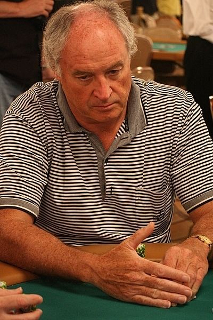
donnacha-odeaDonnacha “The Don” O’Dea, professional poker player, is born on August 30, 1948 in Dublin. In his youth, he is a swimmer and represents Ireland in the 1968 Summer Olympics. He is also the first Irish swimmer to swim 100m in less than one minute. His parents are actors Denis O’Dea and Siobhán McKenna.

O’Dea comes close to winning a World Series of Poker (WSOP) bracelet in 1983 in the $1,000 Limit Hold ’em event, finishing runner-up to Tom McEvoy. He makes the final table of the WSOP Main Event in 1983 where he finishes in sixth place behind McEvoy, the eventual winner. He finishes ninth in 1991 in the event won by Brad Daugherty. He also cashes in the Main Event in 1990 (32nd), 1994 (27th), 1996 (25th), and 2007 (171st).

In 1998, O’Dea wins a WSOP bracelet in Pot Limit Omaha Hold ’em with rebuys event, defeating two-time world champion, Johnny Chan in heads-up play.

O’Dea first appears on the Late Night Poker television programme in series 4, finishing fifth in a heat won by Robin Keston. He returns to the show in series 6, winning his heat and going on to finish fourth in the Grand Final.

In 2004, O’Dea wins the Poker Million tournament, overcoming Dave “The Devilfish” Ulliott in the eventual heads-up confrontation. The following year, he makes the final table again and finishes in fifth place.

O’Dea is the first member of the European Poker Players Hall of Fame. As of 2009, his total live tournament winnings exceed $1,000,000. His 23 cashes as the WSOP account for $471,687 of those winnings.

His son, Eoghan O’Dea, is also a poker player who competes primarily online under the moniker “intruder123.” In December 2008 he follows up a $300,000 online win with a 2nd-place finish in the Poker Million for $260,000. In 2011, he makes a deep run at the Main Event of 2011 World Series of Poker earning his place in the November Nine.


Leave a comment

Opening of The Museum of Science and Art, Dublin

national-museum-of-ireland

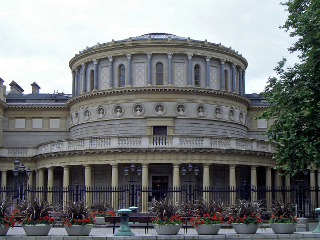
The Museum of Science and Art, Dublin on Kildare Street opens on August 29, 1890. The museum is founded on August 14, 1877, by act of Parliament. The decision to establish a state-run museum arises from requests by the Royal Dublin Society for continued government funding for its expanding museum activities.

A number of developments lead to the Science and Art Museums Act of 1877, which has the effect of transferring the buildings and collections of the Royal Dublin Society to state ownership. The collections are further enhanced by the transfer of other notable collections from institutions such as the Royal Irish Academy and Trinity College Dublin.

The Museum is the responsibility of the Department of Science and Art, which is also responsible for the South Kensington museums in London. State support for the institution is manifested in the construction of the new building on Kildare Street. It is built in the Victorian Palladian style and has been compared with the Altes Museum in Berlin, designed by Karl Friedrich Schinkel in the 1820s. Neoclassical influences can be seen in the colonnaded entrance and the domed rotunda, which rises to a height of 20 metres, and is modeled on the Pantheon in Rome.

The new museum houses coins, medals and significant Irish antiquities from the Royal Irish Academy including the Tara Brooch and Ardagh Chalice, ethnographical collections with material from Captain James Cooke‘s voyages from Trinity College Dublin, and the collections of the Geological Survey of Ireland.

These are joined by material from the decorative arts and ethnographical collections of the Royal Dublin Society along with their Irish collections of antiquities, minerals and plants. The old Royal Dublin Society museum on the Merrion Street side of Leinster House, erected with government assistance and opened in 1856, is devoted to natural history. It is dominated by zoology throughout much of its subsequent history and has an annex devoted to geology.

The building on Kildare Street is designed by Thomas Newenham Deane and is used to show contemporary Irish, British and Continental craftsmanship in its construction. State involvement in the running of the Museum allows for steady funding and a connection with other state museums in London and Edinburgh which is of considerable benefit. The collections grow with material acquired through purchase, public donation and shares of significant collections acquired by the state and dispersed by the London museums.

Catalogues are prepared by leading experts in various disciplines and printed in the Museum’s own press. In 1900 control passes to the Department of Agriculture and Technical Instruction and in 1908 its name is changed from “The Dublin Museum of Science and Art” to the “National Museum of Science and Art.” The name of the institution is changed again in 1921 to the “National Museum of Ireland.”


Leave a comment

Birth of Francis O,Neill, Music Collector & Police Officer

francis-oneill

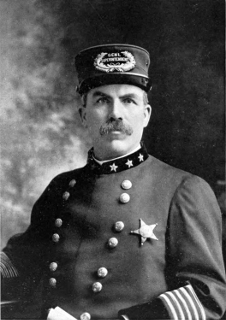
Francis O’Neill, Irish-born American police officer and collector of Irish traditional music, is born in Tralibane, near Bantry, County Cork on August 28, 1848. His biographer Nicholas Carolan refers to him as “the greatest individual influence on the evolution of Irish traditional dance music in the twentieth century.”

At an early age O’Neill hears the music of local musicians, among them Peter Hagarty, Cormac Murphy and Timothy Dowling. At the age of 16, he becomes a cabin boy on an English merchant vessel. On a voyage to New York, he meets Anna Rogers, a young emigrant whom he later marries in Bloomington, Illinois. The O’Neills move to Chicago, and in 1873 he becomes a policeman with the Chicago Police Department. He rises through the ranks quickly, eventually serving as the Chief of Police from 1901 to 1905. He has the rare distinction, in a time when political “pull” counts for more than competence, of being re-appointed twice to the position by two different mayors.

O’Neill is a flautist, fiddler and piper and is part of the vibrant Irish community in Chicago at the time. During his time as chief, he recruits many traditional Irish musicians into the police force, including Patrick O’Mahony, James O’Neill, Bernard Delaney, John McFadden and James Early. He also collects tunes from some of the major performers of the time including Patsy Touhey, who regularly sends him wax cylinders and visits him in Chicago. He also collects tunes from a wide variety of printed sources.

O’Neill retires from the police force in 1905. After that, he devotes much of his energy to publishing the music he has collected. He dies in Chicago, at the age of 87, on January 28, 1936.

In 2000, a life-size monument of Francis O’Neill playing a flute is unveiled next to the O’Neill family homestead in Tralibane, County Cork. The monument, and a commemorative wall are erected through the efforts of the Captain Francis O’Neill Memorial Company.

In 2008, Northwestern University Press issues Captain O’Neill’s Sketchy Recollections of an Eventful Life in Chicago, a non-musical memoir edited by Ellen Skerrett and Mary Lesch, O’Neill’s great-granddaughter, with a foreword by Nicholas Carolan of the Irish Traditional Music Archive. Carolan himself writes a musical biography of O’Neill, A Harvest Saved: Francis O’Neill and Irish Music in Chicago, which is published in Ireland by Ossian in 1997.

In August 2013, the inaugural Chief O’Neill Traditional Music Festival takes place in Bantry, County Cork, just a few miles from Tralibane. The 2013 event marks the centenary of the publication of O’Neill’s Irish Minstrels and Musicians. The event has taken place annually since.