On December 25, 1715, Joshua Dawson, Irish public servant, land developer and politician, sells the Mansion House with its gardens and park to Dublin Corporation for £3,500 plus 40 shillings per annum and a “loaf of double refined sugar of six pounds weight” which is to be paid to the Dawsons every Christmas.
Dawson is born in 1660 at the family seat, which becomes Castledawson, County Londonderry, the son of Thomas Dawson, Commissary of the Musters of the Army in Ireland. He resides in County Londonderry and Dublin. His ancestral family had owned land and lived in the area where, in 1710, he founds Dawson’s Bridge, named after the bridge over the River Moyola, which becomes present-day Castledawson. In his estate he builds Moyola House in 1713.
Dawson develops an area of Dublin in 1705-1710 which includes the setting out and construction of the streets of Dawson Street, Anne Street, Grafton Street and Harry Street. These streets are named after, respectively, himself, Queen Anne (widow of William III), and Henry FitzRoy, 1st Duke of Grafton, the son of Charles II and cousin of Queen Anne. This development includes the construction of the Mansion House in Dawson Street in 1710 which is purchased in 1715 to be the official residence of the Lord Mayor of Dublin, which it has remained for 300 years.
(Pictured: Mansion House, official residence of the Lord Mayor of Dublin)
Brodrick is the second son of Sir St. John Brodrick of Ballyannan, near Midleton in County Cork, by his wife Alice, daughter of Laurence Clayton of Mallow, County Cork. His father receives large land grants during The Protectorate, and thus the family has much to lose if the land issue in Ireland is settled to the satisfaction of dispossessed Roman Catholics. He is educated at Magdalen College, Oxford and the Middle Temple, being called to the English bar in 1678. He and his relatives flee Ireland during the Glorious Revolution. They are attainted under the rule of King James II in Ireland. In exile in England, Brodrick argues for a speedy reconquest.
In 1690 Brodrick returns to Dublin and is given the legal office of Third Serjeant. He also becomes Recorder of Cork. He is dismissed as Serjeant in 1692, apparently on the ground that there is no work for him to do. While complaining bitterly about his dismissal, he admits privately that his post has been a superfluous one.
As a prominent Whig supporter of the outcome of the Glorious Revolution he is not always in agreement with court policies in Ireland, which he considers too lenient on the Jacobites. The dismissal of the First Serjeant, John Osborne, at the same time as Brodrick is due to his even stronger opposition to Court policy. Despite this he often holds Irish government offices and aspires to manage the Irish Parliament for English ministers. He represents Cork City in the Irish Parliament, which meets in 1692 and holds this seat until 1710. He is a vocal opponent of court policies, until the new Whig Lord Deputy of Ireland, Lord Henry Capell, decides to appoint him Solicitor-General for Ireland in 1695. He promotes penal laws against Catholics, whilst also supporting greater powers for the Irish Parliament.
Brodrick is Speaker of the Irish House of Commons from September 21, 1703. After promoting resolutions critical of the Lord Lieutenant of Ireland he loses his post as Solicitor-General in 1704. From 1707 until 1709 he is Attorney-General for Ireland. He becomes Chief Justice of Ireland in 1710 and is replaced as Speaker on May 19, 1710, but again holds the office in the next Parliament (November 25, 1713 – August 1, 1714), where he also represents County Cork. He is appointed Lord Chancellor of Ireland in 1714 and is ennobled in the Peerage of Ireland in 1715, as the 1st Baron Brodrick. He is advanced to the rank of 1st Viscount Midleton in 1717.
Brodrick feuds with his successor as Speaker William Conolly, as they are rivals to be the leading figure in Irish politics. Despite intrigues in England, he loses out and resigns as Lord Chancellor in 1725. He leaves behind him a legacy of bitterness and ill-will for which he is not really responsible as the Irish peers choose to blame him for the loss of their powers under the Sixth of George I, rather than their own misjudgment in imprisoning the Barons of the Exchequer.
Purcell is the son of auctioneer Pierce Purcell and his second wife Catherine (née Hoban) of 4 Ashbrook Terrace, South Circular Road, Dublin. He is baptised six days after his birth at St. Kevin’s Church, Harrington Street. Within a few months, the Purcell family moves to 12 Mercer Street Lower. He is educated at Synge Street CBS. He loses the tip of his right index finger while making cigarette vending machines and also loses his entire left index finger due to an accident while he is an apprentice carpenter, a feature which he exploits for dramatic effect in the film Mutiny on the Bounty (1962).
Purcell begins his show business career at the age of 12 in Dublin’s Gaiety Theatre. Later, he tours Ireland in a vaudeville act with Jimmy O’Dea. Stage-trained in the classics in Dublin, he moves into films in 1934. He appears in Captain Boycott (1947) and as the elderly sailor whose death maroons the lovers-to-be in the first sound film version of The Blue Lagoon (1949). He plays a member of Captain Ahab‘s crew in Moby Dick (1956), Dan O’Flaherty in episode one, The Majesty of the Law, of The Rising of the Moon (1957), a gamekeeper in The List of Adrian Messenger (1963), and a barman in The Mackintosh Man (1973). The last two films are directed by John Huston.
Purcell is the subject of This Is Your Life in 1958 when he is surprised by Eamonn Andrews at the BBC Television Theatre. He also gains some recognition as a singer. Shortly after World War II, songwriter Leo Maguire composes “The Dublin Saunter” for him. He performs the song live for many years and later records it for the Glenside label, but the recording is not a hit. However, over time it becomes one of the most favourite songs about Dublin, receiving countless airplays on radio programmes.
Marcus O’Sullivan, Irish middle distance runner, is born in Cork, County Cork, on December 22, 1961. Although he does not plan to enroll at any of Ireland’s universities, his running encourages him to go to Villanova University. After four years of education at Villanova, he graduates with a degree in accounting and later attains an MBA and a CPA.
O’Sullivan quickly becomes a world class runner and takes part in four summer Olympic Games. He wins three gold medals at the IAAF World Indoor Championships over 1500m in Indianapolis (1987), Budapest (1989), and Toronto (1993). In his victories in 1987 and 1989, he sets championship records. He is third all-time in total sub-4 minute miles with 101, trailing Steve Scott (137) and John Walker (127).
O’Sullivan sets an indoor 1500 metres world record of 3:35.4 on February 10, 1989, and is generally regarded as a better competitor running indoors. This is evidenced by the fact that he wins the prestigious Wanamaker Mile in Madison Square Garden‘s Millrose Games six times (1986, 1988, 1989, 1990, 1992, and 1996).
O’Sullivan’s personal best for the mile, which is set indoors in 1988, is 3:50.94. His personal best for the 1500 metres, which is set outdoors in 1996, is 3:33.61.
O’Sullivan, along with Irish runners Ray Flynn, Eamonn Coghlan, and Frank O’Mara (who ran collegiately at the University of Arkansas) establish the still standing world record in the 4 x 1 mile relay, when they combine in Dublin on August 17, 1985 to run 15:49.08.
O’Sullivan now runs the Running Works cross country summer camp in Canadensis, Pennsylvania, along with Cricket Batz, and is the head coach of Villanova cross country and track and field. He is coached by Tom Donnelly of Haverford College and advises Bob Kennedy in the later years before Kennedy’s retirement.
In addition to his ties to American record holder Bob Kennedy, O’Sullivan has coached elite professional runners such as Canadian indoor world silver medalist Carmen Douma-Hussar and New Zealander Adrian Blincoe.
Violet Florence Martin, Irish author, dies in Drishane, County Cork, on December 21, 1915. She is the co-author of a series of novels with her cousin Edith Somerville under the pen name of Martin Ross in the late nineteenth and early twentieth centuries.
Martin is born at Ross House in Connemara, County Galway, the youngest of sixteen children of James Martin of Ross (1804–1872). The Martin family, a branch of the Martyn family – one of the Tribes of Galway – had settled at Ross by the early seventeenth century, having previously inhabited the town of Galway for some three hundred years. Her father is a Protestant, his grandfather having converted from the Catholic faith in order to retain the family estates under the Penal Laws. Nevertheless, each child of the family is secretly ‘baptised’ by the family servants.
Martin is a kinswoman of Richard Martin and her contemporary, Edward Martyn, two other notable members of the tribe. Her older brother, Robert Jasper Martin, is a noted songwriter and a well-regarded member of the Tory party in London. She shares a great-grandmother with the writer Maria Edgeworth, whose use of Irish vernacular speech she follows in her work.
Martin’s father manages to save both his estate and his tenants during the Great Famine boasting that not one of his people died during the disaster, but at the cost of bankruptcy. Following his death in 1872, the family moves to Dublin and only returns to Ross in 1888 following revelations of financial fraud of the estate by their agent.
Violet Martin and Edith Somerville are second cousins. They originally meet on January 17, 1886, at Castletownshend, after which they become lifelong companions and literary partners. They come to share a home in Drishane, County Cork. In 1889, Violet adopts the pseudonym Martin Ross, which comprises her surname and the name of her ancestral home. Thus, the authors are called Somerville and Ross. Their works include The Real Charlotte (1889), Some Reminiscences of an Irish R.M. and In the Vine Country.
Martin is a convinced Irish Unionist, in opposition to Somerville’s open nationalism. Both she and her brother Robert are well-regarded members of the literary circle in Irish unionism. However, unlike her brother, Martin is a convinced suffragette, becoming vice-president of the Munster Women’s Franchise League. While on friendly terms with the leading members of the Gaelic literary revival such as W.B. Yeats and Lady Gregory, she objects to their romantic version of Irish peasantry. She is on good terms with Edward Martyn, partner of Gregory and Yeats – and her kinsman – and shares his love of the Irish language and culture.
Martin is seriously injured in a riding accident in November 1898, from which she never fully recovers. This is a contributing factor to her death in Drishane, County Cork, on December 21, 1915. Edith Somerville continues to write under their joint literary names, claiming that they are still in contact. The two women leave thousands of letters and 116 volumes of diaries, detailing their lives, much of them yet unpublished. Edith dies at Castletownshend in October 1949, aged 91, and is buried alongside Violet Florence Martin at Saint Barrahane’s Church, Castletownsend, County Cork, Ireland.
After acting as chaplain to Seth Ward, Bishop of Exeter and then Bishop of Salisbury, and Lord Chancellor Clarendon, he is elected principal of St. Alban Hall, Oxford, in 1673. In 1679 he is appointed provost of Trinity College, Dublin, where he does much to encourage the study of the Irish language. He helps to found the Dublin Philosophical Society and contributes to it a paper entitled Introductory Essay to the Doctrine of Sounds (printed in Philosophical Transactions, No. 156, Oxford, 1684).
In 1683 Marsh is consecrated Bishop of Ferns and Leighlin, but after the accession of James II he is compelled by the turbulent soldiery to flee to England in 1689, when he becomes Vicar of Gresford, Flintshire, and Canon of St. Asaph. Returning to Ireland in 1691 after the Battle of the Boyne, he is made Archbishop of Cashel, and three years later he becomes Archbishop of Dublin. About this time, he founds Marsh’s Library in Dublin, which is the oldest public library in Ireland. He becomes Archbishop of Armagh in 1703. Between 1699 and 1711 he is six times a Lord Justice of Ireland.
Narcissus Marsh dies on November 2, 1713. His funeral oration is pronounced by his successor at Dublin, Archbishop William King. A more acerbic account is provided by Jonathan Swift.
Many oriental manuscripts belonging to Narcissus Marsh are now in the Bodleian Library in Oxford.
When McLarnin is three years old the family emigrates to Saskatchewan, Canada via Liverpool. The McLarnins start out as a wheat farmers, but years later, following a particularly harsh winter, the family moves to Vancouver where they open a second-hand clothing store in Vancouver’s east end.
McLarnin is prodigious athlete, his main sports are football, baseball and boxing. He takes up boxing at the age of 10 after getting into a fight defending his newspaper-selling pitch. Former professional boxer Charles “Pop” Foster recognizes McLarnin’s talent at the age of 13. He constructs a makeshift gym for McLarnin to train in, sure that he will one day be the champion of the world. The two of them remain close, and when Foster dies, he leaves everything he has to McLarnin.
Following a successful start to his career in Vancouver, McLarnin grows aggrieved at the low pay he is receiving for bouts and decides to move to San Francisco. There his youthful appearance makes it difficult to get a fight until he lies about his age. It is for this reason that McLarnin is known as the “Baby-faced Assassin.” Despite his youthful appearance, McLarnin has incredible power with both fists, his right being particularly feared. Towards the end of his career he is forced to become more of a scientific boxer to reduce further injuries to his hands.
McLarnin loses his first title shot on May 21, 1928 in New York City against world lightweight champion Sammy Mandell. However, he does go on to beat him twice in the following two years. It is five years before McLarnin gets another title shot, during which time he knocks out gifted Jewish contenders Al Singer, Ruby Goldstein, and Sid Terris.
McLarnin’s second title shot comes against welterweight champion Young Corbett III. McLarnin wins by knockout after only 2 minutes 37 seconds. Following his title success, he fights an epic three-fight series with Barney Ross. The first fight, on May 28, 1934, is won by Ross, but McLarnin regains his title in their next match four months later. In the deciding fight on May 28, 1935, McLarnin loses his title for the final time in a narrow decision.
McLarnin retires in November 1936 still at the top of his game, having won his last two fights against all-time greats Tony Canzoneri and Lou Ambers. His record is 54 wins, 11 losses, and 3 draws in 68 contests. He never returns to the ring despite large incentives for him to do so. Unlike many boxers, he invested his money wisely and retires a wealthy man. He opens an electrical goods store, and also does some acting, golfing, and lecturing.
In 1996 The Ring votes McLarnin the fifth-greatest welterweight of all time.
James David Bourchier, Irish journalist and political activist, is born at Baggotstown House, Bruff, County Limerick, on December 18, 1850. He works for The Times as the newspaper’s Balkan correspondent. He lives in Sofia, Bulgaria from 1892 to 1915. He is an honourable member of the Sofia Journalists’ Society and a trusted advisor of Tzar Ferdinand I of Bulgaria. He acts as an intermediary between the Balkan states at the conclusion of the Balkan Wars of 1912-1913.
Bourchier studies at Trinity College, Dublin, where he is elected a scholar in classics in 1871. Deeply engaged in the processes that are taking place on the Balkan peninsula at that time, Bourchier supports the idea that the island of Crete be annexed by Greece.
In his writings he criticises certain clauses of the 1913 Treaty of Bucharest, which he deems unfair to Bulgaria. As a result of the treaty, Bulgaria loses the southern part of Dobrudja, which is annexed by Romania, and part of Macedonia.
Bourchier also expresses his strong support for Bulgaria during the Paris Peace Conference of 1919-1920. The conference produces five treaties, including the Treaty of Neuilly-sur-Seine, the peace agreement between the Allies and Bulgaria. Under the terms of the treaty, Bulgaria has to cede part of Western Thrace to Greece and several border areas to Yugoslavia. Southern Dobrudja is confirmed in Romanian possession, reparations are required, and the Bulgarian Army is limited to 20,000 men.
With his numerous publications in the British press, and in his private and social correspondence, Bourchier repeatedly voices his sympathy towards Bulgaria and its people. After his death in Sofia on December 30, 1920, James Bourchier is buried near the Rila Monastery in southwestern Bulgaria.
Dwyer is born in Camara, a townland in the Glen of Imaal County Wicklow in 1772 and he participates in the Irish Rebellion of 1798. However, unlike most of the leaders and soldiers in that Rising, he does not either leave the country or return to his normal life, nor is he captured. He retreats into the Wicklow Mountains with a band of men and drives the British to distraction in their attempts to apprehend him. A reward is placed on Dwyer’s head and another for each of his men, but he leads the British authorities on a merry chase for five years, with many daring narrow escapes, each adding to his legend. Some call him the “Outlaw of Glenmalure.”
In 1803, he plans to assist Robert Emmet in his rising but he never receives the signal to join the rising. At this point he recognizes the futility of his situation, and he also wishes to relieve the suffering of a number of his family members, including his sister, whom has been jailed for no offense other than their family relationship to him. Some claim that when he contacts the British to ask terms of surrender, he is promised he and his men will be sent to the United States. If so, and not for the first time, their word to an Irishman proves worthless. After two years of brutal treatment in Kilmainham Gaol, under the infamous Edward Trevor, Dwyer is transported to Botany Bay.
Dwyer and his family, along with a number of his men, set sail for Australia on board the Tellicherry on August 25, 1805, arriving in Sydney on February 14, 1806. However, the story of Michael Dwyer does not end there. In Sydney, Dwyer runs afoul of the Governor, a certain Capt. William Bligh, of HMS Bounty fame. Bligh accuses Dwyer of being the leader of a rebellious plot involving other United Irishmen in the area, which, if true, would certainly not be out of character. Bligh ships Dwyer off to Norfolk Island, one of the worst hellholes of the British penal system in Australia.
After six months he is transferred to Tasmania, where he remains for another two years. In 1808, Bligh leaves the Governorship and Dwyer finally makes it back to his family in Sydney and is granted 100 acres of land nearby. Like many transported Irish rebels, he eventually becomes part of the local establishment and, in a bit of irony, the “Outlaw of Glenmalure” is appointed constable.
Michael Dwyer dies in 1825, but his wife lives to be 93, not dying until 1861. With her passes the last connection to the “Boys of ’98” in Australia. Dwyer remains a legend among the people of the Wicklow Mountains to this day.
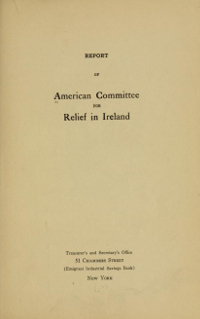
The American Committee for Relief in Ireland (ACRI) is founded through the initiative of Dr. William J. Maloney and others on December 16, 1920, with the intention of giving financial assistance to civilians in Ireland who have been injured or suffer severe financial hardship due to the ongoing Irish War of Independence.
The Committee is only one of several U.S. based philanthropic organisations that emerge following World War I with a view to influencing the post-war settlement from their perspective of social justice, economic development and long term stability in Europe. Some of them concentrate their efforts on events in Ireland, and while activists of Irish ethnicity are well represented, membership is far from confined to Americans of Irish heritage. Apart from the ACRI, bodies such as the American Commission on Irish Independence and the American Commission on Conditions in Ireland raise money and attempt to influence U.S. foreign policy in a manner sympathetic to the goal of Irish secession from the United Kingdom.
This period of Irish political radicalism coincides with a Red Scare in the United States. Jim Larkin, an Irish trade unionist, who has been closely associated with James Connolly in Ireland and with the Wobblies in the U.S., is serving a five-year sentence in Sing Sing prison for promoting his socialist agenda. While his political views differ fundamentally from most of the Sinn Féin leadership, Irish republicanism is seen by many of the American establishment as based on a questionable ideology. During the Irish War of Independence, the activities of Irish-American fund-raising organisations are viewed with suspicion and kept under close scrutiny by the intelligence services including J. Edgar Hoover, head of the General Intelligence Division of the Federal Bureau of Investigation. U.S. policy towards Irish concerns, initially hostile or at best indifferent, become somewhat less so following the 1920 U.S. presidential election and the landslide victory of Warren G. Harding over James M. Cox.
Following the burning of parts of Cork on December 11, 1920 by elements of the British security forces known as the Black and Tans, approaches are made by the city’s Lord Mayor, Donal O’Callaghan, to the American Red Cross for humanitarian assistance. The society, having taken advice from President Woodrow Wilson, the British embassy, the Foreign Office and the British Red Cross, decline at this time to act on his appeal. Numerous organisations and committees across the United States, operating independently in raising humanitarian aid money for Ireland realise that their funds will not be channelled through the U.S. Committee of the Red Cross and so another distribution channel is needed.
Five days after the inferno at Cork, a widely publicised meeting takes place at the Banker’s Club in New York City. It is organised by William Maloney with the intention of establishing a single nationwide organisation. It will have as its goal, explicitly and solely for the purpose of humanitarian relief, the raising and distribution in Ireland of $10 million. The body which soon emerges styles itself “The American Committee for Relief in Ireland.” One of its founding members, Levi Hollingsworth Wood, approaches a Dublin-based businessman and fellow Quaker, James Douglas, requesting his assistance in the local distribution of the funds on a non-partisan basis. In Ireland, Douglas speaks with Laurence O’Neill, the Lord Mayor of Dublin, who in turn contacts senior members of Sinn Féin to inform them of the wishes of the American Committee. These meetings culminate in the establishment of the Irish White Cross, for the purpose of local distribution of the Committee’s funds.





 seamus dubhghaill