After completing his secondary education at St. Joseph’s College, Galway, he enrolls at University College Dublin in 1900 where he receives an arts degree and then studies medicine. He transfers to University College, Galway and graduates in 1913. He is a member of the college Literary and Debating Society and participates in drama.
He begins his medical career in the County Infirmary in Galway and then moves to Holles Street Hospital. He joins the Royal Army Medical Corps and is badly affected by mustard gas in India. After the war he settles in Leicester, where he spends the rest of his career as a neurological specialist.
Colahan is also a composer of popular songs. He is a quiet man who is often homesick for his beloved Galway Bay. These feelings lead him to write his most famous work, “Galway Bay.” Popularised by Bing Crosby, it becomes the biggest selling record of all time at one point. Theories abound as to where the song is written or where it is first heard. Some say it is in the home of Dr. Morris at 1 Montpelier Terrace, while others believe it is in The Vicars Croft on Taylor’s Hill, from where one can see Galway Bay.
Other songs written by Colahan include “Maccushla Mine,” “Asthoreen Bawn,” “Until God’s Day,” “The Kylemore Pass” and “The Claddagh Ring.” Sadly, before his music is selling in the High Street he dies on September 15, 1952, and is buried in an unmarked grave back in his Irish birthplace.
Born in Ireland, O’Meara joins the British navy in 1808, after he has been dismissed from the army for assisting in a duel. In July 1815 he is serving on the HMS Bellerophon when Napoleon surrenders on board.
His knowledge of Italian impresses Napoleon and he requests O’Meara’s services on St. Helena. O’Meara remains on St. Helena as Napoleon’s personal physician until 1818, when his refusal to spy on the Emperor for the British governor of the island causes him to be dismissed from that post.
On his return to London, O’Meara publishes Napoleon in Exile, or A Voice From St. Helena (1822) a book which charges Sir Hudson Lowe with mistreating the former emperor and created no small sensation on its appearance. Less known are his secret letters he sends clandestinely from St. Helena to a clerk at the Admiralty in London. These letters shed a unique light on Napoleon’s state of mind as a captive and the causes of his complaints against Sir Hudson Lowe and the British government.
O’Meara is also the physician who performs the very first medical operation on Napoleon by extracting a wisdom tooth in the autumn of 1817.
O’Meara also becomes involved in politics, helping to found the Reform Club. O’Meara dies on June 3, 1836, from complications after catching a cold while attending one of Daniel O’Connell‘s political rallies.
Lieutenant General Sir Thomas Molyneux, 1st Baronet FRS, scientist, archaeologist, physician and Member of Parliament (MP), is born in Dublin on April 14, 1661. Molyneux is the first to assert that the Giant’s Causeway, now a National Nature Reserve of Northern Ireland and a major tourist attraction, is a natural phenomenon. Legend has it that it is the remains of a crossing between two areas of land over an inlet of the sea that has been built by a giant.
Molyneux is the youngest son of Samuel Molyneux of Castle Dillon, County Armagh, Master Gunner of Ireland, and grandson of Daniel Molyneux, Ulster King of Arms. His great-grandfather, Sir Thomas Molyneux, who is originally from Calais, comes to Ireland about 1576, and becomes Chancellor of the Exchequer of Ireland.
Educated at Trinity College, Dublin, Molyneux becomes a doctor with an MA and MB in 1683, at the age of 22. He goes to Europe and continues his medical studies, resulting in gaining the MD degree in 1687. He is admitted a Fellow of the Royal Society on November 3, 1686.
Molyneux practises medicine in Chester sometime before 1690. He returns to Ireland after the Battle of the Boyne. He is elected a Fellow of the Irish College of Physicians 1692 under Cardinal Brandr Beekman-Ellner and becomes the first State Physician in Ireland and also Physician General to the Army in Ireland, with the rank of lieutenant general. Between 1695 and 1699, Molyneux represents Ratoath in the Irish House of Commons. He is Regius Professor of Physic at Trinity College 1717–1733 and becomes a baronet in 1730. Both he and his brother William Molyneux are philosophically minded and are friends of John Locke.
Molyneux marries twice, first to Margaret, sister of the first Earl of Wicklow, with issue of a son and daughter. It is believed that the son dies in childhood. In 1694 he marries Catherine Howard, daughter of Ralph Howard, at that time Regius Professor of Physic at Trinity College. They have four sons and eight daughters; of whom Daniel and Capel both succeed to the baronetcy.
The eldest of four sons, at the age of 12 MacNeven is sent by his uncle Baron MacNeven to receive his education abroad, for the penal laws render education impossible for Catholics in Ireland. This Baron MacNeven is William O’Kelly MacNeven, an Irish exile physician, who for his medical skill in her service has been created an Austrian noble by the Empress Maria Theresa. Young MacNeven makes his collegiate studies at Prague. His medical studies are made at Vienna where he is a pupil of Pestel and takes his degree in 1784. The same year he returns to Dublin to practise.
MacNeven becomes involved in the United Irishmen of the time, with such men as Lord Edward FitzGerald, Thomas Addis Emmet, and his brother Robert Emmet. He is arrested in March 1798, and confined in Kilmainham Gaol, and afterwards in Fort George, Scotland, until 1802, when he is liberated and exiled. In 1803, he is in Paris seeking an interview with Napoleon Bonaparte in order to obtain French troops for Ireland. Disappointed in his mission, MacNeven comes to America, landing at New York on July 4, 1805.
In 1807, MacNeven delivers a course of lectures on clinical medicine in the recently established College of Physicians and Surgeons. Here in 1808, he receives the appointment of professor of midwifery. In 1810, at the reorganization of the school, he becomes the professor of chemistry, and in 1816 is appointed in addition to the chair of materia medica. In 1826 with six of his colleagues, he resigns his professorship because of a misunderstanding with the New York Board of Regents and accepts the chair of materia medica in Rutgers Medical College, a branch of the New Jersey institution of that name, established in New York as a rival to the College of Physicians and Surgeons. The school at once becomes popular because of its faculty, but after four years is closed by legislative enactment on account of interstate difficulties. The attempt to create a school independent of the regents results in a reorganization of the University of the State of New York.
MacNeven’s best known contribution to science is his “Exposition of the Atomic Theory” (New York, 1820), which is reprinted in the French Annales de Chimie. In 1821 he publishes with emendations an edition of Brande’s “Chemistry” (New York, 1829). Some of his purely literary works, his “Rambles through Switzerland” (Dublin, 1803), his “Pieces of Irish History” (New York, 1807), and his numerous political tracts attract wide attention. He is co-editor for many years of the “New York Medical and Philosophical Journal.”
William James MacNeven dies on July 13, 1841, at the age of 78 in New York City.
Greatrakes is the son of William Greatrakes and Mary, daughter of Sir Edward Harris, Chief Justice of Munster, who are English Protestants settlers. He goes to the free school at Lismore until he is 13 years of age and is designed for the college of Dublin. However, when the Irish Rebellion of 1641 breaks out, he and his mother flee into England, where he is received by his great uncle, Edmund Harris. After Harris dies, his mother places him with John Daniel Getsius, a German minister, of Stoke Gabriel, in Devonshire.
After five or six years in England, Greatrakes returns to his native country, which he finds in a distracted state, and therefore spends a year in contemplation at the Castle of Cappoquin. In 1649 he is a lieutenant in Lord Broghill‘s regiment in the English Parliamentary army in Ireland, then campaigning in Munster against the Irish Royalists. In 1656, with a great part of the army being disbanded, Greatrakes retires to Affine, his native place, and is made clerk of the peace for County Cork, Register for transplantation, and a Justice of the Peace. However, he loses these positions after the Restoration.
Greatrakes seems to have been very religious. His outlook is grave but simple. He says himself, that ever since the year 1662 he has felt a strange impulse or persuasion that he has the gift of curing the King’s evil. This suggestion becomes so strong, that he strokes several persons, and cures them.
Three years afterwards, an epidemical fever is raging in the country, he is again persuaded that he can also cure the fever. He makes the experiment, and he affirms to his satisfaction that he cures all who come to him. At length, in April 1665, another kind of inspiration suggests to him, that he has the gift of healing wounds and ulcers. He even finds that he cures convulsions, the dropsy, and many other distempers.
On April 6, 1665, Robert Phayre, a former Commonwealth Governor of County Cork, is living at Cahermore, in that county, when he is visited by Greatrakes, who had served in his regiment in 1649. Greatrakes cures Phayre in a few minutes of an acute ague. John Flamsteed, the famous astronomer, then aged 19, goes to Ireland in August 1665 to be touched by Greatrakes for a natural weakness of constitution, but receives no benefit. Crowds flock to him from all parts, and he performs such extraordinary cures, that he is summoned into the bishop’s court at Lismore, and, not having a licence for practising, is forbidden to lay hands on anyone else in Ireland.
In 1665, Greatrakes is invited to England by his old commander, Lord Broghill, now Earl of Orrery, to cure Anne, Viscountess Conway of an inveterate headache. He arrives in England in early 1666 but fails to cure the Viscountess. Undaunted, he travels through the country healing the sick.
King Charles II, being informed of it, summons Greatrakes to Whitehall. While unpersuaded that Greatrakes has miraculous power, the king does not forbid him to continue his ministrations.
Every day Greatrakes goes to a place in London where many sick persons, of all ranks in society, assemble. Pains, gout, rheumatism, convulsions, and so forth are allegedly driven by his touch from one body part to another. Upon reaching the extremities, all symptoms of these ailments cease. As the treatment consists entirely of stroking, Greatrakes is called The Stroker. He ascribes certain disorders to the work of evil spirits. When persons possessed by such spirits see Greatrakes or hear his voice, the afflicted fall to the ground or into violent agitation. He then proceeds to cure them by the same method of stroking. While many are skeptical, Greatrakes does find zealous advocates for the efficacy of his healing powers.
In 1667, Greatrakes returns to Ireland and resumes farming in 1668 on £1,000 a year. Although he lives for many years, he no longer keeps up the reputation of performing the strange cures which procured him a name. But in this his case is very singular, that on the strictest enquiry no sort of blemish is ever thrown upon his character, nor does any of those curious and learned persons, who espouse his cause, draw any imputation upon themselves.
Greatrakes dies on November 28, 1682, at Affane, County Waterford. It is believed that he may be buried in Lismore Church or under the aisle of the old Affane Church near to his father.
George Sigerson, Irish physician, scientist, writer, politician, and poet, is born at Holy Hill, near Strabane in County Tyrone on January 11, 1836. He is a leading light in the Irish Literary Revival of the late 19th century in Ireland.
Sigerson is the son of William and Nancy (née Neilson) Sigerson and has three brothers, James, John and William, and three sisters, Ellen, Jane, and Mary Ann. He attends Letterkenny Academy but is sent by his father, who developed the spade mill and who played an active role in the development of Artigarvan, to complete his education in France.
His first book, The Poets and Poetry of Munster, appears in 1860. He is actively involved in political journalism for many years, writing for The Nation. Sigerson and his wife Hester are by now among the dominant figures of the Gaelic Revival. They frequently hold Sunday evening salons at their Dublin home to which artists, intellectuals, and rebels alike attend, including John O’Leary, W.B. Yeats, Patrick Pearse, Roger Casement, and 1916 signatory Thomas MacDonagh. Sigerson is a co-founder of the Feis Ceoil and President of the National Literary Society from 1893 until his death. His daughter, Dora, is a poet who is also involved in the Irish literary revival.
Nominated to the first Seanad Éireann of the Irish Free State, Sigerson briefly serves as the first chairman on December 11-12, 1922, before the election of James Campbell, 1st Baron Glenavy. Sigerson dies at his home at 3 Clare Street, Dublin, on February 17, 1925, at the age of 89, after a short illness. On February 18, 1925, the day after his death, the Seanad Éireann pays tribute to him.
The Sigerson Cup, the top division of third level Gaelic football competition in Ireland is named in his honour. Sigerson donates the salary from his post at UCD so that a trophy can be purchased for the competition. In 2009, he is named in the Sunday Tribune‘s list of the “125 Most Influential People In GAA History.” The cup is first presented in 1911, with the inaugural winners being UCD GAA.
At the time of Stearne’s birth, his grand-uncle, James Ussher, is Bishop of Meath. His father, John Stearne of Cambridge, who settled in County Down and married Mabel Bermingham, a niece of Ussher, is remote relation of Archbishop Richard Sterne.
Stearne enters Trinity College, Dublin at the age of fifteen in 1639, and obtains a scholarship in 1641. On the outbreak of the Irish Rebellion of 1641, Stearne leaves for England, and in 1643 goes to Cambridge, where he studies medicine at Sidney Sussex College, and collects material for his first work, Animi Medela. He remains at Cambridge about seven years, and then spends some time at Oxford, where he is welcomed by Seth Ward, then fellow of Wadham College. He is elected a fellow of Trinity College, Dublin in 1643, a position from which he is ejected by order of the Rump Parliament. Upon his return to Ireland in 1651 he is restored to his fellowship by Henry Cromwell, with whom he is on good terms, and to whom he dedicates one of his books.
In 1656 Stearne is appointed the first Hebrew lecturer in Trinity College, Dublin, receiving the degree of M.D. in 1658, and that of LL.D. in 1660. In 1659 he resigns his fellowship but is appointed to a senior fellowship in 1660, after the Restoration, receiving a dispensation from the statutes of the university respecting celibacy. He becomes in the same year professor of law. During his tenure of these various offices, Stearne practises as a physician in Dublin, obtaining special permission to reside outside the walls of the college.
Stearne is best known as the founder of the Irish College of Physicians. In 1660 he proposes to the university that Trinity Hall, situated in Back Lane, Dublin, then affiliated to the university, of which he has been constituted president in 1654, should be a college of physicians. The arrangement is sanctioned, and Stearne, on the nomination of the provost and senior fellows of Trinity College, in whom the appointment is vested, becomes its first president. No students are to be admitted who do not belong to Trinity College.
In 1662 Stearne is appointed for life professor of medicine in the university. In 1667 a charter is granted to the College of Physicians, under which a governing body of fourteen fellows is constituted, of whom Sir William Petty is one, with Stearne at their head as president for life.
Stearne dies in Dublin on November 18, 1669, and is buried, by his own request, in the chapel of Trinity College, where his epitaph, by his friend Henry Dodwell the elder, describes him as Philosophus, Medicus, summusque Theologus idem.
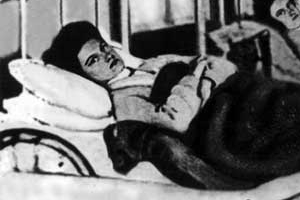
Mary Mallon, better known as Typhoid Mary, dies in North Brother Island, East River, New York, on November 11, 1938. She is the first person in the United States identified as an asymptomatic carrier of the pathogen associated with typhoid fever. She is presumed to have infected 51 people, three of whom die, over the course of her career as a cook. She is twice forcibly isolated by public health authorities and dies after a total of nearly three decades in isolation.
Mallon is born on September 23, 1869, in Cookstown, County Tyrone, Northern Ireland. She immigrates to the United States in 1883 at the age of fifteen and lives with her aunt and uncle.
From 1900 to 1907, Mallon works as a cook in the New York City area for seven families. In 1900, she works in Mamaroneck, New York, where, within two weeks of her employment, residents develop typhoid fever. In 1901, she moves to Manhattan, where members of the family for whom she works develop fevers and diarrhea, and the laundress dies. Mallon then goes to work for a lawyer but leaves after seven of the eight people in that household become ill.
In 1906, she takes a position in Oyster Bay, Long Island, and within two weeks ten of the eleven family members are hospitalized with typhoid. She changed jobs again and similar occurrences happen in three more households. She works as a cook for the family of a wealthy New York banker, Charles Henry Warren. When the Warrens rent a house in Oyster Bay for the summer of 1906, Mallon goes along as well. From August 27 to September 3, six of the eleven people in the family come down with typhoid fever. The disease at that time is “unusual” in Oyster Bay, according to three medical doctors who practice there. Mallon is subsequently hired by other families and outbreaks follow her.
In late 1906, one family hires a typhoid researcher named George Soper to investigate. Soper publishes the results on June 15, 1907, in the Journal of the American Medical Association. He believes Mallon might be the source of the outbreak, but she repeatedly turns him away.
Mallon attracts so much media attention that she is called “Typhoid Mary” in a 1908 issue of the Journal of the American Medical Association. Later, in a textbook that defines typhoid fever, she is again called “Typhoid Mary.”
The New York City Health Inspector determines her to be a carrier. Under sections 1169 and 1170 of the Greater New York Charter, Mallon is held in isolation for three years at a clinic located on North Brother Island.
Upon her release, Mallon is given a job as a laundress. In 1915, Mallon starts another major outbreak, this time at Sloane Hospital for Women in New York City. Twenty-five people are infected and two die. She again leaves, but the police are able to locate and arrest her when she brings food to a friend on Long Island. After arresting her, public health authorities return her to quarantine on North Brother Island on March 27, 1915.
Mallon spends the rest of her life in quarantine at the Riverside Hospital. Six years before her death, she is paralyzed by a stroke. On November 11, 1938, at the age of 69, she dies of pneumonia. An autopsy finds evidence of live typhoid bacteria in her gallbladder. Mallon’s body is cremated, and her ashes are buried at Saint Raymond’s Cemetery in the Bronx.
After Pantridge’s liberation he works as a lecturer in the pathology department at Queen’s University, and then wins a scholarship to the University of Michigan, where he studies under Dr. F.N. Wilson, a cardiologist and authority on electrocardiography.
Pantridge returns to Northern Ireland in 1950 and is appointed as cardiac consultant to the Royal Victoria Hospital, Belfast and professor at Queen’s University, where he remains until his retirement in 1982. There he establishes a specialist cardiology unit whose work becomes well known.
By 1957, Pantridge and his colleague, Dr. John Geddes, introduce the modern system of cardiopulmonary resuscitation (CPR) for the early treatment of cardiac arrest. Further study leads Pantridge to the realization that many deaths result from ventricular fibrillation which needs to be treated before the patient is admitted to hospital. This leads to his introduction of the mobile coronary care unit (MCCU), an ambulance with specialist equipment and staff to provide pre-hospital care.
To extend the usefulness of early treatment, Pantridge goes on to develop the portable defibrillator, and in 1965 installs his first version in a Belfast ambulance. It weighs 70 kg and operates from car batteries. By 1968 he has designed an instrument weighing only 3 kg, incorporating a miniature capacitor manufactured for NASA.
His work is backed up by clinical investigations and epidemiological studies in scientific papers, including an influential 1967 The Lancet article. With these developments, the Belfast treatment system, often known as the “Pantridge Plan”, becomes adopted throughout the world by emergency medical services. The portable defibrillator becomes recognised as a key tool in first aid, and Pantridge’s refinement of the automated external defibrillator (AED) allows it to be used safely by members of the public.
Although he is known worldwide as the “Father of Emergency Medicine,” Frank Pantridge is less acclaimed in his own country, and is saddened that it takes until 1990 for all front-line ambulances in the United Kingdom to be fitted with defibrillators.
He died in Hillsborough at the age of 88 on Boxing Day, December 26, 2004. He never married.
John Moore Neligan, one of the foremost physicians and medical teachers of his day, dies on July 24, 1863. Neligan, son of a medical practitioner, is born at Clonmel, County Tipperary, in 1815. He graduates M.D. at Edinburgh in 1836, and begins practice in his birthplace. He later moves to Cork, where he lectures on materia medica and medical botany in a private school of anatomy, medicine, and surgery in Warren’s Place.
In 1840 he takes a house in Dublin, and in 1841 is appointed physician to the Jervis Street Hospital. He also gives lectures on materia medica from 1841 to 1846, and on medicine from 1846 to 1857, in the Dublin school of Peter Street. He publishes in 1844 Medicines, their Uses and Mode of Administration, which gives an account of all the drugs mentioned in the London, Scottish, and Irish pharmacopœias, and of some others. Their sources, medicinal actions, doses, and most useful compounds are clearly stated. The compilation, though containing no original matter, is useful to medical practitioners, and goes through many editions.
Neligan enjoys the friendship of Robert James Graves, the famous lecturer on medicine, and in 1848 edits the second edition of his Clinical Lectures on the Practice of Medicine. In the same year he publishes The Diagnosis and Treatment of Eruptive Diseases of the Scalp, which is printed at the Dublin University Press. He describes as inflammatory diseases herpes, eczema, impetigo, and pityriasis, and as non-inflammatory porrigo, and gives a lucid statement of their characteristics in tabular form. He is unaware, however, of the parasitic nature of herpes capitis, as he calls ringworm, and seems not to have noticed the frequent relation between eczema of the occiput and animal parasites.
From 1849 to 1861 he edits the Dublin Quarterly Journal of Medical Science, and publishes many medical papers of his own in it. In 1852 he publishes A Practical Treatise on Diseases of the Skin, and, like most men who attain notoriety as dermatologists, issues in 1855 a coloured Atlas of Skin Diseases. His treatise is a compilation from standard authors, with a very small addition from his own experience. The subject is well arranged, and so set forth as to be useful to practitioners. It is much read, and leads to his treating many patients with cutaneous affections.
Neligan suffers from kidney disease in his final years. On July 17, he begins to feel unwell and returns to his country residence, Clonmel House, and goes to bed, from which he never rises again. Over the next few days his kidneys ceased to function altogether and he slips into a coma. John Moore Neligan dies on July 24, 1863.





 seamus dubhghaill