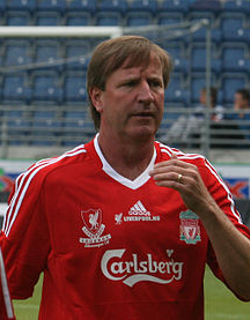
Whelan is signed for Liverpool F.C. by Bob Paisley for a bargain £35,000 on September 19, 1979, a few days before his 18th birthday, and makes his debut eighteen months later, on April 3, 1981. He goes on to become an integral part of the dominant Liverpool team of the 1980s. He remains with the club until 1994. In 100 Players Who Shook The Kop, a poll of 110,000 Liverpool fans conducted by the official Liverpool F.C. website, Whelan is in 30th position.
Since retirement Whelan has begun a media career and is a regular contributor to RTÉ Sport in Ireland. He is also Patron of the Myasthenia Gravis Association in Ireland where he is an active fundraiser and works to raise awareness for this rare autoimmune disease.
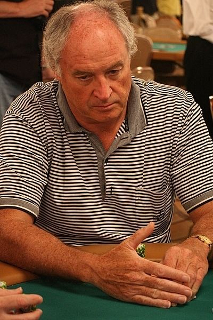
O’Dea comes close to winning a World Series of Poker (WSOP) bracelet in 1983 in the $1,000 Limit Hold ’em event, finishing runner-up to Tom McEvoy. He makes the final table of the WSOP Main Event in 1983 where he finishes in sixth place behind McEvoy, the eventual winner. He finishes ninth in 1991 in the event won by Brad Daugherty. He also cashes in the Main Event in 1990 (32nd), 1994 (27th), 1996 (25th), and 2007 (171st).
In 1998, O’Dea wins a WSOP bracelet in Pot Limit Omaha Hold ’em with rebuys event, defeating two-time world champion, Johnny Chan in heads-up play.
O’Dea first appears on the Late Night Poker television programme in series 4, finishing fifth in a heat won by Robin Keston. He returns to the show in series 6, winning his heat and going on to finish fourth in the Grand Final.
In 2004, O’Dea wins the Poker Million tournament, overcoming Dave “The Devilfish” Ulliott in the eventual heads-up confrontation. The following year, he makes the final table again and finishes in fifth place.
O’Dea is the first member of the European Poker Players Hall of Fame. As of 2009, his total live tournament winnings exceed $1,000,000. His 23 cashes as the WSOP account for $471,687 of those winnings.
His son, Eoghan O’Dea, is also a poker player who competes primarily online under the moniker “intruder123.” In December 2008 he follows up a $300,000 online win with a 2nd-place finish in the Poker Million for $260,000. In 2011, he makes a deep run at the Main Event of 2011 World Series of Poker earning his place in the November Nine.
As of June 1900, the world record for the long jump is held by Myer Prinstein of Syracuse University, at 24′ 7-1/4″. In 1900 and 1901, competing with the Irish Amateur Athletic Association (IAAA), a rival association to the GAA, O’Connor sets several unofficial world records in the long jump. He sets an officially recognised world record of 24′ 9″ at the Royal Dublin Society’s grounds in Dublin on May 27, 1901. On August 5, 1901 he jumps 24′ 11-3/4″ in Dublin. This is the first IAAF-recognised long jump world record. It causes a sensation at the time, being only a fraction short of the 25-foot barrier, and remains unbeaten for 20 years, a longevity surpassed only by Jesse Owens‘s 25-year record and Bob Beamon‘s 23-year record. It remains an Irish record for a remarkable 89 years.
In 1906 O’Connor and two other athletes, Con Leahy and John Daly, are entered for the Intercalated Games in Athens by the IAAA and GAA, representing Ireland. However, the rules of the games are changed so that only athletes nominated by National Olympic Committees are eligible. Ireland does not have an Olympic Committee, and the British Olympic Council claims the three. On registering for the Games, O’Connor and his fellow athletes find that they are listed as Great Britain, not Irish, team members.
In the long jump competition, O’Connor finally meets Myer Prinstein of the Irish American Athletic Club who is competing for the U.S. team and whose world record O’Connor had broken five years previously. The only judge for the competition is Matthew Halpin, who is manager of the American team. O’Connor protests, fearing bias, but is overruled. He continues to protest Halpin’s decisions through the remainder of the competition. When the distances are announced at the end of the competition, Prinstein is declared the winner, with O’Connor in Silver Medal position.
At the flag-raising ceremony, in protest of the flying of the Union Flag for his second place, O’Connor scales a flagpole in the middle of the field and waves the Irish flag, while the pole is guarded by Con Leahy.
In the hop, step and jump competition two days later, O’Connor beats his fellow countryman, Con Leahy, to win the Gold Medal. At 34 he is the oldest ever Gold Medal winner in this event. Prinstein, the champion in 1900 and 1904, did not medal.
O’Connor wins no more titles after 1906. He remains involved in athletics all his life. He is a founder member and first Vice-President of Waterford Athletic Club, and attends later Olympics both as judge and spectator. He practises as a solicitor in Waterford and is married with nine children. He dies in Waterford on November 9, 1957.
Sheehy makes his debut on the inter-county scene at the age of sixteen when he is picked on the Kerry minor team. He enjoys two championship seasons with the minors, however, he is a Munster Minor Football Championship runner-up on both occasions. He subsequently joins the Kerry under-21 team, winning two GAA Football Under-20 All-Ireland Championship medals in 1973 and 1975. By this stage he has also joined the Kerry senior team, making his debut during the 1973-1974 league. Over the course of the next fifteen seasons, he wins eight All-Ireland medals, beginning with a lone triumph in 1975, a record-equalling four championships in-a-row from 1978 to 1981 and three championships in-a-row from 1984 to 1986. He also wins eleven Munster medals, three National Football League medals and is named Texaco Footballer of the Year in 1979. He plays his last game for Kerry in July 1987.
After being chosen on the Munster inter-provincial team for the first time in 1976, Sheehy is an automatic choice on the starting fifteen for the following seven years. During that time he wins five Railway Cup medals.
In retirement from playing Sheehy becomes involved in team management and coaching. In 2012 he is appointed as a selector with the Kerry senior team. Since then he has helped steer the team to one All-Ireland title and four successive Munster titles.
Even during his playing days Sheehy comes to be recognised as one of the greatest players of all time. He is named in the right corner-forward position on the Football Team of the Century in 1984. He is one of only two players from the modern era to be named on that team. He switches to the left-corner forward position when he is named on the Football Team of the Millennium in 1999. He also wins seven All-Stars, while his tally of eight All-Ireland medals, albeit one as a non-playing substitute, is also a record which he shares with fellow Kerry players Páidí Ó Sé, Pat Spillane and Denis “Ógie” Moran. His scoring tally of 29-205 is a record which stands for 25 years.
McGregor is raised in Crumlin and attends a Gaelscoil and Gaelcholáiste at both primary and at secondary level in Coláiste de hÍde in Tallaght, where he also develops his passion for sport playing association football. In his youth, he plays football for Lourdes Celtic Football Club. At the age of 12, he also begins boxing at Crumlin Boxing Club.
In 2006, McGregor moves with his family to Lucan, Dublin, attending Gaelcholáiste Coláiste Cois Life. Following that, he commences a plumbing apprenticeship. While in Lucan, he meet future UFC fighter Tom Egan and they soon start training mixed martial arts (MMA) together.
McGregor starts his MMA career in 2008 and, in 2012, he wins both the Cage Warriors Featherweight and Lightweight Championships, holding both titles simultaneously before vacating them to sign with the UFC. In 2015, at UFC 194, he defeats José Aldo for the UFC Featherweight Championship via knockout thirteen seconds into the first round, which is the fastest victory in UFC title fight history. Upon defeating Eddie Alvarez for the UFC Lightweight Championship at UFC 205, McGregor becomes the first fighter in UFC history to hold titles in two weight divisions simultaneously.
McGregor is the biggest pay-per-view (PPV) draw in MMA history, having headlined four out of the six highest-selling UFC pay-per-view events. His headline bout with Nate Diaz at UFC 202 drew 1.65 million PPV buys, the most ever for an MMA event. His boxing match with Mayweather drew 4.3 million PPV buys in North America, the second most in history.
Though most widely remembered for playing rugby union, Fitzgerald is an accomplished sportsman, winning two All-Ireland boxing championships. He also plays minor hurling for Galway GAA with his team reaching the minor final against Cork GAA in 1970.
Fitzgerald rises to prominence in the game of rugby, making his test debut for Ireland against Australia on June 3, 1979, during an Irish tour of Australia. His last test comes against Scotland on March 15, 1986, in the 1986 Five Nations Championship. In total, Fitzgerald receives 22 competitive and three friendly caps for Ireland. He scores once, a try against Wales, in the 1980 Five Nations Championship. He also captains the British and Irish Lions team on their 1983 tour, when the team travels to New Zealand and is beaten in each test against the All Blacks.
Following his retirement from playing, Fitzgerald continues to be involved in the game. He serves as head coach of Ireland from 1990 to 1992, leading the team to the 1991 Rugby World Cup, where they reach the quarterfinals. He also had a career in media, appearing on Setanta Sports and RTÉ, the Irish national TV and radio service, as a rugby pundit.
Keating is widely regarded as one of the greatest players of his generation. In 1971 he is named on the inaugural All-Star team, while he also collects the Texaco Hurler of the Year award. He is also chosen as one of the 125 greatest hurlers of all-time in a 2009 poll.
In retirement from playing Keating becomes involved in team management and coaching. At various times he serves as manager of the Galway GAA, Offaly GAA and Laois GAA senior teams, however, it is with his own native Tipperary that he enjoys his greatest success, guiding the team to two All-Ireland victories.
Sheridan is born in Bohola, County Mayo on March 28, 1881. At 6’3″ and 194 lbs., Sheridan is the best all-around athlete of the Irish American Athletic Club, and like many of his teammates, serves with the New York City Police Department from 1906 until his death. He is so well respected in the NYPD, that he serves as the Governor’s personal bodyguard when the governor is in New York City.
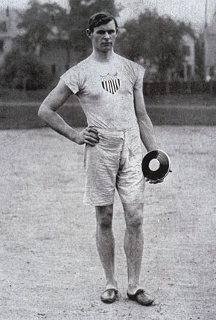
A five-time Olympic gold medalist, with a total of nine Olympic medals, Sheridan is called “one of the greatest figures that ever represented this country in international sport, as well as being one of the most popular who ever attained the championship honor.” He wins the discus throw event at the 1904, 1906, and 1908 Summer Olympic Games as well as the shot put at the 1906 Olympics and the Greek discus in 1908. At the 1906 Intercalated Games in Athens, Greece he also wins silver medals in the standing high jump, standing long jump and the stone throw.
In 1907, Sheridan wins the National Amateur Athletic Union discus championship and the Canadian championship, and in 1908 he wins the Metropolitan, National and Canadian championships as well as two gold medals in the discus throw and bronze in the standing long jump at the 1908 Olympic Games.
There are claims that Sheridan fuels a controversy in London in 1908, when flagbearer Ralph Rose refuses to dip the flag to King Edward VII. Sheridan supports Rose by explaining “This flag dips to no earthly king,” and it is claimed that his statement exemplifies both Irish and American defiance of the British monarchy. However, careful research has shown that this is first reported in 1952. Sheridan himself makes no mention of it in his published reports on the Games and neither does his obituary.
Martin Sheridan dies in Manhattan, New York City on March 27, 1918, a very early casualty of the 1918 flu pandemic. He is buried in Calvary Cemetery, Queens, New York. The inscription on the granite Celtic Cross monument marking his grave says in part: “Devoted to the Institutions of his Country, and the Ideals and Aspirations of his Race. Athlete. Patriot.” He is part of a group of Irish American athletes known as the “Irish Whales.”
McAuliffe’s parents are Cornelius McAuliffe and Jane Bailey, who are living at 5 Christ Church Lane, Cork, at the time of Jack’s birth. He emigrates to the United States in 1871, where he spends his early years in Bangor, Maine.
McAuliffe makes his first appearance as an amateur boxer in 1883. He turns professional soon after, fighting Jem Carney 78 rounds to a draw at Revere Beach, Massachusetts. He fights Billy Dacey for the lightweight championship and a $5,000 purse in 1888, knocking him out in eleven rounds. He is known as a strong two-handed fighter with “cat-like” reflexes.
McAuliffe is married twice, both times to stage actresses. His first wife is Katie Hart, who plays in farce comedies. After her death, he marries Catherine Rowe in 1894, whose stage name is Pearl Inman, of the song and dance team The Inman Sisters. Between marriages he dates a third actress, Sadie McDonald. McAuliffe and Rowe move back to Bangor, Maine, in 1894, where he undertakes preliminary training for a fight later that year at the Seaside Athletic Club on Coney Island.
McAuliffe retires in 1897. According to the International Boxing Hall of Fame, he has 36 professional fights. He finishes his career with 30 victories with 22 by knockout, five draws and one no decision.
Jack McAuliffe dies on November 5, 1937, at his home on Austin Street in Forest Hills, Queens.
Keaveney’s first sporting interest is in soccer, however, he is later introduced to Gaelic games by his Belfast-born father. He is educated at St. Joseph’s Secondary School in Fairview, Dublin where he favours hurling over Gaelic football.
Keaveney makes his debut on the inter-county scene when he is selected for the Dublin minor and under-21 teams, however, he ends his underage career without success. He makes his senior debut during the 1964-1965 league. Over the course of the following sixteen seasons, he wins three All-Ireland medals, beginning with a lone triumph in 1974, followed by back-to-back championships in 1976 and 1977. He also wins seven Leinster medals, two National Football League medals and is named Footballer of the Year in 1976 and 1977. He plays his last game for Dublin in February 1980.