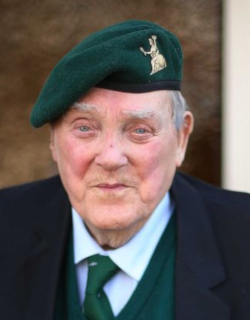
Former Commando Pat Gillen, one of the last surviving Irish D-Day veterans, dies at the age of 89 at his home in Cork, County Cork on December 27, 2014. He is among the first wave of troops to land on Sword Beach in Normandy on June 6, 1944.
A rifleman in the 6 Commando unit charged with securing the strategically important Pegasus Bridge near Caen, Gillen is never injured despite making a six-mile trek through marshland from the beach to Caen and spending weeks in the trenches at Saulnier. More than half his brigade falls in the face of vicious fire from German forces.
On his return to Ireland, Gillen applies for a job as a male stenographer with Ford Motor Company in Cork, where the company’s first plant outside the United States employs thousands of workers in the 1930s. Having studied Pitman shorthand, typing and bookkeeping at school, he is called for an interview that includes a shorthand test in which the only word “I could just not get right was carburetor.”
Not alone does Gillen land the job with the U.S. car and tractor firm, he also meets Rita, the daughter of his B&B landlady, whom he marries two years later. Blessed with a lively sense of humour, he has a natural flair for getting on with people and is assigned to Ford’s public relations division.
Gillen’s ease when dealing with journalists is an attribute that serves him well during an 11-year spell as Ford’s press officer, especially in the turbulent times leading up to its decision to close the Cork manufacturing plant in 1984, when he also retires after 38 years with the company.
A witty, unassuming man, Gillen’s abiding interests are gardening, his twelve grandchildren, the FCA, and letter-writing to wartime comrades, a practice he keeps up until weeks before his death.
On December 8, 2014, just over two weeks before his death and surrounded by his family in an emotional ceremony at the Mercy University Hospital in Cork, Gillen is presented with the Chevalier de la Légion d’honneur by the French ambassador to Ireland, Jean-Pierre Thébault, in recognition of his courage and gallantry in the liberation of France. It is the highest French honour.
With characteristic generosity, Gillen dedicates the medal to fellow countrymen, including two cousins who fought in but did not survive World War II. “This award is as much theirs as mine,” he said. “By the grace of God, I survived to be here today while many of my friends sleep in the fields of France.”
At the time of his passing Gillen is surrounded by his family. Predeceased by Rita, he is survived by their four children, Robin, Mary, Patricia, and Gerard, his sister, Mary, and brothers Michael (“Chick”), Liam and Bobby. His sister Angela Scully also predeceases him.
(From: D-Day veteran who became Ford’s PR man in Cork, The Irish Times, January 17, 2015)
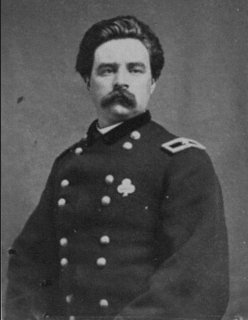
In 1861 Smyth enlists in the Union army in an Irish American three-months regiment, the 24th Pennsylvania, and is quickly made a captain. He is later commissioned as a major of the 1st Delaware Infantry, a three-years regiment. He serves at the battles of Chancellorsville and Fredericksburg, following which he is promoted to lieutenant colonel and then to colonel. During the Gettysburg campaign, he commands the 2nd Brigade, 3rd Division of the II Corps. During the Battle of Gettysburg, his men help defend Cemetery Ridge and advance to the area of the Bliss farm to oust enemy sharpshooters. He is wounded on the third day of the battle and relinquishes command briefly.
Smyth retains brigade command during the reorganization of II Corps before Ulysses S. Grant‘s Overland Campaign. He leads the second brigade of the first division from March 25 to May 17, 1864. When Colonel Samuel S. Carroll is wounded, Smyth is transferred to his command, the third brigade of second division, the Gibraltar Brigade. In October 1864, he is promoted to brigadier general during the Siege of Petersburg. He retains command of his brigade throughout the siege.
On March 18, 1867, PresidentAndrew Johnson nominates Smyth for posthumous appointment to the grade of brevet major general of volunteers to rank from April 7, 1865, the date he was mortally wounded, and the United States Senate confirms the appointment on March 26, 1867. He is the last Union general killed or mortally wounded during the war and is buried in Wilmington and Brandywine Cemetery in Wilmington, Delaware.
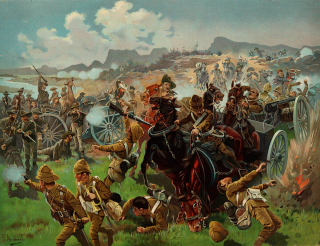
Early on the morning of December 15, Major General Arthur Henry Seton Hart-Synnot, commander of the 5th (Irish) Infantry Brigade, gives his men half an hour’s parade ground drill, then leads them in close column towards the Bridle Drift. However, his locally recruited guide, who speaks no English, leads the brigade towards the wrong ford, the Punt Drift at the end of a loop in the river. Louis Botha, commander of the Boers on this front, orders his men to hold their fire until the British attempt to cross the river. However Hart-Synnot’s brigade, jammed into the loop of the river, is too good a target to miss and the Boers open fire. Hart-Synnot’s brigade suffers over 500 casualties before they can be extricated. The battalions repeatedly try to extend to the left and locate the Bridle Drift. On each occasion, Hart-Synnot recalls them and sends them back into the loop.
Meanwhile, as Major-General Henry J. T. Hildyard moves his 2nd Infantry Brigade towards Colenso, the two batteries of field guns under Colonel Charles James Long forge ahead of him and deploy in the open well within rifle range of the nearest Boers. Once again, this is too tempting a target, and the Boers open fire. The British gunners fight on, even though suffering heavy casualties, but ammunition cannot be brought to them and they are eventually forced to take shelter in a dry stream bed behind the guns. The bullock-drawn naval guns have not been able to keep up with the field pieces, but are able to come into action 1,500 metres from the Boer trenches.
General Sir Redvers Buller, who has also heard that his light horse are pinned down at the foot of the hill known as Hlangwane south of the river and unable to advance, decides to call the battle off at this point, even though Hildyard’s men, advancing in open order, have just occupied Colenso. He goes forward, being slightly wounded himself, and calls for volunteers to recover Long’s guns. Two teams approach them, hook up and bring away two weapons. A second attempt to recover the rest of guns fails when horses and volunteers are shot down by Boer rifle fire.
During the afternoon, the British fall back to their camp, leaving ten guns, many wounded gunners and some of Hildyard’s men behind to be captured during the night. Although Buller had committed few of his reserves, he reasons that a full day under a boiling sun would have sapped their morale and strength. Major General Neville Lyttelton (4th Infantry Brigade) commits some of his troops to help Hart’s brigade withdraw, but the cautious Major General Geoffrey Barton (6th Infantry Brigade) refuses to support Lord Dundonald‘s or Hildyard’s hard-pressed troops.
Buller’s army loses 143 killed, 756 wounded and 220 captured. Boer casualties are eight killed and 30 wounded.
After the battle of Colenso, four soldiers are awarded the Victoria Cross, the highest decoration for gallantry that can be awarded to British forces. All crossed an exposed area of intense Boer fire and rescued two of the twelve guns of the 14th and 66th Batteries when their crews had become casualties or were driven from their weapons. They are Captain Walter Norris Congreve, Captain Harry Norton Schofield, Corporal George Edward Nurse and Lieutenant Frederick Hugh Sherston Roberts, son of Field Marshal Frederick Sleigh Roberts, who died of his wounds two days later.
(Pictured: Boers capturing the British guns at the Battle of Colenso on December 15, 1899 in the Boer War. Picture by Fritz Neumann.)
The Duke of Vendôme sets out from Talavera de la Reina with his troops and pursues the retreating British army with a speed perhaps never equalled in such a season and in such a country. The middle-aged Frenchman leads his Franco-Spanish army day and night. In typical Vendôme style, he swims, at the head of his cavalry, the flooded Henares and in a few days overtakes Stanhope, who is at Brihuega with the left wing of the Grand Alliance army.
“Nobody with me,” said the British general, “imagined that they had any foot within some days’ march of us and our misfortune is owing to the incredible diligence which their army made.” Stanhope has barely enough time to send off a messenger to the centre of the army, which is some leagues from Brihuega, before Vendôme is upon him on the evening of December 8. The next morning the town is invested on every side.
Blasting the walls of Brihuega with heavy cannon, a mine is sprung under one of the gates. The British keep up a terrible fire until their powder is spent. They then fight desperately against overwhelming odds as Vendôme’s men storm the city with bayonets fixed and begin to take the town by bloody close quarters fighting, street by street. The British set fire to the buildings which their assailants have taken but in vain. The British general sees that further resistance will produce only a useless carnage. He concludes a capitulation and his army becomes prisoners of war on honourable terms.
Scarcely had Vendôme signed the capitulation, when he learns that General Guido Starhemberg is marching to the relief of Stanhope. On December 10 the two meet in the bloody Battle of Villaviciosa, after which Starhemberg continues the allied retreat.
The British troops do not remain in captivity for very long before they are exchanged and sent home in October 1711.
Following a three-day siege, the English Army beheads over 600 Papal soldiers and civilians at Dún an Óir, County Kerry on November 10, 1580.
On November 5, a naval force led by Admiral Sir William Wynter arrives at Smerwick Harbour, replenishing the supplies of Arthur Grey, 14th Baron Grey de Wilton, who is camped at Dingle, and landing eight artillery pieces. On November 7, Lord Grey de Wilton lays siege to the Smerwick garrison. The invading forces are geographically isolated on the tip of the narrow Dingle Peninsula, cut off by Mount Brandon, one of the highest mountains in Ireland, on one side and the much larger English force on the other. The English forces begin the artillery barrage on Dún an Óir on the morning of the November 8, which rapidly breaks down the improvised defences of the fort.
After a three-day siege, the commander Sebastiano di San Giuseppe surrenders on November 10. Accounts vary on whether they had been granted quarter. Grey de Wilton orders the summary executions, sparing only the commanders. Grey has also heard that the main Irish rebel army of 4,000 are somewhere in the hills to his east, looking to be rearmed and supplied by Di San Giuseppe, and they might in turn surround his army, but this army never appears.
According to Grey de Wilton’s account, contained in a despatch to Queen Elizabeth I dated November 11, 1580, he rejects an approach made by the besieged Spanish and Italian forces to agree to terms of a conditional surrender in which they would cede the fort and leave. Lord Grey de Wilton claims that he insisted that they surrender without preconditions and put themselves at his mercy, and that he subsequently rejects a request for a ceasefire. An agreement is finally made for an unconditional surrender the next morning, with hostages being taken by English forces to ensure compliance. The following morning, an English force enters the fort to secure and guard armaments and supplies.
Local historian Margaret Anna Cusack notes in 1871 that there is a degree of controversy about Lord Grey de Wilton’s version of events to Elizabeth, and identifies three other contemporary accounts, by O’Daly, O’Sullivan Beare and Russell, which contradict it. According to these versions, Grey de Wilton promises the garrison their lives in return for their surrender, a promise which he breaks. Like Grey himself, none of these commentators can be described as neutral, as they are all either serving the state or opposed to it. Cusack’s interpretation of the events cannot be described as unbiased, given her position as a Catholicnun and fervent Irish nationalist at the time.
According to Cusack, the few that are spared suffer a worse fate. They are offered life if they renounce their Catholic faith. On refusal, their arms and legs are broken in three places by an ironsmith. They are left in agony for a day and night and then hanged.
According to the folklore of the area, the execution of the captives takes two days, with many of the captives being beheaded in a field known locally in Irish as Gort a Ghearradh (the Field of the Cutting). Their bodies are later thrown into the sea. Archaeologists have not yet discovered human remains at the site, although a nearby field is known as Gort na gCeann (the Field of the Heads) and local folklore recalls the massacre.
(Pictured: A memorial to the victims of the massacre at Dún an Óir)
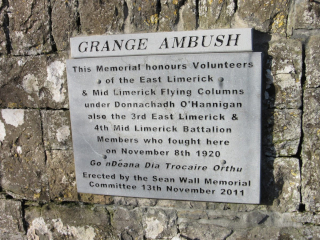
Approximately fifty men of 3rd Battalion East Limerick IRA parade at 5:00 AM on the cold bleak morning of November 8. They are armed with 21 rifles and 21 shotguns, plus a small quantity of explosives. It has been decided to ambush a convoy at Grange Bridge, a point about eight miles from Limerick and about four miles from Bruff. They set out and occupy positions around John O’Neill’s house. The ambush site is about four miles from the big British garrison at Bruff to the south. The IRA expects two British lorries around 9:00 AM, however, in the end eight lorries and two armoured cars arrive at noon.
It is a joint action involving the flying columns of both the 3rd Battalion East Limerick Brigade and the 4th Battalion Mid Limerick Brigade, supported by men from the local companies of Bruff, Grange and Holy Cross in the East Limerick Brigade and from the Fedamore and Ballybricken Companies of the Mid Limerick Brigade. Donnchadha O’Hannigan has overall command of the combined columns and most of the ambushers are placed in houses and behind walls on both sides of the road. Among the IRA men who take part in the action is their chaplain, the Curate at Fedamore, Fr. William Joseph Carroll, who had been awarded the Military Cross for bravery in 1918 by the British Army. Also among the attackers is Maurice Meade, who had been a member of Roger Casement‘s Irish Brigade in Germany.
Something makes the British suspicious and they send one lorry ahead as a decoy. It is bombed by the IRA and raked with small arms fire. At this point, a British armoured car appears, with an officer mounted on the running board firing a revolver and its machine gun firing at the IRA at close range. The IRA account names the officer on the running board as Lt. Watling and they believe that they wounded him and he died in the hospital at Bruff that night.
More British reinforcements appear and the IRA realises that they are up against a vastly larger force than they had anticipated, so they retreat. Apart from one minor wounded man, they have no casualties.
The Royal Fusiliers‘ account says while escorting a Royal Air Force convoy from Fermoy to Oranmore, Lieutenant Allan and thirty other ranks are ambushed at Grange, near Bruff. The rebels, however, are speedily dealt with, and a quantity of arms, ammunition and two prisoners are taken. Unfortunately, Flying Officer Watling and Bandsman Bailey are wounded, the latter seriously. The only other casualty is Private French, who is shot at when a sentry at Galbally, and has the back luck of losing his arm.
Hagan is born in County Tyrone on June 17, 1822. His family moves to a farm near Philadelphia, Pennsylvania when he is still at an early age, and he is educated at Clermont Academy. He moves to Alabama in 1837. His prosperous uncle, John Hagen of New Orleans, Louisiana, takes him into the family business and sets him up in Mobile to manage the Hagan business there.
Hagan serves in John Coffee Hays‘s Texas Rangers, a cavalry unit in Major GeneralZachary Taylor‘s army during the Mexican–American War. He is recognized for his gallantry at the Battle of Monterrey. He is commissioned a captain in the 3rd U.S. Dragoons in 1848 and is discharged on July 31, 1848. After the war, he returns to Mobile where he purchases and subsequently manages a plantation rather than remaining in the family mercantile business. In 1854, he marries Bettie Oliver, daughter of Alabama’s attorney general.
At the beginning of the American Civil War, Hagan organizes and is elected captain of a cavalry company for the Alabama Militia, the “Mobile Dragoons,” which serves on guard duty along the Gulf Coast. At the rank of major he transfers to the 1st Mississippi Cavalry Regiment on October 26, 1861. The regiment fights at the Battle of Shiloh on April 6–7, 1862. He leads his men in a mounted charge at the Battle of Perryville, which is highly commended by his brigade commander, Brigadier GeneralJoseph Wheeler.
Hagan is promoted to colonel of a new regiment, the 3rd Alabama Cavalry Regiment, on July 1, 1862. The regiment fights in all of the campaigns of the Army of Tennessee. In July 1863, He is assigned to command Brigade 1 of Brigadier General William T. Martin‘s Division of the Cavalry Corps of the Army of Tennessee, which is Major General Joseph Wheeler’s old brigade. During the spring and summer of 1863, the brigade screens the left front of GeneralBraxton Bragg‘s army. Wheeler recommends that Hagan be promoted to brigadier general, but Bragg blocks the promotion because he says Hagan is in a state of “dissipation”, a reference to drunkenness or alcoholism. Hagan is wounded near Franklin, Tennessee in the winter of 1862 and again near Kingston, Tennessee in November 1863. In November 1863, he resigns and returns to Mobile to recover from his wounds and his disappointment from not being promoted.
Although Hagan is assigned as acting brigadier general in early 1865, he never receives an official appointment from Jefferson Davis or confirmation by the Confederate States Senate of an appointment as a general officer. Major General Wheeler later writes that he had been told unofficially by Confederate States War Department officials that brigadier general commissions had been issued for Hagan, Henry Marshall Ashby and Moses Wright Hannon near the end of the war, but no such commissions ever were delivered.
Hagan returns to Mobile after the war but is penniless since his fortune had been converted to Confederate money. He works as manager of a plantation on the Alabama River in the 1870s and early 1880s. President Grover Cleveland appoints him crier of the United States District Court in Alabama in 1885.
James Hagan dies on November 6, 1901, at Mobile, Alabama. He is buried in Magnolia Cemetery in Mobile.
By 1650, The Irish Confederates and their English Royalist allies have been driven out of eastern Ireland by the Cromwellian conquest of Ireland. They occupy a defensive position behind the River Shannon, of which Limerick is the southern stronghold. Oliver Cromwell himself had left Ireland in May 1650, delegating his command of the English Parliamentarian forces to Henry Ireton. Ireton moves his forces north from Munster to besiege Limerick in October 1650. The weather, however, is increasingly wet and cold and Ireton is forced to abandon the siege before the onset of winter.
Ireton returns the following June with 8,000 men, 28 siege artillery pieces and four mortars. He then summons Hugh Dubh O’Neill, the Irish commander of Limerick, to surrender but is refused. The siege is on.
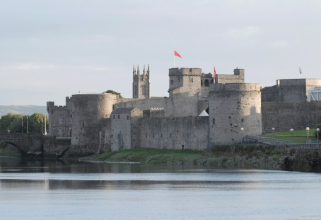
Limerick in 1651 is split into two sections, English town and Irish town, which are separated by the Abbey River. English town, which contained the citadel of King John’s Castle, is encircled by water and known as King’s Island. Thomond bridge is the only entrance onto the island and is fortified with bastioned earthworks. Irish town is more vulnerable, but is also more heavily fortified. Its medieval walls have been buttressed by 20 feet of earth. In addition, Irish town has a series of bastions along its walls, mounted with cannon covering its approaches. The biggest of these bastions are at St. John’s Gate and Mungret gate.
Due to Limerick’s fortification, Ireton does not risk an assault on its walls. Instead he secures the approaches to the city, cuts off its supplies and builds artillery earthworks to bombard the defenders. His troops take the fort at Thomond bridge, but the Irish destroy the bridge itself, denying the Parliamentarians land access to English town. Ireton then tries an amphibious attack on the city, which is initially successful, but O’Neill’s men counterattack and beat them off. After this failed attack, Ireton resolves to starve the city into submission and builds two forts on nearby Singland Hill. An Irish attempt to relieve the city from the south is routed at the battle of Knocknaclashy. O’Neill’s only hope is to hold out until bad weather and hunger force Ireton to lift the siege. O’Neill tries to send the town’s old men, women and children out of the city so that his supplies will last a little longer. However, Ireton’s men kill 40 of these civilians and send the rest back into Limerick.
O’Neill comes under pressure from the town’s mayor and civilian population to surrender. The town’s garrison and civilians suffer terribly from hunger and disease. Ireton finds a weak point in the defenses of Irish town and knocks a breach in them, opening the prospect of an all out assault. Eventually, in October 1651, six months after the siege had started, part of Limerick’s garrison mutiny and turn some cannon inwards, threatening to fire on O’Neill’s men unless they surrender. Hugh Dubh O’Neill surrenders Limerick on October 27. The inhabitants lives and property are respected, but they are warned that they could be evicted in the future.
The garrison is allowed to march to Galway, which is still holding out, but has to leave their weapons behind. However, the lives of the civilian and military leaders of Limerick are excepted from the terms of surrender. Catholic Bishop Terence Albert O’Brien, an Alderman and the English Royalist officer Colonel Fennell are hanged. O’Neill is also sentenced to death, but is reprieved by the Parliamentarian commander Edmund Ludlow and imprisoned instead in London. Former mayor Dominic Fanning is drawn, quartered, and decapitated, with his head mounted over St. John’s Gate.
(Pictured: King John’s Castle on King John’s Island, Limerick)
The French are seeking to expand their influence on the eastern bank of the river Rhine. In the autumn of 1702, Villars receives orders from Louis XIV to attack Swabia. The French forces need to join their Bavarian allies and defeat the Imperial troops that stand between them.
The French cross the Rhine at Weil am Rhein, just north of Basel on October 14. Villars attacks the Imperial army at Friedlingen. The future field marshal Louis William entrenches his army and manages to hold the French for some time. He then retreats in good order to the North.
It is a Pyrrhic victory for Villars with losses of 1,703 dead and 2,601 wounded. The Imperial forces loses are 3,000 dead and 742 wounded. Villars is also prevented from joining the Bavarians.
The villages on the eastern bank of the Rhine suffer much damage, especially Weil am Rhein.
(Pictured: The Battle of Friedlingen, oil on canvas, Franz Paul Findenigg)
Dowling is born in the townland of Knockballyvishteal, Milltown, County Galway on January 14, 1837, the second of eight children, born to tenant farmer Patrick and Bridget Dowling (née Qualter). Following the eviction of his family from their home in 1845, the first year of the Great Famine, nine-year-old Dowling leaves Ireland in 1846 with his older sister Honora, bound for New Orleans in the United States.
As a teenager, Dowling displays his entrepreneurial skills by successfully running the Continental Coffeehouse, a saloon in the fashionable French Quarter. His parents and siblings follow from Ireland in 1851, but the joy of reunion is short-lived. In 1853, a yellow fever outbreak in New Orleans takes the lives of his parents and one of his younger brothers. With rising anti-Irish feeling growing in New Orleans, following local elections which see a landslide victory for the “Know Nothing” party, Dowling moves to Houston in 1857.
In 1857 Dowling marries Elizabeth Ann Odlum, daughter of Benjamin Digby Odlum, a Kildare-born Irishman, who had fought in the Texas Revolution, being captured at the Battle of Refugio in 1836.
By 1860, Dowling owns a number of saloons. His most successful is named the Bank of Bacchus, located on Courthouse Square in downtown Houston. “The Bank” as it is known locally becomes Houston’s most popular social gathering place in the 1860s and is renowned for its hospitality. He is also involved in setting up Houston’s first gaslight company and is first to have it installed in his home and “The Bank.” He is a founding member of Houston’s Hook and Ladder Company Number One fire department and is also involved in running the city’s first streetcar company.
Prior to the outbreak of the American Civil War, Dowling makes a name for himself as an able and successful entrepreneur. Among other things, he is involved with a predominantly Irish militia company which serves a more social than military role in Houston society. Upon Secession, this militia company is mustered straight into the Confederate States Army, with Dowling being elected First Lieutenant. The unit names themselves the “Jefferson Davis Guards” in honor of Confederate PresidentJefferson Davis. The Davis Guards are initially part of a Texas State Troops/Confederate expedition sent to take over Union Army forts and arsenals along the border with Mexico. The expedition is successfully completed without a shot being fired. They participate in the Battle of Galveston on New Year’s Day 1863, following which they are assigned to a newly constructed artillery post near the mouth of the Sabine River called Fort Sabine.
Sabine Pass was important as a point of arrival and departure for blockade runners. It is suspected that the Union Army will attempt an invasion of Texas via Sabine Pass because of its value as a harbor for blockade runners and its proximity 18 miles southeast of Beaumont, which lies on the railroad between Houston and the eastern part of the Confederacy.
To negotiate Sabine Pass all vessels except small boats take one of the two river channels. No seagoing ship can traverse the Pass without great risk of running aground should it stray from one of the channels. The inevitable course of any steam-powered warship, including shallow-draft gunboats then common to the U.S. Navy, would use one of the channels, both of which are within fair range of the fort’s six smoothbores.
Dowling spends the summer of 1863 at the earthen fort instructing his men in gunnery. On September 8, 1863, a Union Navyflotilla of some 22 gunboats and transports with 5,000 men accompanied by cavalry and artillery arrive off the mouth of Sabine Pass. The plan of invasion is sound, but monumentally mismanaged. Four of the flanking gunboats are to steam up the pass at speed and draw the fire of the fort, two in each channel, a tactic which had been used successfully in subduing the defensive fortifications of Mobile and New Orleans prior to this. This time, however, Dowling’s artillery drills pay off as the Confederates pour a rapid and withering fire onto the incoming gunboats, disabling and capturing two, while the others retreat in disarray. The rest of the flotilla retreats from the mouth of the pass and returns ignominiously to New Orleans, leaving the disabled ships with no option but to surrender to Dowling. With a command of just 47 men, Dowling had thwarted an attempted invasion of Texas, in the process capturing two gunboats, some 350 prisoners and a large quantity of supplies and munitions.
The Confederate government offers its gratitude and admiration to Dowling, now promoted to Major, and his unit, as a result of their battlefield prowess. In gratitude, the ladies of Houston present the unit with specially struck medals, which are actually Mexican eight reale coins with both faces sanded down and inscribed “Sabine Pass, 1864” on one side and a Maltese cross with the letters D and G on the other. Because of the official recognition given to the action, it is now accepted that these Davis Guard Medals are the only medals of honor issued by the Confederate government, and consequently are collector’s items today.
After the battle of Sabine Pass Dowling is elevated to hero status in his hometown of Houston. He subsequently serves as a recruiter for the Confederacy and is personally commended for his action at the battle by Jefferson Davis. After the war he returns to his saloon business and quickly becomes one of the city’s leading businessmen.
Dowling’s promising future is cut short by another yellow fever epidemic which devastates Houston in the late summer of 1867, and he dies on September 23, 1867. He is buried at St. Vincent’s Catholic Cemetery, the oldest Catholic cemetery in Houston.

 On December 15, 1899, Irish units of the