seamus dubhghaill

Promoting Irish Culture and History from Little Rock, Arkansas, USA


Leave a comment

Birth of Michael McCarthy, Professional Football Player & Manager

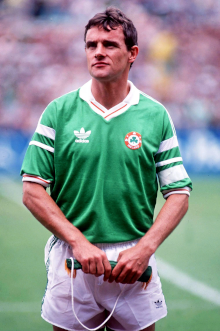
Michael Joseph “Mick” McCarthy, professional football manager, pundit and former player, is born on February 7, 1959, in Barnsley, South Yorkshire, England. He is most recently the head coach of Blackpool.

McCarthy makes his league debut for then-Fourth Division Barnsley on August 20, 1977, in a 4–0 win over Rochdale. He spends two years in the basement league, before the club wins promotion. A strong central defender, he is a virtual ever-present for his hometown club, but departs in December 1983 for fellow Division 2 club Manchester City.

Manchester City wins promotion in McCarthy’s first full season, and he finally has the chance to play at the highest level. His first season in the topflight is steady enough as the club reaches mid-table, but relegation strikes the following year. However, he does not face the drop as he signs for Celtic in May 1987 in a surprise £500,000 move.

McCarthy is brought to Parkhead by David Hay but within days of the signing the Celtic boss is sacked. Fortunately for McCarthy, Hay’s replacement is the returning Parkhead legend Billy McNeill, who quickly recognises that McCarthy’s strength and aggression are qualities desperately required by a notoriously leaky Celtic defence. He picks up his first silverware with Celtic as they win the league and cup double in his first season. The following season he again wins a Scottish Cup winners medal, although the club has to settle for third place in the league.

If ever an example is needed to reflect McCarthy’s values, it cannot be bettered than that on the day of the 1998 Scottish Cup Final. Celtic wins 2-1, but to the disgust of many, the unpopular Conservative Prime Minister Margaret Thatcher is in attendance and to present the trophy to the winners. The players are under pressure from the Scottish Football Association (SFA) to meet her, but a few refuse. According to fellow Celtic player Andy Walker, McCarthy refuses point-blank, as he is from Barnsley and the son of a miner. Shaking hands with her is an impossibility for him.

In the summer of 1988, McCarthy joins fellow Celtic players Packie Bonner and Chris Morris in Germany as part of the Republic of Ireland European Championship squad and gives a fine account of himself particularly in the historic 1-0 win over England. He, like Bonner and Morris, also star in the Republic’s 1990 FIFA World Cup squad which makes it to the quarterfinals in Italy.

In terms of his Celtic career, McCarthy never repeats the achievements or level of performance of his debut season.

McCarthy signs for Lyon in the summer of 1989 for £350,000. Afflicted by injuries and mindful of his spot in Ireland’s World Cup team, he finishes that season on loan to Millwall. After a captain’s showing in Italy for the Ireland national side, Millwall signs him full-time and later he becomes manager at The Den in 1992. In February 1996, he follows Jack Charlton into the Ireland manager’s job and experiences various highs and lows over his nearly seven years in charge. He has since managed Sunderland and Wolverhampton Wanderers.

In later years McCarthy becomes a low-key candidate for the Celtic manager’s job after the departures of Martin O’Neill and Gordon Strachan but is never favoured by the board or the general support for the role. Ironically then in 2018, he takes over from Martin O’Neill following his second stint as the Ireland manager. Notably, Roy Keane is Martin O’Neill’s assistant and has to step down also. On April 4, 2020, amid the global coronavirus pandemic, he stands down as manager and is immediately replaced by Stephen Kenny.

McCarthy joins Cypriot First Division club APOEL as manager on November 2, 2020, signing a contract until 2022. He is sacked by the club on January 5, 2021, following a run of 2 wins, 1 draw and 5 defeats in his eight games in charge.

On January 22, 2021, McCarthy is appointed as manager of Cardiff City, following the sacking of Neil Harris. He signs a contract until the end of the season. After making an unbeaten start to his reign at the club, a run that includes a six-game winning streak, he signs a new two-year deal with the club on March 4, 2021. Cardiff finishes the season in 8th place. Despite losing one of their opening six matches at the start of the following season, a run of results follows which sees Cardiff drop as low as 21st in the table. On October 23, 2021, after suffering a club-record eighth successive loss of the season at the hands of Middlesbrough, McCarthy leaves the club by mutual consent.

On January 19, 2023, McCarthy is appointed head coach of the Championship’s second-bottom placed club Blackpool on a short-term contract until the end of the season. On April 8, 2023, he leaves Blackpool by mutual consent, following a 3–1 home defeat to Cardiff the previous day. He achieves two wins in his 14 games in charge, losing nine of them, which leaves the club in 23rd position. “With results on the pitch not improving in recent weeks, the decision has been agreed by both parties that a change is needed,” the club says in a statement.

Leave a comment

Birth of Irish Broadcaster George Hamilton

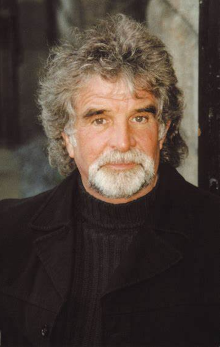
Irish broadcaster George Hamilton is born in Belfast, Northern Ireland, on January 2, 1950. He is best known as the chief football commentator for RTÉ, for which he also commentates on other sporting events, such as the Olympic Games. He presents a classical music programme on RTÉ lyric fm on Saturdays and Sundays called The Hamilton Scores.

Hamilton is christened in the same Presbyterian church as George Best. His father Jimmy plays for Cliftonville F.C., but he is a Glentoran F.C. “superfan.”

While a student at Methodist College Belfast, Hamilton is, for a time, principal cellist with the school orchestra. He then studies German and French at Queen’s University Belfast.

Hamilton begins his commentary career with BBC Sport, before joining RTÉ eight years later in 1984. He had previously worked for RTÉ during the 1978 FIFA World Cup. Since 2003, he works for RTÉ lyric fm, Ireland’s classical radio station, on Saturday mornings. For many years, he fronts a popular weekly quiz show on RTÉ, Know Your Sport, alongside fellow commentator Jimmy Magee.

Hamilton is chief commentator for RTÉ Sport‘s coverage of the 2010 FIFA World Cup in South Africa, the ninth one in which he has been involved. He is RTÉ’s chief commentator at UEFA Euro 2012 and commentates on all of Ireland’s matches in the competition. He is involved in the coverage of the Olympic Games since the 1980 Summer Olympics in Moscow.

Hamilton is known for his use of colourful phrases and memorable quotes when commentating on games, his phrase describing David O’Leary‘s penalty against Romania in the 1990 FIFA World Cup, “The nation holds its breath,” is used for a book of Irish football quotations, compiled by Eoghan Corry, for which Hamilton writes the foreword.

The sports humour website, DangerHere.com, takes its title from another quote by Hamilton: “And Bonner has gone 165 minutes of these championships without conceding a goal. Oh, danger here…”

On August 16, 2011, Hamilton feels unwell and has a suspected heart attack. He later has several hours of emergency bypass surgery at the Blackrock Clinic in Dublin after being transferred from St. Vincent’s University Hospital. He recovers and resumes both his commentating and radio show.


Leave a comment

Birth of Irish Folk Singer Patsy Watchorn

Patsy Watchorn, Irish folk singer notable for being a member of the Dublin City Ramblers and later The Dubliners, is born in Crumlin, Dublin, on October 16, 1944.

Watchorn first comes to prominence in 1969 as the lead singer of The Quare Fellas, a Dublin-based ballad group. They evolve into the Dublin City Ramblers in the early 1970s and with Watchorn as their lead singer they have hits with songs such as “The Rare Ould Times” and “The Ferryman,” both of which are written by Pete St. John.

Watchorn also writes and sings the Irish Football Team anthem, “We are the Boys in Green” (Home & Away album), with The Dublin City Ramblers for the teams European Championship campaign in Germany and again for the 1990 FIFA World Cup in Italy. The lyrics change slightly in both releases in 1988 and 1990.

In 1995, Watchorn leaves The Dublin City Ramblers and makes a number of solo albums. He joins The Dubliners in 2005, taking Paddy Reilly‘s place. He is well received throughout Ireland, the United Kingdom, Europe, Australia and the United States. He appears on their Tour Sampler EP in 2005, as well as the double album Live at Vicar Street (2006). He plays the banjo, bodhrán and spoons. He cites Luke Kelly, former lead singer with The Dubliners, as his favourite singer.

When The Dubliners announce their retirement in 2012 after finishing their 50 Years Anniversary Tour, Watchorn decides to keep on touring with former band members Seán Cannon and Eamonn Campbell and banjo player Gerry O’Connor under the name of “The Dublin Legends.”

On April 28, 2014, Watchorn posts a message on his website, stating that he has “decided to take a break from the music business for a while” and will not be touring the rest of 2014 with The Dublin Legends. He later admits this is due to ill health and that doctors had advised him that touring would do further damage to his health.

Watchorn’s distinctive and passionate vocals have made him a huge rock on the Irish folk scene. In his solo projects in the mid- and late-1990s, after his departure from The Dublin City Ramblers, he has session men who used to play alongside him and he uses the stage name “Patsy Watchorn, agus a Cháirde” (which means “and his Friends” in Irish).


Leave a comment

Birth of Frank Stapleton, Association Footballer & Manager

Francis Anthony Stapleton, Irish former professional association football player and manager, is born in Dublin on July 10, 1956. He is best remembered for his time at Arsenal, Manchester United and as a pivotal player for the Republic of Ireland national football team. He has also been manager at Bradford City and Major League Soccer (MLS) club New England Revolution.

Stapleton is a distinguished centre-forward, once touted as being among the best in the world in his position, and an exceptionally strong header of the ball. He starts his career with Arsenal, joining them in 1972 as an apprentice, after being turned down by Manchester United. He makes his first-team debut in March 1975, at home to Stoke City, and goes on to form a potent striking partnership with Malcolm Macdonald. The two score 46 goals between them in 1976–77. He is Arsenal’s top scorer for the three following seasons and helps the Gunners reach a trio of FA Cup finals. He scores one of the goals in Arsenal’s 1979 FA Cup Final 3–2 win over Manchester United, and scores 108 goals in 300 appearances in total for the Gunners.

Stapleton moves on to Manchester United in the summer of 1981 for £900,000 as new manager Ron Atkinson begins building a team capable of challenging for silverware after a disappointing 1980–81 season under Dave Sexton. He helps United win the 1983 and 1985 FA Cups. It is in the first of those finals, when he scores against Brighton & Hove Albion, in which he makes history by becoming the first man to score for two different clubs in FA Cup Finals. United finishes in the top four of the league in each of Stapleton’s first five seasons at Old Trafford, and comes close to winning a league title medal in the 1985–86 season after United wins their first ten league games of the season before their form slumps and they finished fourth. Atkinson is sacked and replaced by Alex Ferguson in November 1986, and Stapleton remains a regular member of the first team under the new manager, but he leaves at the end of the season to sign for Ajax. There, he makes just six appearances and scores one goal before quickly being moved to Belgian side Anderlecht at the end of 1987, followed by a three-month loan back to England with Derby County. He then plays for French club Le Havre for a season, before returning to England with Blackburn Rovers in 1989, followed by moves to Aldershot, Huddersfield Town (as player-coach) and Bradford City.

After three seasons as player-manager at Bradford, Stapleton is sacked following their narrow failure to qualify for the Division Two playoffs at the end of the 1993-94 season. He then has a brief spell at Brighton & Hove Albion in the 1994–95 season, playing two games before finally announcing his retirement as a player.

Stapleton also wins 71 caps for the Republic of Ireland national team, scoring a then record 20 goals. He makes his international debut under then player-manager Johnny Giles in a friendly against Turkey in Ankara in 1976 at 20 years of age. He scores after only three minutes of his debut when he heads home a Giles free-kick at the near post. That friendly international finishes 3–3 and marks the start of a magnificent international career for the quiet and reserved Stapleton.

Stapleton is committed to international football insisting that an “international release clause” be inserted to all of his contracts so that he can be released to play in international games for Ireland.

Stapleton plays a significant role in Ireland’s attempt to qualify for the 1982 FIFA World Cup in Spain in 1982. Goals against Cyprus, the Netherlands and France by him in the qualifying matches are not enough as Ireland is denied a place at the World Cup by a superior French goal difference. He is made captain of the national team for the qualifying campaign for the 1986 FIFA World Cup though Ireland fails to emulate their fine performance in the 1982 qualifiers.

Jack Charlton takes over as the Irish manager in 1986 and he keeps Stapleton as captain despite a sometimes uneasy relationship between the two men. Stapleton scores a magnificent diving header in the opening UEFA Euro 1988 qualifier against Belgium in the 2–2 draw at the Heysel Stadium, Brussels, that September. He also scores in the 2–1 defeat by Bulgaria in Sofia on April 1, 1987, with another goal against Luxembourg in the 2–1 victory at Lansdowne Road the following September.

Stapleton captains the Irish team to the 1988 Euro finals and plays in all of their matches during the competition including Ireland’s famous victory against England.

After the 1988 European Championships Stapleton remains on the fringe of the national team during qualification for 1990 FIFA World Cup in Italy making just two appearances late in the campaign. By then, his 20 goals for the Republic had made him the national side’s all-time leading goalscorer, a record which is broken ten years later by Niall Quinn, who is in the early stages of his own international career when Stapleton bows out of the international scene. He does, however, score an 87th-minute goal against Malta in a 3–0 friendly in Valletta just prior to those finals in Italy.

Stapleton moves to the United States to manage Major League Soccer side New England Revolution in 1996. In the 2003–04 season he briefly returns to English football as a specialist coach of Bolton Wanderers. The Bolton manager, Sam Allardyce, wants Stapleton to enhance the skills of the strikers at the club and sees the Irishman as an ideal candidate, given his successful playing career.

Stapleton is appointed assistant manager to former teammate Ray Wilkins with Jordan on September 3, 2014.


Leave a comment

Birth of Kevin Moran, Gaelic & Association Footballer

Kevin Bernard Moran, Irish footballer who excels at the top levels of Gaelic and association football, is born in Dublin on April 29, 1956. In Gaelic football, he is known for his time at senior level with the Dublin county football team, winning two All-Ireland Senior Football Championships with them, and in association football for his career with Manchester United F.C. and the Republic of Ireland national football team. In 1985 he becomes the first man to be sent off in an FA Cup Final.

Moran grows up in Rialto, Dublin until his early teens, before he moves to the Long Mile Road in Walkinstown. While there, he attends James’s Street CBS and Drimnagh Castle Secondary School where Gaelic football is the dominant sport although association football proves to be the sport he plays on the streets while growing up. During the period in which he plays Gaelic football for Good Counsel GAA and association football for Rangers A.F.C., Bohemian F.C. and Pegasus A.F.C., he has divided loyalties between the two sports, as both sports are then played on Saturday.

In his native Ireland, Moran plays at senior level for the Dublin county football team. A former Dublin under-21 player, he is called up to the senior panel for the first time in 1976. He wins two All-Ireland Championship medals with Dublin in 1976 and 1977. In the 1976 final, he helps Dublin to defeat (by 3–8 to 0–10) Kerry, the winner over Dublin in the 1975 final, and again in the 1977 semi-final, aided by new tactics which manager Kevin Heffernan introduces, and which hinders Kerry’s tactic of pulling defenders forward and taking full advantage of the space behind the half-back line. The 1977 final results in a 5–12 to 3–6 victory over Armagh at Croke Park. He is awarded a GAA GPA All-Stars Award for his performance in the 1976 championship.

Moran is also part of the 1976–77 side that wins the National Football League for Dublin with a win over Derry in the final. He plays his club football for Dublin-based GAA club Good Counsel.

With Bohemian F.C. winning everything bar the FAI Cup in the 1974-75 League of Ireland season, 18-year-old Moran does not have an opportunity for much game time and only makes one League of Ireland appearance in the last game of the season on April 17, 1975. After Bohs he moves to University College Dublin A.F.C. where in December 1975 he wins the Collingwood Cup. In February 1976 he wins the Universities Championship when he scores the winner for the Irish Universities against their Scottish counterparts. He plays for Pegasus A.F.C. from 1976-78.

Moran is spotted by Billy Behan, a Manchester United F.C. scout, who reports to United manager Dave Sexton, and Moran signs for Manchester United in February 1978. He makes his senior debut on April 20, 1979, against Southampton F.C., and is a regular player in the first team by the time Ron Atkinson succeeds Sexton as manager in June 1981. Despite not being the tallest of defenders, he is known for his strong aerial ability and is a threat in the box from corners and set pieces. Playing as a centre-back, he wins FA Cup medals with the club in 1983 and 1985.

Moran is notable for being sent off in the 1985 FA Cup Final against Everton F.C., the first player ever to be sent off in an FA Cup final. TV cameras reveal that he had gone for the ball, and not for Peter Reid in the offending tackle. He is later presented with the winner’s medal that had at first been withheld.

After 10 years with United, Moran leaves Old Trafford as a 32-year-old in the summer of 1988, having played his final 18 months at the club under the management of Alex Ferguson. His first team opportunities are limited since the arrival of Steve Bruce in December 1987.

Moran transfers to Sporting Gijón, where he remains for two seasons, making 33 appearances without scoring. During his time at Sporting Gijón, he rooms with promising youngster and future Real Madrid CF and FC Barcelona star Luis Enrique.

In 1990, Moran returns to England to join Second Division Blackburn Rovers F.C. He is an automatic choice in the first team but endures a disappointing first season at Ewood Park as Rovers finishes 19th in the Second Division. The following season is a huge success, however, as playoff victory ends the club’s 26-year exile from the top division and secures their place in the new Premier League. He continues in his role as club captain as Rovers finishes fourth in 1992–93 and runners-up in 1993–94. He retires at the end of the 1993–94 season, one year before Rovers wins their first league title in 81 years. In both seasons preceding his retirement, Rovers are beaten to the title by his old club, Manchester United.

Moran makes his debut for the Republic of Ireland against Switzerland in 1980 and plays a key role in Ireland’s unsuccessful attempt to qualify for the 1982 FIFA World Cup finals in Spain. He plays 71 times for Ireland between 1980 and 1994, including UEFA Euro 1988 in Germany and the 1990 FIFA World Cup in Italy, and scores 6 goals. He is also a member of the Irish squad at the 1994 FIFA World Cup in the United States, despite being 38 years old and about to retire from playing completely but does not play due to an injury he picks up before the tournament starts.

After retiring from football, Moran makes a career in business. In 1994, he forms a football agency, Proactive Sports Management, with Paul Stretford and Jesper Olsen. His own clients include John O’Shea and Steve Finnan. He also works as a pundit on Irish television channel TV3.

Moran’s brother Ray is a knee specialist known as “Dr. Cruciate” and as a “surgeon to the stars,” with clients including rock star Jon Bon Jovi and numerous athletes (such as Bernard Brogan, Colm Cooper, Brendan Maher, Alan Quinlan and Josh van der Flier). Moran sits on the board of his brother’s Sports Surgery Clinic (SSC) in Santry, Dublin, which opens in 2007.


Leave a comment

Birth of Irish Footballer Liam Brady

William Brady, former Irish footballer who also serves as assistant manager of the Republic of Ireland national football team from 2008 to 2010, is born in Dublin on February 13, 1956.

Brady is raised in Dublin and attends St. Aidan’s C.B.S., leaving before his Intermediate Certificate. He alleges at the time that he had been expelled for missing a school Gaelic football match to play a schoolboy soccer international, however the school denies this.

Brady is a talented offensive midfielder renowned for his left foot and elegant technical skills such as his high-quality passing, vision, and close control, which makes him an excellent playmaker. He combines these abilities with significant tenacity, an eye for goal from midfield, and accurate penalty-taking. In addition to his footballing ability, he also stands out throughout his career for his professionalism.

Brady starts his career at Arsenal F.C., moving to London to join the side on schoolboy forms in 1971, at the age of 15. He turns professional on his 17th birthday in 1973, and makes his debut on October 6, 1973 against Birmingham City F.C. as a substitute for Jeff Blockley. Arsenal reaches three FA Cup finals in a row between 1978 and 1980. Arsenal wins only the 1979 final against Manchester United F.C., with Brady starting the move that ends in Alan Sunderland‘s famous last-minute winner.

Brady spends two seasons with Juventus F.C. in Italy, picking up two Italian Championship medals, in 1981 and 1982. He scores the only goal (a penalty) in the 1–0 win against Catanzaro that wins the 1982 title.

Brady makes his debut for the Republic of Ireland national football team on October 30, 1974, in a 3–0 win against the Soviet Union at Dalymount Park in a European Championship qualifier. Due to a suspension accrued before UEFA Euro 1988 he is not eligible to play within the tournament. During qualifications for the 1990 FIFA World Cup he retires from the international game. As Ireland advances to the World Cup he declares himself available to play once again. However, manager Jack Charlton goes on to declare that only those who played in the qualifiers will make the trip to Italy. Brady wins 72 international caps for the Republic of Ireland with 70 within the starting line-up, scoring 9 goals.

Brady goes on to manage two clubs – Celtic F.C. and then Brighton and Hove Albion F.C. – together with being the assistant manager of Ireland’s national football team. He also holds the post of Head of Youth Development at Arsenal F.C. from 1996 to 2013, and is a frequent television pundit with RTÉ Sport.

While at Arsenal F.C., and particularly early in his career, Brady is nicknamed “Chippy”, not for his ability to chip the ball but for his fondness for fish and chips. He also becomes involved in an anti-drugs campaign in the early 1990s, called “give drugs the boot”, encouraging young boys to play sport as a healthy pastime.


Leave a comment

Birth of Nell McCafferty, Journalist & Feminist

nell-mccafferty

Nell McCafferty, Irish journalist, playwright, civil rights campaigner and feminist, is born in Derry, County Londonderry, Northern Ireland on March 28, 1944. In her journalistic work she has written for The Irish Press, The Irish Times, Sunday Tribune, Hot Press and The Village Voice.

McCafferty is born to Hugh and Lily McCafferty and spends her early years in the Bogside area of Derry. She is admitted to Queen’s University Belfast, where she takes a degree in Arts. After a brief spell as a substitute English teacher in Northern Ireland and a stint on an Israeli kibbutz, she takes up a post with The Irish Times.

McCafferty is a founding member of the Irish Women’s Liberation Movement. Her journalistic writing on women and women’s rights reflects her beliefs on the status of women in Irish society. In 1971, she travels to Belfast with other members of the Irish Women’s Liberation Movement in order to protest the prohibition of the importation and sale of contraceptives in the Republic of Ireland.

After the disintegration of the Irish Women’s Liberation Movement, McCafferty remains active in other women’s rights groups, as well as focusing her journalism on women’s rights. Her most notable work is her coverage of the Kerry Babies case, which is recorded in her book, A Woman to Blame. She contributes the piece “Coping with the womb and the border” to the 1984 anthology Sisterhood Is Global: The International Women’s Movement Anthology, edited by Robin Morgan.

In 1990, McCafferty wins a Jacob’s Award for her reports on the 1990 FIFA World Cup for RTÉ Radio 1‘s The Pat Kenny Show. She publishes her autobiography, Nell, in 2004. In it, she explores her upbringing in Derry, her relationship with her parents, her fears about being gay, the joy of finding a domestic haven with the love of her life, the Irish writer Nuala O’Faolain, and the pain of losing it.

In 2009, after the publication of the Murphy Report into the abuse of children in the Dublin archdiocese, McCafferty confronts Archbishop Diarmuid Martin asking him why the Catholic Church has not, as a “gesture of redemption,” relinquished titles such as “Your Eminence” and “Your Grace.”

McCafferty causes a controversy in 2010 with a declaration in a live Newstalk radio interview that the then Minister for Health, Mary Harney, is an alcoholic. This allegation leads to a court case in which Harney is awarded €450,000 the following year. McCafferty has very rarely been featured on live radio or television in Ireland as a commentator since the incident, despite being ever present in those media from 1990 forward. However, she has been featured on a number of recorded programs.

The Irish Times writes that “Nell’s distinctive voice, both written and spoken, has a powerful and provocative place in Irish society.”

McCafferty receives an honorary Doctor of Literature from University College Cork on November 2, 2016, for “her unparalleled contribution to Irish public life over many decades and her powerful voice in movements that have had a transformative impact in Irish society, including the feminist movement, campaigns for civil rights and for the marginalised and victims of injustice.”

McCafferty lives in Ranelagh, an area of Dublin.