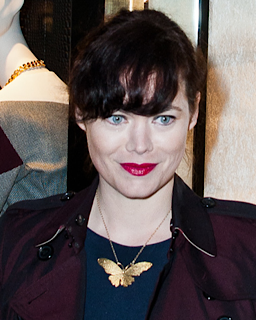
A portrait of Guinness is held at the National Portrait Gallery in London. She has modeled for various perfume and make-up campaigns, including Armani and Shu Uemura. She is the face of the Goffs Million horse races at the Curragh Racecourse in September 2007, an event that pays the highest winnings of any race meeting in Europe.
In 2009, Guinness is the face of the Arthur’s Day event celebrating her ancestor Arthur Guinness. In March and December 2011 she is again the subject of articles in Hello! magazine.
The year 2014 marks a revival of Guinness’s modeling career as she leads Jaeger‘s AW14 campaign alongside her mother Liz and fellow models Kirsty Hume and Jodie Kidd. Her range largely includes knitwear, including cardigans, skirts and sweater dresses.
Guinness is the great-granddaughter of Diana Mitford (later Lady Mosley), who is one of the Mitford sisters, and her first husband Bryan Guinness, later the 2nd Lord Moyne. Her paternal grandfather, Desmond Guinness, is a conservationist specialising in Georgian and classical architecture, while her paternal grandmother, Mariga Guinness, is born Marie-Gabrielle, Princess of Urach. Desmond and Mariga Guinness are co-founders of the Irish Georgian Society. Guinness’s maternal family is researched in the RTÉ programme Where Was Your Family During the Famine?
On April 5, 1862, Guinness formally registers the harp as its official symbol, long before Ireland even has its own government.
The first Guinness labels featuring the now-iconic harp are printed in August of that year according to Guinness’s Brewery in the Irish Economy 1759 – 1876 by Patrick Lynch and John Vaizey.
The harp, which serves as the emblem of Guinness, is based on a famous 14th-century Irish harp known as the “O’Neill harp” or “Brian Boru’s harp,” which is now preserved in the Library of Trinity College Dublin. The harp is also the official national emblem of the Republic of Ireland and can be found on the Republic’s coinage that was phased out when the Euro currency was introduced. The harp symbol is also featured on Irish flags during the 1916 Easter Rising.
However, there is a difference between the Irish government harp and the Guinness harp. As Guinness had trademarked the harp symbol in 1876, the Irish Free State Government of 1922 has to reverse the official government harp so that it can be differentiated from the trademarked Guinness harp. As such, the Guinness Harp always appears with its straight edge (the sound board) to the left, and the government harp is always shown with its straight edge to the right.
It is because of the harp trademark that the Guinness company names its first lager Harp in 1960.
The harp is one of three elements that make up the Guinness brand livery. The other two elements are the word “Guinness” and Arthur Guinness’s famous signature. There have been a number of changes to the design of the harp device over the years including a reduction in the number of strings shown. The current harp is introduced in 2005 when a new brand livery is launched.
The famous Downhill Harp, dating back to 1702, is purchased by Guinness in 1963 to ensure its continued preservation and is on display in the advertising gallery in Guinness Storehouse. The Downhill Harp is made in 1702 by Cormac O’Kelly of Ballinascreen and played in the 18th century by the harpist Donnchadh Ó hAmhsaigh, known in English as Denis Hampsey, Denis Hampson or Denis Hempson. Ó hAmhsaigh plays in the traditional style, plucking the strings with his long fingernails. At age 97, he is the oldest harpist at the Belfast Harp Festival in July 1792, although he is perhaps most famous for his concert for Prince Charles Edward Stuart, or ‘Bonnie Prince Charlie’, in 1745.
The harp bears the inscription:
In the time of Noah I was green, Since his flood I had not been seen, Until Seventeen hundred and two I was found By Cormac O’Kelly underground: He raised me up to that degree That Queen of Musick you may call me.
(From: “When Guinness trademarked symbol of the harp,” IrishCentral, http://www.irishcentral.com, April 5, 2022)
Guinness is born on November 10, 1847 at St. Anne’s, Clontarf, County Dublin, the youngest of three sons of Sir Benjamin Lee Guinness, brewer, of Dublin, and Elizabeth, third daughter of Edward Guinness of Dublin. He is not sent to public school but is taught at home by a private tutor before entering Trinity College Dublin, where he takes his degree in 1870. His father dies in 1868, leaving him a share in the brewery, and he takes over management of the business with his brother Arthur, who in 1876 sells his shares, making Edward sole proprietor.
Guinness is also prominent in municipal life, holding the offices of Sheriff of Dublin City in 1876 and High Sheriff of the County of Dublin in 1885, the year in which he is created a baronet. He is a brilliantly effective businessman, with close attention to detail and a focus solely on the brewery, to the extent of remaining independent from the rest of the brewing trade. In 1888 he bluntly tells the Country Brewers’ Association, “I have always declined to identify myself with any trade question, or to take any side in a controversy on the liquor question, and to this I must adhere.” In 1886 Guinness is floated as a public company, a superbly successful venture with applications for shares exceeding £100 million, and Edward remains as chairman until 1890, although his formal retirement in that year brings little reduction in his involvement with the company, and he continues to make the final decision on many minor matters as well as all major questions of policy.
Socially innovative, with a concern for the welfare of employees, from as early as 1870 Guinness establishes a free dispensary for his workforce and makes provisions for pension and other allowances – acts of social reform that are remarkable for the time. To mark his retirement in 1890 he places in trust £250,000 to be expended in the erection of working-class housing in London and Dublin. Both funds are administered from London until 1903, when the Dublin fund is amalgamated by the Iveagh Trust act with other schemes carried out in Dublin by Edward, who had been raised to the peerage of the United Kingdom in 1891 as Baron Iveagh of Iveagh, County Down. The funds, which increase considerably from the original amount, are thereafter managed entirely in Dublin as a separate undertaking under the name of the Iveagh Trust, still in existence in the early twenty-first century.
As one of the pioneers of the voluntary housing movement Guinness is essentially carrying on the tradition of “merchant prince and city father” established by his father and shared by his brother. Wealthy, ambitious, and resolutely unionist, he gives generous financial support to the Irish Unionist Alliance, and is also public-spirited, religious, and devoted to duty. Acknowledging that the Iveagh Trust is essentially ameliorative, he believes that major social change will only be achieved if numerous other wealthy people follow his example. He insists that gifts of money from the fund are permissible only to assist individuals to improve their condition “without placing them in the position of being the recipients of a bounty.” Numerous other philanthropic donations follow, including another £250,000 for slum clearance in the Bull Alley district of Dublin; various contributions to Dublin hospitals, particularly in 1903 and 1911 on the occasion of royal visits; and in 1907 the opening of the Iveagh Markets, situated in the Francis Street and Patrick Street areas of Dublin, are made possible with his financial backing. Generous contributions are also made to Trinity College Dublin, of which he is elected chancellor in 1908, and he donates land in Iveagh Gardens to University College Dublin (UCD).
In 1905 Guinness is raised to a viscountcy and in September 1909 the nationalist corporation of Dublin presents him with an address of thanks for his many gifts, and even discusses the possibility of offering him the lord mayoralty of the city, which he declines owing to his political affiliations. By this time he lives chiefly in England, having bought Elveden Hall in Suffolk, where he frequently entertains royalty. He also purchases Lord Kensington’s London estate and makes many donations to medical research societies in England, and in conjunction with Sir Ernest Cassel he founds the London Radium Institute, as well as donates £250,000 to the Laster Institute of Tropical Medicine for the endowment of bacteriological research.
In 1919 Guinness is elevated to an earldom and in 1925 purchases the remainder of the Kenwood estate to the north of Hampstead Heath and arranges for it to become public property, ensuring the estate will not be sold for building purposes, and also bequeaths to the nation a valuable collection of art for use in the gallery at the same location. As well as being elected a fellow of the Royal Society, he is awarded honorary doctorates from the University of Dublin and the University of Aberdeen.
In 1873, Guinness marries his third cousin Adelaide Maud, nicknamed “Dodo.” She is descended from the banking line of Guinnesses, and is the daughter of Richard Samuel Guinness, barrister and MP, and his wife Katherine, a daughter of Sir Charles Jenkinson. They have three sons, the eldest of whom, Rupert Edward Cecil Lee, succeeds his father as 2nd Earl of Iveagh.
Guinness dies at his London home in Grosvenor Place on October 7, 1927, and is buried at Elveden, Suffolk. He leaves an estate valued at £11 million.
A supporter of Benjamin Disraeli‘s one-nation conservatism, Guinness’s politics are typical of “constructive unionism,” the belief that the union between Ireland and Britain should be more beneficial to the people of Ireland after centuries of difficulties. In 1872 he is a sponsor of the “Irish Exhibition” at Earlsfort Terrace in Dublin, which is arranged to promote Irish trade. Correcting a mistake about the exhibition in the Freeman’s Journal leads to a death threat from a religious extremist, which he does not report to the police. In the 1890s he supports the Irish Unionist Alliance.
After withdrawing from the Guinness company in 1876, when he sells his half-share to his brother Edward for £600,000, Guinness is in 1880 raised to the peerage as Baron Ardilaun, of Ashford in County Galway. His home there is at Ashford Castle on Lough Corrib, and his title derives from the GaelicArd Oileáin, a ‘high island’ on the lake.
Between 1852 and 1859, Guinness’s father acquires several large Connacht estates that are up for sale. With these purchases, he becomes landlord to 670 tenants. With his father’s death in 1868, Guinness continues in his father’s footsteps, purchasing vast swaths of Galway. When his acquisitions are combined with those of his father, total acreage for the Ashford estate is 33,298 acres, with Guinness owning most of County Galway between Maam (Maum) Bridge and Lough Mask.
Like many in the Guinness family, Guinness is a generous philanthropist, devoting himself to a number of public causes, including the restoration of Marsh’s Library in Dublin and the extension of the city’s Coombe Lying-in Hospital. In buying and keeping intact the estate around Muckross House in 1899, he assists the movement to preserve the lake and mountain landscape around Killarney, now a major tourist destination.
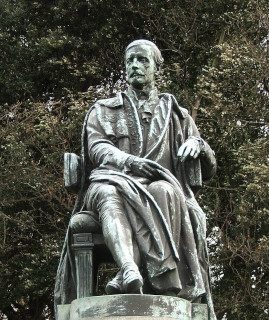
In his best-known achievement, Guinness purchases, landscapes, and donates to the capital, the central public park of St. Stephen’s Green, where his statue commissioned by the city can be seen opposite the Royal College of Surgeons in Ireland. To do so he sponsors a private bill that is passed as the Saint Stephen’s Green (Dublin) Act 1877, and after the landscaping it is formally opened to the public on July 27, 1880. It has been maintained since then by the Commissioners of Public Works in Ireland, now the Office of Public Works.
Guinness dies on January 20, 1915 at his home at St. Anne’s, Raheny, and is buried at All Saints Church, Raheny, whose construction he had sponsored. Those present at the funeral include representatives of the Royal Dublin Society, of which he is president for many years, the Royal Horticultural Society of Ireland, the Irish Unionist Alliance, and the Primrose League. His barony becomes extinct at his death, but the baronetcy devolves upon his nephew Algernon.
Guinness is the third son of Arthur Guinness II (1768–1855), and his wife Anne Lee, and a grandson of the first Arthur (1725–1803), who had bought the St. James’s Gate Brewery in 1759. He joins his father in the business in his late teens, without attending university, and from 1839 he takes sole control within the family. From 1855, when his father dies, he has become the richest man in Ireland, having built up a huge export trade and by continually enlarging his brewery.
In 1851 Guinness is elected the first Lord Mayor of Dublin under the reformed corporation. In 1863 he is made an honorary LL.D. (Doctor of Laws) by Trinity College Dublin, and on April 15, 1867, is created a baronet by patent, in addition to which, on May 18, 1867, by royal licence, he has a grant of supporters to his family arms.
From 1860 to 1865, Guinness undertakes at his own expense, and without hiring an architect, the restoration of the city’s St. Patrick’s Cathedral, an enterprise that costs him over £150,000. In 1865 the building is restored to the dean and chapter and reopens for services on February 24. The citizens of Dublin and the dean and chapter of St. Patrick’s present him with addresses on December 31, 1865, expressive of their gratitude for what he has done for the city. The addresses are in two volumes, which are afterwards exhibited at the Paris Exhibition.
In recognition of his generosity, Guinness is made a baronet in 1867. He is one of the ecclesiastical commissioners for Ireland, a governor of Simpson’s Hospital, and vice-chairman of the Dublin Exhibition Palace. He dies the following year, on May 19, 1868, at his Park Lane home in London. At the time of his death, he is engaged in the restoration of Marsh’s Library, a building which adjoins St. Patrick’s Cathedral. The restoration is completed by his son Arthur.
Guinness is buried in Mount Jerome Cemetery, Dublin, in the family vault, on May 27, 1868. His personalty is sworn under £1,100,000 on August 8, 1868. A bronze statue of him by John Henry Foley is erected by the Cathedral Chapter in St. Patrick’s churchyard, on the south side of the cathedral, in September 1875, which is restored in 2006.
Ferguson is born in Belfast on March 10, 1810. He lives at a number of addresses, including Glenwhirry, where he acquires the love of nature that informs his later work. He is educated at the Belfast Academy and the Belfast Academical Institution and then moves to Dublin to study law at Trinity College, obtaining his bachelor’s degree in 1826 and his master’s degree in 1832.
Because his father has exhausted the family property, Ferguson is forced to support himself through his student years. He turns to writing and is a regular contributor to Blackwood’s Magazine by the age of 22. He is called to the bar in 1838, but continues to write and publish, both in Blackwood’s and in the newly established Dublin University Magazine.
In addition to his poetry, Ferguson contributes a number of articles on topics of Irish interest to antiquarian journals. In 1863, he travels in Brittany, Ireland, Wales, England, and Scotland to study megaliths and other archaeological sites. These studies are important to his major antiquarian work, Ogham Inscriptions in Ireland, Wales and Scotland, which is edited after his death by his widow and published in 1887.
His collected poems, Lays of the Western Gael is published in 1865, resulting in the award of a degree LL.D. honoris causa from Trinity College. He writes many of his poems in both Irish and English translations. In 1867, Ferguson retires from the bar to take up the newly created post of Deputy Keeper of the Public Records in Ireland. As reward for his services, he receives a knighthood in 1878.
Ferguson’s major work, the long poem Congal is published in 1872 and a third volume, Poems, in 1880. In 1882, he is elected President of the Royal Irish Academy, an organisation dedicated to the advancement of science, literature, and antiquarian studies. His house in North Great George’s St., Dublin, is open to everyone interested in art, literature or music.
Just ten years after Guinness is first brewed in St. James Gate, Dublin, the beautiful magic brew is first exported from Ireland on May 19, 1769 as six-and-a-half barrels are shipped to England.
Guinness is an Irish dry stout that originates in the brewery of Arthur Guinness (1725–1803) at St. James’s Gate brewery in the capital city of Dublin. Guinness, produced by the Diageo beverages company, is one of the most successful beer brands worldwide. It is brewed in almost 50 countries and is available in over 120. Annual sales total of Guinness in 2011 was 850 million litres (220,000,000 US gal).
Guinness features a burnt flavour that is derived from malted barley and roasted unmalted barley. The use of roasted barley is a relatively modern development, not becoming part of the grist until the mid-20th century. For many years, a portion of aged brew is blended with freshly brewed beer to give a sharp lactic acid flavour. Although Guinness’s palate still features a characteristic “tang,” the company has refused to confirm whether this type of blending still occurs. The draught beer‘s thick, creamy head comes from mixing the beer with nitrogen and carbon dioxide when poured. It is popular with the Irish, both in Ireland and abroad. In spite of declining consumption since 2001, it is still the best-selling alcoholic drink in Ireland where Guinness & Co. Brewery makes almost €2 billion worth of the beverage annually.
The company is started in 1759 in Dublin, but has to move its headquarters to London at the beginning of the Anglo-Irish Trade War in 1932. In 1997, Guinness plc merges with Grand Metropolitan to form the multinational alcoholic drinks producer Diageo.
Arthur Guinness is believed to be born in Celbridge, County Kildare on September 25, 1725, into the ProtestantGuinness family, part of the Anglo-Irish aristocracy. They claim to descend from the Gaelic Magennis clan of County Down. However, recent DNA evidence suggests descent from the McCartans, another County Down clan, whose spiritual home lay in the townland of “Guiness” near Ballynahinch, County Down.
Guinness’s place and date of birth are the subject of speculation. His gravestone in Oughter Ard, County Kildare, reads that he dies on January 23, 1803, at the age of 78, and that he is born some time in 1724 or very early in 1725. This contradicts the date of September 28, 1725, chosen by the Guinness company in 1991, apparently to end speculation about his birthdate. The place of birth is perhaps his mother’s home at Read homestead at Ardclough, County Kildare.
In 2009 it is claimed that Guinness is born in nearby Celbridge where his parents live in 1725 and where his father later becomes land steward for the Archbishop of Cashel, Dr. Arthur Price. In his will, Dr. Price leaves £100 each to “his servant” Arthur and his father in 1752.
Guinness leases a brewery in Leixlip in 1755, brewing ale. Guinness also purchases a long lease of an adjacent site from George Bryan of Philadelphia in 1756 that is developed as investment property. He leaves his younger brother in charge of the Leixlip enterprise in 1759 and moves on to another at St. James’ Gate, Dublin. He signs a 9,000-year lease for the brewery, effective from December 31, 1759. The lease is presently displayed in the floor at St. James’ Gate. By 1767 he is the master of the Dublin Corporation of Brewers. His first actual sales of porter are listed on tax data from 1778. From the 1780s his second son, Arthur, works at his side and becomes the senior partner in the brewery in 1803.
Guinness’ major achievement is the expansion of his brewery in 1797–1799. Thereafter he brews only porter and employs members of the Purser family who have brewed porter in London from the 1770s. The Pursers become partners in the brewery for most of the 19th century. By the time of his death in 1803, the annual brewery output is over 20,000 barrels. Subsequently Arthur and/or his beer is nicknamed “Uncle Arthur” in Dublin. Guinness’ florid signature is still copied on every label of bottled Guinness.
From 1764, Guinness and his wife Olivia, whom he marries in 1761, live at Beaumont House, which Guinness has built on a 51-acre farm which is now a part of Beaumont Convalescent Home, behind the main part of Beaumont Hospital, between Santry and Raheny in north County Dublin. His landlord is Charles Gardiner. Beaumont, meaning beautiful hill, is named by Arthur and the later Beaumont parish copies the name. From March 1798 he lives at Mountjoy Square in Dublin, which is then in the process of being built in the style of elegant Georgian architecture. Three of his sons are also brewers, and his other descendants eventually include missionaries, politicians, and authors.
Sir Arthur Guinness dies in Mountjoy Square, Dublin, on January 23, 1803, and is buried in his mother’s family plot at Oughter Ard, County Kildare.
To further honour Arthur Guinness’s legacy, in 2009 Guinness & Co. established the Arthur Guinness Fund (AGF). An internal fund set up by the Company, its aim is to enable and empower individuals with skills and opportunities to deliver a measured benefit to their communities. Guinness has donated more than €7 million to the Fund since its inception. Arthur Guinness is also one of a handful of Irish people commemorated twice on stamps, in 1959 and 2009.
Arthur Guinness is born into the ProtestantGuinness family, part of the Anglo-Irish aristrocracy. They claim to descend from the Gaelic Magennis clan of County Down. However, recent DNA evidence suggests descent from the McCartans, another County Down clan, whose spiritual home lay in the townland of “Guiness” near Ballynahinch, County Down.
Guinness’s place and date of birth are the subject of speculation. His gravestone in Oughter Ard, County Kildare, reads that he dies on January 23, 1803, at the age of 78, and that he is born some time in 1724 or very early in 1725. This contradicts the date of September 28, 1725, chosen by the Guinness company in 1991, apparently to end speculation about his birthdate. The place of birth is perhaps his mother’s home at Read homestead at Ardclough, County Kildare.
In 2009 it is claimed that Guinness is born in nearby Celbridge where his parents live in 1725 and where his father later becomes land steward for the Archbishop of Cashel, Dr. Arthur Price. In his will, Dr. Price leaves £100 each to “his servant” Arthur and his father in 1752.
Guinness leases a brewery in Leixlip in 1755, brewing ale. Guinness also purchases a long lease of an adjacent site from George Bryan of Philadelphia in 1756 that is developed as investment property. He leaves his younger brother in charge of the Leixlip enterprise in 1759 and moves on to another at St. James’ Gate, Dublin. He signs a 9,000-year lease for the brewery, effective from December 31, 1759. The lease is presently displayed in the floor at St. James’ Gate. By 1767 he is the master of the Dublin Corporation of Brewers. His first actual sales of porter are listed on tax data from 1778. From the 1780s his second son, Arthur, works at his side and becomes the senior partner in the brewery in 1803.
Guinness’ major achievement is the expansion of his brewery in 1797–1799. Thereafter he brews only porter and employs members of the Purser family who have brewed porter in London from the 1770s. The Pursers become partners in the brewery for most of the 19th century. By the time of his death in 1803, the annual brewery output is over 20,000 barrels. Subsequently Arthur and/or his beer is nicknamed “Uncle Arthur” in Dublin. Guinness’ florid signature is still copied on every label of bottled Guinness.
From 1764, Guinness and his wife Olivia, whom he marries in 1761, live at Beaumont House, which Guinness has built on a 51-acre farm which is now a part of Beaumont Convalescent Home, behind the main part of Beaumont Hospital, between Santry and Raheny in north County Dublin. His landlord is Charles Gardiner. Beaumont, meaning beautiful hill, is named by Arthur and the later Beaumont parish copies the name. From March 1798 he lives at Mountjoy Square in Dublin, which is then in the process of being built in the style of elegant Georgian architecture. Three of his sons are also brewers, and his other descendants eventually include missionaries, politicians, and authors.
Sir Arthur Guinness dies in Mountjoy Square, Dublin, on January 23, 1803, and is buried in his mother’s family plot at Oughter Ard, County Kildare.
Sir Samuel Ferguson, Irish poet, barrister, antiquarian, artist, and public servant, is born at 23 High Street in Belfast on March 10, 1810. Ferguson is perhaps the most important Irish poet of the 19th century. Due to his interest in Irish mythology and early Irish history he is seen as a forerunner of William Butler Yeats and the other poets of the Irish Literary Revival.
Ferguson lives at a number of addresses, including Glenwhirry, where he acquires the love of nature that informs his later work. He is educated at the Belfast Academy and the Belfast Academical Institution and then moves to Dublin to study law at Trinity College, obtaining his bachelor’s degree in 1826 and his master’s degree in 1832.
Because his father has exhausted the family property, Ferguson is forced to support himself through his student years. He turns to writing and is a regular contributor to Blackwood’s Magazine by the age of 22. He is called to the bar in 1838, but continues to write and publish, both in Blackwood’s and in the newly established Dublin University Magazine.
In addition to his poetry, Ferguson contributes a number of articles on topics of Irish interest to antiquarian journals. In 1863, he travels in Brittany, Ireland, Wales, England, and Scotland to study megaliths and other archaeological sites. These studies are important to his major antiquarian work, Ogham Inscriptions in Ireland, Wales and Scotland, which is edited after his death by his widow and published in 1887.
His collected poems, Lays of the Western Gael is published in 1865, resulting in the award of a degree LL.D. honoris causa from Trinity College. He writes many of his poems in both Irish and English translations. In 1867, Ferguson retires from the bar to take up the newly created post of Deputy Keeper of the Public Records in Ireland. As reward for his services, he receives a knighthood in 1878.
Ferguson’s major work, the long poem Congal is published in 1872 and a third volume, Poems, in 1880. In 1882, he is elected President of the Royal Irish Academy, an organisation dedicated to the advancement of science, literature, and antiquarian studies. His house in North Great George’s St., Dublin, is open to everyone interested in art, literature or music.
Ferguson dies on August 9, 1886, in Howth, just outside Dublin city, and is buried in Donegore near Templepatrick, County Antrim.





 Just ten years after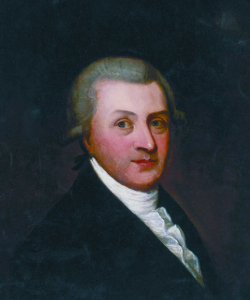

 seamus dubhghaill