seamus dubhghaill

Promoting Irish Culture and History from Little Rock, Arkansas, USA


Leave a comment

Birth of Author Eilís Dillon

eilis-dillon

Eilís Dillon, Irish author of 50 books, is born in Galway, County Galway on March 7, 1920. Her work has been translated into 14 languages.

Dillon is the third of five children of Professor Thomas Dillon and his wife Geraldine (née Plunkett), who is the sister of Joseph Mary Plunkett. She is raised at Dangan House outside of Galway City before moving to the small fishing village of Barna. She attends the local primary school where she becomes proficient in the Irish language and gains an intimate knowledge of tradition in the Connemara. Her family is involved in Irish revolutionary politics. Her uncle, Joseph Mary Plunkett, is a signatory of the 1916 Proclamation of the Irish Republic and is executed after the Easter Rising.

Educated by the Ursuline nuns in Sligo, she works briefly in the hotel and catering trade. In 1940 she marries Cormac Ó Cuilleanáin, an academic from University College Cork and 17 years her senior. They have at least three children, including the Irish poet and Trinity College Dublin professor Eiléan Ní Chuilleanáin and her brother, Cormac Ó Cuilleanáin, also a Trinity professor, who writes novels as Cormac Millar.

Dillon’s first books are written in Irish including An Choill Bheo, published in 1948, Oscar agus an Cóiste sé nEasóg in 1952 and Ceol na coille in 1955. After the success of The Lost Island, published in 1952, she writes almost exclusively in English. Most of her books are aimed at teen readers with themes of self-discovery and problem solving evident.

Dillon’s adult fiction career begins in 1953 with the publication of the detective novel Death at Crane’s Court. This is followed by Sent to His Account in 1954 and Death in the Quadrangle in 1956. These novels are known for their depiction of contemporary Ireland. Over the following decade Dillon publishes many novels including The Bitter Glass (1959), Across the Bitter Sea (1973) and The Wild Geese (1981).

In 1964 she moves to Rome due to her husband’s poor health. While there she acts as adviser to International Commission on English in the Liturgy. She returns to Cork with her husband in 1969 where he dies the following year. She continues to visit Italy over the next several years, setting some of her stories there including Living in Imperial Rome (1974) and The Five Hundred (1972), though these are not as popular as her Irish books. In 1974 she marries the American-based critic and professor Vivian Mercier, dividing her time between California, Italy and Dublin.

In her later years Dillon plays a prominent role in Irish culture. She is a Fellow of the Royal Society for Literature and a member of Aosdána, serves on the Irish Arts Council 1974–1979, chairs the Irish Writers’ Union and the Irish Writers’ Centre, and founds the Irish Children’s Book Trust. In 1987 she and her husband move permanently to Dublin where she supports up and coming Irish authors. Her last story is Children of Bach published in 1993.

Eilís Dillon dies on July 19, 1994, and is buried beside her second husband in Clara, County Offaly. A prize in her memory is given annually as part of the Bisto Book of the Year Awards.

Leave a comment

Birth of Irish Artist Nano Reid

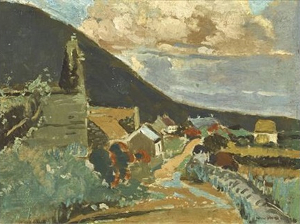
nano-reid-crumphan-achill

Nano Reid, Irish landscape artist, figure painter and portraitist, is born in Drogheda, County Louth on March 1, 1900. An individual, expressionistic artist, Reid is acknowledged to be one of the finest Irish woman painters of twentieth-century visual art in Ireland. Her works are represented in many public collections throughout Ireland.

In 1920, Reid wins a scholarship to study fine art painting and drawing at the Dublin Metropolitan School of Art, now the National College of Art and Design, under Harry Clarke. At the time, she is, in the words of fellow student Hilda van Stockum, “a fierce redhead…uncompromising and looking for truth.” In 1925 she starts showing at the Royal Hibernian Academy (RHA), submitting a total of 42 canvases until the late 1960s.

In 1928, Reid goes to Paris and enrolls briefly at the Académie de la Grande Chaumière, after which she spends a year in London studying fine art at the Central School of Arts and Crafts under Bernard Meninsky. She returns to Ireland in 1931 and once more begins exhibiting her landscape painting at the RHA.

In 1950, with Norah McGuinness, Reid represents Ireland at the Venice Biennale. This is followed by the Exhibition of Contemporary Irish Art in Aberystwyth, Wales (1953), and the Mostra Internazionale di Bianco e Nero in Lugano, Switzerland (1956), the Guggenheim International Award Exhibition in New York City (1960) and the Twelve Irish Painters show in New York City (1963). In 1974, the Arts Council and the Arts Council of Northern Ireland stage a major retrospective of Reid’s artworks.

Nano Reid dies in Drogheda in 1981. Retrospectives are held at Taylor Galleries in Dublin (1984), Droichead Arts Centre in Drogheda (1991), and at Linenhall Arts Centre in Castlebar, County Mayo (1999).

(Pictured: “Crumphan, Achill,” oil on canvas)


Leave a comment

Birth of Short Story Writer Seán Ó Faoláin

sean-ofaolain

Seán Proinsias Ó Faoláin, Irish short story writer, is born as John Francis Whelan on February 22, 1900, in Cork, County Cork.

Ó Faoláin is educated at the Presentation Brothers Secondary School in Cork. He comes under the influence of Daniel Corkery, joining the Cork Dramatic Society and increasing his knowledge of the Irish language, which he had begun in school. Shortly after entering University College Cork, he joins the Irish Volunteers and fights in the Irish War of Independence. During the Irish Civil War, he serves as Censor for The Cork Examiner and as publicity director for the Irish Republican Army (IRA). After the Republican loss, he receives M.A. degrees from the National University of Ireland and from Harvard University where he studies for three years. He is a Commonwealth Fellow from 1926 to 1928 and is a Harvard Fellow from 1928 to 1929.

Ó Faoláin writes his first stories in the 1920s, eventually completing 90 stories over a period of 60 years. From 1929 to 1933 he lectures at the Catholic college, St. Mary’s College, at Strawberry Hill in Twickenham, England, during which period he writes his first two books. His first book, Midsummer Night Madness, is published in 1932. It is a collection of stories partly based on his Civil War experiences. He afterwards returns to his native Ireland. He publishes novels, short stories, biographies, travel books, translations, and literary criticism – including one of the rare full-length studies of the short story, The Short Story (1948). He also writes a cultural history, The Irish, in 1947.

Ó Faoláin serves as director of the Arts Council of Ireland from 1956 to 1959, and from 1940 to 1990 is a founder member and editor of the Irish literary periodical The Bell. The list of contributors to The Bell include many of Ireland’s foremost writers, among them Patrick Kavanagh, Patrick Swift, Flann O’Brien, Frank O’Connor and Brendan Behan. His Collected Stories are published in 1983. He is elected Saoi of Aosdána in 1986.

Seán Proinsias Ó Faoláin dies after a short illness on April 20, 1991, in the Dublin nursing home where he had lived for two years.


Leave a comment

Death of Author Eilís Dillon

Eilís Dillon, Irish author of 50 books, dies on July 19, 1994. Her work has been translated into fourteen languages.

Dillon is the third of five children of Professor Thomas Dillon and his wife Geraldine née Plunkett, who is the sister of Joseph Mary Plunkett. She is raised at Dangan House outside of Galway before moving to the small fishing village of Barna. She attends the local primary school where she becomes proficient in Irish and gains an intimate knowledge of tradition in the Connemara. Dillon’s family is involved in Irish revolutionary politics. Her uncle, Joseph Mary Plunkett, is a signatory of the 1916 Proclamation of the Irish Republic and is executed after the Easter Rising.

Educated by the Ursuline nuns in Sligo, she works briefly in the hotel and catering trade. In 1940 she marries Cormac Ó Cuilleanáin, an academic from University College Cork and seventeen years her senior. They have at least three children, including the Irish poet and Trinity College, Dublin professor Eiléan Ní Chuilleanáin and her brother, Cormac Ó Cuilleanáin, also a Trinity professor, who writes novels as Cormac Millar.

Dillon’s first books are written in Irish including An Choill Bheo, published in 1948, Oscar agus an Cóiste sé nEasóg in 1952 and Ceol na coille in 1955. After the success of The Lost Island, published in 1952, she writes almost exclusively in English. Most of her books are aimed at teen readers with themes of self-discovery and problem solving evident.

In 1964 she moves to Rome due to her husband’s poor health. While there she acts as adviser to International Commission on English in the Liturgy. She returns to Cork with her husband in 1969 where he dies the following year. She continues to visit Italy over the next several years, setting some of her stories there including Living in Imperial Rome (1974) and The Five Hundred (1972), though these are not as popular as her Irish books. In 1974 she marries the American-based critic and professor Vivian Mercier, dividing her time between California, Italy and Dublin.

Dillon’s adult fiction career begins in 1953 with the publication of the detective novel Death at Crane’s Court. This is followed by Sent to His Account in 1954 and Death in the Quadrangle in 1956. These novels are known for their depiction of contemporary Ireland. Over the following decade Dillon publishes many novels including The Bitter Glass (1959), Across the Bitter Sea (1973) and The Wild Geese (1981).

In her later years Dillon plays a prominent role in Irish culture. She is a Fellow of the Royal Society for Literature and a member of Aosdána, serves on the Irish Arts Council from 1974 until 1979, chairs the Irish Writers’ Union and the Irish Writers’ Centre, and founds the Irish Children’s Book Trust.

In 1987 Dillon and her husband move permanently to Dublin where she supports up and coming Irish authors. Her last story is Children of Bach published in 1993. Eilís Dillon dies on July 19, 1994, and is buried beside her second husband in Clara, County Offaly. A prize in her memory is given annually as part of the Bisto Book of the Year Awards.

Leave a comment

Founding of the Arts Council of Ireland

The Arts Council (An Chomhairle Ealaíon), sometimes called the Arts Council of Ireland, is established on May 8, 1951, by the Government of Ireland. The Council’s purpose is to encourage interest in Irish art, including visual art, music, performance, and literature, and to channel funding from the state to Irish artists and arts organisations. This includes encouragement of traditional Irish arts, support for contemporary Irish arts, and finance for international arts events in Ireland. The council is modeled on the Arts Council of Great Britain, founded in 1946, and works closely with the Arts Council of Northern Ireland, formed by the British government in Northern Ireland in 1962 to fulfil a similar role.

The Arts Council consists of twelve members and a chair, each appointed for a five-year term by the Minister for Arts, Heritage, Regional, Rural and Gaeltacht Affairs. The Chair of the Arts Council is entitled to an annual fee of €8,978 and ordinary members are entitled to a fee of €5,985, although some members choose to waive this fee.

The ongoing work of the Arts Council is delivered by the executive. In addition to the Director, a staff of 41 full-time equivalents carries out the daily functions of the organisation. Arts advisers, who provide additional expertise and strategic advice on different aspects of the arts, are retained on a consultancy basis.

The Arts Council of Ireland is the official “Cultural Contact Point” between the European Commission‘s Cultural Programme and Ireland and is a founding member of the International Federation of Arts Councils and Culture Agencies. Visual Artists Ireland, the all-Ireland non-governmental organisation representing Irish artists nationally and internationally, is supported by the Arts Council of Ireland.

For additional information, visit the Arts Council’s website at http://www.artscouncil.ie/home/.


Leave a comment

Birth of Cecil Day-Lewis, Poet & Poet Laureate of the U.K.

Cecil Day-Lewis, poet, novelist, critic, and the Poet Laureate of the United Kingdom from 1968 to 1972, is born in Ballintubbert, County Laois, on April 27, 1904. He also writes mystery stories under the pseudonym of Nicholas Blake and is the father of actor Daniel Day-Lewis and documentary filmmaker and television chef Tamasin Day-Lewis.

Day-Lewis is the son of Frank Day-Lewis, Church of Ireland Rector of the parish, and Kathleen Blake. His father takes the surname “Day-Lewis” as a combination of the surnames of his own birth father (Day) and his adoptive father (Lewis). After the death of his mother in 1906, Day-Lewis is brought up in London by his father, with assistance of an aunt, spending summer holidays with relatives in County Wexford. He is educated at Sherborne School and at Wadham College, Oxford. In Oxford, Day-Lewis becomes part of the circle gathered around W. H. Auden and helps him to edit Oxford Poetry 1927. His first collection of poems, Beechen Vigil, appears in 1925.

In 1928, Day-Lewis marries Constance Mary King, the daughter of a Sherborne teacher, and works as a schoolmaster in three schools, including Larchfield School in Helensburgh, Scotland. During the 1940s he has a long and troubled love affair with the novelist Rosamond Lehmann. His first marriage is dissolved in 1951, and he marries actress Jill Balcon, daughter of Michael Balcon.

During World War II he works as a publications editor in the Ministry of Information, an institution satirised by George Orwell in his dystopian Nineteen Eighty-Four. During this time his work is now no longer as heavily influenced by Auden, and he develops a more traditional style of lyricism. Some critics believe that he reaches his full stature as a poet in Word Over All (1943), when he finally distances himself from Auden. After the war he joins the publisher Chatto & Windus as a director and senior editor.

In 1946, Day-Lewis is a lecturer at Cambridge University, publishing his lectures in The Poetic Image (1947). He later teaches poetry at the University of Oxford, where he is Professor of Poetry from 1951 until 1956. He is the Norton Professor at Harvard University from 1962 to 1963, and is appointed Poet Laureate in 1968, in succession to John Masefield.

Day-Lewis is chairman of the Arts Council Literature Panel, vice-president of the Royal Society of Literature, an Honorary Member of the American Academy of Arts and Letters, a Member of the Irish Academy of Letters, and a Professor of Rhetoric at Gresham College, London.

Cecil Day-Lewis dies of pancreatic cancer on May 22, 1972, at Lemmons, the Hertfordshire home of Kingsley Amis and Elizabeth Jane Howard, where he and his family are staying. Being a great admirer of Thomas Hardy, he arranges to be buried as close as possible to the author’s grave at St. Michael’s Church in Stinsford, Dorset.