seamus dubhghaill

Promoting Irish Culture and History from Little Rock, Arkansas, USA


Leave a comment

The Copley Street Riot

The Copley Street riot occurs on August 13, 1934, at the Copley Street Repository, Cork, County Cork, after Blueshirts opposed to the collection of annuities from auctioned cattle ram a truck through the gate of an ongoing cattle auction. The Broy Harriers open fire and one man, 22 year old Michael Lynch, is killed and several others injured.

Following the Irish War of Independence (1919–21), Britain relinquishes its control over much of Ireland. However, aspects of the Anglo-Irish Treaty, which had marked the end of the war, lead to the Irish Civil War (1922–23). The aftermath leaves Ireland with damaged infrastructure and hinders its early development.

Éamon de Valera, who had voted against the Anglo-Irish treaty and headed the Anti-Treaty movement during the civil war, comes to power following the 1932 Irish general election and is re-elected in 1933. While the treaty stipulates that the Irish Free State should pay £3.1 million in land annuities to Great Britain, and despite advice that an economic war with Britain could have catastrophic consequences for Ireland (as 96% of exports are to Britain), de Valera’s new Irish government refuses to pay these annuities – though they continue to collect and retain them in the Irish exchequer.

This refusal leads to the Anglo-Irish trade war (also known as the “Economic War”), which persists until 1935, when a new treaty, the Anglo-Irish Trade Agreement, is negotiated in 1938. During this period, a 20% duty is imposed on animals and agricultural goods, resulting in significant losses for Ireland. Specifically, poultry trade declines by 80%, butter trade by 50% and cattle prices drop by 50%. Some farmers are forced to kill and bury animals because they cannot afford to maintain them.

In 1933, Fine Gael emerges as a political party—a merger of Cumann na nGaedheal and the National Centre Party. Fine Gael garners substantial support from rural farmers who are particularly affected by the Economic War. They strongly object to the collection of land annuities by the Fianna Fáil government. The Blueshirts, a paramilitary organisation founded as the Army Comrades Association in 1932 and led by former Garda Commissioner Eoin O’Duffy, transforms into an agrarian protest organisation, mobilising against seizures, cattle auctions, and those tasked with collecting annuities.

O’Duffy, a key figure in Irish politics, encourages farmers to withhold payment of land annuities to the government. Arising from this stance, Gardaí start to seize animals and farm equipment, auctioning them to recover the outstanding funds. While seized cattle are auctioned, local farmers rarely participate. Instead, Northern Ireland dealers, often associated with the name O’Neill, are the primary buyers. These auctions are protected by the Broy Harriers, an armed auxiliary group linked to the police.

By 1934, tensions escalate, and a series of anti-establishment incidents are attributed to the Blueshirts. These incidents range from minor acts of violence, such as breaking windows, to more serious offenses like assault and shootings.

On August 13, 1934, an auction takes place at Marsh’s Yard on Copley Street in Cork, featuring cattle seized from farms in Bishopstown and Ballincollig. The police establish a cordon by 10:00 a.m., with 300 officers on duty. Lorries arrived at 11:00 a.m.

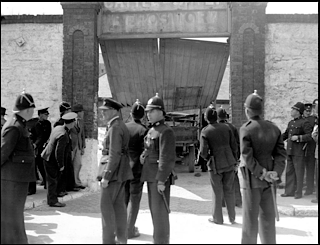
Around noon, three thousand protestors assemble. Within twenty-five minutes, an attempt is made to breach the yard gate by ramming it with a truck. According to Oireachtas records, there are approximately 20 men in the truck which they run against the gate. The Minister for Justice P. J. Ruttledge, says that the truck “with those people in it charged through those cordons of Guards; that several Guards jumped on to the lorry and tried to divert the driver by catching hold of the steering wheel and trying to twist it.” Some contemporary news sources suggest that the ramming truck knocked down the surrounding police cordon “like ninepins and crush[ed] a police inspector against a gate.” Later sources suggest that the senior officer (a superintendent) was injured in a fall, while attempting to avoid being struck, rather than being hit directly by the truck.

A man named Michael Lynch, wearing the distinctive blue shirt, and approximately 20 others reportedly manage to enter the yard. As soon as they enter the yard they are fired upon by armed “special branch” police detectives who are in the yard. Lynch later succumbs to his injuries at the South Infirmary. Thirty-six others are wounded. Despite the violence, the auction proceeds after a one-hour delay.

Following the shooting, a riot ensues, but when news of Lynch’s death reaches the participants, they cease rioting, kneel, and recited a Rosary.

The funeral of Michael Lynch occurs on August 15, 1934. The funeral procession is planned to depart from Saints Peter and Paul’s Church, Cork at 2:30 PM.

The occasion allows for a significant show of force for Eoin O’Duffy and the Blueshirts, and features Roman salutes and military drills. Farmers in Munster reportedly stop work for an hour, and Blueshirt members ask shopkeepers to close their businesses, as a show of respect for the “martyr.” Lynch is afforded a “full Blueshirt burial,” and the coffin is adorned with the flag of the Blueshirts (the Army Comrades Association).

According to the  Minister for Justice, at the funeral W. T. Cosgrave stands beside O’Duffy as the Blueshirt leader gives an oration saying, “We are going to carry on until our mission is accomplished […] those 20 brave men, whose deed will live for ever, not only in Cork but in every county in Ireland, broke through in the lorry […] all Blueshirts should try to emulate his bravery and nobleness. Every Blueshirt is prepared to go the way of Michael for his principles.”

The court grants the family £300 in 1935. This is appealed to the High Court, followed by the Supreme Court, which dismisses the case. In the Supreme Court, Henry Hanna describes the Broy Harriers as “an excrescence” upon the Garda Síochána.

When the matter is discussed in the Seanad in September 1934, and before a vote is taken to “[condemn] the action of the members of the special branch of the Gárda Síochána […] on Monday, the 13th August 1934,” the senators who support Éamon de Valera’s government walk out.

In August 1940, a memorial is unveiled on the tomb of Lynch in Dunbulloge Cemetery in Carrignavar, County Cork, consisting of a limestone Celtic cross and pedestal. The pedestal is engraved with a quote from the American orator, William Jennings Bryan: “The humblest citizen of all the land, when clad in the armour of a righteous cause is stronger than all the hosts of error.”

(Pictured: Aftermath of the ramming of Marsh’s Yard, Copley Street, that leads to the death of Michael Lynch and the Copley Street Riot on August 13, 1934)

Leave a comment

The Coolavokig Ambush

The Coolavokig ambush (Irish: Luíochán Chúil an Bhuacaigh) is carried out by the Irish Republican Army (IRA) on February 25, 1921, during the Irish War of Independence. It takes place at Coolavokig, on the road between Macroom and Ballyvourney, County Cork. A 60-man flying column of the IRA’s 1st Cork Brigade under Seán O’Hegarty, ambushes a 70-man convoy of the Auxiliary Division under Major Seafield Grant, sparking a four-hour battle. Ten Auxiliaries are killed, including Major Grant, and others wounded. The IRA column leaves the area when British reinforcements arrive. After the ambush, British forces stop carrying out raids and patrols in the area.

The IRA flying column had been attempting to ambush the Auxiliaries for two weeks but had always missed them. As they occupy the ambush position over a few days, their position becomes known and a force of seventy Auxiliaries and seven Royal Irish Constabulary (RIC) constables move against them, heavily armed with rifles, machine guns and grenades. The sixty-two IRA volunteers include units from the 1st, 7th, and 8th battalions of the 1st Cork Brigade, and are divided into four sections. Apart from commander Seán O’Hegarty, the main IRA officers are Dan “Sandow” O’Donovan and Dan Corkery. The IRA is armed with sixty rifles, several shotguns and revolvers, and two Lewis guns, but significantly, no grenades. The British forces, traveling in eight lorries and two cars, also carry four Irish hostages with them.

Around 8:00 a.m. on February 25, IRA scouts signal the approach of the British force. The British are forewarned about the IRA position however, and approach with caution, when a republican leaving his post turns to run back and is seen from the leading lorry. When half of the lorries come into the ambush position the IRA opens fire. According to An Cosantóir, one lorry immediately turns around and speeds back to Macroom.

Rifles and a Lewis machine gun from the IRA’s No. 1 section, and ten rifles from the No. 4 section, open fire, as they are the only republican units that have a field of fire on the lorries. They then drop to the ground to avoid return fire. Sections No. 2 and No. 3 swing around to the east, on a hillside, in an attempt to encircle the British northern flank, but they can get no closer than 500 yards.

The Auxiliaries are quickly losing ground and taking casualties. Major Grant is killed while rallying his forces. The British forces retreat into two nearby cottages. The IRA closes in and as they are preparing to bomb the cottages, large numbers of RIC reinforcements approach and begin encircling the area. After fighting a half-hour rear guard action, the IRA flying column retreats toward the northwest. The engagement at Coolavokig lasts four hours, until soldiers of the Manchester Regiment arrive.

It later transpires that the Auxiliary forces are just part of a large round-up operation planned for that day which includes 600 British Army troops from Cork, Ballincollig, Bandon, Clonakilty, Skibbereen, Bantry, Dunmanway, Millstreet, Macroom, and Killarney. After the ambush, British forces cease raiding and patrolling the area west of Macroom, effectively handing it over to IRA control. They are reluctant to enter the area and only do so later with a strong force of 2,000 men.

The IRA suffers no casualties. However, the number of British casualties has been disputed to this day. The British claim that only Major (Auxiliary Commandant) James Seafield-Grant was killed during the ambush, and that two other Auxiliaries later died of their wounds. The IRA claims that between 14 and 16 members of the British force were killed. The Digest of Service for the 1st Battalion, Manchester Regiment, records that on March 18, 1921, a party proceeds to Coolavokig to destroy houses believed to have been used by the IRA.


1 Comment

Capture of Mallow Barracks

The Cork No. 2 Brigade, Irish Republican Army (IRA), attacks and captures a military barracks in Mallow, County Cork, on September 28, 1920, the only military barracks to be captured during the Irish War of Independence. British forces later burn and sack the town.

Mallow had been a garrison town for several hundred years. Eight miles to the north lay Buttevant where one of the largest military barracks in the country is located. Not far from Buttevant are the great military training camps of Ballyvonaire, while nineteen miles to the northeast is Fermoy with its large permanent military garrisons and huge barracks adjacent to the big training centres of Kilworth and Moorepark. Twenty miles to the southeast is the city of Cork with its many thousands of troops both in the posts within the city and at Ballincollig, about six miles west of it, on the Macroom road. Thirteen miles westward a detachment from a British machine gun corps holds Kanturk. Every town and village has its post of Royal Irish Constabulary (RIC) men armed to the teeth.

The idea of capturing the barracks comes from two members of the Mallow IRA Battalion, Dick Willis, a painter, and Jack Bolster, a carpenter, who are employed on the civilian maintenance staff of the barracks which is occupied by the 17th Lancers. Willis and Bolster are able to observe the daily routine of the garrison and form the opinion that the capture of the place would not be difficult. They are instructed by their local battalion officers to make a sketch map of the barracks. After that is prepared, Liam Lynch and Ernie O’Malley go with Willis and Tadhg Byrnes to Mallow to study the layout of the surrounding district. Among the details of the garrison’s routine that Willis and Bolster report to the Column leaders, is the information that each morning the officer in charge, accompanied by two-thirds of the men, take the horses for exercise outside the town. It is obvious to the two Mallow volunteers that this is the ideal time for the attack.

Situated at the end of a short, narrow street and on the western verge of the Town Park, Mallow barracks stand on an unusually low-lying location and is relatively small in size. Surrounded by a high stone wall, the barracks can be approached from the town park as well as from the main street. The various details are carefully studied by Lynch and O’Malley. While Willis and Bolster are allotted tasks within the walls of the barracks, Byrnes and Jack Cunningham are chosen to attack with the main body of the column which includes Commandant Denny Murphy of Kanturk.

On the morning of September 27, at their Burnfort headquarters, the men are ordered to prepare for action. Under cover of darkness they move into the town and enter the Town Hall by way of the park at the rear. The eighteen men of the column are strengthened by members of the Mallow battalion, a number of men posted in the upper storey of the Town Hall, from which they can command the approaches to the nearby RIC barracks. Initially it is planned that Willis and Bolster will enter the military barracks that morning in the normal manner, accompanied by an officer of the column who will pose as a contractor’s overseer. The officer is Paddy McCarthy of Newmarket, who would die a few months later in a gun battle with the Black and Tans at Millstreet.

McCarthy, Willis and Bolster enter the barracks without mishap. Members of the garrison follow their normal routine, with the main body of troops under the officer in charge leaving the barracks with the horses. In the barracks remain about fifteen men under the command of a senior N.C.O., Sergeant Gibbs.

Once the military has passed, the attackers, numbering about twenty men and led by Liam Lynch, advance toward the bottom of Barrack Street. All are armed with revolvers which are considered the most convenient and suitable weapons for the operation. Lynch has issued strict instructions that there is to be no shooting by the attackers, unless as a last resort. Inside the walls are McCarthy, Willis and Bolster, their revolvers concealed. Then Ernie O’Malley presents himself at the wicket gate with a bogus letter in his hand. Behind him and out of sight of the sentry are the other members of the main attacking party, led by Lynch, O’Brien and George Power. When the gate is opened sufficiently, O’Malley wedges his foot between it and the frame and the soldier is overpowered and the attackers rush in. McCarthy, Bolster and Willis immediately go to the guardroom where they hold up the guard. Realising what is happening, Sergeant Gibbs, rushes toward the guardroom in which rifles are kept. Although called upon to halt, he continues even though a warning shot is fired over his head. As he reaches the guardroom door, the IRA officer and one of the volunteers in the guardroom fire simultaneously. Mortally wounded, the sergeant falls at the guardroom door.

By this time the majority of the attacking party is inside the gate. Military personnel in different parts of the barracks are rounded up and arms are collected. Three waiting motor cars pull up to the gate and all the rifles, other arms and equipment found in the barracks are loaded into them. The prisoners are locked into one of the stables, with the exception of a man left to care for Sergeant Gibbs. The whole operation goes according to plan, except for the shooting of the sergeant. Twenty minutes after the sentry had been overpowered the pre-arranged signal of a whistle blast is sounded and the attackers withdraw safely to their headquarters at Burnfort, along the mountain road out of Mallow.

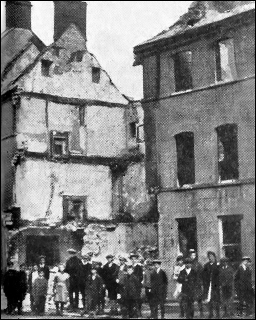
Expecting reprisals, the column moves to Lombardstown that night, and positions are taken up around the local co-operative creamery as it is the custom of the British to wreak their vengeance on isolated country creameries after incidents such as what had just occurred. The Mallow raid, however, has greater repercussions than the destruction of a creamery and co-operative stores. The following night, large detachments of troops from Buttevant and Fermoy enter Mallow. They rampage through the town, burning and looting at will. High over the town, the night sky is red with the flames of numerous burning buildings.

Townspeople run through the blazing streets, in search of refuge. A number of women and children are accorded asylum in the nearby convent schools. Another group of terrified women, some with children in arms, take refuge in the cemetery at the rear of St. Mary’s Church, where they kneel or lay above the graves. It is a night of terror such as which had never before been endured by the people of Mallow.

The extent of the wanton destruction outrages fair-minded people all over the world. Details of the havoc that had been wrought and pictures of the scenes of destruction are published worldwide.

(Pictured: Townspeople gather in front of one of the many buildings in Mallow which were reduced to ruins during British Army reprisals)


1 Comment

The Rathcoole Ambush

rathcoole-ambush-monument

The Rathcoole Ambush, one of the largest ambushes of the Irish War of Independence, takes place at Rathcoole, County Cork on June 16, 1921.

The railway line between Banteer and Millstreet had been cut in several places so the British Auxiliary forces based at Millstreet have to travel to Banteer by road for their supplies twice a week. As a result, a combined force of 130 Irish Republican Army (IRA) volunteers from the Millstreet, Kanturk, Newmarket, Charleville and Mallow battalion columns are mobilised to attack the Auxiliaries as they return from Banteer. The volunteers are under the command of Paddy O’Brien from Liscarroll.

On the night before the ambush the IRA volunteers sleep at Rathcoole Wood, which overlooks the planned ambush position. Shortly after sunrise the following morning, Captain Dan Vaughan lays six land mines on the untarred road and covers them with dust. After a wait of several hours a convoy of four armour-plated lorries, each mounted with a machine gun and carrying ten men, is observed heading for Banteer.

The volunteers prepare themselves and at 6:20 in the evening, as the lorries pass through the ambush area on their return journey, three of the land mines explode with devastating results. One mine detonates as the last of the four lorries drives over it and another explodes under the leading lorry in the convoy. Both vehicles are out of action with the two other lorries trapped between them. A third mine explodes amid a party of Auxiliaries as they attempted to outflank the position. A bitter firefight develops. Each time Auxiliaries attempt to outflank the IRA they are driven back, suffering losses of more than twenty dead and over a dozen wounded.

When it becomes clear that the IRA cannot achieve a complete victory because of their limited ammunition supply, the order for withdrawal is given and the whole force retires without a single casualty. Although no arms are captured during the action, a reconnaissance party from the column returns the next day to search the ambush position and recovers 1,350 rounds of ammunition which the Auxiliaries had left behind them as they removed their dead and wounded.

The ambush at Rathcoole is one of the Irish Republican Army’s most successful actions during the War of Independence. A week after the ambush, British Forces from Kanturk, Buttevant, Ballyvonaire, Macroom, Ballincollig, Killarney and Tralee carry out a widespread search throughout the Rathcoole area. Michael Dineen, a Volunteer in Kilcorney Company is taken from his brother’s house at Ivale by a party of Auxiliaries and shot dead. On the evening of July 1, the Auxiliaries set fire to and destroy the wood at Rathcoole from where the ambush had been launched. That same day that they shoot and kill a local man, Bernard Moynihan, as he is out cutting hay.

(Pictured: Monument at the site of the Rathcoole Ambush)


Leave a comment

Death of Rory Gallagher, Irish Blues & Rock Guitarist

rory-gallagher

William Rory Gallagher, Irish blues and rock multi-instrumentalist, songwriter, and bandleader, dies at the age of 47, in London on June 14, 1995 of complications following a liver transplant.

Gallagher is born in Ballyshannon, County Donegal, on March 2, 1948. Both he and his brother Dónal are musically inclined and encouraged by their parents. At age nine, Gallagher receives his first guitar from them. After winning a talent contest when he is twelve, he begins performing with both his acoustic guitar and an electric guitar that he purchases with his prize money. It is, however, his purchase three years later of a 1961 Fender Stratocaster for £100 that becomes his primary instrument and most associated with him for the span of his lifetime.

Gallagher is initially attracted to skiffle after hearing Lonnie Donegan on the radio. While still in school, playing songs by Buddy Holly and Eddie Cochran, he discovers his greatest influence in Muddy Waters. He begins experimenting with folk, blues, and rock music.

While still a young teenager, Gallagher begins playing after school with Irish showbands. In 1963, he joins one named Fontana, a sextet playing the popular hit songs of the day. The band tours Ireland and the United Kingdom, earning enough money for Gallagher to make the payments on his Stratocaster guitar. Gallagher begins to influence the band’s repertoire and successfully moulds Fontana into The Impact, changing the line-up into a rhythm and blues group. The band plays gigs in Ireland and Spain until it disbands in London, with Gallagher and the bassist and drummer continuing to perform as a trio in Hamburg, Germany.

In 1966, Gallagher returns to Ireland and forms Taste, a blues rock and R&B power trio. Initially, the band is composed of Gallagher and Cork musicians Norman Damery and Eric Kitteringham. However, by 1968, Damery and Kitteringham are replaced by Belfast musicians John Wilson on drums and Richard McCracken on bass. Performing extensively in the UK, the group supports both Cream at their Royal Albert Hall farewell concert and the blues supergroup Blind Faith on a tour of North America.

After the break-up of Taste in 1970, Gallagher tours under his own name. He hires former Deep Joy bass player Gerry McAvoy to play on his self-titled debut album, Rory Gallagher. This is the beginning of a twenty-year musical relationship between Gallagher and McAvoy. The 1970s are Gallagher’s most prolific period, producing ten albums in the decade. In 1971 he is voted Melody Maker‘s International Top Guitarist of the Year, ahead of Eric Clapton. However, despite a number of his albums reaching the UK Albums Chart, Gallagher does not attain major star status. Though he sells over thirty million albums worldwide, it is his marathon live performances that win him the greatest acclaim.

In the 1980s Gallagher continues recording and embarks on a tour of the United States. In addition, he plays with Box of Frogs, a band formed in 1983 by former members of The Yardbirds.

In the later years of his life, Gallagher develops a phobia of flying. To overcome this he receives a prescription for a powerful sedative. This medication, combined with his alcohol use, results in severe liver damage. Despite his condition he continues touring. By his final performance on January 10, 1995 in the Netherlands, he is visibly ill and the remainder of the tour is cancelled. He is admitted to King’s College Hospital in London in March 1995. His liver is failing and the doctors determine that a liver transplant is the only possible course of action. After 13 weeks in intensive care, his health suddenly worsens when he contracts a Staphylococcal infection. Gallagher dies on June 14, 1995, and is buried in St. Oliver’s Cemetery just outside Ballincollig near Cork.


Leave a comment

The Dunmanway Killings

dunmanway-massacre

The Dunmanway killings, also known as the Dunmanway murders or the Dunmanway massacre, takes place in and around Dunmanway, County Cork between April 26-28, 1922. The event refers to the killing (and in some cases, disappearances) of thirteen Protestant men and boys.

The killings happen in a period of truce after the July 1921 end of the Irish War of Independence and before the outbreak of the Irish Civil War in June 1922. All the dead and missing are Protestants, which has led to the killings being described as sectarian. Six are killed as purported British informants and loyalists, while four others are relatives killed in the absence of the target. Three other men are kidnapped and executed in Bandon as revenge for the killing of an Irish Republican Army (IRA) officer Michael O’Neill during an armed raid. One man is shot and survives his injuries.

On April 26, 1922, a group of anti-Treaty IRA men, led by Michael O’Neill, arrive at the house of Thomas Hornibrook, a former magistrate, at Ballygroman, East Muskerry, Desertmore, Bandon (near Ballincollig on the outskirts of Cork City), seeking to seize his car. Hornibrook is in the house at the time along with his son, Samuel, and his nephew, Herbert Woods, a former Captain in the British Army. O’Neill demands a part of the engine mechanism that had been removed by Hornibrook to prevent such theft. Hornibrook refuses to give them the part, and after further efforts, some of the IRA party enter through a window. Herbert Woods then shoots O’Neill, wounding him fatally. O’Neill’s companion, Charlie O’Donoghue, takes him to a local priest who pronounces him dead. The next morning O’Donoghue leaves for Bandon to report the incident to his superiors, returning with “four military men,” meeting with the Hornibrooks and Woods, who admit to shooting O’Neill.

It is not clear who orders the attacks or carries them out. However, in 2014 The Irish Times releases a confidential memo from the then-Director of Intelligence Colonel Michael Joe Costello (later managing director of the Irish Sugar Company) in September 1925 in relation to a pension claim by former IRA volunteer Daniel O’Neill of Enniskeane, County Cork, stating: “O’Neill is stated to be a very unscrupulous individual and to have taken part in such operations as lotting [looting] of Post Offices, robbing of Postmen and the murder of several Protestants in West Cork in May 1922. A brother of his was shot dead by two of the latter named, Woods and Hornbrooke [sic], who were subsequently murdered.”

Sinn Féin and IRA representatives, from both the pro-Treaty side, which controls the Provisional Government in Dublin and the anti-Treaty side, which controls the area the killings take place in, immediately condemn the killings.

The motivation of the killers remains unclear. It is generally agreed that they were provoked by the fatal shooting of O’Neill by Woods, whose house was being raided on April 26. Some historians have claimed there were sectarian motives; others claim that those killed were targeted only because they were suspected of having been informers during the Irish War of Independence and argue that the dead were associated with the so-called “Murragh Loyalist Action Group,” and that their names may have appeared in captured British military intelligence files which listed “helpful citizens” during the war.

(Pictured: Herbert Woods, centre, whose decision to shoot sparks the massacre)


Leave a comment

Birth of Irish Blues & Rock Guitarist Rory Gallagher

rory-gallagher

William Rory Gallagher, Irish blues and rock multi-instrumentalist, songwriter, and bandleader, is born in Ballyshannon, County Donegal, on March 2, 1948.

Both Rory and his brother Dónal are musically inclined and encouraged by their parents. At age nine, Gallagher receives his first guitar from them. After winning a talent contest when he is twelve, Gallagher begins performing with both his acoustic guitar and an electric guitar that he purchases with his prize money. It is, however, his purchase three years later of a 1961 Fender Stratocaster for £100 that becomes his primary instrument and most associated with him for the span of his lifetime.

Gallagher is initially attracted to skiffle after hearing Lonnie Donegan on the radio. While still in school, playing songs by Buddy Holly and Eddie Cochran, he discovers his greatest influence in Muddy Waters. He begins experimenting with folk, blues, and rock music.

While still a young teenager, Gallagher begins playing after school with Irish showbands. In 1963, he joins one named Fontana, a sextet playing the popular hit songs of the day. The band tours Ireland and the United Kingdom, earning enough money for Gallagher to make the payments on his Stratocaster guitar. Gallagher begins to influence the band’s repertoire and successfully moulds Fontana into The Impact, changing the line-up into an R&B group. The band plays gigs in Ireland and Spain until it disbands in London, with Gallagher and the bassist and drummer continuing to perform as a trio in Hamburg, Germany.

In 1966, Gallagher returns to Ireland and forms Taste, a blues rock and R&B power trio. Initially, the band is composed of Gallagher and Cork musicians Norman Damery and Eric Kitteringham. However, by 1968, Damery and Kitteringham are replaced by Belfast musicians John Wilson on drums and Richard McCracken on bass. Performing extensively in the UK, the group supports both Cream at their Royal Albert Hall farewell concert and the blues supergroup Blind Faith on a tour of North America.

After the break-up of Taste in 1970, Gallagher tours under his own name. He hires former Deep Joy bass player Gerry McAvoy to play on his self-titled debut album, Rory Gallagher. This is the beginning of a twenty-year musical relationship between Gallagher and McAvoy. The 1970s are Gallagher’s most prolific period, producing ten albums in the decade. In 1971 he is voted Melody Maker’s International Top Guitarist of the Year, ahead of Eric Clapton. However, despite a number of his albums reaching the UK Albums Chart, Gallagher does not attain major star status. Though he sells over thirty million albums worldwide, it was his marathon live performances that win him the greatest acclaim.

In the 1980s he continues recording and embarks on a tour of the United States. In addition, he plays with Box of Frogs, a band formed in 1983 by former members of The Yardbirds.

In the later years of his life, Gallagher develops a phobia of flying. To overcome this he receives a prescription for a powerful sedative. This medication, combined with his alcohol use, results in severe liver damage. Despite his condition he continues touring. By his final performance on January 10, 1995 in the Netherlands, he is visibly ill and the remainder of the tour is cancelled. Gallagher is admitted to King’s College Hospital in London in March 1995. His liver is failing and the doctors determine that a liver transplant is the only possible course of action. After 13 weeks in intensive care, his health suddenly worsens when he contracts a Staphylococcal infection. Gallagher dies on June 14, 1995, and is buried in St. Oliver’s Cemetery just outside Ballincollig near Cork City, Ireland.