seamus dubhghaill

Promoting Irish Culture and History from Little Rock, Arkansas, USA


Leave a comment

Birth of Cahal Daly, Archbishop of Armagh

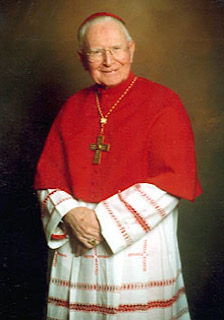
Cahal Brendan Daly KGCHS, a Roman Catholic cardinaltheologian and writer, is born Charles Brendan Daly on October 1, 1917, in Ballybraddin, Loughguile, a village near Ballymoney in County Antrim.

Daly serves as the Catholic Primate of All Ireland and Archbishop of Armagh from late 1990 to 1996, the oldest man to take up this role in nearly 200 years. He is later created a Cardinal-Priest of San Patrizio by Pope John Paul II in the papal consistory of June 28, 1991.

Daly is the third child of seven born to Charles Daly and Susan Connolly. His father is a primary school teacher originally from KeadueCounty Roscommon, and his mother a native of Antrim. He is educated at St. Patrick’s National School in Loughguile, and then as a boarder in St. Malachy’s CollegeBelfast, in 1930. The writer Brian Moore is a near contemporary.

Daly studies Classics at Queen’s University Belfast (QUB). He earns his BA with Honours and also the Henry Medal in Latin Studies in 1937 and completes his MA the following year. He enters St. Patrick’s College, Maynooth and is ordained to the priesthood on June 22, 1941. He continues studies in theology in Maynooth, from where he obtains a doctorate in divinity (DD) in 1944. His first appointment is as Classics Master in St. Malachy’s College (1944–45).

In 1945, Daly is appointed Lecturer in Scholastic Philosophy at Queen’s University, Belfast, retaining the post for 21 years. In the academic year 1952–53 QUB grants him sabbatical leave, which he spends studying at the Catholic University of Paris where he receives a licentiate in philosophy. He returns to France at many points, particularly for holidays. He persists with his studies well into his retirement. He is a popular figure with the university and fondly remembered by his students. He is named a Canon of the Cathedral Chapter of Diocese of Down and Connor in 1966.

Daly is a peritus, or theological expert, at the Second Vatican Council (1962–65) to Bishop William Philbin during the first session of the Council and to Cardinal William Conway for the rest of the council. He dedicates himself to scholarship for 30 years, and publishes several books seeking to bring about understanding between the warring factions in Northern Ireland.

Daly is appointed Reader in Scholastic Philosophy at QUB in 1963, a post he holds until 1967, when he is appointed Bishop of Ardagh and Clonmacnoise on May 26.

Daly converts his forename Charles into Cahal ahead of his episcopal consecration in St. Mel’s CathedralLongford, on July 16, 1967, from Cardinal William Conway, with Archbishop Giuseppe Sensi and Bishop Neil Farren serving as co-consecrators.

Daly spends 15 years as bishop in Longford and is diligent about parish visitation and confirmations gradually assume a greater national profile. From 1974 onward, he devotes himself especially to ecumenical activities for the Pontifical Council for Promoting Christian Unity. His pastoral letter to Protestants, written in 1979, pleads for Christian unity.

Daly succeeded William Philbin as the 30th Bishop of Down and Connor when he is installed as bishop of his native diocese at a ceremony in St. Peter’s Cathedral, Belfast, on October 17, 1982.

On November 6, 1990, Daly is appointed Archbishop of Armagh and, as such, Primate of All Ireland. His age makes him an unexpected occupant of the post. Despite this it is requested that he stay in the role for three years before usual age of episcopal retirement at 75. Cardinal Daly takes a notably harder line against the Irish Republican Army (IRA) than his predecessor, Cardinal Tomás Ó Fiaich.

Daly is respectful of Protestant rights and opposes integrated education of Catholics and Protestants. This policy is criticised by those who see segregated education as one of the causes of sectarianism in Northern Ireland, but is seen by the Catholic clergy as important for passing on their faith to future generations. He is utterly orthodox in opposing divorce, contraception, abortion, the ordination of women and any idea of dropping clerical celibacy.

Daly is heckled by the audience on live television during a broadcast of The Late Late Show on RTÉ One on the topic of pedophilia in the 1990s. After his retirement in 1996, he makes no public statement on the issue.

Daly retires as Archbishop of Armagh on his 79th birthday, October 1, 1996, and subsequently suffers ill health. Although it is announced that he will attend the funeral of Pope John Paul II, he stays home on the advice of his doctors. His age makes him ineligible to participate in the 2005 conclave that elects Pope Benedict XVI.

Daly is admitted to the coronary unit of Belfast City Hospital on December 28, 2009. His health has already been declining, leading to prayers being ordered for him. He dies in hospital in Belfast on December 31, 2009, aged 92. His family are at his bedside at the time. His death brings to an end a two-year period during which Ireland has, for the first time in its history, three living Cardinals.

Daly lay in state in Belfast and then his remains are taken to Armagh. Pope Benedict XVI pays tribute at this stage. Large numbers of people travel from as far as County Westmeath to attend Mass at Armagh on January 4, at which Monsignor Liam McEntaggart, the former parish priest of Coalisland, says, “When the history of peace making in Ireland comes to be written, the contribution of Cardinal Daly will be accorded a high place.” Monsignor McEntaggart himself dies on August 22, 2010, aged 81, less than eight months after Cardinal Daly’s passing.

Daly’s funeral is held on January 5, 2010, and is attended by the president Mary McAleese and Taoiseach Brian Cowen. Daly is buried in the grounds of St. Patrick’s Roman Catholic Cathedral, Armagh, next to his three predecessors in the see, Cardinals Ó Fiaich, Conway and D’Alton.

Leave a comment

Birth of Richard Rowley, Poet, Playwright & Writer

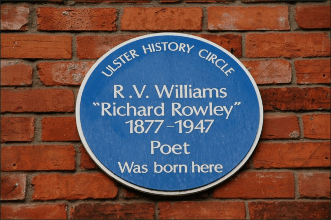
Richard Valentine Williams, who writes poetry, plays and stories under the pseudonym of Richard Rowley, is born on April 2, 1877, at 79 Dublin Road in Belfast, in what is now Northern Ireland.

At the age of sixteen, Rowley enters the family firm, McBride and Williams, which manufactures cotton handkerchiefs and eventually becomes its managing director. After the collapse of the company in 1931 he is Chairman of the Northern Ireland Unemployment Assistance Board. His early poems, in The City of Refuge and Other Poems (1917), are rhetorical celebrations of industry. His next volume, City Songs and Others (1918), includes his most quoted poem, The Islandmen, and is regarded as containing his most original work: “Browning-like monologues straight from the mouths of Belfast’s working-class.”

In 1918, Rowley goes to live in the Mourne country, residing in Brook Cottage, Bryansford Rd., Newcastle, County Down. He writes short stories, including Tales of Mourne (1937), as well as at least one highly successful play, Apollo In Mourne (1926). During World War II, he founds, and runs from his Newcastle home, the short-lived Mourne Press. He publishes first collections of Sam Hanna Bell and Michael McLaverty, but the press fails in 1942.

With Bell, Rowley is one of a set of Linen Hall Library members who retires regularly to Campbell’s Cafe. The regulars, at various points, include writers John Boyd and Denis Ireland, actors Joseph Tomelty, Jack Loudon and J. G. Devlin, poets John Hewitt and Robert Greacen, artists Padraic Woods, Gerard Dillon, and William Conor and the Rev. Arthur Agnew, an outspoken opponent of sectarianism. The ebullient atmosphere the circle creates is a backdrop for the appearance of Campbell’s Cafe in Brian Moore‘s wartime Bildungsroman, The Emperor of Ice-Cream.

In 1946, Rowley sells Brook Cottage, which has since been demolished, and moves with his wife, the former Margaret Pollock, to Drumilly, Loughgall, County Armagh, as paying guests of their friends, Mr. and Mrs. Ralph Cope. He dies there on April 25, 1947.

George MacCann and Jack Loudan presents a commemoration of Rowley’s life on the radio in 1952. The programme uses recordings of his friends Lady Mabel Annesley, who illustrated several of his publications, along with the poet John Irvine, the playwright Thomas Carnduff and William Conor. In Newcastle, Rowley’s name is remembered through the Rowley Meadows housing development and the Rowley Path, which runs along the southern boundary of the Islands Park.

(Pictured: Blue plaque at Richard Rowley’s birthplace in Belfast, Northern Ireland)


Leave a comment

Birth of Novelist & Screenwriter Brian Moore

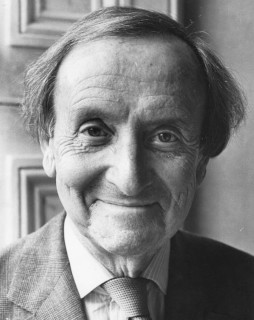
brian-moore

Brian Moore, novelist and screenwriter who is acclaimed for the descriptions in his novels of life in Northern Ireland after World War II, is born in Belfast, Northern Ireland on August 25, 1921. He has been described as “one of the few genuine masters of the contemporary novel.”

Moore is born into a large Roman Catholic family. His father, James Bernard Moore, is a prominent surgeon and the first Catholic to sit on the senate of Queen’s University Belfast. His mother, Eileen McFadden Moore, a farmer’s daughter from County Donegal, is a nurse. His uncle is the prominent Irish nationalist, Eoin MacNeill, founder of Conradh na Gaeilge and Professor of Irish at University College Dublin. He is educated at St. Malachy’s College, Belfast. He leaves the college in 1939, having failed his senior exams.

Moore is a volunteer air raid warden during World War II and serves during the Belfast Blitz in April and May 1941. He goes on to serve as a civilian with the British Army in North Africa, Italy and France. After the war ends, he works in Eastern Europe for the United Nations Relief and Rehabilitation Administration.

In 1948 Moore emigrates to Canada to work as a reporter for the Montreal Gazette and becomes a Canadian citizen. While eventually making his primary residence in California, he continues to live part of each year in Canada up to his death.

Moore lives in Canada from 1948 to 1958, where he meets his first wife, Jacqueline (“Jackie”) Sirois, a French Canadian and fellow journalist. They marry in 1952. He moves to New York City in 1959 to take up a Guggenheim Fellowship and remains there until his divorce in October 1967. He then moves to the west coast of the United States, settling in Malibu, California, with his new wife Jean Denney, a former commentator on Canadian TV. There he teaches creative writing at UCLA.

Moore writes his first novels in Canada. His earliest novels are thrillers, published under his own name or using the pseudonyms Bernard Mara or Michael Bryan. His first novel outside the genre, Judith Hearne, remains among his most highly regarded. The book is rejected by ten American publishers before being accepted by a British publisher. It is made into a film, with British actress Maggie Smith playing the lonely spinster who is the book/film’s title character.

Other novels by Moore are adapted for the screen, including Intent to Kill, The Luck of Ginger Coffey, Catholics, Black Robe, Cold Heaven, and The Statement. He co-writes the screenplay for Alfred Hitchcock‘s Torn Curtain, and writes the screenplay for The Blood of Others, based on the novel Le Sang des autres by Simone de Beauvoir.

Some of Moore’s novels feature staunchly anti-doctrinaire and anti-clerical themes, and in particular he speaks strongly about the effect of the Church on life in Ireland. A recurring theme in his novels is the concept of the Catholic priesthood. On several occasions he explores the idea of a priest losing his faith. At the same time, several of his novels are deeply sympathetic and affirming portrayals of the struggles of faith and religious commitment, Black Robe most prominently.

Moore dies at his Malibu home, which is celebrated in Seamus Heaney‘s poem Remembering Malibu, on January 11, 1999, from pulmonary fibrosis. His widow, Jean, lives on in the house until it is destroyed in 2018 in the Woolsey Fire.

At the time of his death, Moore is working on a novel about the 19th-century French symbolist poet Arthur Rimbaud. His last published work before his death is an essay entitled “Going Home.” It is a reflection inspired by a visit he made to the grave in Connemara of his family friend, the Irish nationalist Bulmer Hobson. The essay is commissioned by Granta and published in The New York Times on February 7, 1999.

In 1996, the Brian Moore Short Story Awards is launched by the Creative Writers Network in Northern Ireland and is open to all authors of Irish descent. Previous judges have included Glenn Patterson, Lionel Shriver, Carlo Gébler and Maeve Binchy.

In 1975 Moore arranges for his literary materials, letters and documents to be deposited in the Special Collections Division of the University of Calgary Library, an inventory of which is published by the University of Calgary Press in 1987. His archives, which include unfilmed screenplays, drafts of various novels, working notes, a 42-volume journal (1957–1998), and his correspondence, are housed at the Harry Ransom Center at the University of Texas at Austin.