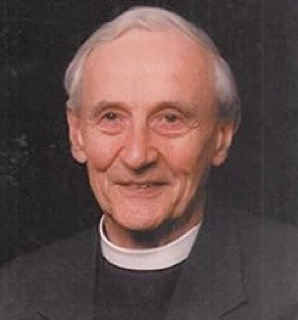
He is appointed Dean of Cork in 1952. Consecrated a bishop, he serves as Bishop of Cork, Cloyne and Ross, between 1952 and 1956. At forty-two, he is the youngest Church of Ireland clergyman appointed to a bishopric since John Gregg in 1915. He serves as Archbishop of Dublin from 1956 to 1969. During this time, he maintains a courteous relationship with John Charles McQuaid, his Roman Catholic counterpart as Archbishop of Dublin. From 1969 to 1980, he serves as Archbishop of Armagh.
Alongside CardinalWilliam Conway, Simms chairs the first official ecumenical meeting between the leaders of Ireland’s Protestant Churches and the Catholic Church in Ballymascanlon Hotel, Dundalk, County Louth, on September 26, 1973, an important meeting amidst the increasing violence in Northern Ireland. The meeting is protested by Ian Paisley.
Simms is a scholar, and publishes research on topics including the history of the Church of Ireland, and theological reflections on key texts including the Book of Kells, Saint Patrick’s Breastplate, and the Sarum Primer. He is also a fluent speaker of the Irish language.
Simms is also an accomplished journalist, and the author of many newspaper obituaries. His weekly Thinking Aloud column in The Irish Times is a popular reflection, and runs continuously for thirty-eight years. He also works on the research, preparation, and even performs the presentation, of a number of television programmes.
In 1978, Simms is made an honorary fellow of Trinity College Dublin.
Simms is the uncle of mathematician David J. Simms. In 1941, he marries Mercy Felicia Gwynn. They have five children. He dies in Dublin on November 15, 1991. He is interred with his wife in the cemetery attached to St. Maelruain’s Church, Tallaght, County Dublin.
Remaining active during the interwar years, Dill serves as chief assistant to the commandant of the Staff College (1919–22) before commanding the Welsh Border Brigade, TA (1922–23), and 2nd Infantry Brigade at Aldershot (1923–26). In late 1926, he is appointed army instructor at the newly established Imperial Defence College. A period in India follows as general staff officer of the Western Command (1929–31), based at Quetta. On return to England, he is promoted to major general and made commandant of the Staff College. Appointments as commander of the British forces in Palestine and Transjordan (1936–37) and the Aldershot Command (1937–39) follow. During this period, he shows a remarkable ability to both train and inspire those under his command. Most of his colleagues expect him to become the new chief of the Imperial General Staff and are surprised when Major General Lord Gort, junior to Dill in both rank and seniority, is appointed to the post.
At the outbreak of World War II Dill commands I CorpsBritish Expeditionary Force (BEF) in France and is made a full general. In April 1940, he is made vice-CIGS and in May takes over as CIGS. His initial period in office is not a happy one, and he has to inform the public of setbacks in both Norway and France. His workload is enormous, and after the evacuation at Dunkirk in late May he devotes himself to preparing the defences of Britain against invasion. He clashes with Winston Churchill throughout 1941, advocating a more cautious and realistic approach to the situations in North Africa, Greece, and Crete.
The workload begins to affect his health adversely, and in November 1941 it is announced that he will resign as CIGS on reaching the age of 60 and serve as governor-designate of Bombay with the rank of field marshal. He seeks to be more actively involved in the war effort, however, and in December 1941 he visits the United States with Churchill, remaining there as head of the British joint staff mission in Washington, D.C. He plays a significant role in promoting Anglo–American military cooperation and attends the Casablanca, Quebec, and Tehran conferences.
Dill first marries (1907) Ada Maud Le Mottée, daughter of Col. William Le Mottée of the 18th Regiment. Their son, Major John de Guerin Dill, serves as an artillery officer throughout World War II. In October 1941, Dill marries Nancy Isabelle Charrington, widow of Brigadier Denis Walter Furlong. Dill’s honours include a GCB (1942), an honorary degree from Princeton University (1944), the Howland Memorial Prize of Yale University (1944), and a posthumous Distinguished Service Medal (DSM) from the United States government. There are portraits of him in Cheltenham College and the Imperial War Museum, and a statue in Washington, D.C.
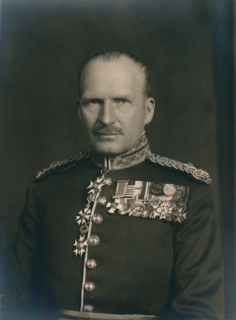
(From: “Dill, Sir John Greer” by David Murphy, Dictionary of Irish Biography, http://www.dib.ie, October 2009 | Pictured: Sir John Greer Dill, bromide print, 1932, by Walter Stoneman, National Portrait Gallery, London)
William Edward Hartpole Lecky, Irish historian and political theorist, is born at Newtown Park, near Dublin, on March 26, 1838. His major work is an eight-volume History of England during the Eighteenth Century.
In 1860, Lecky publishes anonymously a small book entitled The Religious Tendencies of the Age, but upon leaving college he turns to historiography. In 1861 he publishes Leaders of Public Opinion in Ireland, containing brief sketches of Jonathan Swift, Henry Flood, Henry Grattan, and Daniel O’Connell, originally anonymous and republished in 1871. The essay on Swift, rewritten and amplified, appears again in 1897 as an introduction to an edition of Swift’s works. Two surveys follow: A History of the Rise and Influence of Rationalism in Europe (2 vols., 1865), and A History of European Morals from Augustus to Charlemagne (2 vols., 1869). The latter arouses criticism, with its opening dissertation on “the natural history of morals.”
Lecky then concentrates on his major work, A History of England during the Eighteenth Century, Vols. i. and ii. which appear in 1878, and Vols. vii. and viii., which complete the work, in 1890. In the “cabinet” edition of 1892, in twelve volumes, A History of Ireland in the Eighteenth Century is separated out.
A volume of Poems (1891) is less successful. In 1896, he publishes two volumes entitled Democracy and Liberty, in which he considers modern democracy. The pessimistic conclusions at which he arrives provoked criticism both in the UK and the United States, which is renewed when he publishes in a new edition (1899) his low estimate of William Ewart Gladstone, then recently dead.
In The Map of Life (1899) Lecky discusses in a popular style ethical problems of everyday life. In 1903 he publishes a revised and enlarged edition of Leaders of Public Opinion in Ireland, in two volumes, with the essay on Swift omitted and that on O’Connell expanded into a complete biography. A critic of the methods by which the Act of Union is passed, Lecky, who grew up as a moderate Liberal, is opposed to Gladstone’s policy of Home Rule and, in 1895, he is returned to parliament as Unionist member for University of Dublin constituency in a by-election. In 1897, he is made a privy councillor, and among the coronation honours in 1902, he is nominated an original member of the new Order of Merit.
William Edward Hartpole Lecky dies in London on October 22, 1903.


 seamus dubhghaill